Thank you for visiting SNEWPapers!
Sign up free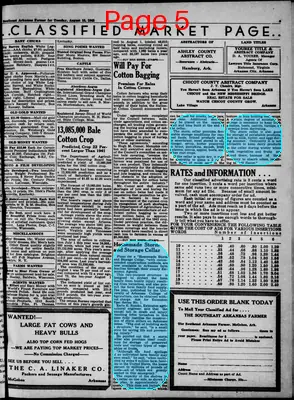
Story
August 18, 1942
Southeast Arkansas Farmer
Mcgehee, Desha County, Arkansas
What is this article about?
University of Arkansas offers free plans for a dual-purpose storm and storage cellar to Arkansas farm families via Extension Agents, protecting against tornadoes and preserving food amid national shortages.
Clipping
OCR Quality
100%
Excellent
Full Text
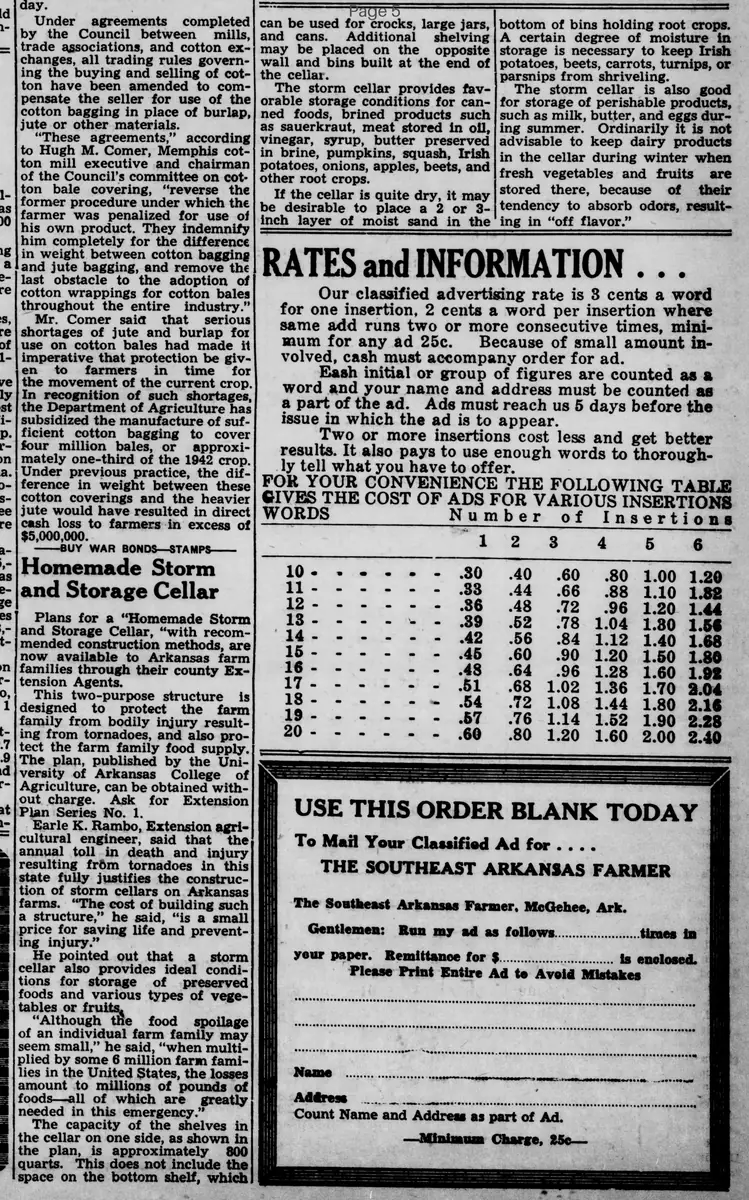
Homemade Storm and Storage Cellar
Plans for a "Homemade Storm and Storage Cellar," with recommended construction methods, are now available to Arkansas farm families through their county Extension Agents.
This two-purpose structure is designed to protect the farm family from bodily injury resulting from tornadoes, and also protect the farm family food supply.
The plan, published by the University of Arkansas College of Agriculture, can be obtained without charge. Ask for Extension Plan Series No. 1.
Earle K. Rambo, Extension agricultural engineer, said that the annual toll in death and injury resulting from tornadoes in this state fully justifies the construction of storm cellars on Arkansas farms. "The cost of building such a structure," he said, "is a small price for saving life and preventing injury."
He pointed out that a storm cellar also provides ideal conditions for storage of preserved foods and various types of vegetables or fruits.
"Although the food spoilage of an individual farm family may seem small," he said, "when multiplied by some 6 million farm families in the United States, the losses amount to millions of pounds of foods -all of which are greatly needed in this emergency."
The capacity of the shelves in the cellar on one side, as shown in the plan, is approximately 800 quarts. This does not include the space on the bottom shelf, which can be used for crocks, large jars, and cans.
Additional shelving may be placed on the opposite wall and bins built at the end of the cellar.
The storm cellar provides favorable storage conditions for canned foods, brined products such as sauerkraut, meat stored in oil, vinegar, syrup, butter preserved in brine, pumpkins, squash, Irish potatoes, onions, apples, beets, and other root crops.
If the cellar is quite dry, it may be desirable to place a 2 or 3-inch layer of moist sand in the bottom of bins holding root crops.
A certain degree of moisture in storage is necessary to keep Irish potatoes, beets, carrots, turnips, or parsnips from shriveling.
The storm cellar is also good for storage of perishable products, such as milk, butter, and eggs during summer. Ordinarily it is not advisable to keep dairy products in the cellar during winter when fresh vegetables and fruits are stored there, because of their tendency to absorb odors, resulting in "off flavor."
Plans for a "Homemade Storm and Storage Cellar," with recommended construction methods, are now available to Arkansas farm families through their county Extension Agents.
This two-purpose structure is designed to protect the farm family from bodily injury resulting from tornadoes, and also protect the farm family food supply.
The plan, published by the University of Arkansas College of Agriculture, can be obtained without charge. Ask for Extension Plan Series No. 1.
Earle K. Rambo, Extension agricultural engineer, said that the annual toll in death and injury resulting from tornadoes in this state fully justifies the construction of storm cellars on Arkansas farms. "The cost of building such a structure," he said, "is a small price for saving life and preventing injury."
He pointed out that a storm cellar also provides ideal conditions for storage of preserved foods and various types of vegetables or fruits.
"Although the food spoilage of an individual farm family may seem small," he said, "when multiplied by some 6 million farm families in the United States, the losses amount to millions of pounds of foods -all of which are greatly needed in this emergency."
The capacity of the shelves in the cellar on one side, as shown in the plan, is approximately 800 quarts. This does not include the space on the bottom shelf, which can be used for crocks, large jars, and cans.
Additional shelving may be placed on the opposite wall and bins built at the end of the cellar.
The storm cellar provides favorable storage conditions for canned foods, brined products such as sauerkraut, meat stored in oil, vinegar, syrup, butter preserved in brine, pumpkins, squash, Irish potatoes, onions, apples, beets, and other root crops.
If the cellar is quite dry, it may be desirable to place a 2 or 3-inch layer of moist sand in the bottom of bins holding root crops.
A certain degree of moisture in storage is necessary to keep Irish potatoes, beets, carrots, turnips, or parsnips from shriveling.
The storm cellar is also good for storage of perishable products, such as milk, butter, and eggs during summer. Ordinarily it is not advisable to keep dairy products in the cellar during winter when fresh vegetables and fruits are stored there, because of their tendency to absorb odors, resulting in "off flavor."
What sub-type of article is it?
Informational Guide
Agricultural Advice
What keywords are associated?
Storm Cellar
Food Storage
Tornado Protection
Arkansas Farms
Extension Plan Series No. 1
What entities or persons were involved?
Earle K. Rambo
Where did it happen?
Arkansas Farms
Story Details
Key Persons
Earle K. Rambo
Location
Arkansas Farms
Story Details
Plans for a homemade storm and storage cellar are available through county Extension Agents to protect Arkansas farm families from tornadoes and store food supplies. Published by University of Arkansas College of Agriculture as Extension Plan Series No. 1, free of charge. Emphasizes low cost for safety and national food conservation during emergency.