Thank you for visiting SNEWPapers!
Sign up free
Story
July 9, 1824
Richmond Enquirer
Richmond, Richmond County, Virginia
What is this article about?
An 1824-era political commentary criticizes John Quincy Adams, John C. Calhoun, and John McLean's public note withdrawing from a Washington dinner subscription to protest Ninian Edwards' exclusion, viewing it as a deceptive tactic to undermine rival W.H. Crawford in the presidential election and influence public opinion.
Clipping
OCR Quality
70%
Good
Full Text
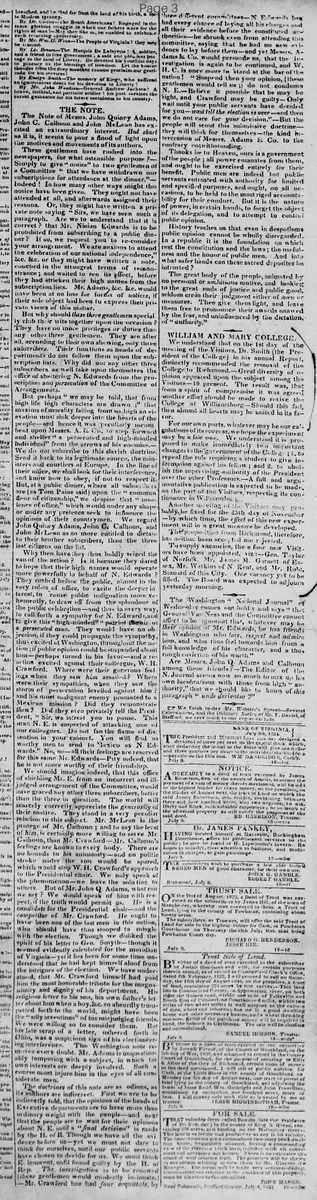
THE NOTE.
The Note of Messrs. John Quincy Adams, John C. Calhoun and John McLean has excited an extraordinary interest. But short as it is, it seems to pour a flood of light upon the motives and movements of its authors. These gentlemen have rushed into the newspapers, for what ostensible purpose?—Simply to give "notice" to two gentlemen of a Committee "that we have withdrawn our subscriptions for attendance at the dinner." Indeed! In how many other ways might this notice have been given. They might not have attended at all, and afterwards assigned their reasons. Or, they might have written a private note saying "Sirs, we have seen such a paragraph. Are we to understand that it is correct? that Mr. Ninian Edwards is to be prohibited from subscribing to a public dinner? If so, we request you to re-consider your arrangement. "We are anxious to attend the celebration of our national independence," &c. &c. or they might have written a note, couched in the strongest terms of remonstrance; and waited to see its effect, before they had stricken their high names from the subscription lists. Mr. Adams, &c. &c. would have been at no loss for words of notices, if their sole object had been to express their private views of this matter. But why should these three gentlemen specially club their wits together upon the occasion? They have no more privileges or duties than any other three gentlemen. They are after all, according to their own showing, only three subscribers. Their functions as heads of departments do not follow them upon the subscription lists. Why did not any other three subscribers as well take upon themselves the office of sheltering N. Edwards from the proscription and persecution of the Committee of Arrangements. But perhaps "we may be told, that from high life high characters are drawn;" that maxims of morality falling from so high an elevation must sink deeper into the hearts of the people—and hence it was peculiarly incumbent upon Messrs. A. & Co. to step forward and shelter "a persecuted and high-minded individual" from the arrows of his enemies.—We do not subscribe to this slavish doctrine. Send it back to its legitimate source, the ministers and courtiers of Europe. In the line of their office, we shall look for their interference, and know how to obey, if not to respect it. But, at a public dinner, where all subscribers are (as Tom Paine said) upon the "common floor of citizenship," we despise that "insolence of office," which would under any shape or under any pretence seek to influence the opinions of their countrymen. We regard John Quincy Adams, John C. Calhoun, and John McLean as no more entitled to dictate to their brother subscribers, than the three last citizens on the list. Why then have they thus boldly seized the van of the action? Is it because they dared to hope that their high names would operate more powerfully in behalf of N. Edwards? They rushed before the public, almost in the very robes of office, to excite the deeper interest, to rouse public indignation more vehemently, to draw off from the splendour of the public celebration—and thus in every way, to call forth a sympathy for N. Edwards, and to give this "high-minded" patriot the air of a persecuted man. They would have no objection, if they could propagate the sympathy, thus excited at Washington, throughout the nation; if public opinion could be suspended about him—perhaps turned in his favor—and a reaction excited against their colleague, W. H. Crawford. Where were their generous feelings when they saw him assailed? Where were their sympathies, when they saw the storm of persecution levelled against him? and his most malignant enemy promoted to a Mexican mission? Did they remonstrate then? Did they even privately tell the President, "Sir, we entreat you to pause. This man N. E. is suspected of attacking one of our colleagues. Do not fan the flame of dissension in your cabinet. You will find as worthy men to send to Mexico as N. Edwards." No, no—all their feelings are reserved for this same Mr. Edwards—But indeed, that he is not more worthy of their friendship. We should imagine indeed, that this office of shielding Mr. E. from an incorrect and ill-judged arrangement of the Committee, would have graced any other three subscribers, better than the three in question. The world will scarcely correctly appreciate the generosity of their motive. They stand in a very peculiar relation to this subject. Mr. McLean is the protege of Mr. Calhoun; and to say the least of him, is certainly more willing to serve Mr. Calhoun, than Mr. Crawford—Mr. Calhoun's Feelings are known to everybody. There are no bounds to his animosity—and no politic stroke under the sun would be spared, which would stop W. H. Crawford's approach to the Presidential chair. We only speak of the phenomenon—we leave the solution to others. But of Mr. John Q. Adams, what can we say? We would speak of him with respect, if the truth would permit us. He is a candidate for the Presidential chair—and the competitor of Mr. Crawford. He ought to have been one of the last men in this nation, who should have thus stooped to mingle with the election. Though we disliked the spirit of his letter to Gen. Smyth—though it seemed evidently calculated for the meridian of Virginia—yet it has been for some time understood that he had kept himself aloof from the intrigues of the election. We have understood, that Mr. Crawford himself had paid him the most honorable tribute for the magnanimity and dignity of his deportment. His religious letter to his son, his own father's letter about him when a boy, &c. so absurdly trumpeted forth to the world, might have been the "silly inventions" of his misjudging friends. We were willing so to consider them. But his late scrap of a letter, ushered forth in Ohio, was a suspicious sign of his electioneering interference. The Washington note removes every doubt. Mr. Adams is unquestionably tampering with a subject, in which his own interests are deeply involved. Such a course must injure him in the eyes of all considerate men. The doctrines of this note are as odious, as its authors are indiscreet. First we are to be indirectly told, that the opinions of the heads of Executive departments are to have more than ordinary weight with the people—and next that the people are to wait for their opinions about N. E. until a "final decision" is made by the H. of R. Though we have all the evidence before us—yet we must not dare to think for ourselves, until our public servants have chosen to decide for us. We must think E. innocent, until found guilty by the H. of Rep. The investigation is to be renewed (these gentlemen would modestly insinuate.)—Mr. Crawford has had four acquittals, by three different committees—N. Edwards has had every chance of laying all his charges and all their evidence before the constituted authorities—he shrunk even from attending this committee, saying that he had no new evidence to lay before them—and yet Messrs. Adams & Co. would persuade us, that the Investigation is—again to be continued, and W. H. C. is once more to stand at the bar of the nation! "Suspend then your opinion, (these gentlemen would tell us:) do not condemn N. E.—Believe it possible that he may be right, and Crawford may be guilty—Only wait until your public servants have decided for you—wait till the election is over—and then we do not care for your decision." But the people will scout this submissive doctrine—they will think for themselves—the kind intercession of Messrs. Adams & Co. to the contrary notwithstanding. Thanks be to Heaven, ours is a government of the people; all power emanates from them, and ought to be exercised entirely for their benefit. Public men are indeed but public servants entrusted with authority for limited and specified purposes, and ought, on all occasions, to be held to the most rigid accountability for their conduct. But it is the nature of power, in certain hands, to forget the object of its delegation, and to attempt to control public opinion. History teaches us that even in despotisms public opinion cannot be wholly disregarded. In a republic it is the foundation on which rest the constitution and the laws; the usefulness and the honor of public men. And into what safer hands can these sacred deposits be intrusted? The great body of the people, animated by no personal or ambitious motive, and looking to the great ends of justice and public good, seldom err in their judgment either of men or measures. Then give them light, and leave them free to pronounce their awards unawed by the fear, and uninfluenced by the dictation, of authority.
The Note of Messrs. John Quincy Adams, John C. Calhoun and John McLean has excited an extraordinary interest. But short as it is, it seems to pour a flood of light upon the motives and movements of its authors. These gentlemen have rushed into the newspapers, for what ostensible purpose?—Simply to give "notice" to two gentlemen of a Committee "that we have withdrawn our subscriptions for attendance at the dinner." Indeed! In how many other ways might this notice have been given. They might not have attended at all, and afterwards assigned their reasons. Or, they might have written a private note saying "Sirs, we have seen such a paragraph. Are we to understand that it is correct? that Mr. Ninian Edwards is to be prohibited from subscribing to a public dinner? If so, we request you to re-consider your arrangement. "We are anxious to attend the celebration of our national independence," &c. &c. or they might have written a note, couched in the strongest terms of remonstrance; and waited to see its effect, before they had stricken their high names from the subscription lists. Mr. Adams, &c. &c. would have been at no loss for words of notices, if their sole object had been to express their private views of this matter. But why should these three gentlemen specially club their wits together upon the occasion? They have no more privileges or duties than any other three gentlemen. They are after all, according to their own showing, only three subscribers. Their functions as heads of departments do not follow them upon the subscription lists. Why did not any other three subscribers as well take upon themselves the office of sheltering N. Edwards from the proscription and persecution of the Committee of Arrangements. But perhaps "we may be told, that from high life high characters are drawn;" that maxims of morality falling from so high an elevation must sink deeper into the hearts of the people—and hence it was peculiarly incumbent upon Messrs. A. & Co. to step forward and shelter "a persecuted and high-minded individual" from the arrows of his enemies.—We do not subscribe to this slavish doctrine. Send it back to its legitimate source, the ministers and courtiers of Europe. In the line of their office, we shall look for their interference, and know how to obey, if not to respect it. But, at a public dinner, where all subscribers are (as Tom Paine said) upon the "common floor of citizenship," we despise that "insolence of office," which would under any shape or under any pretence seek to influence the opinions of their countrymen. We regard John Quincy Adams, John C. Calhoun, and John McLean as no more entitled to dictate to their brother subscribers, than the three last citizens on the list. Why then have they thus boldly seized the van of the action? Is it because they dared to hope that their high names would operate more powerfully in behalf of N. Edwards? They rushed before the public, almost in the very robes of office, to excite the deeper interest, to rouse public indignation more vehemently, to draw off from the splendour of the public celebration—and thus in every way, to call forth a sympathy for N. Edwards, and to give this "high-minded" patriot the air of a persecuted man. They would have no objection, if they could propagate the sympathy, thus excited at Washington, throughout the nation; if public opinion could be suspended about him—perhaps turned in his favor—and a reaction excited against their colleague, W. H. Crawford. Where were their generous feelings when they saw him assailed? Where were their sympathies, when they saw the storm of persecution levelled against him? and his most malignant enemy promoted to a Mexican mission? Did they remonstrate then? Did they even privately tell the President, "Sir, we entreat you to pause. This man N. E. is suspected of attacking one of our colleagues. Do not fan the flame of dissension in your cabinet. You will find as worthy men to send to Mexico as N. Edwards." No, no—all their feelings are reserved for this same Mr. Edwards—But indeed, that he is not more worthy of their friendship. We should imagine indeed, that this office of shielding Mr. E. from an incorrect and ill-judged arrangement of the Committee, would have graced any other three subscribers, better than the three in question. The world will scarcely correctly appreciate the generosity of their motive. They stand in a very peculiar relation to this subject. Mr. McLean is the protege of Mr. Calhoun; and to say the least of him, is certainly more willing to serve Mr. Calhoun, than Mr. Crawford—Mr. Calhoun's Feelings are known to everybody. There are no bounds to his animosity—and no politic stroke under the sun would be spared, which would stop W. H. Crawford's approach to the Presidential chair. We only speak of the phenomenon—we leave the solution to others. But of Mr. John Q. Adams, what can we say? We would speak of him with respect, if the truth would permit us. He is a candidate for the Presidential chair—and the competitor of Mr. Crawford. He ought to have been one of the last men in this nation, who should have thus stooped to mingle with the election. Though we disliked the spirit of his letter to Gen. Smyth—though it seemed evidently calculated for the meridian of Virginia—yet it has been for some time understood that he had kept himself aloof from the intrigues of the election. We have understood, that Mr. Crawford himself had paid him the most honorable tribute for the magnanimity and dignity of his deportment. His religious letter to his son, his own father's letter about him when a boy, &c. so absurdly trumpeted forth to the world, might have been the "silly inventions" of his misjudging friends. We were willing so to consider them. But his late scrap of a letter, ushered forth in Ohio, was a suspicious sign of his electioneering interference. The Washington note removes every doubt. Mr. Adams is unquestionably tampering with a subject, in which his own interests are deeply involved. Such a course must injure him in the eyes of all considerate men. The doctrines of this note are as odious, as its authors are indiscreet. First we are to be indirectly told, that the opinions of the heads of Executive departments are to have more than ordinary weight with the people—and next that the people are to wait for their opinions about N. E. until a "final decision" is made by the H. of R. Though we have all the evidence before us—yet we must not dare to think for ourselves, until our public servants have chosen to decide for us. We must think E. innocent, until found guilty by the H. of Rep. The investigation is to be renewed (these gentlemen would modestly insinuate.)—Mr. Crawford has had four acquittals, by three different committees—N. Edwards has had every chance of laying all his charges and all their evidence before the constituted authorities—he shrunk even from attending this committee, saying that he had no new evidence to lay before them—and yet Messrs. Adams & Co. would persuade us, that the Investigation is—again to be continued, and W. H. C. is once more to stand at the bar of the nation! "Suspend then your opinion, (these gentlemen would tell us:) do not condemn N. E.—Believe it possible that he may be right, and Crawford may be guilty—Only wait until your public servants have decided for you—wait till the election is over—and then we do not care for your decision." But the people will scout this submissive doctrine—they will think for themselves—the kind intercession of Messrs. Adams & Co. to the contrary notwithstanding. Thanks be to Heaven, ours is a government of the people; all power emanates from them, and ought to be exercised entirely for their benefit. Public men are indeed but public servants entrusted with authority for limited and specified purposes, and ought, on all occasions, to be held to the most rigid accountability for their conduct. But it is the nature of power, in certain hands, to forget the object of its delegation, and to attempt to control public opinion. History teaches us that even in despotisms public opinion cannot be wholly disregarded. In a republic it is the foundation on which rest the constitution and the laws; the usefulness and the honor of public men. And into what safer hands can these sacred deposits be intrusted? The great body of the people, animated by no personal or ambitious motive, and looking to the great ends of justice and public good, seldom err in their judgment either of men or measures. Then give them light, and leave them free to pronounce their awards unawed by the fear, and uninfluenced by the dictation, of authority.
What sub-type of article is it?
Historical Event
Deception Fraud
What themes does it cover?
Deception
Justice
Moral Virtue
What keywords are associated?
Political Note
Dinner Subscription
Ninian Edwards
Presidential Election
W. H. Crawford
John Quincy Adams
John C. Calhoun
John Mclean
What entities or persons were involved?
John Quincy Adams
John C. Calhoun
John Mclean
Ninian Edwards
W. H. Crawford
Where did it happen?
Washington
Story Details
Key Persons
John Quincy Adams
John C. Calhoun
John Mclean
Ninian Edwards
W. H. Crawford
Location
Washington
Story Details
Critique of a joint public note by cabinet members Adams, Calhoun, and McLean withdrawing dinner subscriptions to defend excluded Ninian Edwards, interpreted as political scheming to discredit presidential rival Crawford and manipulate public opinion on ongoing investigations.