Thank you for visiting SNEWPapers!
Sign up free
Editorial
December 24, 1807
Alexandria Daily Advertiser
Alexandria, Virginia
What is this article about?
Editorial criticizes Cheetham and quotes his piece decrying Congress's weak response to British aggressions, opting for an explanatory bill on the non-importation act instead of war or embargo, amid tensions over the Leopard incident and trade issues.
Clipping
OCR Quality
95%
Excellent
Full Text
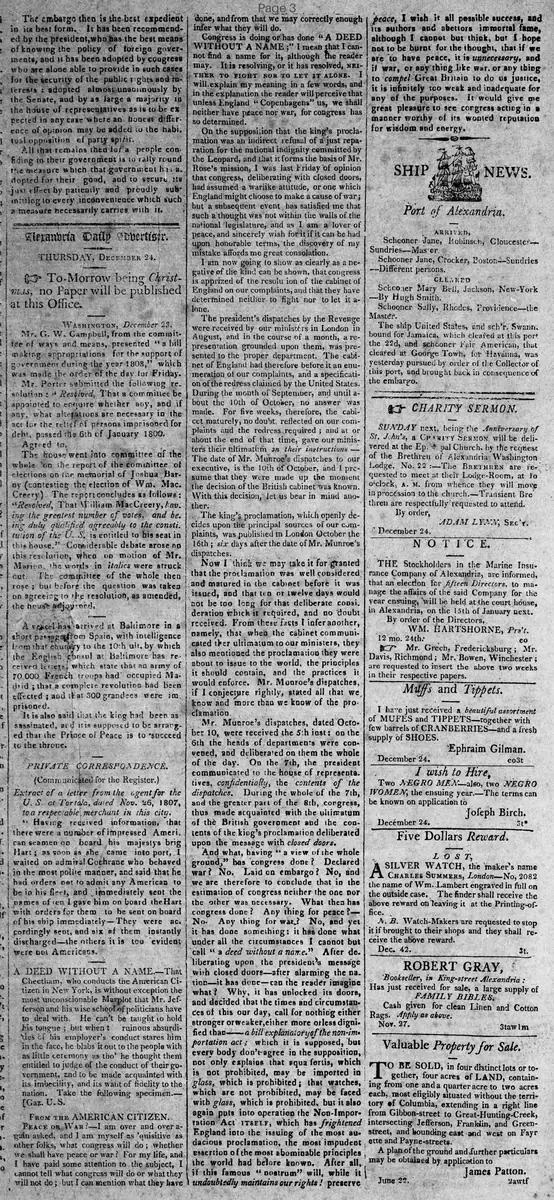
A DEED WITHOUT A NAME. That Cheetham, who conducts the American Citizen in New York, is without exception the most unconscionable Marplot that Mr. Jefferson and his wise school of politicians have to deal with. He can't be taught to hold his tongue; but when the ruinous absurdities of his employer's conduct stares him in the face, he blabs it out to the people with as little ceremony as tho' he thought them entitled to judge of the conduct of their government, and to be made acquainted with its imbecility, and its want of fidelity to the nation. Take the following specimen.--
[Gaz. U.S.
FROM THE AMERICAN CITIZEN
PEACE OR WAR?--I am over and over again asked, and I am myself as inquisitive as other folks, what congress will do; whether we shall have peace or war? For my life, and I have paid some attention to the subject, I cannot tell what congress will do or what they will not do; but I can mention what they have done, and from that we may correctly enough infer what they will do.
Congress is doing or has done "A DEED WITHOUT A NAME." I mean that I cannot find a name for it, although the reader may. It is resolving, or it has resolved, NEITHER TO FIGHT NOR TO LET IT ALONE. I will explain my meaning in a few words, and in the explanation the reader will perceive that unless England "Copenhagens" us, we shall neither have peace nor war, for congress has so determined.
On the supposition that the king's proclamation was an indirect refusal of a just reparation for the national indignity committed by the Leopard, and that it forms the basis of Mr. Rose's mission, I was last Friday of opinion that congress, deliberating with closed doors, had assumed a warlike attitude, or one which England might choose to make a cause of war; but a subsequent event has satisfied me that such a thought was not within the walls of the national legislature, and as I am a lover of peace, and sincerely wish for it if it can be had upon honorable terms, the discovery of my mistake affords me great consolation.
I am now going to show as clearly as a negative of the kind can be shown, that congress is apprized of the resolution of the cabinet of England on our complaints, and that they have determined neither to fight nor to let it alone.
The president's dispatches by the Revenge were received by our ministers in London in August, and in the course of a month, a representation, grounded upon them, was presented to the proper department. The cabinet of England had therefore before it an enumeration of our complaints, and a specification of the redress claimed by the United States.
During the month of September, and until about the 10th of October, no answer was made. For five weeks, therefore, the cabinet maturely, no doubt, reflected on our complaints and the redress required; and at or about the end of that time, gave our ministers their ultimatum on their instructions--The date of Mr. Munroe's dispatches to our executive, is the 10th of October, and I presume that they were made up the moment the decision of the British cabinet was known.
With this decision, let us bear in mind another:
The king's proclamation, which openly decides upon the principal sources of our complaints, was published in London October the 16th; six days after the date of Mr. Munroe's dispatches!
Now I think we may take it for granted that the proclamation was well considered and matured in the cabinet before it was issued, and that ten or twelve days would not be too long for that deliberate consideration which it required, and no doubt received. From these facts I infer another, namely, that when the cabinet communicated their ultimatum to our ministers, they also mentioned the proclamation they were about to issue to the world, the principles it should contain, and the practices it would enforce. Mr. Munroe's dispatches, if I conjecture rightly, stated all that we know and more than we know of the proclamation.
Mr. Munroe's dispatches, dated October 10, were received the 5th inst: on the 6th the heads of departments were convened, and deliberated on them the whole of the day. On the 7th, the president communicated to the house of representatives, confidentially, the contents of the dispatches. During the whole of the 7th, and the greater part of the 8th, congress, thus made acquainted with the ultimatum of the British government and the contents of the king's proclamation deliberated upon the message with closed doors.
And what, having "a view of the whole ground" has congress done? Declared war? No. Laid an embargo? No, and we are therefore to conclude that in the estimation of congress neither the one nor the other was necessary. What then has congress done? Anything for peace? No. Anything for war? No, and yet it has done something: it has done what under all the circumstances I cannot but call "a deed without a name." After deliberating upon the president's message with closed doors--after alarming the nation it has done--can the reader imagine what? Why, it has unlocked its doors, and decided that the times and circumstances of this our day, call for nothing either stronger or weaker, either more or less dignified than a bill explanatory of the non-importation act; which it is supposed, but every body don't agree in the supposition, not only explains that aqua fortis, which is not prohibited, may be imported in glass, which is prohibited; that watches, which are not prohibited, may be faced with glass, which is prohibited. but it also again puts into operation the Non-Importation Act itself, which has frightened England into the issuing of the most audacious proclamation, the most impudent assertion of the most abominable principles the world had before known. After all, if this famous "nostrum" will, while it undoubtedly maintains our rights! preserve peace, I wish it all possible success, and its authors and abettors immortal fame. although I cannot but think, but I hope not to be burnt for the thought, that if we are to have peace, it is unnecessary, and if war, or anything like war, or anything to compel Great Britain to do us justice, it is infinitely too weak and inadequate for any of the purposes. It would give me great pleasure to see congress acting in manner worthy of its wonted reputation for wisdom and energy.
[Gaz. U.S.
FROM THE AMERICAN CITIZEN
PEACE OR WAR?--I am over and over again asked, and I am myself as inquisitive as other folks, what congress will do; whether we shall have peace or war? For my life, and I have paid some attention to the subject, I cannot tell what congress will do or what they will not do; but I can mention what they have done, and from that we may correctly enough infer what they will do.
Congress is doing or has done "A DEED WITHOUT A NAME." I mean that I cannot find a name for it, although the reader may. It is resolving, or it has resolved, NEITHER TO FIGHT NOR TO LET IT ALONE. I will explain my meaning in a few words, and in the explanation the reader will perceive that unless England "Copenhagens" us, we shall neither have peace nor war, for congress has so determined.
On the supposition that the king's proclamation was an indirect refusal of a just reparation for the national indignity committed by the Leopard, and that it forms the basis of Mr. Rose's mission, I was last Friday of opinion that congress, deliberating with closed doors, had assumed a warlike attitude, or one which England might choose to make a cause of war; but a subsequent event has satisfied me that such a thought was not within the walls of the national legislature, and as I am a lover of peace, and sincerely wish for it if it can be had upon honorable terms, the discovery of my mistake affords me great consolation.
I am now going to show as clearly as a negative of the kind can be shown, that congress is apprized of the resolution of the cabinet of England on our complaints, and that they have determined neither to fight nor to let it alone.
The president's dispatches by the Revenge were received by our ministers in London in August, and in the course of a month, a representation, grounded upon them, was presented to the proper department. The cabinet of England had therefore before it an enumeration of our complaints, and a specification of the redress claimed by the United States.
During the month of September, and until about the 10th of October, no answer was made. For five weeks, therefore, the cabinet maturely, no doubt, reflected on our complaints and the redress required; and at or about the end of that time, gave our ministers their ultimatum on their instructions--The date of Mr. Munroe's dispatches to our executive, is the 10th of October, and I presume that they were made up the moment the decision of the British cabinet was known.
With this decision, let us bear in mind another:
The king's proclamation, which openly decides upon the principal sources of our complaints, was published in London October the 16th; six days after the date of Mr. Munroe's dispatches!
Now I think we may take it for granted that the proclamation was well considered and matured in the cabinet before it was issued, and that ten or twelve days would not be too long for that deliberate consideration which it required, and no doubt received. From these facts I infer another, namely, that when the cabinet communicated their ultimatum to our ministers, they also mentioned the proclamation they were about to issue to the world, the principles it should contain, and the practices it would enforce. Mr. Munroe's dispatches, if I conjecture rightly, stated all that we know and more than we know of the proclamation.
Mr. Munroe's dispatches, dated October 10, were received the 5th inst: on the 6th the heads of departments were convened, and deliberated on them the whole of the day. On the 7th, the president communicated to the house of representatives, confidentially, the contents of the dispatches. During the whole of the 7th, and the greater part of the 8th, congress, thus made acquainted with the ultimatum of the British government and the contents of the king's proclamation deliberated upon the message with closed doors.
And what, having "a view of the whole ground" has congress done? Declared war? No. Laid an embargo? No, and we are therefore to conclude that in the estimation of congress neither the one nor the other was necessary. What then has congress done? Anything for peace? No. Anything for war? No, and yet it has done something: it has done what under all the circumstances I cannot but call "a deed without a name." After deliberating upon the president's message with closed doors--after alarming the nation it has done--can the reader imagine what? Why, it has unlocked its doors, and decided that the times and circumstances of this our day, call for nothing either stronger or weaker, either more or less dignified than a bill explanatory of the non-importation act; which it is supposed, but every body don't agree in the supposition, not only explains that aqua fortis, which is not prohibited, may be imported in glass, which is prohibited; that watches, which are not prohibited, may be faced with glass, which is prohibited. but it also again puts into operation the Non-Importation Act itself, which has frightened England into the issuing of the most audacious proclamation, the most impudent assertion of the most abominable principles the world had before known. After all, if this famous "nostrum" will, while it undoubtedly maintains our rights! preserve peace, I wish it all possible success, and its authors and abettors immortal fame. although I cannot but think, but I hope not to be burnt for the thought, that if we are to have peace, it is unnecessary, and if war, or anything like war, or anything to compel Great Britain to do us justice, it is infinitely too weak and inadequate for any of the purposes. It would give me great pleasure to see congress acting in manner worthy of its wonted reputation for wisdom and energy.
What sub-type of article is it?
Foreign Affairs
War Or Peace
Economic Policy
What keywords are associated?
Peace Or War
Non Importation Act
British Proclamation
Congress Inaction
Leopard Incident
Mr Rose Mission
What entities or persons were involved?
Cheetham
Mr. Jefferson
Congress
British Cabinet
Mr. Rose
Mr. Munroe
President
Editorial Details
Primary Topic
Congress's Indecisive Response To British Provocations Via Non Importation Act Explanation
Stance / Tone
Critical Of Congressional Weakness And Inaction
Key Figures
Cheetham
Mr. Jefferson
Congress
British Cabinet
Mr. Rose
Mr. Munroe
President
Key Arguments
Congress Has Done 'A Deed Without A Name' By Neither Declaring War Nor Imposing Embargo
British Cabinet's Ultimatum And King's Proclamation Preceded Us Deliberations
Congress Responded Only With A Bill Explanatory Of The Non Importation Act
This Measure Is Too Weak For War Or Compelling Justice, Unnecessary For Peace
Timeline Shows Us Awareness Of British Decisions Before Acting