Thank you for visiting SNEWPapers!
Sign up free
Editorial
August 3, 1832
Constitutional Whig
Richmond, Virginia
What is this article about?
Editorial criticizes blind popular support for President Andrew Jackson due to party spirit and military admiration, warns of threats to constitutional liberty and republican institutions, and reflects on John Randolph's foresight in opposing the War of 1812 for shifting affections to military figures.
Clipping
OCR Quality
98%
Excellent
Full Text
Wednesday Evening, Aug. 1.
JOHN RANDOLPH—THE STAUNTON AD.
DRESS—GEN. JACKSON.
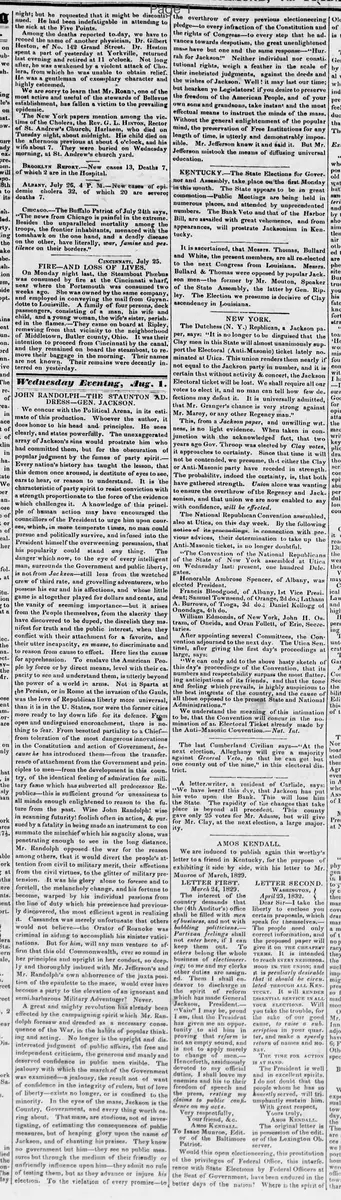
We concur with the Political Arena, in its estimate of this production. Whoever the author, it does honor to his head and principles. He sees clearly, and states powerfully. The unexaggerated array of Jackson's sins would prostrate him who had committed them, but for the obscuration of popular judgment by the fumes of party spirit.
Every nation's history has taught the lesson, that this demon once aroused, is destitute of eyes to see, ears to hear, or reason to understand. It is the characteristic of party spirit to resist conviction with a strength proportionate to the force of the evidence which challenges it. A knowledge of this principle of human action may have encouraged the councillors of the President to urge him upon courses, which, in more temperate times, no man could pursue and politically survive, and infused into the President himself the overweening persuasion, that his popularity could stand any thing.
The danger which now, to the eye of every intelligent man, surrounds the Government and public liberty, is not from Jackson—still less from the wretched crew of third rate, and grovelling adventurers, who possess his ear and his affections, and whose little game is altogether played for dollars and cents, and the vanity of seeming importance—but it arises from the People themselves, from the alacrity they have discovered to be duped, the disrelish they manifest for truth and the public interest, when they conflict with their attachment for a favorite, and their utter incapacity, en masse, to discriminate and to reason from cause to effect. Here lies the cause for apprehension. To enslave the American People by force or by direct means, level with their capacity to see and understand them, is utterly beyond the power of a world in arms. Not in Sparta at the Persian, or in Rome at the invasion of the Gauls, was the love of Republican liberty more universal, than it is in the U. States, nor were the former cities more ready to lay down life for its defence. From open and undisguised encroachment, there is nothing to fear. From besotted partiality to a Chief—from toleration of the most dangerous innovations in the Constitution and action of Government, because he has introduced them—from the transference of attachment from the Government and principles to men—from the development in this country, of the identical feeling of admiration for military fame which has subverted all predecessor Republics—this is sufficient ground for uneasiness to all minds enough enlightened to reason to the future from the past. Wise John Randolph! wise in scanning futurity! foolish often in action, & pursued by a fatality in being made an instrument to consummate the mischief which his sagacity alone, was penetrating enough to see in the long distance.
Mr. Randolph opposed the war for the reason among others, that it would divert the people's attention from civil to military merit, their affections from the civil virtues, to the glitter of military pretension. It was his glory alone to foresee and to foretell, the melancholy change, and his fortune to become, warped by his individual passions from the line of duty which his prescience had previously discovered, the most efficient agent in realizing it. Cassandra was merely unfortunate that others would not believe—the Orator of Roanoke was criminal in aiding to accomplish his sinister vaticinations. But for him, will any man venture to affirm that this old Commonwealth, ever so sound in her principles and upright in her conduct, so deeply and thoroughly imbued with Mr. Jefferson's and Mr. Randolph's own abhorrence of the juxtaposition of the epaulette to the mace, would ever have become a party to the elevation of an ignorant and semi-barbarous Military Adventurer? Never.
A great and mighty revolution has already been effected by the campaigning spirit which Mr. Randolph foresaw and dreaded as a necessary consequence of the War, in the habits of popular thinking and acting. No longer is the upright and disinterested judgment of public affairs, the free and independent criticism, the generous and manly and deserved confidence in public men visible. The jealousy with which the march of the Government was examined—a jealousy, the result not of want of confidence in the integrity of rulers, but of love of liberty—exists no longer, or is confined to the minority. In the eyes of the mass, Jackson is the Country, Government, and every thing worth caring about, That mass, are studious, not of investigating, of estimating the consequences of public measures, but of heaping glory upon the name of Jackson, and of chanting his praises. They know no government but him—they see no public measures but through the medium of their friendly or unfriendly influence upon him—they admit no rule of testing them, but as they advance or injure his election. To the violation of every promise—to the overthrow of every previous electioneering pledge—to every infraction of the Constitution and the rights of Congress—to every step that he advances towards despotism, the great unenlightened mass have but one and the same response—"Hurrah for Jackson!" Neither individual nor constitutional rights, weigh a feather in the scale of their inebriated judgments, against the deeds and the wishes of Jackson. Well! it may last our time; but hearken ye Legislators! if you desire to preserve the freedom of the American People, and of your own sons and grandsons, take instant and the most effectual means to instruct the minds of the mass. Without the general enlightenment of the popular mind, the preservation of Free Institutions for any length of time, is utterly and demonstrably impossible. Mr. Jefferson knew it and said it. But Mr. Jefferson mistook the means of diffusing universal education.
JOHN RANDOLPH—THE STAUNTON AD.
DRESS—GEN. JACKSON.
We concur with the Political Arena, in its estimate of this production. Whoever the author, it does honor to his head and principles. He sees clearly, and states powerfully. The unexaggerated array of Jackson's sins would prostrate him who had committed them, but for the obscuration of popular judgment by the fumes of party spirit.
Every nation's history has taught the lesson, that this demon once aroused, is destitute of eyes to see, ears to hear, or reason to understand. It is the characteristic of party spirit to resist conviction with a strength proportionate to the force of the evidence which challenges it. A knowledge of this principle of human action may have encouraged the councillors of the President to urge him upon courses, which, in more temperate times, no man could pursue and politically survive, and infused into the President himself the overweening persuasion, that his popularity could stand any thing.
The danger which now, to the eye of every intelligent man, surrounds the Government and public liberty, is not from Jackson—still less from the wretched crew of third rate, and grovelling adventurers, who possess his ear and his affections, and whose little game is altogether played for dollars and cents, and the vanity of seeming importance—but it arises from the People themselves, from the alacrity they have discovered to be duped, the disrelish they manifest for truth and the public interest, when they conflict with their attachment for a favorite, and their utter incapacity, en masse, to discriminate and to reason from cause to effect. Here lies the cause for apprehension. To enslave the American People by force or by direct means, level with their capacity to see and understand them, is utterly beyond the power of a world in arms. Not in Sparta at the Persian, or in Rome at the invasion of the Gauls, was the love of Republican liberty more universal, than it is in the U. States, nor were the former cities more ready to lay down life for its defence. From open and undisguised encroachment, there is nothing to fear. From besotted partiality to a Chief—from toleration of the most dangerous innovations in the Constitution and action of Government, because he has introduced them—from the transference of attachment from the Government and principles to men—from the development in this country, of the identical feeling of admiration for military fame which has subverted all predecessor Republics—this is sufficient ground for uneasiness to all minds enough enlightened to reason to the future from the past. Wise John Randolph! wise in scanning futurity! foolish often in action, & pursued by a fatality in being made an instrument to consummate the mischief which his sagacity alone, was penetrating enough to see in the long distance.
Mr. Randolph opposed the war for the reason among others, that it would divert the people's attention from civil to military merit, their affections from the civil virtues, to the glitter of military pretension. It was his glory alone to foresee and to foretell, the melancholy change, and his fortune to become, warped by his individual passions from the line of duty which his prescience had previously discovered, the most efficient agent in realizing it. Cassandra was merely unfortunate that others would not believe—the Orator of Roanoke was criminal in aiding to accomplish his sinister vaticinations. But for him, will any man venture to affirm that this old Commonwealth, ever so sound in her principles and upright in her conduct, so deeply and thoroughly imbued with Mr. Jefferson's and Mr. Randolph's own abhorrence of the juxtaposition of the epaulette to the mace, would ever have become a party to the elevation of an ignorant and semi-barbarous Military Adventurer? Never.
A great and mighty revolution has already been effected by the campaigning spirit which Mr. Randolph foresaw and dreaded as a necessary consequence of the War, in the habits of popular thinking and acting. No longer is the upright and disinterested judgment of public affairs, the free and independent criticism, the generous and manly and deserved confidence in public men visible. The jealousy with which the march of the Government was examined—a jealousy, the result not of want of confidence in the integrity of rulers, but of love of liberty—exists no longer, or is confined to the minority. In the eyes of the mass, Jackson is the Country, Government, and every thing worth caring about, That mass, are studious, not of investigating, of estimating the consequences of public measures, but of heaping glory upon the name of Jackson, and of chanting his praises. They know no government but him—they see no public measures but through the medium of their friendly or unfriendly influence upon him—they admit no rule of testing them, but as they advance or injure his election. To the violation of every promise—to the overthrow of every previous electioneering pledge—to every infraction of the Constitution and the rights of Congress—to every step that he advances towards despotism, the great unenlightened mass have but one and the same response—"Hurrah for Jackson!" Neither individual nor constitutional rights, weigh a feather in the scale of their inebriated judgments, against the deeds and the wishes of Jackson. Well! it may last our time; but hearken ye Legislators! if you desire to preserve the freedom of the American People, and of your own sons and grandsons, take instant and the most effectual means to instruct the minds of the mass. Without the general enlightenment of the popular mind, the preservation of Free Institutions for any length of time, is utterly and demonstrably impossible. Mr. Jefferson knew it and said it. But Mr. Jefferson mistook the means of diffusing universal education.
What sub-type of article is it?
Partisan Politics
Constitutional
Military Affairs
What keywords are associated?
Andrew Jackson
John Randolph
Party Spirit
Republican Liberty
Military Adventurer
Constitutional Innovations
Popular Enlightenment
What entities or persons were involved?
John Randolph
Andrew Jackson
Thomas Jefferson
Editorial Details
Primary Topic
Critique Of Popular Support For Andrew Jackson And Threats To Republican Liberty
Stance / Tone
Strongly Anti Jackson, Warning Of Dangers From Party Spirit And Military Admiration
Key Figures
John Randolph
Andrew Jackson
Thomas Jefferson
Key Arguments
Party Spirit Obscures Judgment Of Jackson's Faults
Danger To Liberty Arises From People's Willingness To Be Duped By Favoritism
Admiration For Military Fame Subverts Republics As In History
Randolph Foresaw War's Shift From Civil To Military Merit
Popular Attachment Transferred From Principles To Jackson Personally
Mass Ignores Constitutional Violations For Jackson's Sake
Enlightenment Of The People Essential To Preserve Free Institutions
Jefferson Recognized Need For Education But Erred In Means