Thank you for visiting SNEWPapers!
Sign up free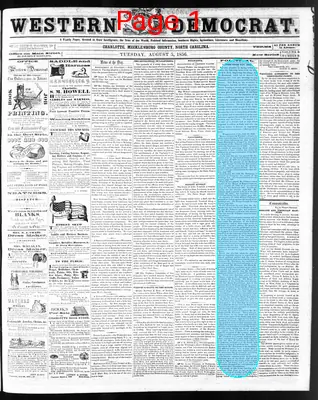
The Western Democrat
Charlotte, Mecklenburg County, North Carolina
What is this article about?
Newspaper introduces a letter from Gov. David S. Reid defending James Buchanan against false claims of supporting the 1841 Bankrupt Law, revealing Millard Fillmore's support instead, and urging North Carolinians to vote for Buchanan in the 1856 presidential election to counter Fremont and preserve the Constitution.
Clipping

OCR Quality
Full Text
LETTER FROM GOV. REID.
We take pleasure in laying before our readers the following letter from the Hon. David S. Reid, disproving the charge that Mr. Buchanan voted for or favored the Bankrupt law; and also showing the real character of the present contest for the Presidency. Gov. Reid, by his residence in Washington, has had excellent opportunities for forming a correct opinion as to the condition of public affairs. This opinion he here gives to the people of his State without reserve; and the character of the man is a sufficient guarantee that it is well considered, unselfish, and sincere. We trust it may not be without its effect in the coming elections. David S. Reid is the steadfast friend of the people of this State, and has never misled or deceived them.—He raises his voice to warn them of the dangers ahead, and invokes them to make common cause against the enemies of the Constitution and the Union. We repeat, it is the voice of a friend—and a man whose judgment is seldom at fault, and who can have no motive to deceive or improperly influence his countrymen.—[Raleigh Standard.
WASHINGTON CITY, July 18, 1856
Messrs. Holden & Wilson:—I have recently received letters from various points in our State, informing me that the Hon. James Buchanan is charged by the political friends of Mr. Fillmore with having voted for the Bankrupt law of 1841. To save the trouble of answering these enquiries separately, I have written this letter for publication, giving a statement of the facts as I find them.
At the time this act was passed Mr. Buchanan was in the United States Senate, and on July 24, 1841, he is recorded as voting against the passage of the Bankrupt bill. See Senate Journal for that session, page 115. On the same day, Mr. Buchanan made a speech against the bill. See Appendix to Congressional Globe for that session, page 205.
On February 25, 1843, Mr. Buchanan is recorded as voting for the repeal of the Bankrupt law. See Senate Journal for the session, page 229.
When the act passed, Mr. Fillmore was a member of the House of Representatives, and on August 18, 1841, he is recorded as voting for the Bankrupt bill. See House Journal for the session, page 378. Mr. Fillmore made a speech in favor of the bill, August 16, 1841. See Appendix to Congressional Globe for the session, page 480.
On January 17, 1843. Millard Fillmore is recorded as voting against the repeal of the Bankrupt act. See House Journal for that session, page 215.
It will, therefore, be seen that Mr. Buchanan DID NOT vote for the Bankrupt law, but that Mr. Fillmore DID; and moreover, that Mr. Buchanan voted FOR THE REPEAL of the law, and Mr. Fillmore voted AGAINST THE REPEAL.
The ensuing Presidential election will be the most important that has ever taken place since the adoption of the Federal Constitution: and as there ought to be no difference of opinion among the people of North Carolina upon the great issue involving, it is to be regretted that a large party are engaged in a course calculated to prove disastrous to the interests of the South and fatal to the principles of the Constitution.
The larger number of those who support Mr. Fillmore are no doubt actuated by pure and patriotic motives; but we must remember that this fact will not render their course, if it succeeds, the less fatal in its consequences to the country. The error may be discovered too late to repair the injury it inflicts.
Every one who has taken the pains to make an impartial inquiry in regard to the state of political parties and the tone of public sentiment, must know that the contest is between Mr. Buchanan, the candidate of the Democratic Constitutional party on the one side, and Mr. Fremont, the Black Republican Abolition candidate on the other. No candid well informed man will venture to express the opinion that Mr. Fillmore stands any chance to be elected by the people. Every vote, therefore, given for Mr. Fillmore weakens Mr. Buchanan and will strengthen Mr. Fremont. The Know-Nothing party of the North has been absorbed by the Black Republicans, and if the Southern Know-Nothings should, by carrying a few Southern States for Mr. Fillmore, succeed in throwing the election into the House of Representatives, then what have we to expect? Could we reasonably hope that a sound man would be chosen by a body which has elected a Black Republican of the deepest dye as its Speaker, and has thus far cast every important vote in favor of that party? It is true that in choosing a President the House votes by States, but that does not make the prospect of success more favorable at this time.
I repeat, the contest is between Mr. Buchanan and Mr. Fremont. Those who prefer the former to the latter and desire to preserve the rights of the States and maintain the Constitution, ought to vote for him, regardless of former political associations.
I am gratified to know that hundreds—including the masses as well as the politicians, who have not heretofore acted with the Democratic party, taking the proper view of the subject, have determined to sacrifice party for the good of the country, and are giving a cordial support to Mr. Buchanan.
Mr. Fremont is a purely sectional candidate, representing a party held together by the one idea, of inveterate hostility to the domestic institutions of the South, and we have nothing to hope from him. On the other hand, Mr. Buchanan is the candidate of a national party; he is a pure man, a statesman of wisdom and experience, and will administer the government according to the principles of the Constitution.
The deepest interest is felt by the Constitutional men of the North and of the South in regard to the result of the August election in our State: and I am sure she will neither disregard her own interests nor disappoint their expectations.
The result of the North Carolina elections has often been to me, as you well know, a source of peculiar pride and satisfaction; but I can assure you that I have never before felt so deep a solicitude for
What sub-type of article is it?
What themes does it cover?
What keywords are associated?
What entities or persons were involved?
Letter to Editor Details
Author
David S. Reid
Recipient
Messrs. Holden & Wilson
Main Argument
gov. reid refutes claims that james buchanan supported the 1841 bankrupt law by citing voting records showing buchanan opposed it while fillmore supported it. he argues the 1856 election pits buchanan against fremont, urging north carolinians to vote for buchanan to protect southern interests and the constitution, warning that fillmore votes aid fremont.
Notable Details