Thank you for visiting SNEWPapers!
Sign up free
Story
September 12, 1853
Worcester Daily Spy
Worcester, Worcester County, Massachusetts
What is this article about?
Satirical report of a small, humorous meeting of 'Old Hunker' Democrats in Worcester to select delegates for a national convention, mocking the party's low attendance and internal criticisms of the 'coalition' with Free Soilers.
Clipping
OCR Quality
95%
Excellent
Full Text
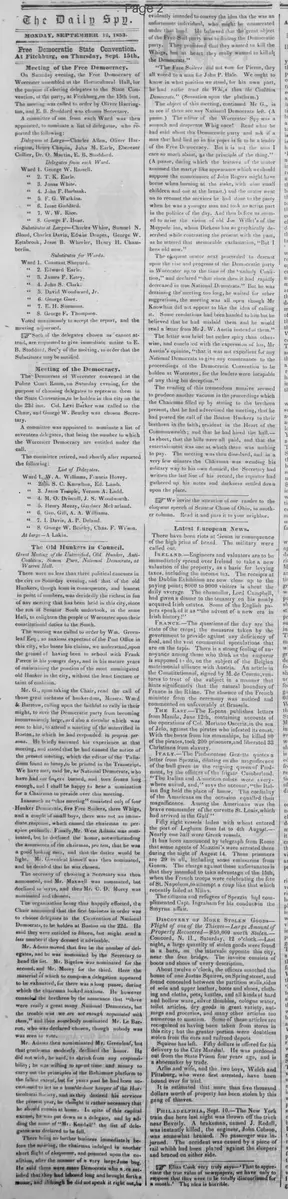
The Old Hunkers in Council.
Great Meeting of the Unterrified, Old Hunker, Anti-Coalition, Simon Pure, National Democrats, at Warren Hall.
There were no less than three political caucuses in the city on Saturday evening, and that of the old Hunkers, though least in consequence, and leanest in point of numbers, was decidedly the richest in fun of any meeting that has been held in this city, since the son of Senator Soule undertook, in the same Hall, to enlighten the people of Worcester upon their constitutional duties to the South.
The meeting was called to order by Wm. Greenleaf Esq., an anxious expectant of the Post Office in this city, who bases his claims, we understand, upon the ground of having been to school with Frank Pierce in his younger days, and in his mature years of maintaining the position of the most unmitigated old Hunker in the city, without the least tincture or taint of coalition.
Mr. G., upon taking the Chair, read the call of those great sachems of hunkerdom, Messrs. Ward & Barstow, calling upon the faithful to rally in their might, to save the Democratic party from becoming inconveniently large, and also a circular which was sent to him, to attend a meeting of the unterrified in Boston, to which he had responded in propria persona. He briefly narrated his experience at that meeting, and stated that he had caused the notice of the present meeting, which the editor of the Palladium found so funny, to be printed in the Transcript.
We have met, said he, as National Democrats, who have had our fingers burned, and toes frozen long enough, and I shall be happy to hear a nomination for a Chairman to preside over this meeting.
Inasmuch as "this meeting" consisted only of four Hunker Democrats, five Free Soilers, three Whigs, and a couple of small boys, there was not an immediate response, which caused the chairman to perspire profusely. Finally, Mr. West Adams was nominated, but he declined the honor, notwithstanding the assurances of the chairman, pro tem, that he was a good looking man, and that the duties would be light. Mr. Greenleaf himself was then nominated, and he decided that he was chosen.
The necessity of choosing a Secretary was then announced, and Mr. Maxwell was nominated, but declined to serve, and then Mr. C. D. Morey was nominated and chosen.
The organization being thus happily effected, the Chair announced that the first business in order was to choose delegates to the Convention of National Democrats, to be holden at Boston on the 22d. He said they were entitled to fifteen, but might send a less number if they deemed it advisable.
Mr. Adams moved that five be the number of delegates, and he was nominated by the Secretary to head the list. Mr. Bigelow was nominated for the second, and Mr. Morey for the third. Here the material of which to compose a delegation appeared to be exhausted, for there was a long pause, during which the chairman looked anxious. He however consoled the brethren by the assurance that "there were really a great many National Democrats, but the trouble was we are not enough acquainted with them," and then somebody nominated Mr. Le Baron, who was declared chosen, though nobody was seen to vote.
Mr. Adams then nominated Mr. Greenleaf, but that gentleman modestly declined the honor. He did not wish, he said, to shrink from any responsibility; he was willing to spend time and money to carry out the principles of the Baltimore platform to the fullest extent, but for years past he had been accustomed to act as a humble door keeper of the Horticultural Society, and as they desired his services the present year, he thought it rather necessary that he should remain at home. In spite of this capital excuse, he was put down as a delegate, and by adding the name of "Mr. Kendall" the list of delegates was declared to be full.
There being no further business immediately before the meeting, the chairman indulged in another short flight of eloquence, and pounced upon the coalition, after the manner of a very large June bug.
He said there were many Democrats who are satisfied that they had labored long and brought forth a mouse, and although he did not speak it right out, he evidently intended to convey the idea that he was an unfortunate individual, who might be enumerated under that head. He believed that the great object of the Free Soil party was to destroy the Democratic party.
They professed that they wanted to kill the Whigs, but at heart they really wanted to kill the Democrats.
The Free Soilers did not vote for Pierce, they all voted to a man for John P. Hale. We ought to know in what position we stand, for his own part, he had rather trust the Whigs than the Coalition Democrats. (Sensation upon the platform.)
The object of this meeting, continued Mr. G., is to see if there are any National Democrats left. (A pause.) The editor of the Worcester Spy was a staunch and desperate Whig once! Read what he had said about the Democratic party and ask if a man that had lied so in his paper is fit to be a leader of the Free Democracy. But it is not the man I care so much about, as the principle of the thing. (A pause, during which the features of the orator assumed the martyr-like appearance which we should suppose the countenance of John Rogers might have borne when burning at the stake, with nine small children and one at the breast.) and the orator went on to recount the services he had done to the party when he was a younger man and took an active part in the politics of the day. And then before us seemed to arise the vision of old Joe Willett's of the Maypole inn, whom Dickens has so graphically described while contrasting the present with the past, as he uttered that memorable exclamation, "But I bees old now."
The eloquent orator next proceeded to descant upon the rise and progress of the Democratic party in Worcester up to the time of the "unholy Coalition," and declared "that since then it had rapidly decreased in true National Democrats." But he was detaining the meeting too long, he waited for other suggestions, the meeting was all open though Mr. Knowlton did not appear to like the idea of calling it. Some resolutions had been handed to him but he believed that he had mislaid them and he would read a letter from Mr. J. W. Austin instead of them.
The letter was brief but rather spicy than otherwise, and concluded with the expression of his, Mr. Austin's opinion, "that it was not expedient for any National Democrats to give any countenance to the proceedings of the Democratic Convention to be holden at Worcester, for the leaders were incapable of anything but deception."
The reading of this tremendous missive seemed to produce another vacuum in the proceedings which the Chairman filled up by stating to the brethren present, that he had advertised the meeting, that he had posted the call of the Boston Hunkers to their brethren in the faith, resident in the Heart of the Commonwealth; and that he had hired the hall.— In short, that the bills were all paid, and that the entertainment was one at which there was nothing to pay. The meeting was then dissolved, and in a very few minutes the Chairman was wending his solitary way to his own domicil, the Secretary had written the last line of his record, the reporter had gathered up his notes and darkness settled down upon the place.
Great Meeting of the Unterrified, Old Hunker, Anti-Coalition, Simon Pure, National Democrats, at Warren Hall.
There were no less than three political caucuses in the city on Saturday evening, and that of the old Hunkers, though least in consequence, and leanest in point of numbers, was decidedly the richest in fun of any meeting that has been held in this city, since the son of Senator Soule undertook, in the same Hall, to enlighten the people of Worcester upon their constitutional duties to the South.
The meeting was called to order by Wm. Greenleaf Esq., an anxious expectant of the Post Office in this city, who bases his claims, we understand, upon the ground of having been to school with Frank Pierce in his younger days, and in his mature years of maintaining the position of the most unmitigated old Hunker in the city, without the least tincture or taint of coalition.
Mr. G., upon taking the Chair, read the call of those great sachems of hunkerdom, Messrs. Ward & Barstow, calling upon the faithful to rally in their might, to save the Democratic party from becoming inconveniently large, and also a circular which was sent to him, to attend a meeting of the unterrified in Boston, to which he had responded in propria persona. He briefly narrated his experience at that meeting, and stated that he had caused the notice of the present meeting, which the editor of the Palladium found so funny, to be printed in the Transcript.
We have met, said he, as National Democrats, who have had our fingers burned, and toes frozen long enough, and I shall be happy to hear a nomination for a Chairman to preside over this meeting.
Inasmuch as "this meeting" consisted only of four Hunker Democrats, five Free Soilers, three Whigs, and a couple of small boys, there was not an immediate response, which caused the chairman to perspire profusely. Finally, Mr. West Adams was nominated, but he declined the honor, notwithstanding the assurances of the chairman, pro tem, that he was a good looking man, and that the duties would be light. Mr. Greenleaf himself was then nominated, and he decided that he was chosen.
The necessity of choosing a Secretary was then announced, and Mr. Maxwell was nominated, but declined to serve, and then Mr. C. D. Morey was nominated and chosen.
The organization being thus happily effected, the Chair announced that the first business in order was to choose delegates to the Convention of National Democrats, to be holden at Boston on the 22d. He said they were entitled to fifteen, but might send a less number if they deemed it advisable.
Mr. Adams moved that five be the number of delegates, and he was nominated by the Secretary to head the list. Mr. Bigelow was nominated for the second, and Mr. Morey for the third. Here the material of which to compose a delegation appeared to be exhausted, for there was a long pause, during which the chairman looked anxious. He however consoled the brethren by the assurance that "there were really a great many National Democrats, but the trouble was we are not enough acquainted with them," and then somebody nominated Mr. Le Baron, who was declared chosen, though nobody was seen to vote.
Mr. Adams then nominated Mr. Greenleaf, but that gentleman modestly declined the honor. He did not wish, he said, to shrink from any responsibility; he was willing to spend time and money to carry out the principles of the Baltimore platform to the fullest extent, but for years past he had been accustomed to act as a humble door keeper of the Horticultural Society, and as they desired his services the present year, he thought it rather necessary that he should remain at home. In spite of this capital excuse, he was put down as a delegate, and by adding the name of "Mr. Kendall" the list of delegates was declared to be full.
There being no further business immediately before the meeting, the chairman indulged in another short flight of eloquence, and pounced upon the coalition, after the manner of a very large June bug.
He said there were many Democrats who are satisfied that they had labored long and brought forth a mouse, and although he did not speak it right out, he evidently intended to convey the idea that he was an unfortunate individual, who might be enumerated under that head. He believed that the great object of the Free Soil party was to destroy the Democratic party.
They professed that they wanted to kill the Whigs, but at heart they really wanted to kill the Democrats.
The Free Soilers did not vote for Pierce, they all voted to a man for John P. Hale. We ought to know in what position we stand, for his own part, he had rather trust the Whigs than the Coalition Democrats. (Sensation upon the platform.)
The object of this meeting, continued Mr. G., is to see if there are any National Democrats left. (A pause.) The editor of the Worcester Spy was a staunch and desperate Whig once! Read what he had said about the Democratic party and ask if a man that had lied so in his paper is fit to be a leader of the Free Democracy. But it is not the man I care so much about, as the principle of the thing. (A pause, during which the features of the orator assumed the martyr-like appearance which we should suppose the countenance of John Rogers might have borne when burning at the stake, with nine small children and one at the breast.) and the orator went on to recount the services he had done to the party when he was a younger man and took an active part in the politics of the day. And then before us seemed to arise the vision of old Joe Willett's of the Maypole inn, whom Dickens has so graphically described while contrasting the present with the past, as he uttered that memorable exclamation, "But I bees old now."
The eloquent orator next proceeded to descant upon the rise and progress of the Democratic party in Worcester up to the time of the "unholy Coalition," and declared "that since then it had rapidly decreased in true National Democrats." But he was detaining the meeting too long, he waited for other suggestions, the meeting was all open though Mr. Knowlton did not appear to like the idea of calling it. Some resolutions had been handed to him but he believed that he had mislaid them and he would read a letter from Mr. J. W. Austin instead of them.
The letter was brief but rather spicy than otherwise, and concluded with the expression of his, Mr. Austin's opinion, "that it was not expedient for any National Democrats to give any countenance to the proceedings of the Democratic Convention to be holden at Worcester, for the leaders were incapable of anything but deception."
The reading of this tremendous missive seemed to produce another vacuum in the proceedings which the Chairman filled up by stating to the brethren present, that he had advertised the meeting, that he had posted the call of the Boston Hunkers to their brethren in the faith, resident in the Heart of the Commonwealth; and that he had hired the hall.— In short, that the bills were all paid, and that the entertainment was one at which there was nothing to pay. The meeting was then dissolved, and in a very few minutes the Chairman was wending his solitary way to his own domicil, the Secretary had written the last line of his record, the reporter had gathered up his notes and darkness settled down upon the place.
What sub-type of article is it?
Historical Event
Curiosity
What themes does it cover?
Social Manners
Misfortune
What keywords are associated?
Hunker Democrats
Political Meeting
Worcester Caucus
National Democrats
Coalition Criticism
Delegate Selection
What entities or persons were involved?
Wm. Greenleaf
West Adams
C. D. Morey
Mr. Maxwell
Mr. Bigelow
Mr. Le Baron
Mr. Kendall
Messrs. Ward & Barstow
Mr. J. W. Austin
Where did it happen?
Warren Hall, Worcester
Story Details
Key Persons
Wm. Greenleaf
West Adams
C. D. Morey
Mr. Maxwell
Mr. Bigelow
Mr. Le Baron
Mr. Kendall
Messrs. Ward & Barstow
Mr. J. W. Austin
Location
Warren Hall, Worcester
Event Date
Saturday Evening
Story Details
A sparsely attended meeting of Old Hunker Democrats in Worcester selects five delegates to a Boston convention amid humorous difficulties and speeches criticizing the coalition with Free Soilers, highlighting the party's decline.