Thank you for visiting SNEWPapers!
Sign up free
Literary
September 25, 1834
Virginia Free Press
Charles Town, Jefferson County, West Virginia
What is this article about?
Biographical account of Robert Burns's lover Highland Mary, detailing her family, their correspondence, the Bible vow ceremony by a stream, and the preservation of mementos like her Bible and hair lock among descendants.
Clipping
OCR Quality
95%
Excellent
Full Text
LADIES' DEPARTMENT.
HIGHLAND MARY.
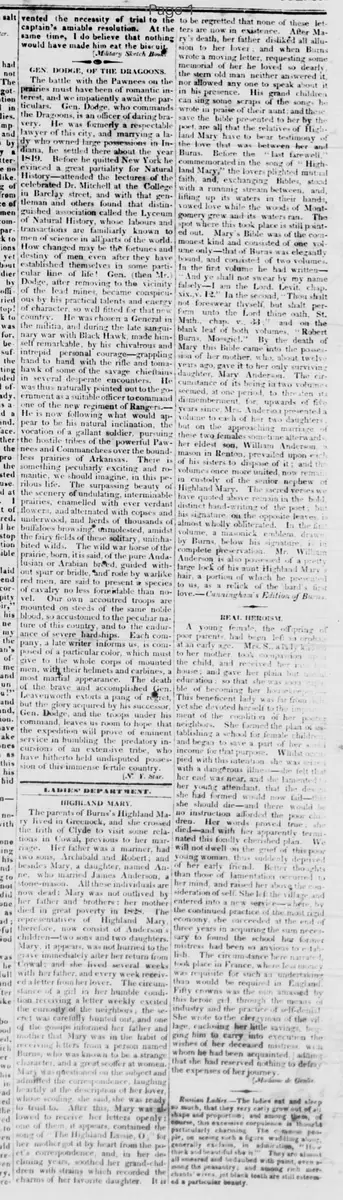
The parents of Burns's Highland Mary lived in Greenock, and she crossed the frith of Clyde to visit some relations in Cowal, previous to her marriage. Her father was a mariner, had two sons, Archibald and Robert, and beside, Mary, a daughter, named Anne, who married James Anderson, a stone-mason. All these individuals are now dead: Mary was not outlived by her father and brothers: her mother died in great poverty in 1813. The representatives of Highland Mary, therefore, now consist of Anderson's children—two sons and two daughters.
Mary, it appears, was not hurried to the grave immediately after her return from Cowal: and she lived several weeks with her father, and every week received a letter from her lover. The circumstance of a girl in her humble condition receiving a letter weekly excited the curiosity of the neighbors, the secret was carefully hunted out, and one of the gossips informed her father and mother that Mary was in the habit of receiving letters from a person named Burns, who was known to be a strange character, and a great scoffer at women. Mary was questioned on the subject and admitted the correspondence, laughing heartily at the despite of her lover, whose scolding she said, she was ready to trust to. After this, Mary was allowed to receive her letters openly: one of them, it appears, contained the song of "The Highland Lassie, O." for her mother got it by heart from the poet's correspondence, and, in her declining years, soothed her grandchildren with strains which recorded the charms of her favorite daughter. It is to be regretted that none of these letters are now in existence. After Mary's death, her father disliked all allusion to her lover; and when Burns wrote a moving letter, requesting some memorial of her he loved so dearly the stern old man neither answered it, nor allowed any one to speak about it in his presence. His grandchildren causing some scraps of the songs he wrote in praise of their aunt: and these save the bible presented to her by the poet, are all that the relatives of Highland Mary have to bear testimony of the love that was between her and Burns. Before the "last farewell," commemorated in the song of "Highland Mary," the lovers plighted mutual faith, and, exchanging Bibles, stood with a running stream between, and, lifting up its waters in their hands, vowed love while the woods of Montgomery grew and its waters ran. The spot where this took place is still pointed out. Mary's Bible was of the commonest kind and consisted of one volume only—that of Burns was elegantly bound, and consisted of two volumes. In the first volume, he had written—"And ye shall not swear by my name falsely—I am the Lord. Levit. chap. xix. v. 12." In the second. "Thou shalt not forswear thyself, but shalt perform unto the Lord thine oath, St. Math. chap. v. v. 33." and on the blank leaf of both volumes, "Robert Burns. Mossgiel." By the death of Mary this Bible came into the possession of her mother, who, about twenty years ago, gave it to her only surviving daughter, Mary Anderson. The circumstance of its being in two volumes seemed, at one period, to threaten its dismemberment, for, upwards of five years since, Mrs. Anderson presented a volume to each of her two daughters, but on the approaching marriage of these two females some time afterwards her eldest son, William Anderson mason in Renton, prevailed upon each of his sisters to dispose of it: and the two volumes once more united, now remain in custody of the senior nephew of Highland Mary. The sacred verses we have quoted above remain in the bold distinct hand-writing of the poet: but his signature, on the opposite leaves, is almost wholly obliterated. In the first volume, a masonick emblem, drawn by Burns, below his signature, is in complete preservation. Mr. William Anderson is also possessed of a pretty large lock of his aunt Highland Mary's hair, a portion of which he presented to us, as a relick of the bard's first love.—Cunningham's Edition of Burns.
HIGHLAND MARY.
The parents of Burns's Highland Mary lived in Greenock, and she crossed the frith of Clyde to visit some relations in Cowal, previous to her marriage. Her father was a mariner, had two sons, Archibald and Robert, and beside, Mary, a daughter, named Anne, who married James Anderson, a stone-mason. All these individuals are now dead: Mary was not outlived by her father and brothers: her mother died in great poverty in 1813. The representatives of Highland Mary, therefore, now consist of Anderson's children—two sons and two daughters.
Mary, it appears, was not hurried to the grave immediately after her return from Cowal: and she lived several weeks with her father, and every week received a letter from her lover. The circumstance of a girl in her humble condition receiving a letter weekly excited the curiosity of the neighbors, the secret was carefully hunted out, and one of the gossips informed her father and mother that Mary was in the habit of receiving letters from a person named Burns, who was known to be a strange character, and a great scoffer at women. Mary was questioned on the subject and admitted the correspondence, laughing heartily at the despite of her lover, whose scolding she said, she was ready to trust to. After this, Mary was allowed to receive her letters openly: one of them, it appears, contained the song of "The Highland Lassie, O." for her mother got it by heart from the poet's correspondence, and, in her declining years, soothed her grandchildren with strains which recorded the charms of her favorite daughter. It is to be regretted that none of these letters are now in existence. After Mary's death, her father disliked all allusion to her lover; and when Burns wrote a moving letter, requesting some memorial of her he loved so dearly the stern old man neither answered it, nor allowed any one to speak about it in his presence. His grandchildren causing some scraps of the songs he wrote in praise of their aunt: and these save the bible presented to her by the poet, are all that the relatives of Highland Mary have to bear testimony of the love that was between her and Burns. Before the "last farewell," commemorated in the song of "Highland Mary," the lovers plighted mutual faith, and, exchanging Bibles, stood with a running stream between, and, lifting up its waters in their hands, vowed love while the woods of Montgomery grew and its waters ran. The spot where this took place is still pointed out. Mary's Bible was of the commonest kind and consisted of one volume only—that of Burns was elegantly bound, and consisted of two volumes. In the first volume, he had written—"And ye shall not swear by my name falsely—I am the Lord. Levit. chap. xix. v. 12." In the second. "Thou shalt not forswear thyself, but shalt perform unto the Lord thine oath, St. Math. chap. v. v. 33." and on the blank leaf of both volumes, "Robert Burns. Mossgiel." By the death of Mary this Bible came into the possession of her mother, who, about twenty years ago, gave it to her only surviving daughter, Mary Anderson. The circumstance of its being in two volumes seemed, at one period, to threaten its dismemberment, for, upwards of five years since, Mrs. Anderson presented a volume to each of her two daughters, but on the approaching marriage of these two females some time afterwards her eldest son, William Anderson mason in Renton, prevailed upon each of his sisters to dispose of it: and the two volumes once more united, now remain in custody of the senior nephew of Highland Mary. The sacred verses we have quoted above remain in the bold distinct hand-writing of the poet: but his signature, on the opposite leaves, is almost wholly obliterated. In the first volume, a masonick emblem, drawn by Burns, below his signature, is in complete preservation. Mr. William Anderson is also possessed of a pretty large lock of his aunt Highland Mary's hair, a portion of which he presented to us, as a relick of the bard's first love.—Cunningham's Edition of Burns.
What sub-type of article is it?
Essay
What themes does it cover?
Love Romance
Religious
Moral Virtue
What keywords are associated?
Highland Mary
Robert Burns
Love Letters
Bible Exchange
Family History
Burns Songs
What entities or persons were involved?
Cunningham's Edition Of Burns
Literary Details
Title
Highland Mary.
Author
Cunningham's Edition Of Burns
Subject
Biographical Account Of Burns's Highland Mary
Key Lines
The Circumstance Of A Girl In Her Humble Condition Receiving A Letter Weekly Excited The Curiosity Of The Neighbors, The Secret Was Carefully Hunted Out, And One Of The Gossips Informed Her Father And Mother That Mary Was In The Habit Of Receiving Letters From A Person Named Burns, Who Was Known To Be A Strange Character, And A Great Scoffer At Women.
Before The "Last Farewell," Commemorated In The Song Of "Highland Mary," The Lovers Plighted Mutual Faith, And, Exchanging Bibles, Stood With A Running Stream Between, And, Lifting Up Its Waters In Their Hands, Vowed Love While The Woods Of Montgomery Grew And Its Waters Ran.
In The First Volume, He Had Written—"And Ye Shall Not Swear By My Name Falsely—I Am The Lord. Levit. Chap. Xix. V. 12." In The Second. "Thou Shalt Not Forswear Thyself, But Shalt Perform Unto The Lord Thine Oath, St. Math. Chap. V. V. 33."