Thank you for visiting SNEWPapers!
Sign up free
Freeman's Chronicle
Columbus, Franklin County, Ohio
What is this article about?
Comparative analysis from the Petersburg Gazette (Sept 28, 1813) detailing Napoleon's declining physical, economical, and moral power from 1812 to January 1813, including losses in territories, armies, alliances, and revenues amid ongoing European wars.
Clipping
OCR Quality
Full Text
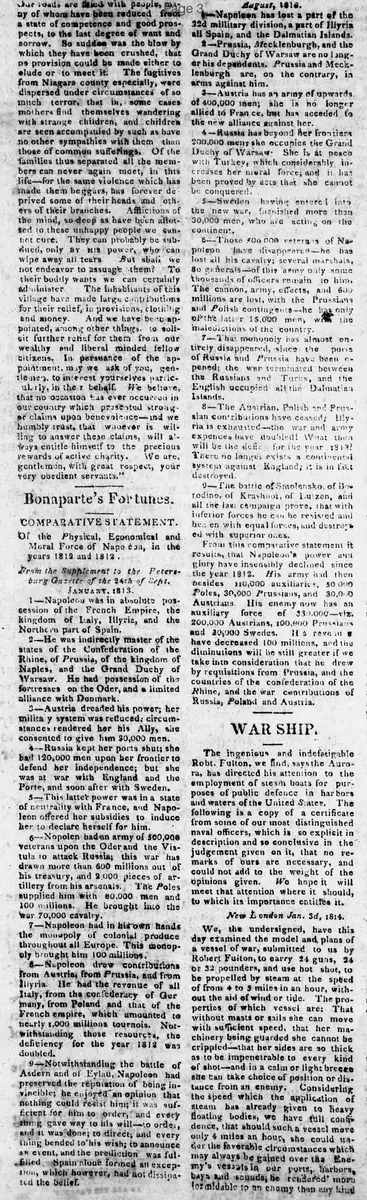
COMPARATIVE STATEMENT.
Of the Physical, Economical and Moral Force of Napoleon, in the years 1812 and 1813.
From the Supplement to the Petersburg Gazette of the 28th of Sept.
JANUARY, 1813.
1—Napoleon was in absolute possession of the French Empire, the kingdom of Italy, Illyria, and the Northern part of Spain.
2—He was indirectly master of the states of the Confederation of the Rhine, of Prussia, of the kingdom of Naples, and the Grand Duchy of Warsaw. He had possession of the Fortresses on the Oder, and a limited alliance with Denmark.
3—Austria dreaded his power; her military system was reduced: circumstances rendered her his Ally, she consented to give him 30,000 men.
4—Russia kept her ports shut; she had 120,000 men upon her frontier to defend her independence: but she was at war with England and the Porte, and soon after with Sweden.
5—This latter power was in a State of neutrality with France, and Napoleon offered her subsidies to induce her to declare herself for him.
6—Napoleon had an army of 500,000 veterans upon the Oder and the Vistula to attack Russia; this war has drawn more than 600 millions out of his treasury, and 2,000 pieces of artillery from his arsenals. The Poles supplied him with 80,000 men and 100 millions. He brought into the war 70,000 cavalry.
7—Napoleon had in his own hands the monopoly of colonial produce throughout all Europe. This monopoly brought him 100 millions.
8—Napoleon drew contributions from Austria, from Prussia, and from Illyria. He had the revenue of all Italy, from the confederacy of Germany, from Poland and that of the French empire, which amounted to nearly 1,000 millions tournois. Notwithstanding those resources, the deficiency of the year 1812 was doubled:
9—Notwithstanding the battle of Austerlitz and of Eylau, Napoleon had preserved the reputation of being invincible; he enjoyed an opinion that nothing could resist him; it was sufficient for him to order, and everything gave way to his will—to order, and it was done; to direct; and everything bended to his wish; to announce an event, and the prediction was fulfilled. Spain alone formed an exception, which however, had not dissipated the belief.
Napoleon has lost a part of the 32d military division, a part of Illyria all Spain, and the Dalmatian Islands.
Prussia, Mecklenburgh, and the Grand Duchy of Warsaw are no longer his dependents. Prussia and Mecklenburgh are, on the contrary, in arms against him.
3—Austria has an army of upwards of 400,000 men; she is no longer allied to France, but has acceded to the new alliance against her.
4—Russia has beyond her frontiers 200,000 men; she occupies the Grand Duchy of Warsaw: She is at peace with Turkey, which considerably increases her moral force; and it has been proved by acts that she cannot be conquered.
5—Sweden having entered into the new war, furnished more than 30,000 men, who are acting on the continent.
6—Those 500,000 veterans of Napoleon have disappeared—he has lost all his cavalry: several marshals, 80 generals—of this army only some thousands of officers remain to him. The cannon, army, effects, and 600 millions are lost, with the Prussians and Polish contingents—he has only of the latter 15,000 men, with the maledictions of the country.
7—That monopoly has almost entirely disappeared, since the ports of Russia and Prussia have been opened; the war terminated between the Russians and Turks, and the English occupied all the Dalmatian Islands.
8—The Austrian, Polish and Prussian contributions have ceased; Illyria is exhausted—the war and army expences have doubled! What then will be the deficit, for the year 1813? There no longer exists a continental system against England; it is in fact destroyed.
9—The battle of Smolensko of Borodino, of Krasnoi, of Lutzen, and all the last campaign prove, that with inferior forces he can be resisted and beaten with equal forces, and destroyed with superior ones.
From this comparative statement it results, that Napoleon's power and glory have insensibly declined since the year 1812. His army had then besides 110,000 auxiliaries, 50,000 Poles, 30,000 Prussians, and 30,000 Austrians. His enemy now has an auxiliary force of 330,000—viz: 200,000 Austrians, 100,000 Prussians and 30,000 Swedes. His revenues have decreased 100 millions, and the diminutions will be still greater if we take into consideration that he drew by requisitions from Prussia, and the countries of the confederation of the Rhine, and the war contributions of Russia, Poland and Austria.
What sub-type of article is it?
What keywords are associated?
What entities or persons were involved?
Where did it happen?
Foreign News Details
Primary Location
Europe
Event Date
January 1813 (Comparing To 1812)
Key Persons
Outcome
napoleon lost territories including parts of illyria, all of spain, dalmatian islands; lost 500,000 veterans, all cavalry, several marshals, 80 generals; revenues decreased by 100 millions; allies like prussia, austria turned against him; continental system destroyed.
Event Details
Comparative statement from Petersburg Gazette supplement (28th Sept) outlines Napoleon's absolute control over French Empire, Italy, Illyria, northern Spain in 1812, indirect mastery over Rhine Confederation, Prussia, Naples, Warsaw; alliances and armies detailed. By January 1813, losses in territories, armies, revenues, and reputation due to Russian campaign and shifting alliances; battles like Borodino and Lutzen show his vulnerability.