Thank you for visiting SNEWPapers!
Sign up free
Letter to Editor
May 5, 1824
Massachusetts Spy And Worcester Advertiser
Worcester, Worcester County, Massachusetts
What is this article about?
H.G. Otis writes to defend the Hartford Convention from charges of disunionist intentions, arguing that its members were loyal patriots who recommended constitutional measures for state defense and amendments, ultimately endorsed by Congress, amid concerns over the War of 1812 and national policy.
Clipping
OCR Quality
98%
Excellent
Full Text
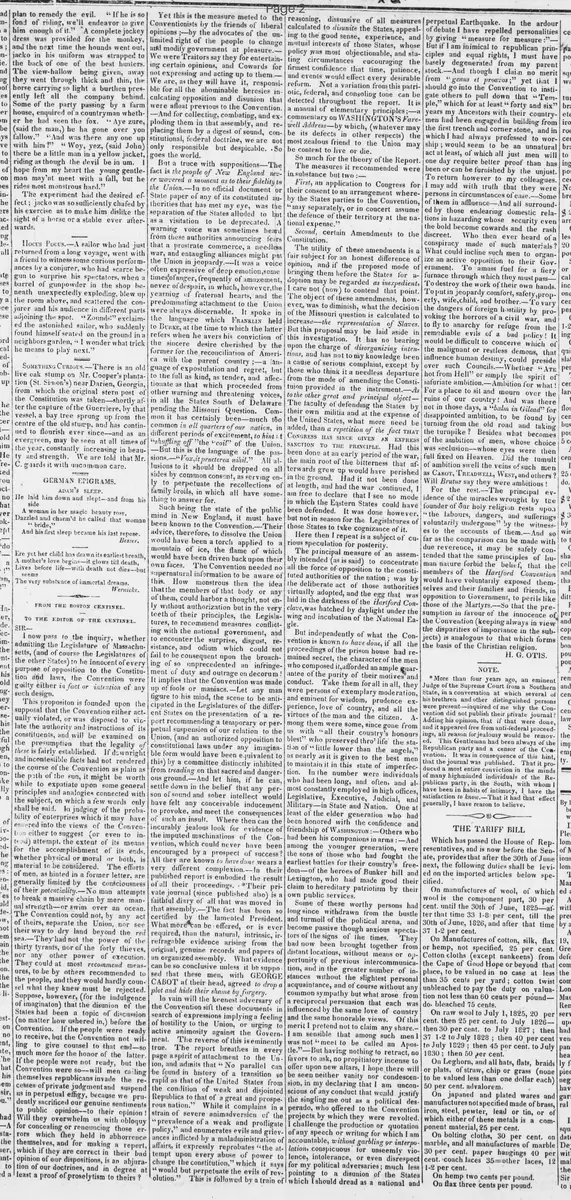
FROM THE BOSTON CENTINEL.
TO THE EDITOR OF THE CENTINEL.
SIR--
I now pass to the inquiry, whether admitting the Legislature of Massachusetts, (and of course the Legislatures of the other States) to be innocent of every purpose of opposition to the Constitution and laws, the Convention were guilty either in fact or intention of any such design.
This proposition is founded upon the supposal that the Convention either actually violated, or was disposed to violate the authority and instructions of its constituents, and will be examined on the presumption that the legality of these is fairly established. If downright and incontestible facts had not rendered the course of the Convention as plain as the path of the sun, it might be worth while to expatiate upon some general principles and analogies connected with the subject, on which a few words only shall be said. In judging of the probability of enterprises which it may have entered into the views of the Convention either to suggest (or even to intend) attempt, the extent of its means for the accomplishment of its ends, whether physical or moral or both, is material to be considered. The efforts of men, as hinted in a former letter, are generally limited by the consciousness of their potentiality.--No man attempts to break a massive chain by mere manual strength--or swim over an ocean. The Convention could not, by any act of theirs, separate the Union, nor see their way to dry land beyond the red sea.--They had not the power of the thirty tyrants, nor of the forty thieves, nor any other power of execution. They could at most recommend measures, to be by others recommended to the people, and they would hardly counsel what they knew must be rejected.
Suppose, however, (for the indulgence of imagination) that the disunion of the States had been a topic of discussion (no matter how ushered in,) before the Convention. If the people were ready to receive, but the Convention not willing to give counsel to that end--so much more for the honor of the latter. If the people were not ready, but the Convention were so--will men calling themselves republicans invade the recesses of private judgment and suspend us in perpetual effigy, because we prudently sacrificed our genuine sentiments to public opinion--to their opinion! Will they overwhelm us with obloquy for concealing or renouncing those errors which they held in abhorrence themselves, and for making a report, which if they are correct in their bad opinion of our dispositions, is an abjuration of our doctrines, and in degree at least a proof of proselytism to theirs?
Yet this is the measure meted to the Conventionists by the friends of liberal opinions ;--by the advocates of the unlimited right of the people to change and modify government at pleasure.--We were Traitors say they for entertaining certain opinions, and Cowards for not expressing and acting up to them.--We are, as they will have it, responsible for all the abominable heresies inculcating opposition and disunion that were afloat previous to the Convention. --And for collecting, combating, and exploding them in that assembly, and replacing them by a digest of sound, constitutional, federal doctrine, we are not only responsible but despicable. So goes the world.
But a truce with suppositions--The fact is the people of New England never wavered a moment as to their fidelity to the Union.--In no official document or State paper of any of its constituted authorities that has met my eye, was the separation of the States alluded to but as a visitation to be deprecated. A warning voice was sometimes heard from these authorities announcing fears that a prostrate commerce, a needless war, and entangling alliances might put the Union in jeopardy.---It was a voice often expressive of deep emotion, sometimes of anger, frequently of amazement, never of despair, in which, however, the yearning of fraternal hearts, and the predominating attachment to the Union were always discernable. It spoke in the language which Franklin held to Burke, at the time to which the latter refers when he avers his conviction of the sincere desire cherished by the former for the reconciliation of America with the parent country;--a language of expostulation and regret, but to the full as kind, as tender, and affectionate as that which proceeded from other warning and threatening voices, in all the States South of Delaware pending the Missouri Question. Common it has certainly been--much too common in all quarters of our nation, in different periods of excitement, to hint at "shuffling off" the "coil" of the Union. -But this is the language of the passions.--"Vox, et praeterea nihil." All allusions to it should be dropped on all sides by common consent, as serving only to perpetuate the recollections of family broils, in which all have something to answer for.
Such being the state of the public mind in New England, it must have been known to the Convention.--Their advice, therefore, to dissolve the Union would have been a torch applied to a mountain of ice, the flame of which would have been driven back upon their own faces. The Convention needed no supernatural information to be aware of this. How monstrous then the idea that the members of that body or any of them, could harbor a thought, not only without authorization but in the very teeth of their principles, the Legislatures, to recommend measures conflicting with the national government, and to encounter the surprise, disgust, resistance, and odium which could not fail to be consequent upon the broaching of so unprecedented an infringement of duty and outrage on decorum! It implies that the Convention was made up of fools or maniacs.--Let any man figure to his mind, the scene to be anticipated in the Legislatures of the different States on the presentation of a report recommending a temporary or perpetual suspension of our relation to the Union, (and an authorized opposition to constitutional laws under any imaginable form would have been equivalent to this) by a committee distinctly inhibited from treading on that sacred and dangerous ground.--And let him, if he can, settle down in the belief that any person of sound and sober intellect would have felt any conceivable inducement to provoke, and meet the consequences of such an insult. Where then can the incurably jealous look for evidence of the imputed machinations of the Convention, which could never have been encouraged by a prospect of success?
All they are known to have done wears a very different complexion.--In their published report is embodied the result of all their proceedings. Their private journal (since published also) is a faithful diary of all that was moved in that assembly.--The fact has been so certified by the lamented President. What more can be offered, or is ever required, than the natural, intrinsic, irrefragable evidence arising from the original, genuine records and papers of an organized assembly. What evidence can be so conclusive unless it be supposed that these men, with GEORGE CABOT at their head, agreed to drop a plot and hide their shame by forgery. In vain will the keenest adversary of the Convention sift these documents in search of expressions implying a feeling of hostility to the Union, or urging to active animosity against the Government. The reverse of this is eminently true. The report breathes in every page a spirit of attachment to the Union, and admits that "No parallel can be found in history of a transition so rapid as that of the United States from the condition of weak and disjointed Republics to that of a great and prosperous nation." While it complains in a strain of severe animadversion of the "prevalence of a weak and profligate policy," and enumerates evils and grievances inflicted by a maladministration of affairs, it expressly reprobates "the attempt upon every abuse of power to change the constitution," which it says "would but perpetuate the evils of revolution." This is followed by a train of reasoning, dissuasive of all measures calculated to disunite the States, appealing to the good sense, experience, and mutual interests of those States, whose policy was most objectionable, and stating circumstances encouraging the firmest confidence that time, patience, and events would effect every desirable reform. Not a variation from this patriotic, federal, and consoling tone can be detected throughout the report. It is a manual of elementary principles;--a commentary on WASHINGTON'S Farewell Address--by which, (whatever may be its defects in other respects) the most zealous friend to the Union may be content to live or die.
So much for the theory of the Report. The measures it recommended were in substance but two :--
First, an application to Congress for their consent to an arrangement whereby the States parties to the Convention, "may separately, or in concert assume the defence of their territory at the national expense."
Second, certain Amendments to the Constitution.
The utility of these amendments is a fair subject for an honest difference of opinion, and if the proposed mode of bringing them before the States for adoption may be regarded as inexpedient I care not (now) to contend that point. The object of these amendments, however, was to diminish, what the decision of the Missouri question is calculated to increase--the representation of Slaves. But this proposal may be laid aside in this investigation. It has no bearing upon the charge of disorganizing intentions, and has not to my knowledge been a cause of serious complaint, except by those who think it a needless departure from the mode of amending the Constitution provided in the instrument.--As to the other great and principal object--The faculty of defending the States by their own militia and at the expense of the United States, what more need be added, than a repetition of the fact THAT CONGRESS HAS SINCE GIVEN AN EXPRESS SANCTION TO THE PRINCIPLE. Had this been done at an early period of the war, the main root of the bitterness that afterwards grew up would have perished in the ground. Had it not been done at length, and had the war continued, I am free to declare that I see no mode in which the Eastern States could have been defended." It was done however, but not in season for the Legislatures of those States to take cognizance of it. Here then I repeat is a subject of curious speculation for posterity.
The principal measure of an assembly intended (as is said) to concentrate all the force of opposition to the constituted authorities of the nation; was by the deliberate act of those authorities virtually adopted, and the egg that was laid in the darkness of the Hartford Conclave, was hatched by daylight under the wing and incubation of the National Eagle.
But independently of what the Convention is known to have done, if all the proceedings of the prison house had remained secret, the character of the men who composed it, afforded an ample guarantee of the purity of their motives and conduct. Take them all in all, they were persons of exemplary moderation, and eminent for wisdom, prudence experience, love of country, and all the virtues of the man and the citizen. Among them were some, since gone from us with "all their country's honours blest" who preserved thro' life the station of "little lower than the angels," as nearly as it is given to the best men to maintain it in this state of imperfection. In the number were individuals who had been long, and often, and almost constantly employed in high offices Legislative, Executive, Judicial, and Military--in State and Nation. One at least of the elder generation who had been honored with the confidence and friendship of Washington:--Others who had been his companions in arms:--And among the younger generation, were the sons of those who had fought the earliest battles for their country's freedom--of the heroes of Bunker hill and Lexington, who had made good their claim to hereditary patriotism by their own public services.
Some of these worthy persons had long since withdrawn from the bustle and turmoil of the political arena, and become passive though anxious spectators of the signs of the times. They had now been brought together from distant locations, without means or opportunity of previous intercommunication, and in the greater number of instances without the slightest personal acquaintance, and of course without any common sympathy but what arose from a reciprocal persuasion that each was influenced by the same love of country and the same honorable views. Of this merit I pretend not to claim any share.--I am sensible that among such men I was not "meet to be called an Apostle." --But having nothing to retract, no favors to ask, no propitiatory incense to offer upon new altars, I hope there will be seen neither vanity nor condescension, in my declaring that I am unconscious of any conduct that would justify the singling me out as a political desperado, who offered to the Convention projects by which they were revolted. I challenge the production or quotation of any speech or writing for which I am accountable, without garbling or interpolation, conspicuous for unseemly violence, intolerance, or even disrespect for my political adversaries; much less pointing to a disunion of the States which I should dread as a national and perpetual Earthquake. In the ardour of debate I have repelled personalities by giving "measure for measure:" But if I am inimical to republican principles and equal rights, I must have basely degenerated from my parent stock.--And though I claim no merit from "genus et proavos;" yet that I should go into the Convention to instigate others to pull down that "Temple," which for at least "forty and six" years my Ancestors with their countrymen had been engaged in building from the first trench and corner stone, and in which I had always professed to worship; would seem to be an unnatural act at least, of which all just men will one day require better proof than has been or can be furnished by the unjust.
To return however to my colleagues. I may add with truth that they were persons in circumstances of ease.--Some of them in affluence--And all surrounded by those endearing domestic relations in hazarding whose security even the bold become cowards and the rash discreet. Who then ever heard of a conspiracy made of such materials? What could incline such men to organize an active opposition to their Government. To amass fuel for a fiery furnace through which they must pass--To destroy the work of their own hands. To put in jeopardy comfort, safety, property, wife, child, and brother.--To vary the dangers of foreign hostility by provoking the horrors of a civil war, and to fly to anarchy for refuge from the remediable evils of a bad policy! It would be difficult to conceive which of the malignant or restless demons, that influence human destiny, could preside over such Councils.---Whether "Ate hot from Hell" or simply the spirit of infuriate ambition.--Ambition for what! For a place to sit and mourn over the ruins of our country! And was there not in those days, a "balm in Gilead" for disappointed ambition, to be found by turning from the old road and taking the turnpike? Besides what becomes of the ambition of men, whose choice was seclusion--whose eyes were then full fixed on Heaven. Did the tumult of ambition swell the veins of such men as Cabot, Treadwell, West, and others? Will Brutus say they were ambitious!
For the rest.--The principal evidence of the miracles wrought by the founder of our holy religion rests upon "the labours, dangers, and sufferings voluntarily undergone" by the witnesses to the accounts of them.--And so far as the comparison can be made with due reverence, it may be safely contended that the same principles of human nature forbid the belief, that the members of the Hartford Convention would have voluntarily exposed themselves and their families and friends, in opposition to Government, to perils like those of the Martyrs.--So that the presumption in favour of the innocence of the Convention (keeping always in view the disparities of importance in the subjects) is analogous to that which forms the basis of the Christian religion.
H. G. OTIS.
NOTE.
*More than four years ago, an eminent Judge of the Supreme Court from a Southern State, in a conversation at which several of his brethren and other distinguished persons were present.--inquired of me why the Convention did not publish their private journal? Adding his opinion, that if that were done, and it appeared free from anti-federal proceedings, all reason for jealousy would be removed. This Gentleman had been always of the Republican party and a censor of the Convention. It was in consequence of this hint, that the journal was published. That it produced a most entire conviction in the minds of many highminded individuals of the Republican party, in the South, with whom I have been in habits of intimacy, I have the satisfaction to know.--That it had that effect generally, I have reason to believe.
TO THE EDITOR OF THE CENTINEL.
SIR--
I now pass to the inquiry, whether admitting the Legislature of Massachusetts, (and of course the Legislatures of the other States) to be innocent of every purpose of opposition to the Constitution and laws, the Convention were guilty either in fact or intention of any such design.
This proposition is founded upon the supposal that the Convention either actually violated, or was disposed to violate the authority and instructions of its constituents, and will be examined on the presumption that the legality of these is fairly established. If downright and incontestible facts had not rendered the course of the Convention as plain as the path of the sun, it might be worth while to expatiate upon some general principles and analogies connected with the subject, on which a few words only shall be said. In judging of the probability of enterprises which it may have entered into the views of the Convention either to suggest (or even to intend) attempt, the extent of its means for the accomplishment of its ends, whether physical or moral or both, is material to be considered. The efforts of men, as hinted in a former letter, are generally limited by the consciousness of their potentiality.--No man attempts to break a massive chain by mere manual strength--or swim over an ocean. The Convention could not, by any act of theirs, separate the Union, nor see their way to dry land beyond the red sea.--They had not the power of the thirty tyrants, nor of the forty thieves, nor any other power of execution. They could at most recommend measures, to be by others recommended to the people, and they would hardly counsel what they knew must be rejected.
Suppose, however, (for the indulgence of imagination) that the disunion of the States had been a topic of discussion (no matter how ushered in,) before the Convention. If the people were ready to receive, but the Convention not willing to give counsel to that end--so much more for the honor of the latter. If the people were not ready, but the Convention were so--will men calling themselves republicans invade the recesses of private judgment and suspend us in perpetual effigy, because we prudently sacrificed our genuine sentiments to public opinion--to their opinion! Will they overwhelm us with obloquy for concealing or renouncing those errors which they held in abhorrence themselves, and for making a report, which if they are correct in their bad opinion of our dispositions, is an abjuration of our doctrines, and in degree at least a proof of proselytism to theirs?
Yet this is the measure meted to the Conventionists by the friends of liberal opinions ;--by the advocates of the unlimited right of the people to change and modify government at pleasure.--We were Traitors say they for entertaining certain opinions, and Cowards for not expressing and acting up to them.--We are, as they will have it, responsible for all the abominable heresies inculcating opposition and disunion that were afloat previous to the Convention. --And for collecting, combating, and exploding them in that assembly, and replacing them by a digest of sound, constitutional, federal doctrine, we are not only responsible but despicable. So goes the world.
But a truce with suppositions--The fact is the people of New England never wavered a moment as to their fidelity to the Union.--In no official document or State paper of any of its constituted authorities that has met my eye, was the separation of the States alluded to but as a visitation to be deprecated. A warning voice was sometimes heard from these authorities announcing fears that a prostrate commerce, a needless war, and entangling alliances might put the Union in jeopardy.---It was a voice often expressive of deep emotion, sometimes of anger, frequently of amazement, never of despair, in which, however, the yearning of fraternal hearts, and the predominating attachment to the Union were always discernable. It spoke in the language which Franklin held to Burke, at the time to which the latter refers when he avers his conviction of the sincere desire cherished by the former for the reconciliation of America with the parent country;--a language of expostulation and regret, but to the full as kind, as tender, and affectionate as that which proceeded from other warning and threatening voices, in all the States South of Delaware pending the Missouri Question. Common it has certainly been--much too common in all quarters of our nation, in different periods of excitement, to hint at "shuffling off" the "coil" of the Union. -But this is the language of the passions.--"Vox, et praeterea nihil." All allusions to it should be dropped on all sides by common consent, as serving only to perpetuate the recollections of family broils, in which all have something to answer for.
Such being the state of the public mind in New England, it must have been known to the Convention.--Their advice, therefore, to dissolve the Union would have been a torch applied to a mountain of ice, the flame of which would have been driven back upon their own faces. The Convention needed no supernatural information to be aware of this. How monstrous then the idea that the members of that body or any of them, could harbor a thought, not only without authorization but in the very teeth of their principles, the Legislatures, to recommend measures conflicting with the national government, and to encounter the surprise, disgust, resistance, and odium which could not fail to be consequent upon the broaching of so unprecedented an infringement of duty and outrage on decorum! It implies that the Convention was made up of fools or maniacs.--Let any man figure to his mind, the scene to be anticipated in the Legislatures of the different States on the presentation of a report recommending a temporary or perpetual suspension of our relation to the Union, (and an authorized opposition to constitutional laws under any imaginable form would have been equivalent to this) by a committee distinctly inhibited from treading on that sacred and dangerous ground.--And let him, if he can, settle down in the belief that any person of sound and sober intellect would have felt any conceivable inducement to provoke, and meet the consequences of such an insult. Where then can the incurably jealous look for evidence of the imputed machinations of the Convention, which could never have been encouraged by a prospect of success?
All they are known to have done wears a very different complexion.--In their published report is embodied the result of all their proceedings. Their private journal (since published also) is a faithful diary of all that was moved in that assembly.--The fact has been so certified by the lamented President. What more can be offered, or is ever required, than the natural, intrinsic, irrefragable evidence arising from the original, genuine records and papers of an organized assembly. What evidence can be so conclusive unless it be supposed that these men, with GEORGE CABOT at their head, agreed to drop a plot and hide their shame by forgery. In vain will the keenest adversary of the Convention sift these documents in search of expressions implying a feeling of hostility to the Union, or urging to active animosity against the Government. The reverse of this is eminently true. The report breathes in every page a spirit of attachment to the Union, and admits that "No parallel can be found in history of a transition so rapid as that of the United States from the condition of weak and disjointed Republics to that of a great and prosperous nation." While it complains in a strain of severe animadversion of the "prevalence of a weak and profligate policy," and enumerates evils and grievances inflicted by a maladministration of affairs, it expressly reprobates "the attempt upon every abuse of power to change the constitution," which it says "would but perpetuate the evils of revolution." This is followed by a train of reasoning, dissuasive of all measures calculated to disunite the States, appealing to the good sense, experience, and mutual interests of those States, whose policy was most objectionable, and stating circumstances encouraging the firmest confidence that time, patience, and events would effect every desirable reform. Not a variation from this patriotic, federal, and consoling tone can be detected throughout the report. It is a manual of elementary principles;--a commentary on WASHINGTON'S Farewell Address--by which, (whatever may be its defects in other respects) the most zealous friend to the Union may be content to live or die.
So much for the theory of the Report. The measures it recommended were in substance but two :--
First, an application to Congress for their consent to an arrangement whereby the States parties to the Convention, "may separately, or in concert assume the defence of their territory at the national expense."
Second, certain Amendments to the Constitution.
The utility of these amendments is a fair subject for an honest difference of opinion, and if the proposed mode of bringing them before the States for adoption may be regarded as inexpedient I care not (now) to contend that point. The object of these amendments, however, was to diminish, what the decision of the Missouri question is calculated to increase--the representation of Slaves. But this proposal may be laid aside in this investigation. It has no bearing upon the charge of disorganizing intentions, and has not to my knowledge been a cause of serious complaint, except by those who think it a needless departure from the mode of amending the Constitution provided in the instrument.--As to the other great and principal object--The faculty of defending the States by their own militia and at the expense of the United States, what more need be added, than a repetition of the fact THAT CONGRESS HAS SINCE GIVEN AN EXPRESS SANCTION TO THE PRINCIPLE. Had this been done at an early period of the war, the main root of the bitterness that afterwards grew up would have perished in the ground. Had it not been done at length, and had the war continued, I am free to declare that I see no mode in which the Eastern States could have been defended." It was done however, but not in season for the Legislatures of those States to take cognizance of it. Here then I repeat is a subject of curious speculation for posterity.
The principal measure of an assembly intended (as is said) to concentrate all the force of opposition to the constituted authorities of the nation; was by the deliberate act of those authorities virtually adopted, and the egg that was laid in the darkness of the Hartford Conclave, was hatched by daylight under the wing and incubation of the National Eagle.
But independently of what the Convention is known to have done, if all the proceedings of the prison house had remained secret, the character of the men who composed it, afforded an ample guarantee of the purity of their motives and conduct. Take them all in all, they were persons of exemplary moderation, and eminent for wisdom, prudence experience, love of country, and all the virtues of the man and the citizen. Among them were some, since gone from us with "all their country's honours blest" who preserved thro' life the station of "little lower than the angels," as nearly as it is given to the best men to maintain it in this state of imperfection. In the number were individuals who had been long, and often, and almost constantly employed in high offices Legislative, Executive, Judicial, and Military--in State and Nation. One at least of the elder generation who had been honored with the confidence and friendship of Washington:--Others who had been his companions in arms:--And among the younger generation, were the sons of those who had fought the earliest battles for their country's freedom--of the heroes of Bunker hill and Lexington, who had made good their claim to hereditary patriotism by their own public services.
Some of these worthy persons had long since withdrawn from the bustle and turmoil of the political arena, and become passive though anxious spectators of the signs of the times. They had now been brought together from distant locations, without means or opportunity of previous intercommunication, and in the greater number of instances without the slightest personal acquaintance, and of course without any common sympathy but what arose from a reciprocal persuasion that each was influenced by the same love of country and the same honorable views. Of this merit I pretend not to claim any share.--I am sensible that among such men I was not "meet to be called an Apostle." --But having nothing to retract, no favors to ask, no propitiatory incense to offer upon new altars, I hope there will be seen neither vanity nor condescension, in my declaring that I am unconscious of any conduct that would justify the singling me out as a political desperado, who offered to the Convention projects by which they were revolted. I challenge the production or quotation of any speech or writing for which I am accountable, without garbling or interpolation, conspicuous for unseemly violence, intolerance, or even disrespect for my political adversaries; much less pointing to a disunion of the States which I should dread as a national and perpetual Earthquake. In the ardour of debate I have repelled personalities by giving "measure for measure:" But if I am inimical to republican principles and equal rights, I must have basely degenerated from my parent stock.--And though I claim no merit from "genus et proavos;" yet that I should go into the Convention to instigate others to pull down that "Temple," which for at least "forty and six" years my Ancestors with their countrymen had been engaged in building from the first trench and corner stone, and in which I had always professed to worship; would seem to be an unnatural act at least, of which all just men will one day require better proof than has been or can be furnished by the unjust.
To return however to my colleagues. I may add with truth that they were persons in circumstances of ease.--Some of them in affluence--And all surrounded by those endearing domestic relations in hazarding whose security even the bold become cowards and the rash discreet. Who then ever heard of a conspiracy made of such materials? What could incline such men to organize an active opposition to their Government. To amass fuel for a fiery furnace through which they must pass--To destroy the work of their own hands. To put in jeopardy comfort, safety, property, wife, child, and brother.--To vary the dangers of foreign hostility by provoking the horrors of a civil war, and to fly to anarchy for refuge from the remediable evils of a bad policy! It would be difficult to conceive which of the malignant or restless demons, that influence human destiny, could preside over such Councils.---Whether "Ate hot from Hell" or simply the spirit of infuriate ambition.--Ambition for what! For a place to sit and mourn over the ruins of our country! And was there not in those days, a "balm in Gilead" for disappointed ambition, to be found by turning from the old road and taking the turnpike? Besides what becomes of the ambition of men, whose choice was seclusion--whose eyes were then full fixed on Heaven. Did the tumult of ambition swell the veins of such men as Cabot, Treadwell, West, and others? Will Brutus say they were ambitious!
For the rest.--The principal evidence of the miracles wrought by the founder of our holy religion rests upon "the labours, dangers, and sufferings voluntarily undergone" by the witnesses to the accounts of them.--And so far as the comparison can be made with due reverence, it may be safely contended that the same principles of human nature forbid the belief, that the members of the Hartford Convention would have voluntarily exposed themselves and their families and friends, in opposition to Government, to perils like those of the Martyrs.--So that the presumption in favour of the innocence of the Convention (keeping always in view the disparities of importance in the subjects) is analogous to that which forms the basis of the Christian religion.
H. G. OTIS.
NOTE.
*More than four years ago, an eminent Judge of the Supreme Court from a Southern State, in a conversation at which several of his brethren and other distinguished persons were present.--inquired of me why the Convention did not publish their private journal? Adding his opinion, that if that were done, and it appeared free from anti-federal proceedings, all reason for jealousy would be removed. This Gentleman had been always of the Republican party and a censor of the Convention. It was in consequence of this hint, that the journal was published. That it produced a most entire conviction in the minds of many highminded individuals of the Republican party, in the South, with whom I have been in habits of intimacy, I have the satisfaction to know.--That it had that effect generally, I have reason to believe.
What sub-type of article is it?
Persuasive
Political
Reflective
What themes does it cover?
Politics
Constitutional Rights
Military War
What keywords are associated?
Hartford Convention
Union Fidelity
Constitutional Amendments
State Defense
War Of 1812
New England Loyalty
Federal Doctrine
What entities or persons were involved?
H. G. Otis
The Editor Of The Centinel
Letter to Editor Details
Author
H. G. Otis
Recipient
The Editor Of The Centinel
Main Argument
the hartford convention was not guilty of disunionist intentions; its members were loyal to the union, their report promoted federal principles, and their recommendations for state defense and constitutional amendments were constitutional and later sanctioned by congress.
Notable Details
References Washington's Farewell Address
Mentions Missouri Question
Cites Franklin And Burke
Discusses Publication Of Private Journal
Praises Character Of Members Like George Cabot