Thank you for visiting SNEWPapers!
Sign up free
Editorial
July 18, 1873
The New Northwest
Portland, Multnomah County, Oregon
What is this article about?
Francis D. Gage defends the ongoing progress of woman suffrage, citing improved public opinion in sermons, lectures, education, newspapers, and professions, despite post-election lull and convention attendance issues.
Clipping
OCR Quality
95%
Excellent
Full Text
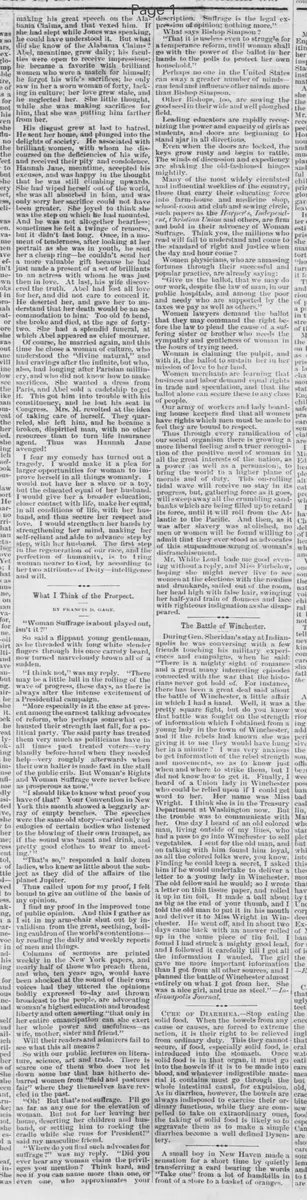
What I Think of the Prospect.
BY FRANCIS D. GAGE.
"Woman Suffrage is about played out, isn't it?"
So said a flippant young gentleman, as he threaded with long white slender fingers through his once carroty beard, now turned marvelously brown all of a sudden.
"I think not," was my reply. "There may be a little lull in the rolling of the wave of progress, these days, as there is always after the intense excitement of a Presidential campaign.
"More especially is it the case at present among the earnest talking advocates of reform, who perhaps somewhat exhausted their strength last fall, for a political party. The said party has treated them very much as politicians have in all times past treated voters—very blandly beforehand when they needed help—very roughly afterwards when their own halter is made fast in the stall of the public crib. But Woman's Rights and Woman Suffrage were never before as prosperous as now."
"I should like to know what proof you have of that? Your Convention in New York this month showed a beggarly array of empty benches. The speeches were the same old story—varied only by eulogies of certain bodies who listened to the blowing of their own trumpet, as if the sound was 'meat and drink, and pretty good clothes to wear to meeting.'"
"That's so," responded a half dozen ladies, who knew as little about the subject as they did of the affairs of the planet Jupiter.
Thus called upon for my proof, I felt bound to give an outline of the basis of my opinion.
I find my proof in the improved tone of public opinion. And this I gather as I sit in my arm-chair shut out by invalidism from the great, seething, boiling cauldron of the world's contentions—by reading the daily and weekly reports of men and things.
Columns of sermons are printed weekly in the New York papers, and nearly half of those who preach them, and who, ten years ago, would have been shocked at the sound of their own voices had they uttered the opinions boldly expressed to-day and thrown broadcast to the people, are advocating woman's highest education and broadest liberty and often asserting "that only in her entire emancipation can she exert her whole power and usefulness—as wife, mother, sister and friend."
Will their readers and admirers fail to see what this all means?
So with our public lectures on literature, science, art and trade. There is scarce one of them who does not let down some bar that has hitherto debarred women from "field and pastures fair" where they themselves have reveled in the past.
"Oh! But that's not suffrage. I'll go as far as any one for the elevation of woman. But not for her leaving her home, deserting her children and husband, or setting him to rocking the cradle while she runs for President!" said my masculine friend.
"Where do you find such advocates for suffrage?" was my reply. "Did you ever hear any woman claim the privileges you mention? Think hard, and see if you can name more than one, or even one, who approximates your description. Suffrage is the legal expression of opinion; nothing more."
What says Bishop Simpson?
"That it is useless even to struggle for a temperance reform, until woman shall go with the power of the ballot in her hands to the polls to protect her own household."
Perhaps no one in the United States can sway a greater number of minds can lead and influence other minds more than Bishop Simpson.
Other Bishops, too, are sowing the good seed in their wide and well ploughed field.
Leading educators are rapidly recognizing the power and capacity of girls as students, and doors are beginning to stand ajar in all directions.
Even when the doors are locked, the keys grow rusty and begin to rattle. The winds of discussion and expediency are shaking the old-fashioned hinges mightily.
Many of the most widely circulated and influential weeklies of the country, those that carry their educating force into farm-house and mechanic shop, school-room and club and sewing circle, such papers as the Harper's, Independent, Christian Union and others, are firm and bold in their advocacy of Woman Suffrage. Think you, the millions who read will fail to understand and come to the standard of right and justice when the day and hour come?
Women physicians, who are amassing fortunes through their successful and popular practice, are already saying: "Give us the ballot, that we may do our work, despite the law of man, in our public hospitals, and among the poor and needy who are supported by the taxes we pay as well as others."
Women lawyers demand the ballot that they may command the right before the law to plead the cause of a suffering sister or brother who needs the sympathy and gentleness of woman in the hours of trying need.
Woman is claiming the pulpit, and with it, the ballot to sustain her in her mission of love to her land.
Women merchants are learning that business and labor demand equal rights in trade and speculation, and that the ballot alone can secure these to any class of people.
Our army of workers and lady boarding house keepers find that all women have rights which men must be made to feel they are bound to respect.
Thus through every ramification of our social organism there is growing a more liberal feeling and a truer recognition of the positive need of woman in all the great interests of the nation, as a power (as well as a persuasion), to bring the world to a higher plane of morals and of duty. This on-rolling tidal wave will receive no stay in its progress, but, gathering force as it goes, will sweep away all the crumbling sand-banks which are being filled up to retard its force, until it will roll from the Atlantic to the Pacific. And then, as it was after slavery was abolished, no men or women will be found willing to admit that they ever stood as advocates of this stupendous wrong of woman's disfranchisement.
Mr. White Loud bade me good evening without a reply, and Miss Furbelow, hoping she might never live to see women at the elections with the rowdies and drunkards, sailed out of the room, her head high with false hair, swinging her half-yard train of flounces and lace with righteous indignation as she disappeared.
BY FRANCIS D. GAGE.
"Woman Suffrage is about played out, isn't it?"
So said a flippant young gentleman, as he threaded with long white slender fingers through his once carroty beard, now turned marvelously brown all of a sudden.
"I think not," was my reply. "There may be a little lull in the rolling of the wave of progress, these days, as there is always after the intense excitement of a Presidential campaign.
"More especially is it the case at present among the earnest talking advocates of reform, who perhaps somewhat exhausted their strength last fall, for a political party. The said party has treated them very much as politicians have in all times past treated voters—very blandly beforehand when they needed help—very roughly afterwards when their own halter is made fast in the stall of the public crib. But Woman's Rights and Woman Suffrage were never before as prosperous as now."
"I should like to know what proof you have of that? Your Convention in New York this month showed a beggarly array of empty benches. The speeches were the same old story—varied only by eulogies of certain bodies who listened to the blowing of their own trumpet, as if the sound was 'meat and drink, and pretty good clothes to wear to meeting.'"
"That's so," responded a half dozen ladies, who knew as little about the subject as they did of the affairs of the planet Jupiter.
Thus called upon for my proof, I felt bound to give an outline of the basis of my opinion.
I find my proof in the improved tone of public opinion. And this I gather as I sit in my arm-chair shut out by invalidism from the great, seething, boiling cauldron of the world's contentions—by reading the daily and weekly reports of men and things.
Columns of sermons are printed weekly in the New York papers, and nearly half of those who preach them, and who, ten years ago, would have been shocked at the sound of their own voices had they uttered the opinions boldly expressed to-day and thrown broadcast to the people, are advocating woman's highest education and broadest liberty and often asserting "that only in her entire emancipation can she exert her whole power and usefulness—as wife, mother, sister and friend."
Will their readers and admirers fail to see what this all means?
So with our public lectures on literature, science, art and trade. There is scarce one of them who does not let down some bar that has hitherto debarred women from "field and pastures fair" where they themselves have reveled in the past.
"Oh! But that's not suffrage. I'll go as far as any one for the elevation of woman. But not for her leaving her home, deserting her children and husband, or setting him to rocking the cradle while she runs for President!" said my masculine friend.
"Where do you find such advocates for suffrage?" was my reply. "Did you ever hear any woman claim the privileges you mention? Think hard, and see if you can name more than one, or even one, who approximates your description. Suffrage is the legal expression of opinion; nothing more."
What says Bishop Simpson?
"That it is useless even to struggle for a temperance reform, until woman shall go with the power of the ballot in her hands to the polls to protect her own household."
Perhaps no one in the United States can sway a greater number of minds can lead and influence other minds more than Bishop Simpson.
Other Bishops, too, are sowing the good seed in their wide and well ploughed field.
Leading educators are rapidly recognizing the power and capacity of girls as students, and doors are beginning to stand ajar in all directions.
Even when the doors are locked, the keys grow rusty and begin to rattle. The winds of discussion and expediency are shaking the old-fashioned hinges mightily.
Many of the most widely circulated and influential weeklies of the country, those that carry their educating force into farm-house and mechanic shop, school-room and club and sewing circle, such papers as the Harper's, Independent, Christian Union and others, are firm and bold in their advocacy of Woman Suffrage. Think you, the millions who read will fail to understand and come to the standard of right and justice when the day and hour come?
Women physicians, who are amassing fortunes through their successful and popular practice, are already saying: "Give us the ballot, that we may do our work, despite the law of man, in our public hospitals, and among the poor and needy who are supported by the taxes we pay as well as others."
Women lawyers demand the ballot that they may command the right before the law to plead the cause of a suffering sister or brother who needs the sympathy and gentleness of woman in the hours of trying need.
Woman is claiming the pulpit, and with it, the ballot to sustain her in her mission of love to her land.
Women merchants are learning that business and labor demand equal rights in trade and speculation, and that the ballot alone can secure these to any class of people.
Our army of workers and lady boarding house keepers find that all women have rights which men must be made to feel they are bound to respect.
Thus through every ramification of our social organism there is growing a more liberal feeling and a truer recognition of the positive need of woman in all the great interests of the nation, as a power (as well as a persuasion), to bring the world to a higher plane of morals and of duty. This on-rolling tidal wave will receive no stay in its progress, but, gathering force as it goes, will sweep away all the crumbling sand-banks which are being filled up to retard its force, until it will roll from the Atlantic to the Pacific. And then, as it was after slavery was abolished, no men or women will be found willing to admit that they ever stood as advocates of this stupendous wrong of woman's disfranchisement.
Mr. White Loud bade me good evening without a reply, and Miss Furbelow, hoping she might never live to see women at the elections with the rowdies and drunkards, sailed out of the room, her head high with false hair, swinging her half-yard train of flounces and lace with righteous indignation as she disappeared.
What sub-type of article is it?
Suffrage
Feminism
What keywords are associated?
Woman Suffrage
Public Opinion
Emancipation
Ballot Rights
Temperance Reform
Women Professionals
Social Progress
What entities or persons were involved?
Francis D. Gage
Bishop Simpson
Harper's
Independent
Christian Union
Women Physicians
Women Lawyers
Women Merchants
Editorial Details
Primary Topic
Progress And Prospects Of Woman Suffrage
Stance / Tone
Optimistic Advocacy For Woman Suffrage
Key Figures
Francis D. Gage
Bishop Simpson
Harper's
Independent
Christian Union
Women Physicians
Women Lawyers
Women Merchants
Key Arguments
Improved Public Opinion Shown In Sermons Advocating Women's Education And Emancipation
Public Lectures Opening Fields To Women
Bishop Simpson Argues Suffrage Needed For Temperance Reform
Educators Recognizing Women's Capacity As Students
Influential Weeklies Like Harper's Advocate Woman Suffrage
Women Professionals Demand Ballot For Rights In Hospitals, Courts, Pulpit, Business
Suffrage As Legal Expression Of Opinion, Not Disrupting Home Roles
Woman Suffrage Wave Will Inevitably Progress Across The Nation