Thank you for visiting SNEWPapers!
Sign up free
Editorial
January 17, 1803
Jenks' Portland Gazette. Maine Advertiser
Portland, Cumberland County, Maine
What is this article about?
This editorial, part II on Maine's separation from Massachusetts, argues for independence by highlighting benefits like improved local governance, better law enforcement, resolution of land title issues, promotion of local industries, increased population through emigration, and countering Southern states' influence in the U.S. by gaining equal statehood.
Clipping
OCR Quality
98%
Excellent
Full Text
Jenks' Portland Gazette
MONDAY, JANUARY 17.
On the Separation of Maine.
NUMBER II.
In the other numbers was considered, first what would be the situation of Maine if erected into an independent state in comparison with other states; secondly, the disadvantageous peculiarities attendant on our present connection with Massachusetts. In this number we shall be principally confined to a consideration of the subject as it respects the advantages to be obtained by a separation.
Were we to become an independent state, a government of our own, among ourselves, would have the most benign influence upon the state of society. It has been an old maxim that the observance of the regulations of government, and the execution of its laws generally bear a near proportion as to the force and effect they are apt to have, to the distance of the governors from the governed. When a government is near its subjects the execution of its laws is always spirited and energetic; and vice versa. Servants of the public, situated at a distance from the powers to whom they are accountable, are too apt to consider themselves at an equal distance from accountability. They are always remiss and neglectful of their duty. As there is but little probability of their ever being called to an account, or of their conduct, whether good or bad, ever reaching the eye of their superintendent, they consider an ignorance of their duty as of no consequence; and are still less concerned about its execution. These observations are not seemingly verified, in any other quarter, more forcibly than, at present, in some parts of Maine. Or else whence has arisen those various riotous and tumultuous outrages in different parts of the country? What but a laxity in a criminal degree in the execution of the laws, has induced and encouraged large bodies of men to combine; and in express contempt of authority and violation of law to league together to defend themselves against the lawful proprietors of large tracts of land, upon which they had lawlessly, and without the consent, approbation or even knowledge of the proprietors, seated themselves.
This looseness in the execution of the laws is of an extensively evil tendency. Punishment should tread fast, and with promptitude, upon the heels of offenders. By inadvertency in the execution of laws, a relaxation, not only of laws is introduced, but also of morals. Every good principle becomes corrupted and depraved. Patriotism dies; and with it every other prop of society.
But on the other hand; when the eye of the government is directly over its servants; when the different departments are a watch upon one another: and at the same time a support and encouragement to one another; laws are executed, and become efficient. The magistrates and officers of every rank are anxiously concerned to understand, and faithfully to execute the duties annexed to their respective offices. We should then stand a chance to have a government of laws; and not a mere mobocracy. The strong arm of the law would then become visible to every one; and, instead of being like a mere legendary tale, would be a terror to evil doers, and an encouragement to such as do well. The state of such a community would be inviting and agreeable to every one. Men would stand some chance of being protected in the enjoyment of their persons and estates.
But there are other considerations yet remaining which must have some weight in the determination of the great question. It has been before observed that the situation of many of the titles to land are in an intricate state of embarrassment; insomuch that legislative aid is rendered absolutely necessary to their extrication. The peculiar situation of our present legislature, and our representation therein, are such that it will be in vain to look to it for much assistance in this particular. Had we a legislature appropriately our own, the advantages resulting from it would be incalculably great in comparison with the opportunity and privileges we now have in the one in which we have some little concern. Every state, and every community has its peculiar local concerns, daily coming before, and interesting its legislative body. The legislature of this State, consisting of ten of Massachusetts to one of Maine, can very seldom be induced to attend to such remote, uninteresting concerns as locally and exclusively relate to the inhabitants of Maine. If any thing of this kind happens to be brought forward in that body, it is either postponed, or raced through without deliberation or concern. By such means a bad matter is often made worse; and instead of rectifying a former error a new host are introduced.
A legislature composed of the inhabitants of Maine, and none other, would feel interested in the particular affairs of Maine. Men will attend faithfully and punctually to their own concerns: but not to the concerns of other people. It must be a legislature of Maine only that will patiently attend to the concerns of Maine. They would feel interested that business should not be inconsiderately raced over, or postponed to another session, under a hope, thereby, finally to get rid of it. Local statutes would then be made applicable to the peculiarities of the situation of Maine. Commerce, manufactures, fishery and industry would be encouraged. Banks, turnpike and other incorporations would be suitably managed and promoted: and lotteries for charitable and benevolent purposes might be authorized in certain instances. Literature and literary institutions would then find a patron in the legislature of Maine. Our law makers would then consist only of our own neighbors, acquainted with our concerns, our views and situations. We should not then be governed by the extravagant maxims of an old and wealthy state. Our representatives would not have to attend on a greater body from day to day, and from session to session, like some speculating land jobber, without being able finally to bring about any favorite measures for his more immediate constituents: and to no other purpose unless excepting to be a witness of the transactions of a powerful body, bent wholly upon the aggrandizement of their part of the state.
It may be time now to come to consideration of the probable effect which a separation would have upon the population. I take it for granted that every well wisher to the prosperity of Maine will consider the promotion of its population as an object of no inconsiderable moment. There is, in Maine, a large extent of uncultivated territory. The wealth of Maine will increase in proportion as that shall be subdued and brought into a state of cultivation: of course an increase of population will be an increase of wealth.
Whenever we become an independent state we shall find the spirit of emigration into this country to be considerably increased. The face of things here, in the eyes of strangers, will wear an entirely different aspect. Hitherto the inhabitants of Maine have been considered as a set of adventurers into a wilderness. They have been considered as a mere lawless banditti. If a Separation should take place we should be considered as an independent people, making our own laws, regulating our own police, managing our own concerns, and as having punctuality and certainty in the execution of our laws. We should not be considered a mere colony of Massachusetts, in which every thing is too apt to be left to its own direction and regulation, without the aid and attention of laws and legal punishment: and in which there is a never failing sluggishness in the progress of every thing of a moral, literary or civil tendency. Under a Separation the incitements to emigration into Maine would be every way more powerful than they now are. Men of the first ability and of the first estates would be tempted to seat themselves among us. We should not be wholly inundated with the mere banditti of other states. Men worthy to be intrusted with office would be more apt to take positions among the ruder settled parts of the country, who would probably regulate affairs among them, and help to introduce some of the more humane and civil virtues.
Under our present colonial state, men of ability and estate but seldom think of settling among us. Such men can live where they please. A preference would never induce them to settle in a country under a foreign government, totally out of the way of every opportunity for preferment and office. All who now adventure into the country do it through necessity. If they happen to be men of abilities they are always young men, who have never had an opportunity to prove themselves such elsewhere. Almost all the large estates in this country have been acquired here; and not elsewhere.
There is also a great national consideration which ought to have its weight in this case. We all know and see that, at least, one of the Southern states is using every mean in her power to cramp the New-England states; and to gain an ascendency over them. This is fully displayed in every important question agitates at the seat of government of the United States. It is a great point with that state to seek out opportunities for making and constituting new states in every instance where there is the least probability that, when formed, they will become subservient to her interest and views. By these means she has already, acquired an important influence in the Senate of the United States.
Now there, as we profess to be patriots, and friends to the New England states, of which we are a part, it certainly becomes us to endeavor to the utmost of our ability to maintain our respectability as well in our national government as elsewhere.
Let us now come forward, and assume the reins of government for ourselves; and a rank equal to the rest of the states in the Union. Instead of any longer remaining the porch or out house to the great Mansion house, become of ourselves a complete mansion house. Let us no longer remain dependent on a superior. That man is surely possessed of a mean and base spirit who wishes forever to remain a dependent lacquey.
MONDAY, JANUARY 17.
On the Separation of Maine.
NUMBER II.
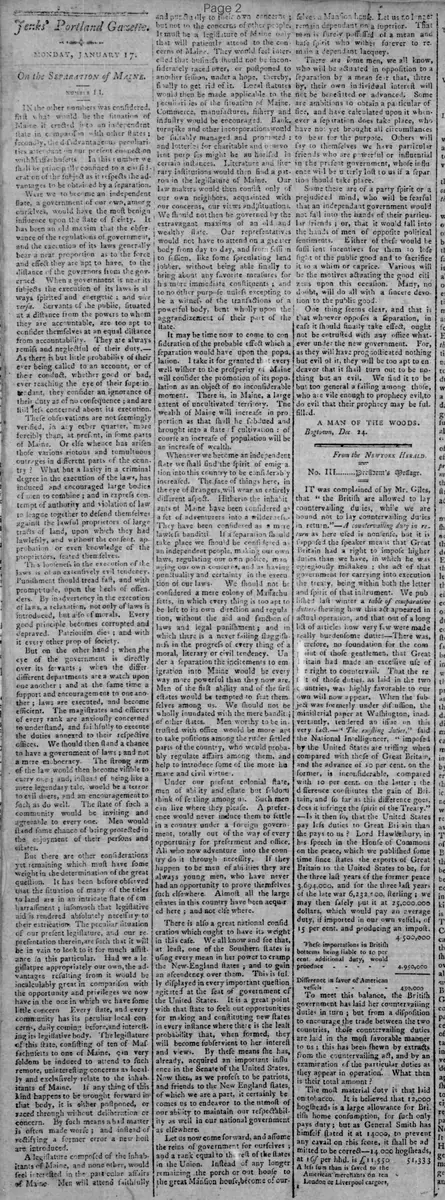
In the other numbers was considered, first what would be the situation of Maine if erected into an independent state in comparison with other states; secondly, the disadvantageous peculiarities attendant on our present connection with Massachusetts. In this number we shall be principally confined to a consideration of the subject as it respects the advantages to be obtained by a separation.
Were we to become an independent state, a government of our own, among ourselves, would have the most benign influence upon the state of society. It has been an old maxim that the observance of the regulations of government, and the execution of its laws generally bear a near proportion as to the force and effect they are apt to have, to the distance of the governors from the governed. When a government is near its subjects the execution of its laws is always spirited and energetic; and vice versa. Servants of the public, situated at a distance from the powers to whom they are accountable, are too apt to consider themselves at an equal distance from accountability. They are always remiss and neglectful of their duty. As there is but little probability of their ever being called to an account, or of their conduct, whether good or bad, ever reaching the eye of their superintendent, they consider an ignorance of their duty as of no consequence; and are still less concerned about its execution. These observations are not seemingly verified, in any other quarter, more forcibly than, at present, in some parts of Maine. Or else whence has arisen those various riotous and tumultuous outrages in different parts of the country? What but a laxity in a criminal degree in the execution of the laws, has induced and encouraged large bodies of men to combine; and in express contempt of authority and violation of law to league together to defend themselves against the lawful proprietors of large tracts of land, upon which they had lawlessly, and without the consent, approbation or even knowledge of the proprietors, seated themselves.
This looseness in the execution of the laws is of an extensively evil tendency. Punishment should tread fast, and with promptitude, upon the heels of offenders. By inadvertency in the execution of laws, a relaxation, not only of laws is introduced, but also of morals. Every good principle becomes corrupted and depraved. Patriotism dies; and with it every other prop of society.
But on the other hand; when the eye of the government is directly over its servants; when the different departments are a watch upon one another: and at the same time a support and encouragement to one another; laws are executed, and become efficient. The magistrates and officers of every rank are anxiously concerned to understand, and faithfully to execute the duties annexed to their respective offices. We should then stand a chance to have a government of laws; and not a mere mobocracy. The strong arm of the law would then become visible to every one; and, instead of being like a mere legendary tale, would be a terror to evil doers, and an encouragement to such as do well. The state of such a community would be inviting and agreeable to every one. Men would stand some chance of being protected in the enjoyment of their persons and estates.
But there are other considerations yet remaining which must have some weight in the determination of the great question. It has been before observed that the situation of many of the titles to land are in an intricate state of embarrassment; insomuch that legislative aid is rendered absolutely necessary to their extrication. The peculiar situation of our present legislature, and our representation therein, are such that it will be in vain to look to it for much assistance in this particular. Had we a legislature appropriately our own, the advantages resulting from it would be incalculably great in comparison with the opportunity and privileges we now have in the one in which we have some little concern. Every state, and every community has its peculiar local concerns, daily coming before, and interesting its legislative body. The legislature of this State, consisting of ten of Massachusetts to one of Maine, can very seldom be induced to attend to such remote, uninteresting concerns as locally and exclusively relate to the inhabitants of Maine. If any thing of this kind happens to be brought forward in that body, it is either postponed, or raced through without deliberation or concern. By such means a bad matter is often made worse; and instead of rectifying a former error a new host are introduced.
A legislature composed of the inhabitants of Maine, and none other, would feel interested in the particular affairs of Maine. Men will attend faithfully and punctually to their own concerns: but not to the concerns of other people. It must be a legislature of Maine only that will patiently attend to the concerns of Maine. They would feel interested that business should not be inconsiderately raced over, or postponed to another session, under a hope, thereby, finally to get rid of it. Local statutes would then be made applicable to the peculiarities of the situation of Maine. Commerce, manufactures, fishery and industry would be encouraged. Banks, turnpike and other incorporations would be suitably managed and promoted: and lotteries for charitable and benevolent purposes might be authorized in certain instances. Literature and literary institutions would then find a patron in the legislature of Maine. Our law makers would then consist only of our own neighbors, acquainted with our concerns, our views and situations. We should not then be governed by the extravagant maxims of an old and wealthy state. Our representatives would not have to attend on a greater body from day to day, and from session to session, like some speculating land jobber, without being able finally to bring about any favorite measures for his more immediate constituents: and to no other purpose unless excepting to be a witness of the transactions of a powerful body, bent wholly upon the aggrandizement of their part of the state.
It may be time now to come to consideration of the probable effect which a separation would have upon the population. I take it for granted that every well wisher to the prosperity of Maine will consider the promotion of its population as an object of no inconsiderable moment. There is, in Maine, a large extent of uncultivated territory. The wealth of Maine will increase in proportion as that shall be subdued and brought into a state of cultivation: of course an increase of population will be an increase of wealth.
Whenever we become an independent state we shall find the spirit of emigration into this country to be considerably increased. The face of things here, in the eyes of strangers, will wear an entirely different aspect. Hitherto the inhabitants of Maine have been considered as a set of adventurers into a wilderness. They have been considered as a mere lawless banditti. If a Separation should take place we should be considered as an independent people, making our own laws, regulating our own police, managing our own concerns, and as having punctuality and certainty in the execution of our laws. We should not be considered a mere colony of Massachusetts, in which every thing is too apt to be left to its own direction and regulation, without the aid and attention of laws and legal punishment: and in which there is a never failing sluggishness in the progress of every thing of a moral, literary or civil tendency. Under a Separation the incitements to emigration into Maine would be every way more powerful than they now are. Men of the first ability and of the first estates would be tempted to seat themselves among us. We should not be wholly inundated with the mere banditti of other states. Men worthy to be intrusted with office would be more apt to take positions among the ruder settled parts of the country, who would probably regulate affairs among them, and help to introduce some of the more humane and civil virtues.
Under our present colonial state, men of ability and estate but seldom think of settling among us. Such men can live where they please. A preference would never induce them to settle in a country under a foreign government, totally out of the way of every opportunity for preferment and office. All who now adventure into the country do it through necessity. If they happen to be men of abilities they are always young men, who have never had an opportunity to prove themselves such elsewhere. Almost all the large estates in this country have been acquired here; and not elsewhere.
There is also a great national consideration which ought to have its weight in this case. We all know and see that, at least, one of the Southern states is using every mean in her power to cramp the New-England states; and to gain an ascendency over them. This is fully displayed in every important question agitates at the seat of government of the United States. It is a great point with that state to seek out opportunities for making and constituting new states in every instance where there is the least probability that, when formed, they will become subservient to her interest and views. By these means she has already, acquired an important influence in the Senate of the United States.
Now there, as we profess to be patriots, and friends to the New England states, of which we are a part, it certainly becomes us to endeavor to the utmost of our ability to maintain our respectability as well in our national government as elsewhere.
Let us now come forward, and assume the reins of government for ourselves; and a rank equal to the rest of the states in the Union. Instead of any longer remaining the porch or out house to the great Mansion house, become of ourselves a complete mansion house. Let us no longer remain dependent on a superior. That man is surely possessed of a mean and base spirit who wishes forever to remain a dependent lacquey.
What sub-type of article is it?
Constitutional
Legal Reform
Partisan Politics
What keywords are associated?
Maine Separation
Independent State
Law Execution
Local Legislature
Land Titles
Population Growth
Emigration
Southern Influence
What entities or persons were involved?
Massachusetts
Maine
Southern States
New England States
United States Senate
Editorial Details
Primary Topic
Advantages Of Maine's Separation From Massachusetts
Stance / Tone
Strongly Pro Separation
Key Figures
Massachusetts
Maine
Southern States
New England States
United States Senate
Key Arguments
Local Government Ensures Spirited And Energetic Law Execution Due To Proximity.
Distance From Governors Leads To Remiss Officials And Lax Law Enforcement, Causing Riots And Moral Decay.
A Maine Legislature Would Better Address Local Land Title Embarrassments And Concerns Ignored By Massachusetts Body.
Local Laws Would Promote Commerce, Manufactures, Fisheries, Banks, And Literature Specific To Maine.
Separation Would Improve Maine's Image, Attracting Emigrants Of Ability And Estate, Increasing Population And Wealth.
Currently, Only Adventurers Or The Needy Settle In Maine Due To Its Colonial Status.
Becoming A State Counters Southern States' Efforts To Dominate The U.S. Senate By Adding A New England Aligned State.
Maine Should Assume Equal Rank In The Union Rather Than Remain Dependent On Massachusetts.