Thank you for visiting SNEWPapers!
Sign up free
Gazette Of The United States
Philadelphia, Philadelphia County, Pennsylvania
What is this article about?
In the British House of Commons on April 5, a debate on imposing a tax on dogs to relieve poor rates amid food scarcity. Mr. Dent proposed 2s. 6d. per dog, citing consumption of provisions and hydrophobia risks. Mr. Pitt suggested up to 3s., with exemptions for the poor, partly for state revenue. Motion passed without division.
Merged-components note: Sequential reading order and text continuation indicate this is a single foreign news report on the British House of Commons debate on a tax on dogs that was split during parsing.
Clipping
OCR Quality
Full Text
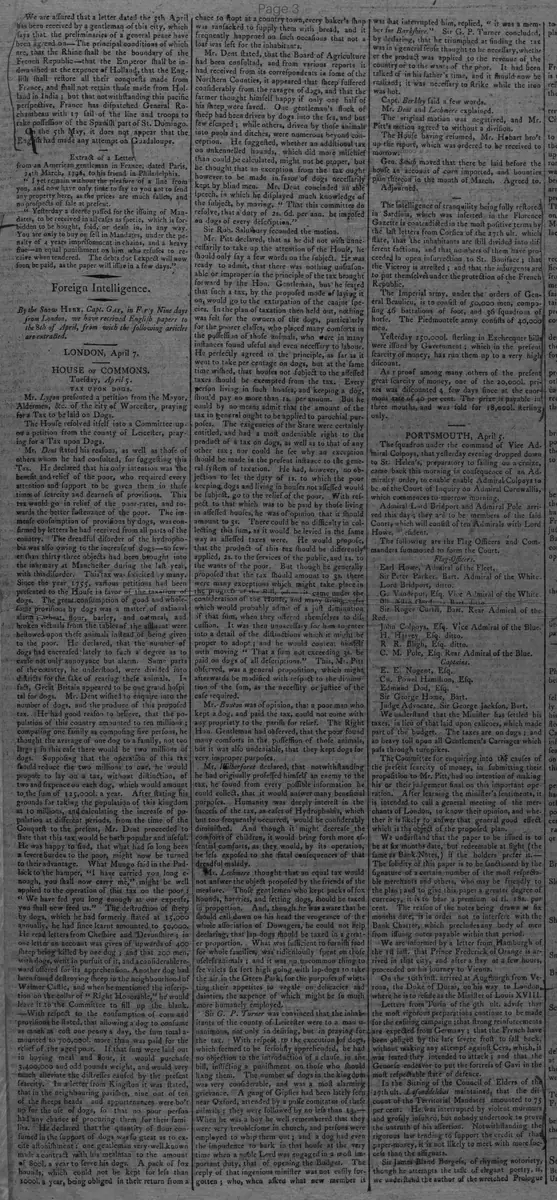
By the Snow Hebe, Capt. Gay, in Forty Nine days from London, we have received English papers to the 5th of April, from which the following articles are extracted.
LONDON, April 7.
HOUSE OF COMMONS.
Tuesday, April 5.
TAX UPON DOGS.
Mr. Lygon presented a petition from the Mayor, Aldermen, &c. of the city of Worcester, praying for a Tax to be laid on Dogs.
The House resolved itself into a Committee upon a petition from the county of Leicester, praying for a Tax upon Dogs.
Mr. Dent stated his reasons, as well as those of others whom he had consulted, for suggesting this Tax. He declared that his only intention was the benefit and relief of the poor, who required every attention and support to be given them in these times of scarcity and dearness of provisions. This tax would go in relief of the poor-rates, and towards the better maintenance of the poor. The immense consumption of provisions by dogs, was confirmed by letters he had received from all parts of the country. The dreadful disorder of the hydrophobia was also owing to the increase of dogs—no fewer than thirty-three objects had been brought into the infirmary at Manchester during the last year, with this disorder. This tax was solicited by many. Since the year 1755, various petitions had been presented to the House in favor of the taxation of dogs. The great consumption of good and wholesome provisions by dogs was a matter of national alarm; wheat, flour, barley, and oatmeal, and broken victuals from the tables of the affluent were bestowed upon these animals instead of being given to the poor. He declared, that the number of dogs had increased lately to such a degree as to cause not only annoyance but alarm: Some parts of the country, he understood, were divided into districts for the sake of rearing these animals. In fact, Great Britain appeared to be one grand hospital for dogs. Mr. Dent wished to enquire into the number of dogs, and the produce of this proposed tax. He had good reason to believe, that the population of this country amounted to ten millions; computing one family as composing five persons, he thought the average of one dog to a family, not too large; in this case there would be two millions of dogs. Supposing that the operation of this tax should reduce the two millions to one, he would propose to lay on a tax, without distinction, of two and sixpence on each dog, which would amount to the sum of 125,000l. a year. After stating his grounds for taking the population of this kingdom at 10 millions, and calculating the increase of population at different periods, from the time of the Conquest to the present, Mr. Dent proceeded to state that this tax would be both popular and useful. He was happy to find, that what had so long been a severe burden to the poor, might now be turned to their advantage. What Mungo said in the Padlock to the hamper, "I have carried you long enough, you shall now carry me," might be well applied to the operation of this tax on the poor "We have fed you long enough at our expense, you shall now feed us." The destruction of sheep by dogs, which he had formerly stated at 15,000 annually, he had since learnt amounted to 50,000. He read letters from Cheshire and Devonshire; in one letter an account was given of upwards of 400 sheep being killed by one dog; and that 200 men, with dogs, went in pursuit of it, and a considerable reward offered for its apprehension. Another dog had been found destroying sheep in the neighbourhood of Walmer Castle, and when he mentioned the inscription on the collar of "Right Honorable," he would leave it to the Committee to fill up the blank. With respect to the consumption of corn and provisions he stated, that allowing a dog to consume as much as cost one penny a day, the sum total amounted to 700,000l. more than was paid for the relief of the aged poor. If that sum were laid out in buying meal and flour, it would purchase 3,400,000 and odd pounds weight, and would very much alleviate the distresses caused by the present scarcity. In a letter from Kingston it was stated, that in the neighbouring parishes, nine out of ten of the sheep's heads and appurtenances were bought up for the use of dogs, so that no poor person had any chance of procuring them for their families. He declared that the quantity of flour consumed in the support of dogs was so great as to excite astonishment: one gentleman very well known made a contract with his mealman to the amount of 500l. a year to serve his dogs. A pack of fox hounds; which could not be kept for less than 1000l. a year, being obliged in their return from a
chace to stop at a country town, every baker's shop was ransacked to supply them with bread, and it frequently happened on such occasions that not a loaf was left for the inhabitants.
Mr. Dent stated, that the Board of Agriculture had been consulted, and from various reports it had received from its correspondents in some of the Northern Counties, it appeared that sheep suffered considerably from the ravages of dogs, and that the farmer thought himself happy if only one half of his sheep were saved. One gentleman's flock of sheep had been driven by dogs into the sea, and but few escaped: while others, driven by those animals into pools and ditches, were numerous beyond conception. He suggested, whether an additional tax on unkennelled hounds, which did more mischief than could be calculated, might not be proper, but he thought that an exception from the tax ought however to be made in favor of dogs necessarily kept by blind men. Mr. Dent concluded an able speech, in which he displayed much knowledge of the subject, by moving, "That this committee do resolve, that a duty of 2s. 6d. per ann. be imposed on dogs of every description."
Sir Rob. Salusbury seconded the motion.
Mr. Pitt declared, that as he did not wish unnecessarily to take up the attention of the House, he should only say a few words on the subject. He was ready to admit, that there was nothing unreasonable or improper in the principle of the tax brought forward by the Hon. Gentleman, but he feared that such a tax, by the proposed mode of laying it on, would go to the extirpation of the canine species. In the plan of taxation then held out, nothing was felt for the owners of the dogs, particularly for the poorer classes, who placed many comforts in the possession of those animals, who were in many instances found useful and even necessary to labour. He perfectly agreed in the principle, as far as it went to take percentage on dogs, but at the same time wished, that houses not subject to the assessed taxes should be exempted from the tax. Every person living in such houses, and keeping a dog, should pay no more than 1s. per annum. But he could by no means admit that the amount of the tax in general ought to be applied to parochial purposes. The exigencies of the State were certainly entitled, and had a most undeniable right to the product of a tax on dogs, as well as to that of any other tax; nor could he see why an exception should be made in the present instance to the general system of taxation. He had, however, no objection to let the duty of 1s. to which the poor keeping dogs and living in houses not assessed would be subject, go to the relief of the poor. With respect to that which was to be paid by those living in assessed houses, he was of opinion that it should amount to 3s. There could be no difficulty in collecting this sum, as it would be levied in the same way as assessed taxes were. He would propose, that the product of this tax should be differently applied, 2s. to the services of the public, and 1s. to the wants of the poor. But though he generally proposed that the tax should amount to 3s. there were many exceptions which might take place in the progress of the Bill, when it came under the consideration of the House, and many strong reasons for which would probably admit of a just diminution of that sum, when they offered themselves to discussion. It was then unnecessary for him to enter into a detail of the distinctions which it might be proper to adopt; and he would content himself with moving "That a sum not exceeding 3s. be paid on dogs of all descriptions." This, Mr. Pitt observed, was a general proposition, which might afterwards be modified with respect to the diminution of the sum, as the necessity or justice of the case required.
Mr. Buxton was of opinion, that a poor man who kept a dog, and paid the tax, could not come with any propriety to the parish for relief. The Right Hon. Gentleman had observed, that the poor found many comforts in the possession of those animals, but it was also undeniable, that they kept dogs for very improper purposes.
Mr. Wilberforce declared, that notwithstanding he had originally professed himself an enemy to the tax, he found from every possible information he could collect, that it would answer many beneficial purposes. Humanity was deeply interested in the success of the tax, as cases of Hydrophobia, which but too frequently occurred, would be considerably diminished. And though it might decrease the comforts of children, it would bring forth more essential comforts, as they would, by its operation, be less exposed to the fatal consequences of that dreadful malady.
Mr. Lechmere thought that an equal tax would not answer the object proposed by the friends of the measure. Those gentlemen who kept packs of fox hounds, harriers, and setting dogs, should be taxed in proportion. And, though he was aware that he should call down on his head the vengeance of the whole association of Dowagers, he could not help declaring, that lap-dogs should be taxed in a greater proportion. What was sufficient to furnish food for whole families, was ridiculously spent on those useless animals; and it was no uncommon thing to see valets six feet high going with lap-dogs to take the air in the Green Park, for the purpose of whetting their appetites to regale on delicacies and dainties, the expense of which might be so much more humanely employed.
Sir G. P. Turner was convinced that the inhabitants of the county of Leicester were to a man unanimous, not only in desiring, but in praying for the tax. With respect to the execution of dogs, which seemed to be seriously apprehended, he had no objection to the introduction of a clause in the bill, inflicting a punishment on those who should hang them. The number of dogs in the kingdom was very considerable, and was a most alarming grievance. A gang of Gipsies had been lately seen near Oxford, attended by a posse comitatus of these animals; they were followed by no less than 13. When he was a boy he well remembered that they were very troublesome in church, and persons were employed to whip them out; and a dog had even the impudence to bark in that house at the very time when a noble Lord was engaged in a most important duty, that of opening the Budget. The reply of that ingenious minister was not easily forgotten; who, when asked what new member it
was that interrupted him, replied, "it was a member for Berkshire." Sir G. P. Turner concluded, by declaring, that he triumphed at finding the tax was in general thought to be necessary, whether the product was applied to the revenue of the country or to the wants of the poor. It had been talked of in his father's time, and it should now be realized; it was necessary to strike while the iron was hot.
Capt. Berkley said a few words.
Mr. Dent and Lechmere explained.
The original motion was negatived, and Mr. Pitt's motion agreed to without a division.
The House having resumed, Mr. Hobart brought up the report, which was ordered to be received to morrow.
Gen. Smith moved that there be laid before the house an account of corn imported, and bounties paid thereon in the month of March. Agreed to.
Adjourned.
What sub-type of article is it?
What keywords are associated?
What entities or persons were involved?
Where did it happen?
Foreign News Details
Primary Location
London
Event Date
April 5
Key Persons
Outcome
original motion for 2s. 6d. tax negatived; mr. pitt's motion for sum not exceeding 3s. agreed to without division.
Event Details
Debate in House of Commons on petition for tax on dogs to relieve poor amid scarcity. Mr. Dent argued for 2s. 6d. per dog due to provisions consumption, sheep destruction, and hydrophobia. Mr. Pitt proposed up to 3s. with exemptions for poor in unassessed houses at 1s., partly for state. Others supported with concerns over packs, lap-dogs, and benefits.