Thank you for visiting SNEWPapers!
Sign up free
Editorial
March 10, 1775
The Virginia Gazette
Williamsburg, Virginia
What is this article about?
Satirical editorial disguised as ship news describes the vessel St. Stephen under Capt. North, employing a crew of 'white slaves' bound body and soul in the Guinea trade, with free sailors as proud ballast. The ship plans a dangerous voyage to America, facing hazards in Boston and New York.
Clipping
OCR Quality
98%
Excellent
Full Text
SHIP NEWS extraordinary.
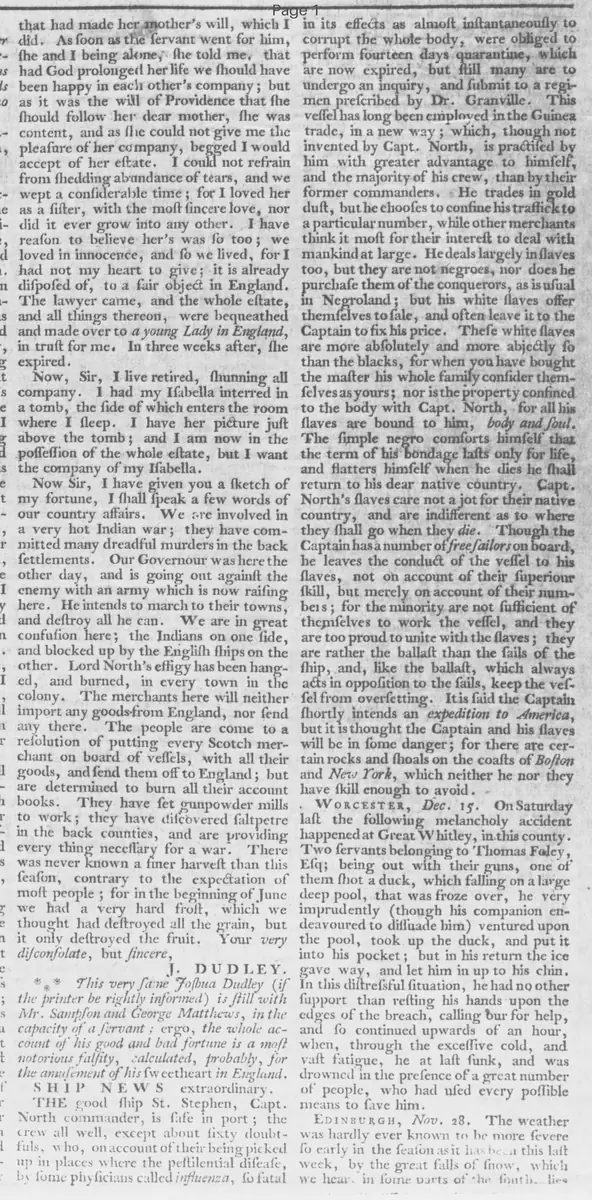
THE good ship St. Stephen, Capt. North commander, is safe in port; the crew all well, except about sixty doubtfuls, who, on account of their being picked up in places where the pestilential disease, by some physicians called influenza, so fatal in its effects as almost instantaneously to corrupt the whole body, were obliged to perform fourteen days quarantine, which are now expired, but still many are to undergo an inquiry, and submit to a regimen prescribed by Dr. Granville. This vessel has long been employed in the Guinea trade, in a new way; which, though not invented by Capt. North, is practised by him with greater advantage to himself, and the majority of his crew, than by their former commanders. He trades in gold dust, but he chooses to confine his traffick to a particular number, while other merchants think it most for their interest to deal with mankind at large. He deals largely in slaves too, but they are not negroes, nor does he purchase them of the conquerors, as is usual in Negroland; but his white slaves offer themselves to sale, and often leave it to the Captain to fix his price. These white slaves are more absolutely and more abjectly so than the blacks, for when you have bought the master his whole family consider themselves as yours; nor is the property confined to the body with Capt. North, for all his slaves are bound to him, body and soul. The simple negro comforts himself that the term of his bondage lasts only for life, and flatters himself when he dies he shall return to his dear native country. Capt. North's slaves care not a jot for their native country, and are indifferent as to where they shall go when they die. Though the Captain has a number of free sailors on board, he leaves the conduct of the vessel to his slaves, not on account of their superior skill, but merely on account of their number; for the minority are not sufficient of themselves to work the vessel, and they are too proud to unite with the slaves; they are rather the ballast than the sails of the ship, and, like the ballast, which always acts in opposition to the sails, keep the vessel from oversetting. It is said the Captain shortly intends an expedition to America, but it is thought the Captain and his slaves will be in some danger; for there are certain rocks and shoals on the coasts of Boston and New York, which neither he nor they have skill enough to avoid.
THE good ship St. Stephen, Capt. North commander, is safe in port; the crew all well, except about sixty doubtfuls, who, on account of their being picked up in places where the pestilential disease, by some physicians called influenza, so fatal in its effects as almost instantaneously to corrupt the whole body, were obliged to perform fourteen days quarantine, which are now expired, but still many are to undergo an inquiry, and submit to a regimen prescribed by Dr. Granville. This vessel has long been employed in the Guinea trade, in a new way; which, though not invented by Capt. North, is practised by him with greater advantage to himself, and the majority of his crew, than by their former commanders. He trades in gold dust, but he chooses to confine his traffick to a particular number, while other merchants think it most for their interest to deal with mankind at large. He deals largely in slaves too, but they are not negroes, nor does he purchase them of the conquerors, as is usual in Negroland; but his white slaves offer themselves to sale, and often leave it to the Captain to fix his price. These white slaves are more absolutely and more abjectly so than the blacks, for when you have bought the master his whole family consider themselves as yours; nor is the property confined to the body with Capt. North, for all his slaves are bound to him, body and soul. The simple negro comforts himself that the term of his bondage lasts only for life, and flatters himself when he dies he shall return to his dear native country. Capt. North's slaves care not a jot for their native country, and are indifferent as to where they shall go when they die. Though the Captain has a number of free sailors on board, he leaves the conduct of the vessel to his slaves, not on account of their superior skill, but merely on account of their number; for the minority are not sufficient of themselves to work the vessel, and they are too proud to unite with the slaves; they are rather the ballast than the sails of the ship, and, like the ballast, which always acts in opposition to the sails, keep the vessel from oversetting. It is said the Captain shortly intends an expedition to America, but it is thought the Captain and his slaves will be in some danger; for there are certain rocks and shoals on the coasts of Boston and New York, which neither he nor they have skill enough to avoid.
What sub-type of article is it?
Satire
Partisan Politics
Slavery Abolition
What keywords are associated?
Ship Satire
White Slaves
Capt North
Guinea Trade
American Expedition
Political Bondage
What entities or persons were involved?
Capt. North
Dr. Granville
St. Stephen
Boston
New York
Editorial Details
Primary Topic
Satirical Critique Of Political Servitude Under Capt. North
Stance / Tone
Satirical Mockery Of Abject Political Loyalty
Key Figures
Capt. North
Dr. Granville
St. Stephen
Boston
New York
Key Arguments
Capt. North Trades In White Slaves Who Sell Themselves Body And Soul
These Slaves Are More Abject Than Black Slaves, Binding Families
Free Sailors Act As Proud Ballast Opposing The Slaves
Vessel Plans Risky Expedition To America Amid Coastal Dangers