Thank you for visiting SNEWPapers!
Sign up free
Atlanta Daily World
Atlanta, Fulton County, Georgia
What is this article about?
Clark Foreman, white adviser on Negro economic status under Secretary Ickes, proposes self-sufficient Negro communities funded by PWA and Negro resources, inspired by W.E.B. DuBois' self-help ideas, to achieve economic emancipation amid New Deal discrimination.
Merged-components note: Continuation of the Adviser for Negro story from page 1 to page 4.
Clippings
1 of 2
OCR Quality
Full Text
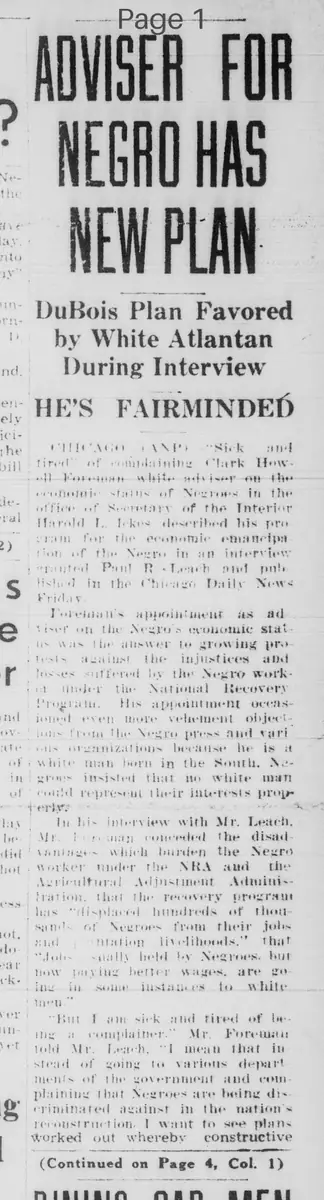
DuBois Plan Favored by White Atlantan During Interview
HE'S FAIRMINDED
Clark Foreman, adviser on the economic status of Negroes in the office of Secretary of the Interior Harold L. Ickes, described his program for the economic emancipation of the Negro in an interview quoted by Paul R. Leach and published in the Chicago Daily News Friday.
Ickes' appointment of Foreman as adviser on the Negro's economic status was an answer to growing protests against the injustices and losses suffered by the Negro worker under the National Recovery Program. His appointment occasioned even more vehement objections from the Negro press and various organizations because he is a white man born in the South. Negroes insisted that no white man could represent their interests properly.
In his interview with Mr. Leach, Foreman conceded the disadvantages which burden the Negro worker under the NRA and the Agricultural Adjustment Administration, that the recovery program has displaced hundreds of thousands of Negroes from their jobs and national livelihoods, that jobs totally held by Negroes, but wholly owning better wages, are going in some instances to whites.
But I am sick and tired of being the complainer," Mr. Foreman told Mr. Leach. "I mean that instead of going to various departments of the government and complaining that Negroes are being discriminated against in the nation's reconstruction, I want to see plans worked out whereby constructive
(Continued on Page 4, Col. 1)
Advisor for
(Continued from Page 1)
work can be done for them."
Before going to Washington, Mr. Foreman was associated with the Rosenwald Fund. Last spring the leaders of that Fund held an economic conference in Washington which was addressed by Negro and white leaders. At that time the speech made by Dr. W. E. B. DuBois, editor of The Crisis, was regarded as one of the most radical on the agenda. He proposed that the Negro should help himself, pool his resources, and lift himself by his own bootstraps economically and otherwise without depending on the goodwill of alien people.
His speech seemed to be a slap in the face to those who had been kind to the Negro.
In his interview with Mr. Leach, Mr. Foreman indicated that he had studied the DuBois speech thoroughly and that, instead of finding it radical, he discovered it to be practicable. He discussed his plans with Mr. Leach.
"Those plans, as is Mr. Foreman's idea, of the Negro's capabilities, are unusual in a white man," writes Mr. Leach, and then quoted Mr. Foreman to say:
W. E. B. DuBois, the famous Negro leader, says that the only way the Negro can develop is through group effort. He is quite right. I propose that the public works administration let him build his own self-sufficient communities.
"Our American Negro cities, built from the ground up?" Mr. Leach asked.
"Yes. Start with the subsistence homestead plan, so that they can have little plots of ground to sustain themselves, with a beginning on housing. With that as a municipal start - financed by their own people-there are many wealthy Negroes, you know-and by the public works administration, they would construct their own public utilities. With power and fuel and water developed by their own activities, they could next turn to industry."
"Would not that be placing the Negro industry in severe competition with white-controlled industry?"
"Not if it were properly planned, with careful discovery of what is needed, what materials are at hand! The Negro is the first to be laid off when depression comes, the last to get his job back when hard times end. The greatest problem that Negroes have is finding employment for the leaders they have developed."
"You have no doubt about the ability of Negroes to do this for themselves?" Mr. Leach asked.
"Not at all. There is no reason to say that a Negro cannot do anything. I do not recognize a limitation upon him and his ability. Reared with an inferiority complex because of the great handicap under which he has always labored in a mixed community, he makes his own limitations.
"This plan would provide segregation of colored folk in their own communities, would it not?" Leach pursued.
"I do not advocate segregation but Negro-built, Negro controlled, so their communities should be that the colored people would have freedom for exercise of their own abilities, an outlet for the leadership which has been developed."
Mr. Foreman believes that such communities would place the Negroes on the road to economic emancipation.
What sub-type of article is it?
What themes does it cover?
What keywords are associated?
What entities or persons were involved?
Where did it happen?
Story Details
Key Persons
Location
Washington
Story Details
Clark Foreman proposes building self-sufficient Negro communities through group effort and public works funding, inspired by DuBois' self-help philosophy, to overcome economic discrimination under New Deal programs and achieve emancipation.