Thank you for visiting SNEWPapers!
Sign up free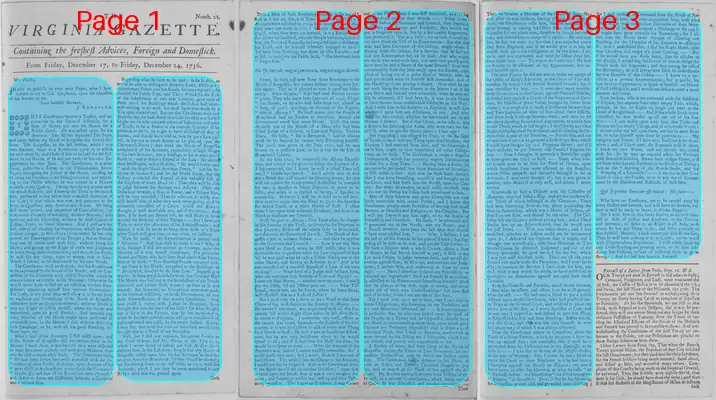
The Virginia Gazette
Richmond, Williamsburg, Richmond County, Virginia
What is this article about?
John Randolph writes to the printer to publish his detailed rebuttal to Col. Spotswood's response, defending the House of Burgesses' resolution to sue Spotswood for mismanaging public funds allocated for buildings in Brunswick County, Virginia, in 1720. He refutes Spotswood's personal attacks, recounts their history, and highlights Spotswood's financial irregularities and temper.
Merged-components note: These components form a single continuous letter to the editor from J. Randolph, spanning pages 1-3, responding to Col. Spotswood.
Clippings
1 of 3
OCR Quality
Full Text
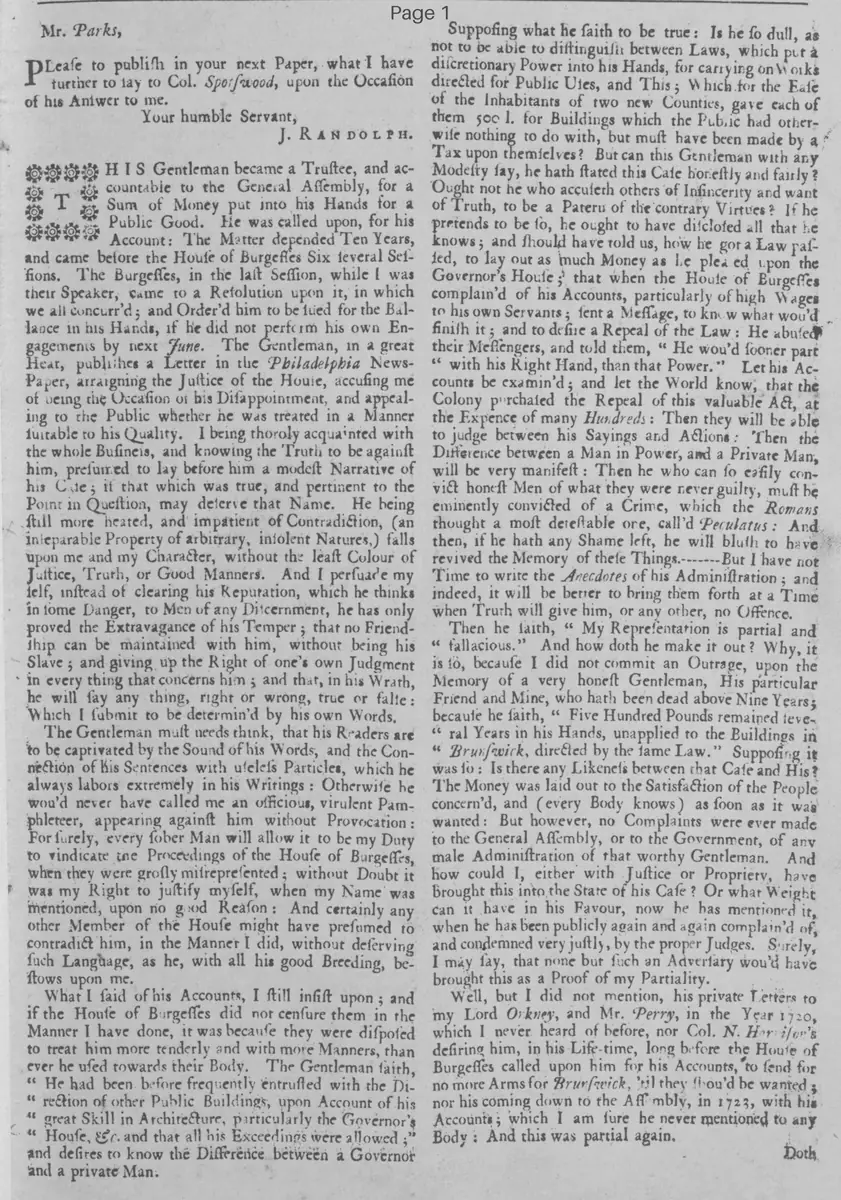
Please to publish in your next Paper, what I have further to lay to Col. Spotswood, upon the Occasion of his Answer to me.
Your humble Servant,
J. RANDOLPH.
To his Gentleman became a Trustee, and accountable to the General Assembly, for a Sum of Money put into his Hands for a Public Good. He was called upon, for his Account: The Matter depended Ten Years, and came before the House of Burgesses Six several Sessions. The Burgesses, in the last Session, while I was their Speaker, Came to a Resolution upon it, in which we all concurr'd: and Order'd him to be sued for the Balance in his Hands, if he did not perform his own Engagements by next June. The Gentleman, in a great Heat, publishes a Letter in the Philadelphia News-Paper, arraigning the Justice of the House, accusing me of being the Occasion of his Disappointment, and appealing to the Public whether he was treated in a Manner suitable to his Quality. I being thoroughly acquainted with the whole Business, and knowing the Truth to be against him, preferred to lay before him a modest Narrative of his Case; if that which was true, and pertinent to the Point in Question, may deserve that Name. He being still more heated, and impatient of Contradiction, (an inseparable Property of arbitrary, insolent Natures,) falls upon me and my Character, without the least Colour of Justice, Truth, or Good Manners. And I persuade myself, instead of clearing his Reputation, which he thinks in some Danger, to Men of any Discernment, he has only proved the Extravagance of his Temper; that no Friendship can be maintained with him, without being his Slave; and giving up the Right of one's own Judgment in every thing that concerns him; and that, in his Wrath, he will say any thing, right or wrong, true or false: Which I submit to be determin'd by his own Words.
The Gentleman must needs think, that his Readers are to be captivated by the Sound of his Words, and the Connection of his Sentences with useless Particles, which he always labors extremely in his Writings: Otherwise he wou'd never have called me an officious, virulent Pamphleteer, appearing against him without Provocation: For surely, every sober Man will allow it to be my Duty to vindicate the Proceedings of the House of Burgesses, when they were grossly misrepresented; without Doubt it was my Right to justify myself, when my Name was mentioned, upon no good Reason: And certainly any other Member of the House might have presumed to contradict him, in the Manner I did, without deserving such Language, as he, with all his good Breeding, bestows upon me.
What I said of his Accounts, I still insist upon; and if the House of Burgesses did not censure them in the Manner I have done, it was because they were disposed to treat him more tenderly and with more Manners, than ever he used towards their Body. The Gentleman says, He had been before frequently entrusted with the Direction of other Public Buildings, upon Account of his great Skill in Architecture, particularly the Governor's House, &c. and that all his Exceedings were allowed; and desires to know the Difference between a Governor and a private Man:
Supposing what he says to be true: Is he so dull, as not to be able to distinguish between Laws, which put a discretionary Power into his Hands, for carrying on works directed for Public Uses, and This; Which for the Ease of the Inhabitants of two new Counties, gave each of them 500 l. for Buildings which the Public had otherwise nothing to do with, but must have been made by a Tax upon themselves? But can this Gentleman with any Modesty say, he hath stated this Case honestly and fairly? Ought not he who accuses others of Insincerity and want of Truth, to be a Pattern of the contrary Virtues? If he pretends to be so, he ought to have disclosed all that he knows; and should have told us, how he got a Law passed, to lay out as much Money as he pleased upon the Governor's House; that when the House of Burgesses complain'd of his Accounts, particularly of high Wages to his own Servants; sent a Message, to know what wou'd finish it; and to desire a Repeal of the Law: He abused their Messengers, and told them, "He wou'd sooner part with his Right Hand, than that Power." Let his Accounts be examin'd; and let the World know, that the Colony purchased the Repeal of this valuable Act, at the Expence of many Hundreds: Then they will be able to judge between his Sayings and Actions: Then the Difference between a Man in Power, and a Private Man, will be very manifest: Then he who can so easily convict honest Men of what they were never guilty, must be eminently convicted of a Crime, which the Romans thought a most detestable one, call'd Peculatus: And then, if he hath any Shame left, he will blush to have revived the Memory of these Things.-----But I have not Time to write the Anecdotes of his Administration; and indeed, it will be better to bring them forth at a Time when Truth will give him, or any other, no Offence.
Then he says, "My Representation is partial and fallacious." And how doth he make it out? Why, it is so, because I did not commit an Outrage, upon the Memory of a very honest Gentleman, His particular Friend and Mine, who hath been dead above Nine Years; because he says, "Five Hundred Pounds remained several Years in his Hands, unapplied to the Buildings in Brunswick, directed by the same Law." Supposing it was so: Is there any Likeness between that Case and His? The Money was laid out to the Satisfaction of the People concern'd, and (every Body knows) as soon as it was wanted: But however, no Complaints were ever made to the General Assembly, or to the Government, of any male Administration of that worthy Gentleman. And how could I, either with Justice or Propriety, have Brought this into the State of his Case? Or what Weight can it have in his Favour, now he has mentioned it, when he has been publicly again and again complain'd of. and condemned very justly, by the proper Judges. Surely, I may say, that none but such an Adversary wou'd have brought this as a Proof of my Partiality.
Well, but I did not mention, his private Letters to my Lord Orkney, and Mr. Perry, in the Year 1720, which I never heard of before, nor Col. N. Hollor's desiring him, in his Life-time, long before the House of Burgesses called upon him for his Accounts, to send for no more Arms for Brunswick, 'til they should be wanted: nor his coming down to the Assembly, in 1723, with his Accounts; which I am sure he never mentioned to any Body: And this was partial again.
Doth a Man of such Reasoning deserve to be heard?
And is it not an Abuse of Time to answer him? If his Accounts were adjusted in 1723, how came it to pass, that they were not ready in 1723? Because the Arms were stopped, when they were not wanted, is it a Reason they should not be furnished, after the People had complain'd of him, the House of Burgesses had required him to discharge his Trust, and he himself solemnly engaged to do it?
Yet hath done Nothing, but draw up idle Excuses; and at last, to complete the Farce, saith, "His Merchant hath forgot him."
Næ si hercule, magno jam conatu, magnas nugas dixerit.
I own, he doth just now show some Reverence to the House of Burgesses: but cannot forbear taxing their Justice again: Tho' he is pleased to turn it upon my Insincerity. When he asks, "Who had most Reason to complain, They who have been kept out of 239l. Virginia Money, or he who had been kept out, almost as long, of 93l. Sterling, on Account of the Expedition to Albany?" He must mean, that the People of Brunswick had no Reason to complain, because the Government owed him more Money. Doth this come decently out of the Mouth of a Man, who had been Chief Judge of a Colony, in Law and Equity, Twelve Years. He saith, "He is Betrayed;" and he always must be so, because he cannot help Betraying himself.
The £col. was given in the Year 1720, and he was bound, by a positive Law, to lay it out for the Use of Brunswick County.
In the Year 1722, he contrived the Albany Expedition, and 1000 l. to be given to defray the Expense of it. I say contrived, tho' I know he will a third Time tell me, I "falsifie his Speech:" But I advise him to find out a Word that will express his Meaning better; for this will not answer the sharp-pointed Reflection he intended for me; it signifies to forge, disprove, or prove to be false; and when it is applied to Money, it signifies to counterfeit. However I will be so bold as to tell him, that it never came into my Head to go to his Speeches for naked Truth, or a plain Matter of Fact. I assert what I say upon more authentic Evidence, and have it at Hand to vindicate my Veracity.
Well, he goes to Albany; Five Years after, he charges in his Account of the Trust, an Overplus for Expences in that Journey; strikes off the whole Debt to Brunswick, and demands the Payment of the rest. The House of Burgesses reject it, without Debate ----- and then he applies to the Governor and Council. ----- Now is not this Man quite blind or stupid, when he still insists, that it was reasonable not to perform what the Law required of him til he was paid what he calls a Claim subsequent to the other Matter, and having no Relation to it? And is he not convicted of a manifest Breach of a Law of his own making? ----- What kind of a Judge must he have been, who can entertain such Notions of Law and Equity! ---
I owe one Man Money, --- another owes me more; I won't pay my Debt, til my Debtor pays me. --- What Tribunal, except one, can be found, where he bears Sway, will establish this as a Rule of Justice?
But I must take the Liberty to say a Word to this same Claim of his, in Relation to the Journey to Albany. -----
He knows I was there, was acquainted with all the Expences, 'till within Eight Days before he left New-York, to return to Virginia. I remember very well, soon as the 1000l. was voted, he made it the Subject of his Discourses, as it was his Custom to talk of every new Thing for a Month at least: He said it was an handsome Allowance, but he was very indifferent about it; he would Spend it all; and if it had been but Half the Sum, he would have spent no more. ----- What the Amount of the Expences was, indeed I cannot exactly remember, tho' I could guess very near; but I won't, because I was one of his Officers. Yet, when I saw the Charge in his Accounts, I could not but be surpriz'd. And as the Gentleman saith, "the Spirit mov'd me on another Occasion;" upon this, it came upon my Mind, that it was a very naughty Account; and something within me, rose up and bore Testimony against it. Tho' I gave no Evidence, it was thrown
out of the Place where it was first exhibited, as a Thing that was more jocular than serious. ----- When it was brought before the Governor and Council, they treated it with very great Favour and Kindness; they would not put a Negative upon it, but by a favourable Representation promoted it. Not as a Debt; for as such, it could never have stood the Test of an Examination: But that one who had been Governor of the Colony, might obtain a Bounty from the Crown, for a Service, that he had not had any Recompence for, as he said: And why might not those who went with him, and were very poorly paid, have been let into a Share of the same Bounty? Now how unreasonably doth this Man exult upon his Success, complain of laying out of a great Sum of Money, after he hath got double what he himself first demanded, and of the Hardship of not getting it sooner. How doth he tax me with being his secret Enemy in the Matter? as if his own Merit and Interest were invincible, when he may easily be informed, if I had been so, it was in my Power to have thrown some considerable Obstacles in his Way: And I refer him to his Solicitor in England, to tell him whether I gave him any Assistance, or not. And after that, let him confess, whether he has treated me in the Manner I deserve. But if this Claim, as he calls it, was a Reason for delaying the Arms, why were they not furnish'd, when he got the Money above 3 Years ago?
But supposing I was obliged by Duty, or for the Sake of Truth, to have said any Thing upon this Occasion; the Favours I had received from him, and the Gratitude I ow'd him, ought to have superseded all other Obligations, as he saith. The Gentleman is under a singular Unhappiness, which has proved a mighty Disadvantage to him for a long Time. ---- Having been a Ruler, he can never be persuaded, but some Remains of Sovereignty still reside in him: And now he hath lately dreamt that I was some Foundling, nourish'd and brought up in his Court, and sent forth into the World, upon his Charity: But when he awakes, he will easily recollect, that I am not the Person his Vision hath represented to him.
Men of deep Schemes and great Enterprizes are very little conversant with moral Duties; and I know this Gentleman always made Profession of leaving such small Matters, as Morality and Religion, to his Chaplain: But I will beg Leave to put him right, as to the Duties of Friendship and Gratitude. He saith, "he advanced and promoted me in the World, was my Patron, and I should therefore, have been the last Man that should have contradicted him.
Why. I believe, I am the last of all his Friends he has quarrel'd with; but supposing all he saith to be true, and put the Case further.-
He hath a Dispute with a whole County, about a Sum of Money he had bound himself to pay; it falls to my Lot with Others, to judge between them, and we all determine against him; he flies out; and censures our Judgment; I answer him, and endeavour to shew we were right. ----- Have I therefore violated any Friendship, or incurred any Ingratitude? Must his Friends be as violently addicted to his Humours and Interests as himself? Must they be always of his Side, right or wrong, and never make use of their own Understandings? Let him find such if he can; I own I am not one of that Sort.
Yet I must take upon me to deny, that I owe him so many Obligations; my Learning in my Profession, and my own Behaviour advanced me. ---- Is it not extreamly probable, that he who was look'd upon, by most of the People, as a Tyrant and an Oppressor, should have any Hand in recommending me to them, upon whose good Opinion my Prosperity depended? And is it not a most notorious Truth, that I had no Enemies, except such as were created by his listing me a Favourite, which I never desired, and proved very unprofitable to me.
A Brother of mine, had been Clerk of the House of Burgesses, during the Times of Two Governors, his immediate Predecessors, and he serv'd one Session under him. The Gentleman had a Scheme in his Head, to raise an Army, and Twenty Thousand Pounds to pay 'em, and to march at the Head of 'em against the Indians. My Brother presum'd to utter some Dislike of the Project, in a private Conversation; which being carried to Court, he was dismissed, and another appointed. ---
Then he became a Member of the House of Burgesses; and after several Sessions, having pleased him in some Vote, the Gentleman tells him, that he had done him great Wrong, in taking his Office from him; that his Successor did not please him, therefore he should be turned out; and desired him to accept of it again. -- He told him No, he did not want it; but that I was expected every Day from England, and if he would give it to me, he would look upon the Obligation to be the same: I arrived, and was appointed, and held the Office Four Sessions under him. ---- To whom do I owe this? He had no Reason to be ashamed of my Appointment, but valued himself upon it.
The next Favour he did me was to make me accept of the Office of King's Advocate, in the Court of Vice-Admiralty, by which I lost several Hundred Pounds; but it was necessary for him. ----- I went through many troublesome Prosecutions in that Court, against Piratical Effects; defended him against a Claim of the Proprietors of Carolina, for Effects of great Value, brought by Force from thence; was employed to settle a Difference between him and Two Captains of Men of War about their Effects, and drew long Writings between them; and then he set me about devising Reasons and Arguments, to entitle him to one Third, which at last he got; I don't say by any clear Right, but by his usual Perseverance, and disobeying the Orders of the Lords of the Treasury. --- For all this, and out of upwards of 2000 l. he gave me a little Negro Boy, which I could have bought for 12 l. Virginia Money; and if I don't mistake, he got Twenty odd Piratical Negroes for less. ---- Now I thought, so generous a Benefactor ought to have given me 100 l. at least. ---- Then, when several Courts were to be held for Trial of Pirates, upon which handsome Fees were allowed to the Register, whose Office properly and naturally belonged to me as Advocate, I was never thought of; but it was given to another, who deserved it very well, and whom I never envied.
Afterwards he had a Dispute with the Collector of Hampton, who had seized a Ship, and got her condemned; one Third of which belonged to the Governor: There had been something between 'em, about purchasing the Ship in Partnership, which was a Matter of Debate, affirmed on one Side, and denied by the other. The Collector left the Country without paying him; and a Third Person sets up an Advertisement, that he would pay his just Debts. ----- This was taken down; and I was consulted, whether an Action could not be maintained upon it; I delivered my Opinion that it might, and I brought one accordingly; after Four Hearings, in Two several Courts he obtained Judgment; and out of the Money recovered, he gave me 20 l. for my Fee, which I was very well satisfied with. These are all the great Gains I ever made under his Patronage: and I won't be so silly, to mention the Services I have done for him, nor do I think it was worth his while, to have published so prodigious an Accusation against me upon such small Grounds.
As to his Contests and Enemies, raised on my Account, I deny what he asserts, and affirm it to be as ill-grounded as the rest. ----- He had once a Mind to put a public Affront upon an old Gentleman, who had practised many Years at the General Court, and resolved to place me above him at the Bar, as I was a Barrister at Law, and he was not; I opposed it, and desired to give him Place, in Respect to his Age and long Standing: But he would, and did do it: and this was the only Contest he ever had about me; of which I was always ashamed.
Now the Gentleman comes to Conjecture, about the Cause of a secret Enmity, which he imagines I have taken up against him; and concludes, that it must have proceeded from his Defeating me in my Embay, as he calls it.----. I take this to be one of the Master-strokes, in his way of Writing: For, I know, he has a Mind to make his Court to some Merchant, as if he had been a Champion against the Excise on Tobacco; yet, would leave room, to refer his Meaning, to what he calls "an Embay before; and his refusing the disadvantageous Bargain," as he calls it. Now; if that be his Meaning; his Expression is very odd; and grounded upon Nothing;
for I had nothing in Command from the House of Burgesses to tell him, but only acquainted him, with what I had learnt from the private Discourses of some Members; and if he had accepted a Discharge of the 239 l. it might have gone towards his Exceedings; for I assure him the House never thought of allowing one Farthing for the Overplus of his Expences to Albany: So, now I understand him, I find his Right Hand, upon that Occasion, had forgot it's usual Cunning. -----.- But if he would have any Body fancy, that he alludes to the Excise, I would beg the Favour of him to oblige the World with his Argument; and then among the rest of his Betrayings, he will betray how little he understands the true Interests of this Colony.------ I know he is excellent at a private Representation; but in public, let him have no Opportunity to speak of himself, no Matter of Fact to disguise, and I would not desire to meet a more innocent Adversary.
Now let him, who is not contented with the Addition of Esquire, but requires some other empty Title, which perhaps, he has no Right to, laugh and sneer at the Order of Knighthood.------ And if his whole Stock is not exhausted, let him muster up all the rest of his low Wit.------ I can easily agree with him, that Titles and Honors are but empty Things, and of no intrinsic Worth: I do not value my self upon them, nor has he more Reason to value himself upon those he pretends to.---- My Integrity and Virtue, if I have any, shall speak for themselves; and, if I have none, the Reproach will be mine. I know my own Wants, and am thoroughly acquainted with his: So he may go on and adorn his Writings with beautiful Similies, drawn from vulgar Errors, and not from what has any Existence in the Reality of Things; such as the "Spitting of the Rattle-Snake, and the Weeping of a Crocodile."--..-- I am not in that Condition to value the Praises, or to be put out of Countenance by the Slanders and Ridicule, of such Men.
Qui e primos Omnium esse volunt: Nec Sunt----…
Who have no Constancy, are to be carried away by every Passion and Interest, and will have no Friends, but such as will be ready to swear, in Verba Magistri. Yet I wish him in this latter Season, to exercise himself in Acts of Justice and Kindness, to his Tenants and Servants; to labor to do Right to all Men, with whom he has any Thing to do; and listen patiently to that faithful Monitor, which cannot nor will flatter him. Then he will have nothing to do in Court, nor be vexed with Disputes about Reputation. I wish while his Body and Understanding are growing weak, to see him subduing his Passions, instead of suffering them to grow stronger: And so I bid him heartily Farewell.
What sub-type of article is it?
What themes does it cover?
What keywords are associated?
What entities or persons were involved?
Letter to Editor Details
Author
J. Randolph
Recipient
Mr. Parks
Main Argument
john randolph defends the house of burgesses' decision to sue col. spotswood for failing to account for and expend 500 pounds allocated in 1720 for public buildings in brunswick county, refuting spotswood's accusations of injustice and partiality while exposing his financial mismanagement, temper, and past abuses of power.
Notable Details