Thank you for visiting SNEWPapers!
Sign up free
The Times News
Hendersonville, Henderson County, North Carolina
What is this article about?
US Secretary Hull expresses regret over Japan's denunciation of the 1936 Washington naval treaty, refuses demands for equality, and pledges disarmament efforts amid global naval tensions.
Clipping
OCR Quality
Full Text
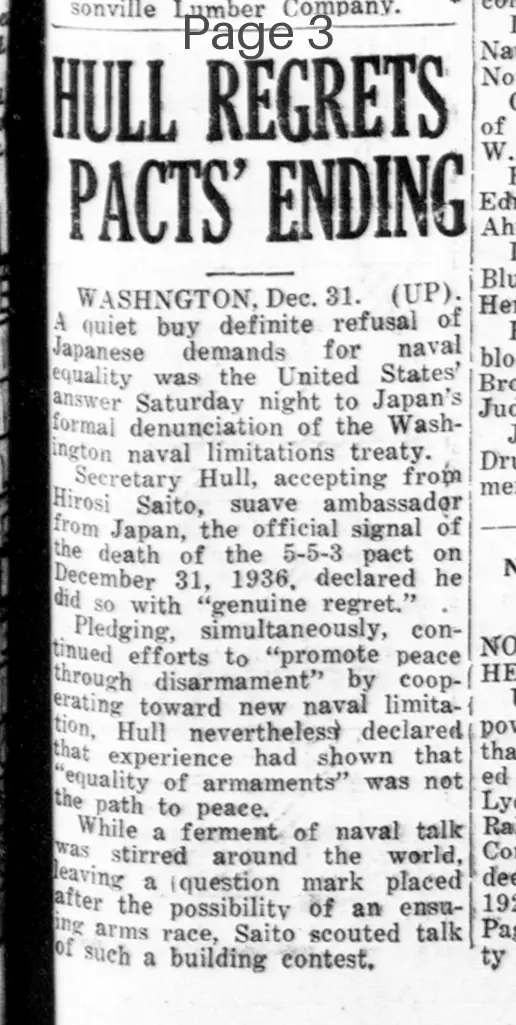
WASHINGTON, Dec. 31. (UP).
A quiet but definite refusal of Japanese demands for naval equality was the United States answer Saturday night to Japan's formal denunciation of the Washington naval limitations treaty.
Secretary Hull, accepting from Hirosi Saito, suave ambassador from Japan, the official signal of the death of the 5-5-3 pact on December 31, 1936, declared he did so with "genuine regret."
Pledging, simultaneously, continued efforts to "promote peace through disarmament" by cooperating toward new naval limitation, Hull nevertheless declared that experience had shown that "equality of armaments" was not the path to peace.
While a ferment of naval talk was stirred around the world, leaving a question mark placed after the possibility of an ensuing arms race, Saito scouted talk of such a building contest.
What sub-type of article is it?
What keywords are associated?
What entities or persons were involved?
Where did it happen?
Foreign News Details
Primary Location
Washington
Event Date
1936 12 31
Key Persons
Outcome
united states refusal of japanese demands for naval equality; genuine regret over the end of the 5-5-3 washington naval limitations treaty; pledge to promote peace through disarmament but declaration that equality of armaments is not the path to peace; saito scouted talk of an arms race.
Event Details
The United States answered Japan's formal denunciation of the Washington naval limitations treaty with a quiet but definite refusal of Japanese demands for naval equality. Secretary Hull accepted the official notice from Japanese Ambassador Hirosi Saito with genuine regret. Hull pledged continued efforts to promote peace through disarmament by cooperating toward new naval limitations, but stated that experience showed equality of armaments was not the path to peace. While naval talk stirred worldwide, leaving uncertainty about an arms race, Saito dismissed such talk.