Thank you for visiting SNEWPapers!
Sign up free
Alexandria Daily Advertiser
Alexandria, Virginia
What is this article about?
Indians of the Wabash are jealous of Osages for opening communication with U.S. states. President's pacific principles expected to prevent native contests. Detailed discussion of Indian war customs across tribes, citing Pratz, De Soto, Mackenzie, with reflections on universal human warfare.
Clipping
OCR Quality
Full Text
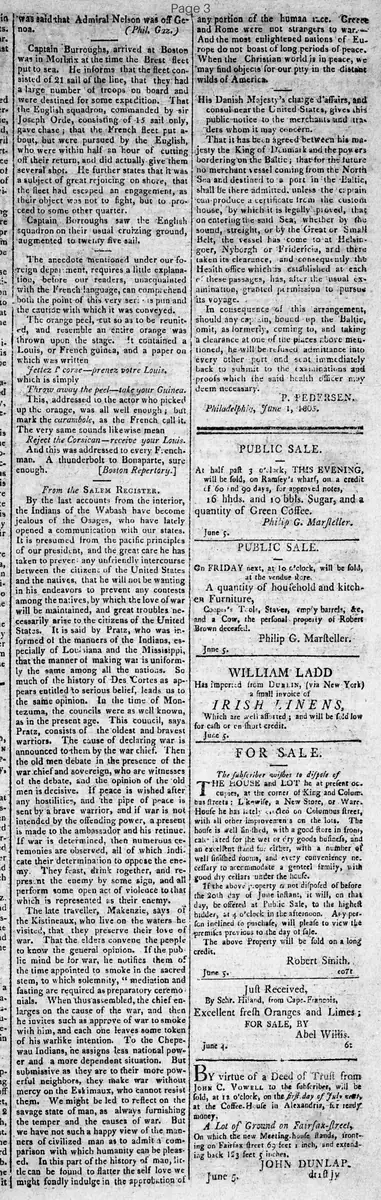
By the last accounts from the interior, the Indians of the Wabash have become jealous of the Osages, who have lately opened a communication with our states.
It is presumed from the pacific principles of our president, and the great care he has taken to prevent any unfriendly intercourse between the citizens of the United States and the natives, that he will not be wanting in his endeavors to prevent any contests among the natives, by which the love of war will be maintained, and great troubles necessarily arise to the citizens of the United States. It is said by Pratz, who was informed of the manners of the Indians, especially of Louisiana and the Mississippi, that the manner of making war is uniformly the same among all the nations. So much of the history of De Soto as appears entitled to serious belief, leads us to the same opinion. In the time of Montezuma, the councils were as well known, as in the present age. This council, says Pratz, consists of the oldest and bravest warriors. The cause of declaring war is announced to them by the war chief. Then the old men debate in the presence of the war chief and sovereign, who are witnesses of the debate, and the opinion of the old men is decisive. If peace is wished after any hostilities, and the pipe of peace is sent by a brave warrior, and if war is not intended by the offending power, a present is made to the ambassador and his retinue.
If war is determined, then numerous ceremonies are observed, all of which indicate their determination to oppose the enemy. They feast, drink together, and represent the enemy by some sign, and all perform some open act of violence to that which is represented as their enemy.
The late traveller, Mackenzie, says of the Kistineaux, who live on the waters he visited, that they preserve their love of war. That the elders convene the people to know the general opinion. If the public mind be for war, he notifies them of the time appointed to smoke in the sacred stem, to which solemnity, meditation and fasting are required as preparatory ceremonies. When thus assembled, the chief enlarges on the cause of the war, and then he invites such as approve of war to smoke with him, and each one leaves some token of his warlike intention. To the Chepewyan Indians, he assigns less national power and a more dependent situation. But submissive as they are to their more powerful neighbors, they make war without mercy on the Eskimaux, who cannot resist them.
We might be led to reflect on the savage state of man, as always furnishing the temper and the causes of war. But we have not such a happy view of the manners of civilized man as to admit a comparison with which humanity can be pleased. In this part of the history of man, little can be found to flatter the self love we might fondly indulge in the approbation of any portion of the human race. Greece and Rome were not strangers to war. And the most enlightened nations of Europe do not boast of long periods of peace. When the Christian world is in peace, we may find objects for our pity in the distant wilds of America.
What sub-type of article is it?
What keywords are associated?
What entities or persons were involved?
Where did it happen?
Domestic News Details
Primary Location
Wabash
Key Persons
Event Details
By the last accounts from the interior, the Indians of the Wabash have become jealous of the Osages, who have lately opened a communication with our states. It is presumed from the pacific principles of our president, and the great care he has taken to prevent any unfriendly intercourse between the citizens of the United States and the natives, that he will not be wanting in his endeavors to prevent any contests among the natives, by which the love of war will be maintained, and great troubles necessarily arise to the citizens of the United States. Detailed account of Indian war declaration customs, councils, ceremonies, and practices among various nations, including Kistineaux and Chepewyan, with reflections on savage and civilized states of war.