Thank you for visiting SNEWPapers!
Sign up free
The Massachusetts Spy, Or, Thomas's Boston Journal
Boston, Suffolk County, Massachusetts
What is this article about?
A letter debating the extent of clerical authority in Congregational churches, criticizing claims of ministerial negativing power over church votes as unscriptural and dangerous, responding to Mr. Z.'s defense of Mr. Adams's views, and advocating for limits on spiritual power to protect religious liberty. Dated Boston, Sept. 7, 1773.
Merged-components note: Merged a single long letter to the editor spanning pages 1 and 2; included the initial image due to spatial overlap and adjacent reading order.
Clippings
1 of 2
OCR Quality
Full Text
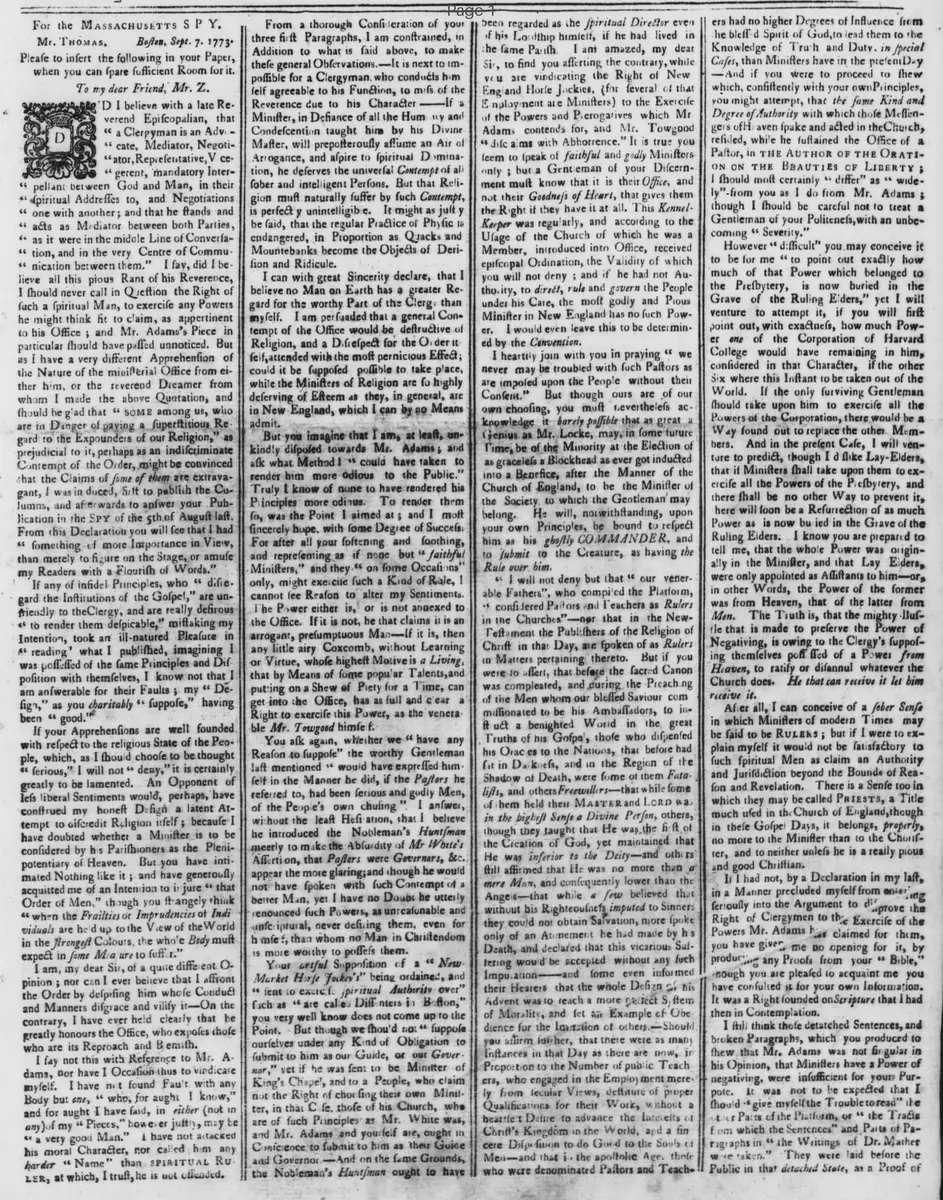
Mr. Thomas,
Boston, Sept. 7. 1773
Please to insert the following in your Paper, when you can spare sufficient Room for it.
To my dear Friend, Mr. Z.
I believe with a late Reverend Episcopalian, that "a Clergyman is an Advocate, Mediator, Negotiator, Representative, Vicegerent, mandatory Interpellant between God and Man, in their spiritual Addresses to, and Negotiations one with another; and that he stands and acts as Mediator between both Parties, as it were in the middle Line of Conversation, and in the very Centre of Communication between them." I say, did I believe all this pious Rant of his Reverence, I should never call in question the Right of such a spiritual Man, to exercise any Powers he might think fit to claim, as appertinent to his Office: and Mr. Adams's Piece in particular should have passed unnoticed. But as I have a very different Apprehension of the Nature of the ministerial Office from either him, or the reverend Dreamer from whom I made the above Quotation, and should be glad that "some among us, who are in Danger of paying a superstitious Regard to the Expounders of our Religion," as prejudicial to it, perhaps as an indiscriminate Contempt of the Order, might be convinced that the Claims of some of them are extravagant, I was induced, first to publish the Cumns, and afterwards to answer your Publication in the Spy of the 5th. of August last.
From this Declaration you will see that I had "something more Importance in View, than merely to figure on the Stage, or amuse my Readers with a Flourish of Words."
If any of infidel Principles, who "disregard the Institutions of the Gospel," are unfriendly to the Clergy, and are really desirous "to render them despicable," mistaking my Intention, took an ill-natured Pleasure in "reading" what I published, imagining I was possessed of the same Principles and Disposition with themselves, I know not that I am answerable for their Faults; my "Design," as you charitably "suppose," having been "good."
If your Apprehensions are well founded with respect to the religious State of the People, which, as I should choose to be thought "serious," I will not "deny," it is certainly greatly to be lamented. An Opponent of less liberal Sentiments would, perhaps, have construed my honest Design a latent Attempt to discredit Religion itself; because I have doubted whether a Minister is to be considered by his Parishioners as the Plenipotentiary of Heaven. But you have intimated Nothing like it; and have generously acquitted me of an Intention to injure "that Order of Men," though you strangely think "that when the Frailties or Imprudencies of Individuals are held up to the View of the World in the strongest Colours, the whole Body must expect in some Measure to suffer."
I am, my dear Sir, of a quite different Opinion; nor can I ever believe that I affront the Order by despising him whose Conduct and Manners disgrace and vilify it. On the contrary, I have ever held clearly that he greatly honours the Office, who exposes those who are its Reproach and Blemish.
I say not this with Reference to Mr. Adams, nor have I Occasion thus to vindicate myself. I have not found Fault with any Body but one, "who, for aught I know," and for aught I have said, in either (not in any) of my "Pieces," however justly, may be "a very good Man." I have not attacked his moral Character, nor called him any harder "Name" than SPIRITUAL RULER, at which, I trust, he is not offended.
From a thorough Consideration of your three first Paragraphs, I am constrained, in Addition to what is said above, to make these general Observations. It is next to impossible for a Clergyman, who conducts himself agreeable to his Function, to miss of the Reverence due to his Character. If a Minister, in Defiance of all the Humanity and Condescension taught him by his Divine Master, will preposterously assume an Air of Arrogance, and aspire to spiritual Domination, he deserves the universal Contempt of all sober and intelligent Persons. But that Religion must naturally suffer by such Contempt, is perfectly unintelligible. It might as justly be said, that the regular Practice of Physic is endangered, in Proportion as Quacks and Mountebanks become the Objects of Derision and Ridicule.
I can with great Sincerity declare, that I believe no Man on Earth has a greater Regard for the worthy Part of this Clergy than myself. I am persuaded that a general Contempt of the Office would be destructive of Religion, and a Disrespect for the Order itself, attended with the most pernicious Effect: could it be supposed possible to take place, while the Ministers of Religion are so highly deserving of Esteem as they, in general, are in New England, which I can by no Means admit.
But you imagine that I am, at least, unkindly disposed towards Mr. Adams; and ask what Method I "should have taken to render him more odious to the Public." Truly I know of none to have rendered his Principles more odious. To render them so, was the Point I aimed at; and I most sincerely hope, with some Degree of Success.
For after all your softening and soothing, and representing as if none but "faithful Ministers," and they "on some Occasions" only, might exercise such a Kind of Rule, I cannot see Reason to alter my Sentiments. The Power either is, or is not annexed to the Office. If it is not, he that claims it is an arrogant, presumptuous Man. If it is, then any little airy Coxcomb, without Learning or Virtue, whose highest Motive is a Living, that by Means of some popular Talents, and putting on a Shew of Piety for a Time, can get into the Office, has as full and clear a Right to exercise this Power, as the venerable Mr. Towgood himself.
You ask again, whether we "have any Reason to suppose" the worthy Gentleman last mentioned "would have expressed himself in the Manner he did, if the Pastors he referred to, had been Serious and godly Men, of the People's own choosing." I answer, without the least Hesitation, that I believe he introduced the Nobleman's Huntsman merely to make the Absurdity of Mr. White's Assertion, that Pastors were Governors, &c. appear the more glaring; and though he would not have spoken with such Contempt of a better Man, yet I have no Doubt he utterly renounced such Powers, as unreasonable and unscriptural, never desiring them, even for himself; than whom no Man in Christendom is more worthy to possess them.
Your crafty Supposition of a "New Market Horse Jockey's" being ordained, and "sent to exercise spiritual Authority over" such as "are called Dissenters in Boston," you very well know does not come up to the Point. But though we should not "suppose ourselves under any Kind of Obligation to submit to him as our Guide, or our Governor," yet if he was sent to be Minister of King's Chapel, and to a People, who claim not the Right of choosing their own Minister, in that Case, those of his Church, who are of such Principles as Mr. White was, and Mr. Adams and yourself are, ought in Conscience to submit to him as their Guide and Governor. And on the Same Grounds, the Nobleman's Huntsman ought to have been regarded as the spiritual Director even of his Lordship himself, if he had lived in the same Parish. I am amazed, my dear Sir, to find you asserting the contrary, while you are vindicating the Right of New England Horse Jockeys, (for several of that Employment are Ministers) to the Exercise of the Powers and Prerogatives which Mr. Adams contends for, and Mr. Towgood "disclaims with Abhorrence." It is true you seem to speak of faithful and godly Ministers only; but a Gentleman of your Discernment must know that it is their Office, and not their Goodness of Heart, that gives them the Right if they have it at all. This Kennel-Keeper was regularly, and according to the Usage of the Church of which he was a Member, introduced into Office, received episcopal Ordination, the Validity of which you will not deny; and if he had not Authority, to direct, rule and govern the People under his Care, the most godly and Pious Minister in New England has no such Power. I would even leave this to be determined by the Convention.
I heartily join with you in praying "we never may be troubled with such Pastors as are imposed upon the People without their Consent." But though ours are of our own choosing, you must nevertheless acknowledge it barely possible that as great a Genius as Mr. Locke, may, in some future Time, be of the Minority at the Election of as graceless a Blockhead as ever got inducted into a Benefice, after the Manner of the Church of England, to be the Minister of the Society, to which the Gentleman may belong. He will, notwithstanding, upon your own Principles, be bound to respect him as his ghostly COMMANDER, and to submit to the Creature, as having the Rule over him.
I will not deny but that "our venerable Fathers", who compiled the Platform, considered Pastors and Teachers as Rulers in the Churches—nor that in the New Testament the Publishers of the Religion of Christ in that Day, are spoken of as Rulers in Matters pertaining thereto. But if you were to assert, that before the sacred Canon was completed, and during the Preaching of the Men whom our blessed Saviour commissioned to be his Ambassadors, to instruct a benighted World in the great Truths of his Gospel, those who dispensed his Oracles to the Nations, that before had sat in Darkness, and in the Region of the Shadow of Death, were some of them Fatalists, and others Freewillers—that while some of them held their Master and Lord in the highest Sense a Divine Person, others, though they thought that He was the first of the Creation of God, yet maintained that He was inferior to the Deity—and others still affirmed that He was no more than a mere Man, and consequently lower than the Angels—that while a few believed that without his Righteousness imputed to Sinners they could not obtain Salvation, more spoke only of an Atonement he had made by his Death, and declared that this vicarious Suffering would be accepted without any such Imputation—and some even informed their Hearers that the whole Design of his Advent was to teach a more perfect System of Morality, and set an Example of Obedience for the Imitation of others. Should you affirm such, that there were as many Instances in that Day as there are now, in Proportion to the Number of public Teachers, who engaged in the Employment merely from secular Views, destitute of proper Qualifications for their Work, without a heartfelt Desire to advance the Interests of Christ's Kingdom in the World, and a sincere Disposition to do Good to the Souls of Men—and that in the apostolic Age, those who were denominated Pastors and Teachers had no higher Degrees of Influence from the blessed Spirit of God, to lead them to the Knowledge of Truth and Duty, in special Cases, than Ministers have in the present Day—And if you were to proceed to show which, consistently with your own Principles, you might attempt, that the same Kind and Degree of Authority with which those Messengers of Heaven spoke and acted in the Church, resided, while he sustained the Office of a Pastor, in The Author of The Oration on The Beauties of Liberty; I should most certainly "differ" as "widely" from you as I do from Mr. Adams; though I should be careful not to treat a Gentleman of your Politeness, with an unbecoming "Severity."
However "difficult" you may conceive it to be for me "to point out exactly how much of that Power which belonged to the Presbytery, is now buried in the Grave of the Ruling Elders," yet I will venture to attempt it, if you will first point out, with exactness, how much Power one of the Corporation of Harvard College would have remaining in him, considered in that Character, if the other Six were this Instant to be taken out of the World. If the only surviving Gentleman should take upon him to exercise all the Powers of the Corporation, there would be a Way found out to replace the other Members. And in the present Case, I will venture to predict, though I do dislike Lay-Elders, that if Ministers Shall take upon them to exercise all the Powers of the Presbytery, and there shall be no other Way to prevent it, there will soon be a Resurrection of as much Power as is now buried in the Grave of the Ruling Elders. I know you are prepared to tell me, that the whole Power was originally in the Minister, and that Lay Elders, were only appointed as Assistants to him—or, in other Words, the Power of the former was from Heaven, that of the latter from Men. The Truth is, that the mighty Struggle that is made to preserve the Power of Negativing, is owing to the Clergy's supposing themselves possessed of a Power from Heaven, to ratify or disannul whatever the Church does. He that can receive it let him receive it.
After all, I can conceive of a Sober Sense in which Ministers of modern Times may be said to be Rulers; but if I were to explain myself it would not be satisfactory to such spiritual Men as claim an Authority and Jurisdiction beyond the Bounds of Reason and Revelation. There is a Sense too in which they may be called Priests, a Title much used in the Church of England, though in these Gospel Days, it belongs, properly, no more to the Minister than to the Chorister, and to neither unless he is a really pious and good Christian.
If I had not, by a Declaration in my last, in a Manner precluded myself from entering seriously into the Argument to disprove the Right of Clergymen to the Exercise of the Powers Mr. Adams has claimed for them, you have given me no opening for it, by producing any Proofs from your "Bible," though you are pleased to acquaint me you have consulted it for your own Information.
It was a Right founded on Scripture that I had then in Contemplation. I still think those detached Sentences, and broken Paragraphs, which you produced to shew that Mr. Adams was not Singular in his Opinion, that Ministers have a Power of negativing, were insufficient for your Purpose. It was not to be expected that I should "give myself the Trouble to read" the other Passages of the Platform, or "the Tracts from which the Sentences" and Parts of Paragraphs in "the Writings of Dr. Mather were taken." They were laid before the Public in that detached State, as a Proof of
your Point. Th: Extract from that Rev. Gentleman, now produced, proves that he held that Ministers have such a Power : But even his Authority will not reconcile the Minds of " the good People among us," who are Friends to religious Liberty, and understand what is meant by the Exercise of it.
But how, my dear Sir, you can "evince" that Mr. Adams is not singular in supposing that a Pastor would not be guilty of violating the Rules of the Platform, should he, "on some Occasions, dissent from the Votes of the Church, and so render them void and of no Effect"— (thus you chuse to express yourself )"by referring to the Practice of Ministers"in former Times, is to me extremely Enigmatical indeed. How can you possibly know, Sir, that those " godly Ministers" did not intentionally violate the Rules of the Platform? there having been godly Men, having "adorned those Churches," and their Names being venerated by the present Generation, (a Proof, by the Way, that good Clergymen are not become despicable) will not certainly prove the contrary, for even Ministers of such a Character have sometimes acted, in particular Instances, much too arbitrarily.
It moreover appears very strange to me that you should assign as Reasons for not mentioning their Names, that they have retired from their Labours, and that their Memory is had in Veneration, when you think it right to follow their Example. and are a professed Advocate for the same Practices.
I would just mention, en passant, that Ministers not sitting"in Councils as Church Officers," but merely " as Church Messengers." is a Thought entirely new to me. I ever conceived very differently of the Matter before. Hence I concluded arose their Precedency to Lay Messengers ; which I most sincerely thought, when assembled on spiritual Affairs they had an undoubted Right to— Hence the Duty of Lay Messengers is to hold the Stirrup, and perform other menial Services—and hence I deduce the Propriety of young Ministers Names appearing at the Foot of the Result, in FAIR ROMAN CAPITALS. on the Right, and the Names of aged Lay Messengers on the Left, in little (curvy Italics ; and the Duty of the Reverend SCRIBE to order it so accordingly
You will allow me to be pleasant, my dear Sir, for the Relief of my own Mind, in this important Controversy
But to return to the Subject of the negativing Power---Could it have been said With Truth that Mr. Adams was singular in his Sentiments, when I published those Columns, it cannot now be affirmed, since you have adopted his Opinions, and, with them, his Method of reasoning, where you make it a Matter of Conscience, on some Occasions, for a Minister to put a Negative on the Votes of a Church. I say, put a Negative-for your Talk of his withholding his Consent only, is a mere Cobweb Covering, and every Man of the least Penetration must know, that a Gentleman of your good Sense would look upon yourself as poorly employed in proving, what is evident to every Reader, that " Mr. Adams is right." (according to his own and your Conception of the Nature of the ministerial Office) in asserting that the Ministers not consenting to the Vote of the Church puts a Negative upon it ;"for this plain Reason, because he will refuse to execute it, when he may be, according to the general Opinion, (from which'ts probable, however, Some may dissent)"the only" Person"in the Church that can" do it
But where, Sir, is the mighty Difficulty in the Minister's being obliged to carry into Execution, as the proper Officer, every Vote which the Church may pass, at Meetings regularly called, and in which he himself presides? I profess to be so dull as not to be able to conceive of a Case where, if -I was a Minister, it would be against my Conscience to do it, after I had taken all proper Pains in the Way of Reasoning and Persuation, to prevent a Vote's passing.'Tis indeed barely"possible" the Church might assemble,without my Knowledge, in an irregular Way, and the major Part vote that I should set Fire to the Meeting House. or Shoot the Sexton; but with such a Vote, passed at such a Meeting, I should have Nothing to do. As to Matters of Discipline, where the Minister calls the Meeting, and is Moderator of it, an Instance can scarcely be produced of a Vote's passing contrary to his Mind. But (supposing the Vote should be to suspend or excommunicate a Member, whom the Minister judges'not deserving of such hard Treatment, why should he scruple to declare or pronounce the Sentence of the Church, after he has, by 'speaking his Mind freely in the Church Meeting, delivered his own Soul ?
Not but just to mention that the most wise
and knowing among the Clergy ought to entertain a Degree of Diffidence of their own Judgment, where great Numbers of the Laity are of a different Opinion.
As this Plea of Conscience is the Sheet-Anchor of the Advocates for the negativing Power, you will allow me to write a little more about it, and about it, without entering fully into the Dispute; and if I should confound this Point with that of the Power of the Keys, to which it is So near of Kin, I hope you will excuse me. A Minister proposes a Person for Admission into the Church before, or at the Time for which, Objections are made; which being of little or no Weight, in the Judgment of the Church, when the Question is put, they vote to receive him. The Minister being of a different Judgment, what is to be done? Why, says Mr. Adams, " The Pastor is to the Doorkeeper as to prevent the Admission of Persons whom he deems unworthy, even though there is a Vote of the Church" for it. He will then publickly declare, that he dissents from the Vote they have passed. This he has a Right to do, on all Occasions, in common with every other Member, and in the supposed Case, he may think himself bound in Conscience to do it. But will the Church thereupon consider their Vote as a Nullity, and the Person as no Member ? No, surely, unless they are the most servile of the Creation of God. On the next Communion Day the Person will be present, to comply with a Gospel Institution. If the Minister should desire, or, which is more consonant to such Pretensions, order him to withdraw, will he, on his Non-compliance violate his Obligations as a Gospel Minister, by refusing to administer the Lord's Supper? Let him answer it to his GREAT MASTER if he should. A Plea of Conscience will not avail, while he, without any Reluctance, has constantly administered to some others whom he had no Reason in the World to think have the smallest Degree of Godliness in their Hearts ; for such here are in almost every Church;some who cannot, for want of Proof or overt Acts, be dealt with in the Way of godly Discipline, and others who on Account of their Eminence, by Reason of Riches, or Office, or their Liberality to the Minister, or to the Church, or merely through spiritual Indolence, are suffered go on quietly in an evil Way. In the former Case the Minister has done his Duty, by endeavouring to prevent the Person's Admission; he has done all that Reason and the New-Testament will warrant him in doing and he may have a peaceful Conscience; in the latter Case, neither he nor the Church can be blameless, till both have done as much as Reason and Scripture require of them respectively, to have the Discipline of the Church duly administered. Here again, if the Church, in his Opinion, Should be too tender, or too severe, he has Nothing to do, in order to keep a good Conscience, but by fair Argument to endeavour to shew to them their Duty. But, says Mr Adams "he is to the Door keeper as to prevent the Exclusion of Persons," when he thinks they ought not to be excluded,notwithstanding the Vote of the Church. "He is bound" in such a Case," in Faithfulness to his Master to negative" the Vote, it being " contrary to the Laws and Interest of Christ" to excommunicate a Member for a Fault that does not deserve Excommunication. Accordingly the Minister, if he is in Mr. Adams's Sentiments, will refuse to pronounce the Sentence of the Church. But by such Refusal, I humbly conceive, as the Duty of his Office is violated, so he discovers his own Obstinacy, more than his Tenderness of Conscience; a Case which happens oftner than most People are aware of. This is all he could do towards multiplying the Vote; and a Church which acknowledges Minister possessed of such Power, would it down quietly under the Oppression; but where a different Opinion prevail, the Members would interpose. and, in a peaceable Way, prevent the excommunicated Person from partaking with them, if he were to be present on a Communion Day for that Purpose. In this as the Body of the Church they might be justified, although the Minister, in the aforementioned Case, being but a single Member could not be vindicated in refusing to administer.' The Claim I am contending against, utterly destroys the best Rule that ever was established for the Government of Societies, namely the Voice of the Majority; and the Practice of the Sandemanian Church, where perfect Unanimity is required, in Order to the Validity of a Vote,is' a thousand Times more rational and eligible.
One Conjecture I will hazard by the Way, without daring it should be applied to any Case that has ever happened, namely, that whatever may be said in justification of
a Minister's refusing to administer either Baptism or the Lord's Supper, contrary to the Mind of the Church, if a Deacon should refuse to carry the Bread and Wine to any particular Communicant whom he judged unworthy, or if a Sexton should neglect to provide Water for Baptism, for Fear of its being profaned by a wrong Application in any particular Instance, (though the Dictates of their Consciences would be as sacred as those of any Clergyman's under Heaven) no Men would despise them more for their Squeamishness than some Gentlemen of the Cloth.
But not to make too many Excursions:-
You Seem to be aware, my dear Sir, that the Power of Negativing,like absolute kingly Power in the State, cannot be safely intrusted in the Hands of the Clergy, without Distinction; and therefore these Expressions--godly Ministers, faithful Ministers,aged and venerable Ministers, &c. But if it cannot safely be lodged with a raw, inexperienced Boy, or a haughty, imperious, overbearing man, if such should happen to be in holy Orders, it ought not to exist in the Church. If it is a Remnant of Popery, unless we are willing to return back into spiritual Egypt, we ought to protest against it.Your Acquaintance with ecclesiastical History will inform you, that on the same Principle on which your Doctrine, namely the Need there is, on some Occasions, for the Interposition of a wiser and better Head than any to be found among those usually denominated by Way of Distinction, the Brotherhood, (though our Saviour says all ye are Brethren. I say, on this same Principle on which your Doctrine is founded, it was judged proper that one Man should be invested with a Power of deciding in all difficult Cases, and from thence HIS HOLINESS derived his Authority
I know not who I am addressing. whether " an old Man, or a young one,"whether a Clergyman, or a Layman; but from the mild, generous and Christian Temper you discover, if you are a Minister, I take you to be as proper a Person to exercise the Power of negativing as any among us; and perhaps you might do it with Advantage, not only to the Church to which you stand particularly related, but to others also, if your Power was extended ; but it does not follow that because some godly, faithful, aged and venerable Ministers have, with advantage to the Churches in some Instances, exercised the Power in'dispute, that it is safe it would be a Part of our ecclesiastical Constitution; and I can by no Means admit that it is Your Principle seems to be this, that although all cannot safely be intrusted with it, as it should never be wantonly exercised (very good Talk) yet it ought always to rest in Petto,with every very good and worthy Minister, to be used on extraordinary Occasions only. Consider of this more thoroughly, my dear Sir, and you will certainly give it up as indefensible.
You appear, Sir, to be, and I make no doubt you are, friendly to the Rights of the Churches, upon your own Principles; and I think you would come a little nearer to mine, if you were not unreasonably afraid that Ministers will become mere Cyphers. He that would be so without a negative Voice, would certainly be unfit to have it ; and such an one as I think you would deem fit to exercise the Power, could preserve his Dignity and Importance full as well without it. A prudent, sensible, pious Minister a mere Cypher! You know, Sir, that it is almost impossible but such a Minister must have as much Influence as it is proper he should have. But you do not seem to have had this impressed upon your Mind, when you say,"we may easily suppose Cases where an aged and venerable Pastor, together with the most 'serious and judicious Part of his Church, could not agree with a Majority in some very important Matters of Discipline"and add, "in such Cases I am sure you could not desire a godly Minister, in the Name of his Great Master, to execute such Votes as are contrary to his Conscience."I cannot so easily suppose such Cases as you may imagine, as I believe such a Minister, joined with such other serious and judicious Men of the Church, would forever secure a Majority, at least, on the same Side of the Question with themselves. But I must beg Leave to repeat, as often as Occasion shall require, what you will not gainsay, that if one Minister has the Right all have-and it is much easier to suppose a Case, now Mr. Adams has published a Doctrine, which many before were unacquainted with, where a young, unfledged, conceited Prig, who before he fancied himself commissioned to utter his Nonsense for the Word of God, was not fit to be admitted into Gentlemen's Company, would exercise this Right of negativing, or(if you choose rather) of withholding his Consent, and refusing to execute Votes, contrary to the Judgment of seven-
eighths of the Church; a great Part of whom perhaps much more knowing and respectable than himself; and for this his Obstinacy he would plead Conscience; for such I suppose have Consciences of their own."
In Churches organized according to the Platform, Ministers were sometimes, it is probable, in the Minority, when Matters were determined in the Presbytery. Had they a negative Voice there ? Or was unanimity essential to every Vote? If neither was the Case, how did they then carry Votes into Execution, contrary to their Judgment, without Trouble to their Consciences?
You think we are not in Danger of ecclesiastical Tyranny, because " the Constitution," (so you are pleased to express yourself )"makes Provision for General Councils, or Synods, where Matters" in dispute"are to be determined." How much Sir, might particular Members, and even whole Churches suffer, notwithstanding such Provision!
You give an extraordinary Reason against a People's complaining " of Laws as cruel and oppressive," namely that their own Legislature made them. What other Way is there for a People to obtain Redress ? I have not however, complained of any ecclesiastical Laws :but of those who act contrary to them, if it is proper to call the Rules of the Platform by that Name.
Though I have written in great haste, yet I acknowledge I have been very tedious and prolix ; and I have to apologize for the Want of due Regularity and Order. "In this Day of inquiry" I have your Allowance to " deliver"my" Sentiments" freely. I know my Doom however, if I greatly offend the Clergy ; and I should, in such a Case, be happy to change Coats with Mr. Adams, notwithstanding a Degree of Indignation has been raised against him among the Laity. But to save my Bacon I promise not to scribble any more, without very great Provocation.
It is high time, Sir, to take my Leave of you, and I should be glad to part in Friendship ;therefore as I have before said that I have the greatest Regard for worthy Clergymen, so I would further declare, that I ever aim to exercise the same Candor towards them, that I could wish might, on all Occasions, be exercised towards my self. I consider them as Men of like Passions with others, and do not look for a Perfection of Conduct and Character, which is beyond the Tether of Humanity. It is from the hearty good Will I bear to the Order, as well as to prevent too great a Degree of spiritual Predominancy, that I would have their Power under proper Bounds and Limits. If my Intentions should be misunderstood and misrepresented, I must submit ; but that I may not appear " singular in"my "Sentiments," to any of my Readers, a Matter of about as much Consequence as that Mr. Adams should not in his, I will close with the Words of one " now retiring from his Labours," who, in his Day, I suppose, " adorned" the Church at England in as high a Degree as any you refer to did the Churches on this Side the Atlantic; and whose Name is, perhaps, as much "venerated by the present Generation."
"It is highly incumbent (says he) on the Laity to be jealous of every Claim of spiritual Power. Let the Clergy have the freest Indulgence to do Good, and preach the Knowledge and Practice of true Religion, and promote Peace and good Will amongst Mankind. Let them be applauded,encouraged and rewarded, when they are Patterns of Virtue, and Examples of real Piety to their Hearers. Such Powers as these God and Man would readily allow them; and as to any other, I apprehend, they have little Right to them, and am sure they have seldom made a wise and rational Use of them."
Y.
What sub-type of article is it?
What themes does it cover?
What keywords are associated?
What entities or persons were involved?
Letter to Editor Details
Author
Y.
Recipient
Mr. Z.
Main Argument
ministers do not possess a scriptural right to a negativing power over church votes, as this claim leads to spiritual tyranny and undermines the voice of the majority; the author defends his criticisms of mr. adams's views and urges limits on clerical authority to preserve religious liberty.
Notable Details