Thank you for visiting SNEWPapers!
Sign up free
Story
January 16, 1889
The Louisiana Democrat
Alexandria, Rapides County, Louisiana
What is this article about?
Historical account of the evolution of private secretaries to U.S. Presidents from 1835 onward, highlighting appointments of relatives like nephews and the formalization of the role under law, from Jackson to Arthur.
Clipping
OCR Quality
98%
Excellent
Full Text
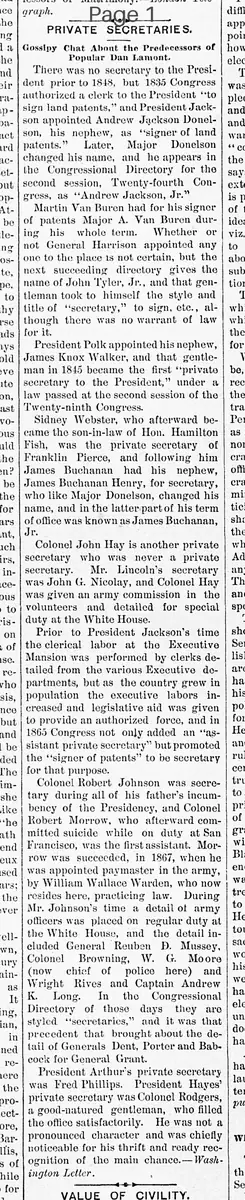
PRIVATE SECRETARIES.
Gossipy Chat About the Predecessors of Popular Dan Lamont.
There was no secretary to the President prior to 1848, but 1835 Congress authorized a clerk to the President "to sign land patents," and President Jackson appointed Andrew Jackson Donelson, his nephew, as "signer of land patents." Later, Major Donelson changed his name, and he appears in the Congressional Directory for the second session, Twenty-fourth Congress, as "Andrew Jackson, Jr."
Martin Van Buren had for his signer of patents Major A. Van Buren during his whole term. Whether or not General Harrison appointed any one to the place is not certain, but the next succeeding directory gives the name of John Tyler, Jr., and that gentleman took to himself the style and title of "secretary," to sign, etc., although there was no warrant of law for it.
President Polk appointed his nephew, James Knox Walker, and that gentleman in 1845 became the first "private secretary to the President," under a law passed at the second session of the Twenty-ninth Congress.
Sidney Webster, who afterward became the son-in-law of Hon. Hamilton Fish, was the private secretary of Franklin Pierce, and following him James Buchanan had his nephew, James Buchanan Henry, for secretary, who like Major Donelson, changed his name, and in the latter part of his term of office was known as James Buchanan, Jr.
Colonel John Hay is another private secretary who was never a private secretary. Mr. Lincoln's secretary was John G. Nicolay, and Colonel Hay was given an army commission in the volunteers and detailed for special duty at the White House.
Prior to President Jackson's time the clerical labor at the Executive Mansion was performed by clerks detailed from the various Executive departments, but as the country grew in population the executive labors increased and legislative aid was given to provide an authorized force, and in 1865 Congress not only added an "assistant private secretary" but promoted the "signer of patents" to be secretary for that purpose.
Colonel Robert Johnson was secretary during all of his father's incumbency of the Presidency, and Colonel Robert Morrow, who afterward committed suicide while on duty at San Francisco, was the first assistant. Morrow was succeeded, in 1867, when he was appointed paymaster in the army, by William Wallace Warden, who now resides here, practicing law. During Mr. Johnson's time a detail of army officers was placed on regular duty at the White House, and the detail included General Reuben D. Mussey, Colonel Browning, W. G. Moore (now chief of police here) and Wright Rives and Captain Andrew K. Long. In the Congressional Directory of those days they are styled "secretaries," and it was that precedent that brought about the detail of Generals Dent, Porter and Babcock for General Grant.
President Arthur's private secretary was Fred Phillips. President Hayes' private secretary was Colonel Rodgers, a good-natured gentleman, who filled the office satisfactorily. He was not a pronounced character and was chiefly noticeable for his thrift and ready recognition of the main chance.—Washington Letter.
Gossipy Chat About the Predecessors of Popular Dan Lamont.
There was no secretary to the President prior to 1848, but 1835 Congress authorized a clerk to the President "to sign land patents," and President Jackson appointed Andrew Jackson Donelson, his nephew, as "signer of land patents." Later, Major Donelson changed his name, and he appears in the Congressional Directory for the second session, Twenty-fourth Congress, as "Andrew Jackson, Jr."
Martin Van Buren had for his signer of patents Major A. Van Buren during his whole term. Whether or not General Harrison appointed any one to the place is not certain, but the next succeeding directory gives the name of John Tyler, Jr., and that gentleman took to himself the style and title of "secretary," to sign, etc., although there was no warrant of law for it.
President Polk appointed his nephew, James Knox Walker, and that gentleman in 1845 became the first "private secretary to the President," under a law passed at the second session of the Twenty-ninth Congress.
Sidney Webster, who afterward became the son-in-law of Hon. Hamilton Fish, was the private secretary of Franklin Pierce, and following him James Buchanan had his nephew, James Buchanan Henry, for secretary, who like Major Donelson, changed his name, and in the latter part of his term of office was known as James Buchanan, Jr.
Colonel John Hay is another private secretary who was never a private secretary. Mr. Lincoln's secretary was John G. Nicolay, and Colonel Hay was given an army commission in the volunteers and detailed for special duty at the White House.
Prior to President Jackson's time the clerical labor at the Executive Mansion was performed by clerks detailed from the various Executive departments, but as the country grew in population the executive labors increased and legislative aid was given to provide an authorized force, and in 1865 Congress not only added an "assistant private secretary" but promoted the "signer of patents" to be secretary for that purpose.
Colonel Robert Johnson was secretary during all of his father's incumbency of the Presidency, and Colonel Robert Morrow, who afterward committed suicide while on duty at San Francisco, was the first assistant. Morrow was succeeded, in 1867, when he was appointed paymaster in the army, by William Wallace Warden, who now resides here, practicing law. During Mr. Johnson's time a detail of army officers was placed on regular duty at the White House, and the detail included General Reuben D. Mussey, Colonel Browning, W. G. Moore (now chief of police here) and Wright Rives and Captain Andrew K. Long. In the Congressional Directory of those days they are styled "secretaries," and it was that precedent that brought about the detail of Generals Dent, Porter and Babcock for General Grant.
President Arthur's private secretary was Fred Phillips. President Hayes' private secretary was Colonel Rodgers, a good-natured gentleman, who filled the office satisfactorily. He was not a pronounced character and was chiefly noticeable for his thrift and ready recognition of the main chance.—Washington Letter.
What sub-type of article is it?
Biography
Historical Event
What themes does it cover?
Family
What keywords are associated?
Private Secretaries
Presidential Staff
Family Appointments
White House History
Name Changes
Military Details
What entities or persons were involved?
Andrew Jackson Donelson
Major A. Van Buren
John Tyler, Jr.
James Knox Walker
Sidney Webster
James Buchanan Henry
John G. Nicolay
John Hay
Robert Johnson
Robert Morrow
William Wallace Warden
Fred Phillips
Colonel Rodgers
Where did it happen?
White House
Story Details
Key Persons
Andrew Jackson Donelson
Major A. Van Buren
John Tyler, Jr.
James Knox Walker
Sidney Webster
James Buchanan Henry
John G. Nicolay
John Hay
Robert Johnson
Robert Morrow
William Wallace Warden
Fred Phillips
Colonel Rodgers
Location
White House
Event Date
1835 1880s
Story Details
Overview of presidential private secretaries starting from Jackson's appointee in 1835, noting family appointments, name changes, legal formalization in 1845 and 1865, and military details under Johnson and Grant.