Thank you for visiting SNEWPapers!
Sign up free
Editorial
September 28, 1812
Norfolk Gazette And Publick Ledger
Norfolk, Virginia
What is this article about?
An editorial from Boston on September 19 dismisses alarming frontier reports of a British invasion from Lower Canada as fabrications by timid talebearers. It cites recent letters and informed opinions indicating Sir George Prevost has no intention to advance, reassuring the safety of U.S. troops at Plattsburgh amid War of 1812 tensions.
Clipping
OCR Quality
95%
Excellent
Full Text
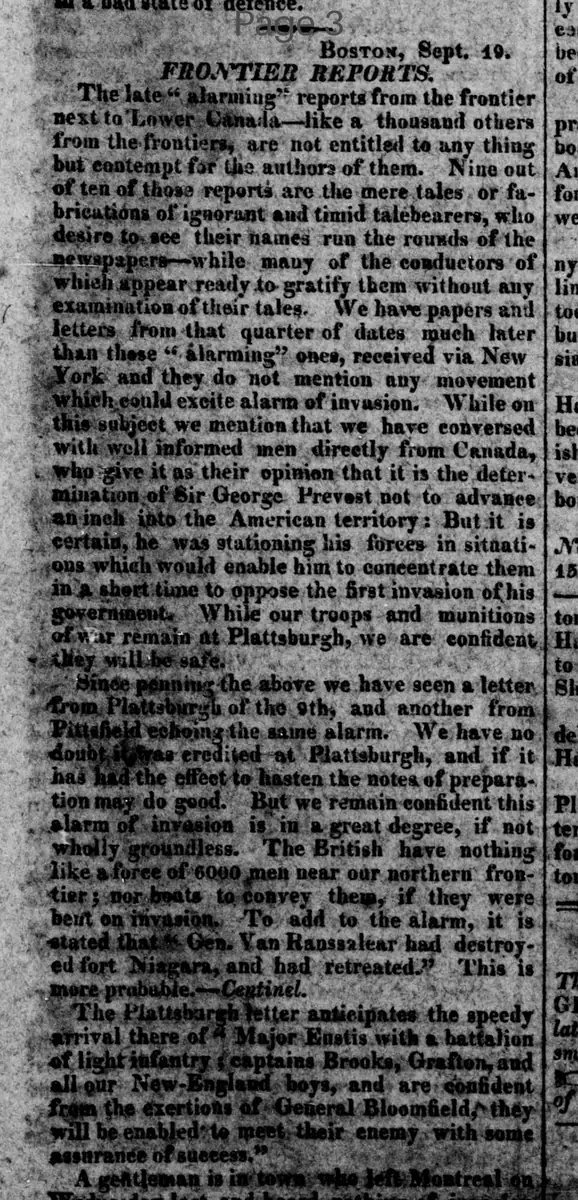
Boston, Sept. 19.
FRONTIER REPORTS.
The late alarming reports from the frontier next to Lower Canada like a thousand others from the frontier, are not entitled to any thing but contempt for the authors of them. Nine out of ten of those reports are the mere tales or fabrications of ignorant and timid talebearers, who desire to see their names run the rounds of the newspapers—while many of the conductors of which appear ready to gratify them without any examination of their tales. We have papers and letters from that quarter of dates much later than these "alarming" ones, received via New York and they do not mention any movement which could excite alarm of invasion. While on this subject we mention that we have conversed with well informed men directly from Canada, who give it as their opinion that it is the determination of Sir George Prevost not to advance an inch into the American territory: But it is certain, he was stationing his forces in situations which would enable him to concentrate them in a short time to oppose the first invasion of his government. While our troops and munitions of war remain at Plattsburgh, we are confident they will be safe.
Since penning the above we have seen a letter from Plattsburgh of the 19th and another from Pittsfield echoing the same alarm. We have no doubt it was credited at Plattsburgh, and if it has had the effect to hasten the notes of preparation may do good. But we remain confident this alarm of invasion is in a great degree, if not wholly groundless. The British have nothing like a force of 6000 men near our northern frontier nor boats to convey them, if they were bent on invasion. To add to the alarm, it is stated that Gen. Van Rensselaer had destroyed Fort Niagara and had retreated. This is more probable. Centinel.
The Plattsburgh letter anticipates the speedy arrival there of Major Eustis with a battalion of light infantry captains Brooke, Grafton—and all our New England boys, and are confident from the exertions of General Bloomfield they will be enabled to meet their enemy with some assurance of success.
FRONTIER REPORTS.
The late alarming reports from the frontier next to Lower Canada like a thousand others from the frontier, are not entitled to any thing but contempt for the authors of them. Nine out of ten of those reports are the mere tales or fabrications of ignorant and timid talebearers, who desire to see their names run the rounds of the newspapers—while many of the conductors of which appear ready to gratify them without any examination of their tales. We have papers and letters from that quarter of dates much later than these "alarming" ones, received via New York and they do not mention any movement which could excite alarm of invasion. While on this subject we mention that we have conversed with well informed men directly from Canada, who give it as their opinion that it is the determination of Sir George Prevost not to advance an inch into the American territory: But it is certain, he was stationing his forces in situations which would enable him to concentrate them in a short time to oppose the first invasion of his government. While our troops and munitions of war remain at Plattsburgh, we are confident they will be safe.
Since penning the above we have seen a letter from Plattsburgh of the 19th and another from Pittsfield echoing the same alarm. We have no doubt it was credited at Plattsburgh, and if it has had the effect to hasten the notes of preparation may do good. But we remain confident this alarm of invasion is in a great degree, if not wholly groundless. The British have nothing like a force of 6000 men near our northern frontier nor boats to convey them, if they were bent on invasion. To add to the alarm, it is stated that Gen. Van Rensselaer had destroyed Fort Niagara and had retreated. This is more probable. Centinel.
The Plattsburgh letter anticipates the speedy arrival there of Major Eustis with a battalion of light infantry captains Brooke, Grafton—and all our New England boys, and are confident from the exertions of General Bloomfield they will be enabled to meet their enemy with some assurance of success.
What sub-type of article is it?
Military Affairs
War Or Peace
What keywords are associated?
Frontier Reports
British Invasion
Plattsburgh
Sir George Prevost
War Of 1812
Military Preparedness
Canadian Frontier
What entities or persons were involved?
Sir George Prevost
Gen. Van Rensselaer
General Bloomfield
Major Eustis
Captain Brooke
Captain Grafton
Editorial Details
Primary Topic
Dismissal Of British Invasion Alarms From Canadian Frontier
Stance / Tone
Skeptical And Reassuring
Key Figures
Sir George Prevost
Gen. Van Rensselaer
General Bloomfield
Major Eustis
Captain Brooke
Captain Grafton
Key Arguments
Frontier Reports Are Mostly Fabrications By Ignorant Talebearers
Recent Papers And Letters Show No Alarming British Movements
Prevost Determined Not To Advance Into American Territory
British Lack Sufficient Forces Or Boats For Invasion
U.S. Troops At Plattsburgh Are Safe
Alarms May Hasten Preparations, Which Is Beneficial
Gen. Van Rensselaer Likely Destroyed And Retreated From Fort Niagara