Thank you for visiting SNEWPapers!
Sign up free
Alexandria Daily Advertiser
Alexandria, Virginia
What is this article about?
Analysis of the July 22 naval engagement between British fleet under Admiral Sir Robert Calder and the combined French-Spanish fleet. Discusses tactics, historical context, and reasons for limited British success, including capturing two ships amid poor weather.
Clipping
OCR Quality
Full Text
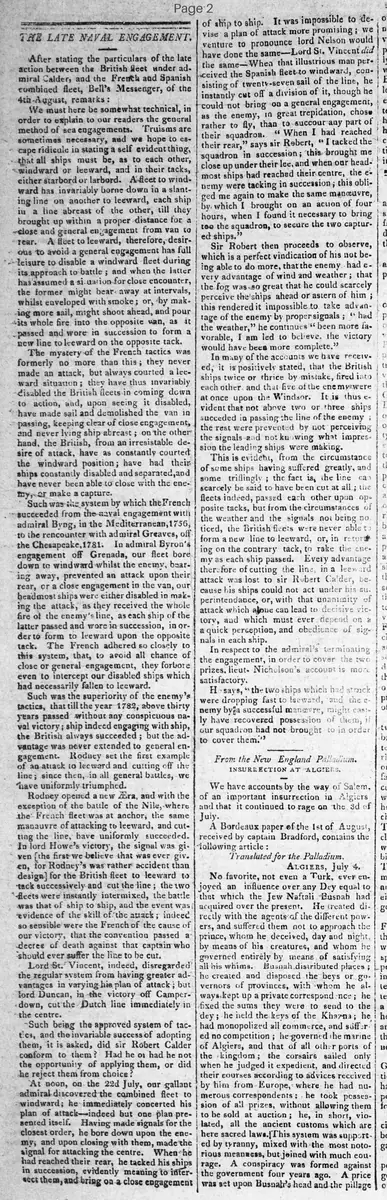
After stating the particulars of the late action between the British fleet under admiral Calder, and the French and Spanish combined fleet, Bell's Messenger, of the 4th August, remarks:
We must here be somewhat technical, in order to explain to our readers the general method of sea engagements. Truisms are sometimes necessary, and we hope to escape ridicule in stating a self evident thing, that all ships must be, as to each other, windward or leeward, and in their tacks, either starboard or larboard. A fleet to windward has invariably borne down in a slanting line on another to leeward, each ship in a line abreast of the other, till they brought up within a proper distance for a close and general engagement from van to rear. A fleet to leeward, therefore, desirous to avoid a general engagement has full leisure to disable a windward fleet during its approach to battle; and when the latter has assumed a situation for close encounter, the former might bear away at intervals, whilst enveloped with smoke; or, by making more sail, might shoot ahead, and pour its whole fire into the opposite van, as it passed and wore in succession to form a new line to leeward on the opposite tack.
The mystery of the French tactics was formerly no more than this; they never made an attack, but always courted a leeward situation; they have thus invariably disabled the British fleets in coming down to action, and, upon seeing it disabled, have made sail and demolished the van in passing, keeping clear of close engagement, and never lying ship abreast; on the other hand, the British, from an irresistible desire of attack, have as constantly courted the windward position; have had their ships constantly disabled and separated, and have never been able to close with the enemy, or make a capture.
Such was the system by which the French succeeded from the naval engagement with admiral Byng, in the Mediterranean, 1756, to the rencounter with admiral Greaves, off the Chesapeake, 1781: In admiral Byron's engagement off Grenada, our fleet bore down to windward whilst the enemy, bearing away, prevented an attack upon their rear, or a close engagement in the van, our headmost ships were either disabled in making the attack, as they received the whole fire of the enemy's line, as each ship of the latter passed and wore in succession, in order to form to leeward upon the opposite tack. The French adhered so closely to this system, that, to avoid all chance of close or general engagement, they forbore even to intercept our disabled ships which had necessarily fallen to leeward.
Such was the superiority of the enemy's tactics, that till the year 1782, above thirty years passed without any conspicuous naval victory; ship indeed engaging with ship, the British always succeeded; but the advantage was never extended to general engagement. Rodney set the first example of an attack to leeward and cutting off the line; since then, in all general battles, we have uniformly triumphed.
Rodney opened a new Era, and with the exception of the battle of the Nile, where the French fleet was at anchor; the same manoeuvre of attacking to leeward, and cutting the line, have uniformly succeeded. In lord Howe's victory, the signal was given the first we believe that was ever given, for Rodney's was rather accident than design] for the British fleet to leeward to tack successively and cut the line; the two fleets were instantly intermixed, the battle was that of ship to ship, and the event was evidence of the skill of the attack; indeed so sensible were the French of the cause of our victory, that the convention passed a decree of death against that captain who should ever suffer the line to be cut.
Lord St. Vincent, indeed, disregarded the regular system from having greater advantages in varying his plan of attack; but lord Duncan, in the victory off Camperdown, cut the Dutch line immediately in the centre.
Such being the approved system of tactics, and the invariable success of adopting them, it is asked, did sir Robert Calder conform to them? Had he or had he not the opportunity of applying them, or did he reject them from choice?
At noon, on the 22d July, our gallant admiral discovered the combined fleet to windward; he immediately concerted his plan of attack--indeed but one plan presented itself. Having made signals for the closest order, he bore down upon the enemy; and upon closing with them, made the signal for attacking the centre. When he had reached their rear, he tacked his ships in succession, evidently meaning to intersect them, and bring on a close engagement of ship to ship. It was impossible to devise a plan of attack more promising; we venture to pronounce lord Nelson would have done the same--Lord St. Vincent did the same--When that illustrious man perceived the Spanish fleet to windward, consisting of twenty-seven sail of the line, he instantly cut off a division of it, though he could not bring on a general engagement, as the enemy, in great trepidation, chose rather to fly, than to succour any part of their squadron. "When I had reached their rear," says sir Robert, "I tacked the squadron in succession; this brought me close up under their lee, and when our headmost ships had reached their centre, the enemy were tacking in succession; this obliged me again to make the same manoeuvre, by which I brought on an action of four hours, when I found it necessary to bring to the squadron, to secure the two captured ships."
Sir Robert then proceeds to observe, which is a perfect vindication of his not being able to do more, that the enemy had every advantage of wind and weather; that the fog was so great that he could scarcely perceive the ships ahead or astern of him; this rendered it impossible to take advantage of the enemy by proper signals; "had the weather," he continues "been more favorable, I am led to believe, the victory would have been more complete."
In many of the accounts we have received, it is positively stated, that the British ships twice or thrice by mistake, fired into each other, and that five of the enemy were at once upon the Windsor. It is thus evident that not above two or three ships succeeded in passing the line of the enemy: the rest were prevented by not perceiving the signals--and not knowing what impression the leading ships were making.
This is evident, from the circumstance of some ships having suffered greatly, and some triflingly; the fact is, the line can scarcely be said to have been cut at all; the fleets indeed, passed each other upon opposite tacks, but from the circumstances of the weather and the signals not being noticed, the British fleets were never able to form a new line to leeward. or, in returning on the contrary tack, to rake the enemy as each ship passed. Every advantage therefore of cutting the line, in a leeward attack was lost to sir Robert Calder, because his ships could not act under his superintendence, or, with that unanimity of attack which alone can lead to decisive victory, and which must ever depend on a quick perception, and obedience of signals in each ship.
In respect to the admiral's terminating the engagement, in order to cover the two prizes. lieut. Nicholson's account is more satisfactory. He says, "the two ships which had struck were dropping fast to leeward, and the enemy by a successful manoeuvre, might easily have recovered possession of them, if our squadron had not brought to in order to cover them."
What sub-type of article is it?
What keywords are associated?
What entities or persons were involved?
Foreign News Details
Event Date
22d July
Key Persons
Outcome
british captured two ships; action lasted four hours; limited success due to fog and weather; british ships fired into each other by mistake; enemy had wind advantage.
Event Details
British fleet under Admiral Calder engaged combined French and Spanish fleet to windward on 22 July. Calder bore down, attacked center, tacked to intersect line for close engagement, but fog prevented clear signals and unified action. Fleets passed on opposite tacks without fully cutting line; engagement ended to secure prizes as they drifted leeward.