Thank you for visiting SNEWPapers!
Sign up free
Literary
May 7, 1799
The New Hampshire Gazette
Portsmouth, Rockingham County, New Hampshire
What is this article about?
Narrative account of King Louis XVI's flight to Varennes during the French Revolution, detailing mob violence against loyal nobles Duke de Choiseul, Count de Damas, and Count de Dampiere, their narrow escapes through royal intervention and unexpected humor, and eventual imprisonment.
Merged-components note: These two components continue the same literary piece describing French Revolutionary manners, with sequential reading order and direct text continuation.
Clipping
OCR Quality
95%
Excellent
Full Text
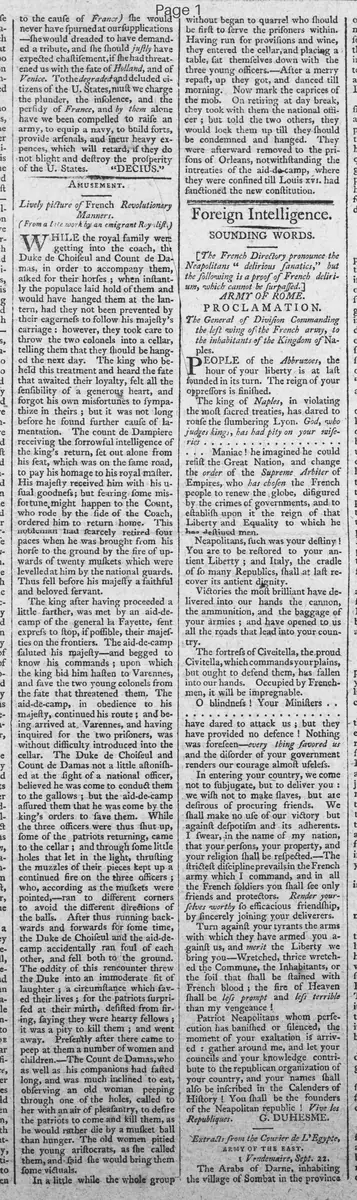
AMUSEMENT.
Lively picture of French Revolutionary
Manners.
(From a late work by an emigrant Royalist.)
WHILE the royal family were
getting into the coach, the
Duke de Choiseul and Count de Da.
mas, in order to accompany them,
asked for their horses: when instant-
ly the populace laid hold of them and
would have hanged them at the lan-
tern, had they not been prevented by
their eagerness to follow his majesty's
carriage: however, they took care to
throw the two colonels into a cellar,
telling them that they should be hang-
ed the next day. The king who be-
held this treatment and heard the fate
that awaited their loyalty, felt all the
sensibility of a generous heart, and
forgot his own misfortunes to sympa-
thize in theirs; but it was not long
before he found further cause of la-
mentation. The count de Dampiere
receiving the sorrowful intelligence of
the king's return, set out alone from
his seat, which was on the same road,
to pay his homage to his royal master.
His majesty received him with his u-
sual goodness; but fearing some mis-
fortune might happen to the Count,
who rode by the side of the Coach,
ordered him to return home. This
nobleman had scarcely retired four
paces when he was brought from his
horse to the ground by the fire of up-
wards of twenty muskets which were
levelled at him by the national guards.
Thus fell before his majesty a faithful
and beloved servant.
The king after having proceeded a
little farther, was met by an aid-de-
camp of the general la Fayette, sent
express to stop, if possible, their maje-
ities on the frontiers. The aid-de-camp
saluted his majesty--and begged to
know his commands; upon which
the king bid him hasten to Varennes,
and save the two young colonels from
the fate that threatened them. The
aid-de-camp, in obedience to his
majesty, continued his route; and be-
ing arrived at Varennes, and having
inquired for the two prisoners, was
without difficulty introduced into the
cellar. The Duke de Choiseul and
Count de Damas not a little astonish-
ed at the sight of a national officer,
believed he was come to conduct them
to the gallows; but the aid-de-camp
assured them that he was come by the
king's orders to save them. While
the three officers were thus shut up,
some of the patriots returning, came
to the cellar; and through some little
holes that let in the light, thrusting
the muzzles of their pieces kept up a
continued fire on the three officers;
who, according as the muskets were
pointed,--ran to different corners
to avoid the different directions of
the balls. After thus running back-
wards and forwards for some time,
the Duke de Choiseul and the aid-de-
camp accidentally ran foul of each
other, and fell both to the ground.
The oddity of this rencounter threw
the Duke into an immoderate fit of
laughter; a circumstance which av-
ed their lives; for the patriots surpri-
sed at their mirth, desisted from fir-
ing, saying they were hearty fellows;
it was a pity to kill them; and went
away. Presently after there came to
peep at them a number of women and
children.--The Count de Damas, who
as well as his companions had fasted
long, and was much inclined to eat,
observing an old woman peeping
through one of the holes, called to
her with an air of pleasantry, to desire
the patriots to come and kill them, as
he would rather die by a musket ball
than hunger. The old woman pitied
the young aristocrats, as he called
them, and said she would bring them
some victuals,
In a little while the whole group
without began to quarrel who should
be first to serve the prisoners within.
Having run for provisions and wine,
they entered the cellar, and placing a
table, sat themselves down with the
three young officers.--After a merry
repast, up they got, and danced till
morning. Now mark the caprices of
the mob. On retiring at day break,
they took with them the national offi-
cer; but told the two others, they
would lock them up till they should
be condemned and hanged. They
were afterward removed to the pri-
sons of Orleans, notwithstanding the
intreaties of the aid-de-camp, where
they were confined till Louis XVI. had
sanctioned the new constitution.
Lively picture of French Revolutionary
Manners.
(From a late work by an emigrant Royalist.)
WHILE the royal family were
getting into the coach, the
Duke de Choiseul and Count de Da.
mas, in order to accompany them,
asked for their horses: when instant-
ly the populace laid hold of them and
would have hanged them at the lan-
tern, had they not been prevented by
their eagerness to follow his majesty's
carriage: however, they took care to
throw the two colonels into a cellar,
telling them that they should be hang-
ed the next day. The king who be-
held this treatment and heard the fate
that awaited their loyalty, felt all the
sensibility of a generous heart, and
forgot his own misfortunes to sympa-
thize in theirs; but it was not long
before he found further cause of la-
mentation. The count de Dampiere
receiving the sorrowful intelligence of
the king's return, set out alone from
his seat, which was on the same road,
to pay his homage to his royal master.
His majesty received him with his u-
sual goodness; but fearing some mis-
fortune might happen to the Count,
who rode by the side of the Coach,
ordered him to return home. This
nobleman had scarcely retired four
paces when he was brought from his
horse to the ground by the fire of up-
wards of twenty muskets which were
levelled at him by the national guards.
Thus fell before his majesty a faithful
and beloved servant.
The king after having proceeded a
little farther, was met by an aid-de-
camp of the general la Fayette, sent
express to stop, if possible, their maje-
ities on the frontiers. The aid-de-camp
saluted his majesty--and begged to
know his commands; upon which
the king bid him hasten to Varennes,
and save the two young colonels from
the fate that threatened them. The
aid-de-camp, in obedience to his
majesty, continued his route; and be-
ing arrived at Varennes, and having
inquired for the two prisoners, was
without difficulty introduced into the
cellar. The Duke de Choiseul and
Count de Damas not a little astonish-
ed at the sight of a national officer,
believed he was come to conduct them
to the gallows; but the aid-de-camp
assured them that he was come by the
king's orders to save them. While
the three officers were thus shut up,
some of the patriots returning, came
to the cellar; and through some little
holes that let in the light, thrusting
the muzzles of their pieces kept up a
continued fire on the three officers;
who, according as the muskets were
pointed,--ran to different corners
to avoid the different directions of
the balls. After thus running back-
wards and forwards for some time,
the Duke de Choiseul and the aid-de-
camp accidentally ran foul of each
other, and fell both to the ground.
The oddity of this rencounter threw
the Duke into an immoderate fit of
laughter; a circumstance which av-
ed their lives; for the patriots surpri-
sed at their mirth, desisted from fir-
ing, saying they were hearty fellows;
it was a pity to kill them; and went
away. Presently after there came to
peep at them a number of women and
children.--The Count de Damas, who
as well as his companions had fasted
long, and was much inclined to eat,
observing an old woman peeping
through one of the holes, called to
her with an air of pleasantry, to desire
the patriots to come and kill them, as
he would rather die by a musket ball
than hunger. The old woman pitied
the young aristocrats, as he called
them, and said she would bring them
some victuals,
In a little while the whole group
without began to quarrel who should
be first to serve the prisoners within.
Having run for provisions and wine,
they entered the cellar, and placing a
table, sat themselves down with the
three young officers.--After a merry
repast, up they got, and danced till
morning. Now mark the caprices of
the mob. On retiring at day break,
they took with them the national offi-
cer; but told the two others, they
would lock them up till they should
be condemned and hanged. They
were afterward removed to the pri-
sons of Orleans, notwithstanding the
intreaties of the aid-de-camp, where
they were confined till Louis XVI. had
sanctioned the new constitution.
What sub-type of article is it?
Prose Fiction
What themes does it cover?
Political
Liberty Freedom
Taxation Oppression
What keywords are associated?
French Revolution
Varennes Flight
King Louis Xvi
Royalists
Mob Violence
Loyalty
National Guards
What entities or persons were involved?
From A Late Work By An Emigrant Royalist.
Literary Details
Title
Lively Picture Of French Revolutionary Manners.
Author
From A Late Work By An Emigrant Royalist.
Key Lines
Thus Fell Before His Majesty A Faithful And Beloved Servant.
The Oddity Of This Rencounter Threw The Duke Into An Immoderate Fit Of Laughter; A Circumstance Which Aved Their Lives;
Now Mark The Caprices Of The Mob.