Thank you for visiting SNEWPapers!
Sign up free
Editorial
July 20, 1874
Orleans County Monitor
Barton, Orleans County, Vermont
What is this article about?
Rhetorical editorial questions the affordability of self-destructive habits like overwork, hasty eating, rich foods, indulgence in appetites, fast living, and tobacco use, which lead to disease and financial waste. Provides hints on sleep for mental workers and calculates savings from avoiding tobacco.
Clipping
OCR Quality
98%
Excellent
Full Text
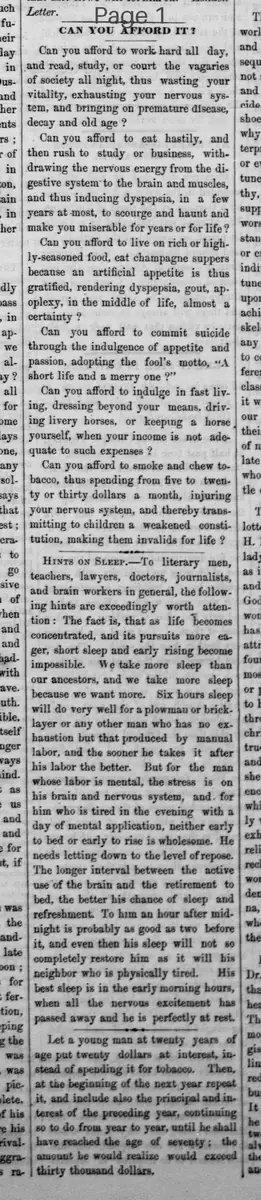
CAN YOU AFFORD IT?
Can you afford to work hard all day,
and read, study, or court the vagaries
of society all night, thus wasting your
vitality, exhausting your nervous system, and bringing on premature disease,
decay and old age ?
Can you afford to eat hastily, and
then rush to study or business, withdrawing the nervous energy from the digestive system to the brain and muscles,
and thus inducing dyspepsia, in a few
years at most, to scourge and haunt and
make you miserable for years or for life?
Can you afford to live on rich or highly-seasoned food, eat champagne suppers
because an artificial appetite is thus
gratified, rendering dyspepsia, gout, apoplexy, in the middle of life, almost a
certainty?
Can you afford to commit suicide
through the indulgence of appetite and
passion, adopting the fool's motto, A
short life and a merry one ?"
Can you afford to indulge in fast living, dressing beyond your means. driving livery horses, or keeping a horse
yourself, when your income is not adequate to such expenses ?
Can you afford to smoke and chew tobacco, thus spending from five to twenty or thirty dollars a month, injuring
your nervous system, and thereby transmitting to children a weakened constitution, making them invalids for life ?
Hints on Sleep. To literary men,
teachers, lawyers, doctors, journalists,
and brain workers in general, the following hints are exceedingly worth attention: The fact is, that as life becomes
concentrated, and its pursuits more eager, short sleep and early rising become
impossible. We take more sleep than
our ancestors, and we take more sleep
because we want more. Six hours sleep
will do very well for a plowman or bricklayer or any other man who has no exhaustion but that produced by manual
labor, and the sooner he takes it after
his labor the better. But or the man
whose labor is mental, the stress is on
his brain and nervous system, and. for
him who is tired in the evening with a
day of mental application, neither early
to bed or early to rise is wholesome. He
needs letting down to the level of repose.
The longer interval between the active
use of the brain and the retirement to
bed. the better his chance of sleep and
refreshment. To him an hour after midnight is probably as good as two before
it, and even then his sleep will not so
completely restore him as it will his
neighbor who is physically tired. His
best sleep is in the early morning hours,
when all the nervous excitement has
passed away and he is perfectly at rest.
Let a young man at twenty years of
age put twenty dollars at interest, instead of spending it for tobacco. Then,
at the beginning of the next year repeat
it, and include also the principal and interest of the preceding year, continuing
so to do from year to year, until he shall
have reached the age of seventy; the amount he would realize would exceed
thirty thousand dollars.
Can you afford to work hard all day,
and read, study, or court the vagaries
of society all night, thus wasting your
vitality, exhausting your nervous system, and bringing on premature disease,
decay and old age ?
Can you afford to eat hastily, and
then rush to study or business, withdrawing the nervous energy from the digestive system to the brain and muscles,
and thus inducing dyspepsia, in a few
years at most, to scourge and haunt and
make you miserable for years or for life?
Can you afford to live on rich or highly-seasoned food, eat champagne suppers
because an artificial appetite is thus
gratified, rendering dyspepsia, gout, apoplexy, in the middle of life, almost a
certainty?
Can you afford to commit suicide
through the indulgence of appetite and
passion, adopting the fool's motto, A
short life and a merry one ?"
Can you afford to indulge in fast living, dressing beyond your means. driving livery horses, or keeping a horse
yourself, when your income is not adequate to such expenses ?
Can you afford to smoke and chew tobacco, thus spending from five to twenty or thirty dollars a month, injuring
your nervous system, and thereby transmitting to children a weakened constitution, making them invalids for life ?
Hints on Sleep. To literary men,
teachers, lawyers, doctors, journalists,
and brain workers in general, the following hints are exceedingly worth attention: The fact is, that as life becomes
concentrated, and its pursuits more eager, short sleep and early rising become
impossible. We take more sleep than
our ancestors, and we take more sleep
because we want more. Six hours sleep
will do very well for a plowman or bricklayer or any other man who has no exhaustion but that produced by manual
labor, and the sooner he takes it after
his labor the better. But or the man
whose labor is mental, the stress is on
his brain and nervous system, and. for
him who is tired in the evening with a
day of mental application, neither early
to bed or early to rise is wholesome. He
needs letting down to the level of repose.
The longer interval between the active
use of the brain and the retirement to
bed. the better his chance of sleep and
refreshment. To him an hour after midnight is probably as good as two before
it, and even then his sleep will not so
completely restore him as it will his
neighbor who is physically tired. His
best sleep is in the early morning hours,
when all the nervous excitement has
passed away and he is perfectly at rest.
Let a young man at twenty years of
age put twenty dollars at interest, instead of spending it for tobacco. Then,
at the beginning of the next year repeat
it, and include also the principal and interest of the preceding year, continuing
so to do from year to year, until he shall
have reached the age of seventy; the amount he would realize would exceed
thirty thousand dollars.
What sub-type of article is it?
Moral Or Religious
Social Reform
Science Or Medicine
What keywords are associated?
Health Warnings
Lifestyle Vices
Anti Tobacco
Sleep Advice
Financial Thrift
Dyspepsia
Nervous System
Moral Reform
Editorial Details
Primary Topic
Warnings Against Unhealthy And Extravagant Lifestyles
Stance / Tone
Moral Exhortation Against Vices
Key Arguments
Overwork And Late Night Activities Waste Vitality And Cause Premature Disease.
Hasty Eating Diverts Energy From Digestion, Leading To Dyspepsia.
Rich Foods And Indulgences Guarantee Diseases Like Gout And Apoplexy.
Indulging Appetites Shortens Life.
Fast Living And Extravagance Exceed Means.
Smoking And Chewing Tobacco Harm Nerves, Weaken Offspring, And Waste Money.
Mental Workers Need More Sleep, Best In Early Morning Hours.
Saving Tobacco Money From Age 20 To 70 Yields Over $30,000.