Thank you for visiting SNEWPapers!
Sign up free
Richmond Enquirer
Richmond, Richmond County, Virginia
What is this article about?
Joint committee of New York Senate and Assembly reports on Governor's January 18 message accusing federal officers of interfering in state elections; finds no evidence of organized misconduct, defends officers' voting rights, and exonerates specific individuals like General Swift and Col. Decatur.
Merged-components note: Continuation of the report on the joint committee of the Senate and Assembly regarding the Governor's message implicating federal officers in state elections; sequential reading order and direct text continuation across components and pages.
Clippings
1 of 2
OCR Quality
Full Text
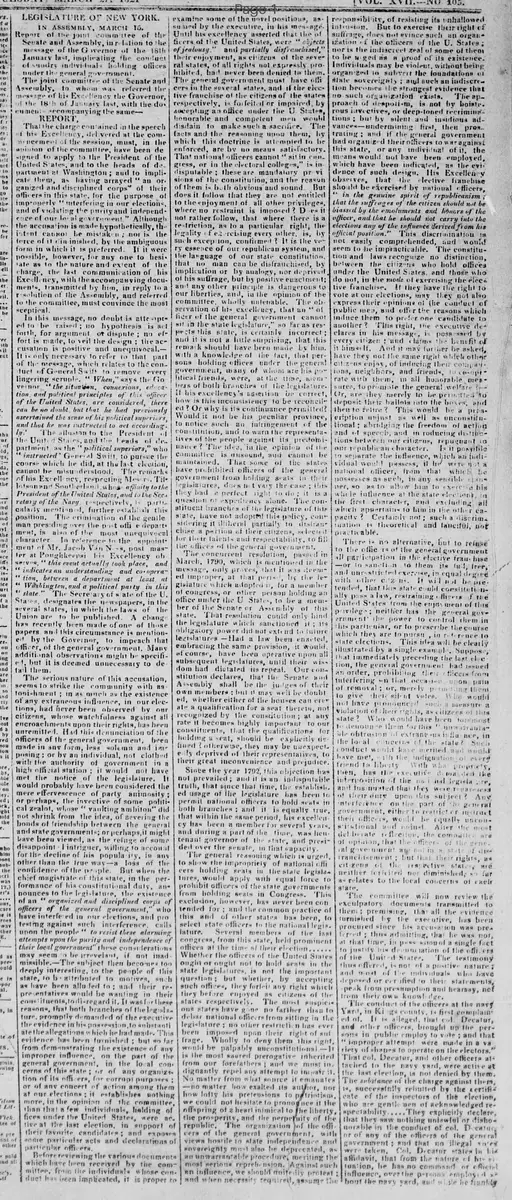
Report of the joint committee of the Senate and Assembly, in relation to the message of the Governor of the 18th January last, implicating the conduct of sundry individuals holding offices under the general government.
The joint committee of the Senate and Assembly, to whom was referred the message of his Excellency the Governor, of the 18th of January last, with the documents accompanying the same—
REPORT.
That the charge contained in the speech of his Excellency, delivered at the commencement of the session, must, in the opinion of the committee, have been designed to apply to the President of the United States, and to the heads of department at Washington: and to implicate them, as having arrayed "an organized and disciplined corps" of their officers in this state, for the purpose of improperly "interfering in our elections, and of violating the purity and independence of our local government." Although the accusation is made hypothetically, the intent cannot be mistaken; nor is the force of it diminished, by the ambiguous form in which it is preferred. If it were possible, however, for any one to hesitate as to the nature and extent of the charge, the last communication of his Excellency, with the accompanying documents, transmitted by him, in reply to a resolution of the Assembly, and referred to the committee, must convince the most sceptical.
In this message, no doubt is attempted to be raised: no hypothesis is set forth, for argument or dispute: no effort is made, to veil the design; the accusation is positive and unequivocal.— It is only necessary to refer to that part of the message, which relates to the conduct of General Swift to remove every lingering scruple. "When," says the Governor "the situation, connections, education, and political principles of this officer of the United States, are considered, there can be no doubt, but that he had previously ascertained the sense of his political superiors, and that he was instructed to act accordingly."
The allusion to the President of the United States, and the heads of department, as the "political superiors," who "instructed" General Swift to pursue the course which he did, at the last election, cannot be misunderstood. The remarks of his Excellency, respecting Messrs. Tilghman and Southerland, whose affinity to the President of the United States, and to the Secretary of the Navy, respectively, is particularly mentioned, further establish this position. The crimination of the gentleman presiding over the post office department, is also of the most unequivocal character In reference to the appointment of Mr. Jacob Van Ness, post master at Poughkeepsie his Excellency observes "this event actually took place, and indicates an understanding and co-operation, between a department at least, at "Washington, and a political party in this "state." The Secretary of state of the U. States, designates the newspapers, in the several states, in which the laws of the Union are to be published. A change has recently been made of one of those papers and this circumstance is mentioned by the Governor, to impeach that officer, of the general government. Many additional observations might be specified, but it is deemed unnecessary to detail them.
The serious nature of this accusation, seems to strike the community with astonishment; in as much as the existence of any extraneous influence, in our elections, had never been observed by our citizens, whose watchfulness against all encroachments upon their rights, has been unremitted. Had this denunciation of the officers of the general government, been made in any form, less solemn and imposing: or by an individual, not clothed with the authority of government in a high official station: it would not have met the notice of the legislature. It would probably have been considered the mere effervescence of party animosity; or perhaps, the invective of some political zealot, whose "vaulting ambition" did not shrink from the idea, of severing the bonds of friendship between the general and state governments; or perhaps, it might have been viewed, as the refuge of some disappointed intriguer, willing to account for the decline of his popularity, in any other than the true way—a loss of the confidence of the people. But when the chief magistrate of this state, in the performance of his constitutional duty, announces to the legislature, the existence of an "organized and disciplined corps of officers of the general government," who have interfered in our elections, and protesting against such interference, calls upon the people "to resist these alarming attempts upon the purity and independence of their local government" these considerations may seem to be irrelevant, if not inadmissible.—The subject then becomes too deeply interesting, to the people of this state, to be attributed to motives, such as have been alluded to: and their representatives would be wanting in their constituents, to disregard it. It was for these reasons, that both branches of the legislature, promptly demanded of the executive the evidence in his possession, to substantiate the allegations which he had made. This evidence has been furnished: but so far from demonstrating the existence of any improper influence, on the part of the general government, in the local concerns of this state; or of any organization of its officers, for corrupt purposes; or of any concert of action among them at our elections; it establishes nothing more, in the opinion of the committee, than that a few individuals, holding offices under the United States, were active at the last election, in support of their favorite candidates: and exposes some particular acts and declarations of particular officers.
Before reviewing the various documents which have been received by the committee, from the individuals whose conduct has been implicated, it is proper to examine some of the novel positions, assumed by the executive, in his message.
Until his excellency asserted that the officers of the United States, were "objects of jealousy," and partially disfranchised, their enjoyment, as citizens of the several states, of all rights not expressly prohibited, had never been denied to them. The general government must have officers in the several states, and if the elective franchise of the citizens of the states respectively, is forfeited or impaired, by accepting an office under the U States honorable and competent men would disdain to make such a sacrifice. The facts and the reasoning upon them, by which this doctrine is attempted to be enforced, are by no means satisfactory.
That national officers cannot "sit in congress, or in the electoral colleges," is indisputable: these are mandatory provisions of the constitution, and the reason of them is both obvious and sound. But does it follow that they are not entitled to the enjoyment of all other privileges, where no restraint is imposed? Does it not rather follow, that where there is a restriction, as to a particular right, the legality of exercising every other, is, by such exception, confirmed? It is the very essence of our republican system, and the language of our state constitution, that no man can be disfranchised, by implication or by analogy, nor deprived of his suffrage, but by positive enactment; and any other principle is dangerous to our liberties, and, in the opinion of the committee, wholly untenable. The observation of his excellency, that an "officer of the general government cannot sit in the state legislature," so far as respects this state, is certainly incorrect; and it is not a little surprising, that this remark should have been made by him, with a knowledge of the fact, that persons holding offices under the general government, many of whom are his political friends, were, at the time, members of both branches of the legislature.
If his excellency's assertion be correct, how is this inconsistency to be reconciled? Or why is its continuance permitted? Would it not be his peculiar province, to notice such an infringement of the constitution, and to warn the representatives of the people against its predominance? The idea, in the opinion of the committee is misuse, and cannot be maintained. That some of the states have prohibited officers of the general government from holding seats in their legislatures, does not vary the case: this they had a perfect right to do: it is a question of expediency alone. The constituent branches of the Legislature of this state, have not adopted this policy, considering it illiberal partially to disfranchise a portion of their citizens, selected for their talents and respectability, to fill the offices of the general government.
The concurrent resolution, passed in March, 1792, which is mentioned in the message, only proves, that it was deemed improper, at that period, by the legislature which adopted it, for a member of congress, or other person holding an office under the U States, to be a member of the Senate or Assembly of this state. That resolution could only bind the legislature which sanctioned it; its obligatory power did not extend to future legislatures—Had a law been enacted, embracing the same provision, it would, of course, have been operative upon all subsequent legislatures, until their wisdom had dictated its repeal. Our constitution declares, that the Senate and Assembly shall be the judges of their own members: but it may well be doubted, whether either of the houses can create a qualification for a seat there in, not recognized by the constitution; at any rate it becomes highly important to our constituents, that the qualifications for holding a seat, should be explicitly defined? otherwise, they may be unexpectedly deprived of their representatives, to their great inconvenience and prejudice.
Since the year 1792, this objection has not prevailed; and it is an indisputable truth, that since that time, the established usage of the legislature has been to permit national officers to hold seats in both branches: and it is equally true, that within the same period, his excellency has been a member for several years, and during a part of the time, was lieutenant governor of the state, and presided over the senate, in that capacity.
The general reasoning which is urged, to show the impropriety of national officers holding seats in the state legislatures, would apply with equal force to prohibit officers of the state governments from holding seats in Congress. This exclusion, however, has never been contended for: and the common practice of this and of other states has been, to select state officers to the national legislature. Several members of the last congress, from this state, held prominent offices at the time of their election.
Whether the officers of the United States ought or ought not to hold seats in the state legislatures, is not the important question; but whether, by accepting such offices, they forfeit any right which they before enjoyed as citizens of the states respectively. The most suspicious states have gone no farther than to debar national officers from sitting in the legislature: no other restriction has ever been imposed upon their right of suffrage. Wholly to deny them this right, would be palpably unconstitutional—It is the most sacred prerogative inherited from our forefathers: and we must indignantly repel any attempt to impair it. No matter from what source it emanates—no matter how exalted its author, nor how lofty his pretensions to patriotism, we could not hesitate to pronounce it the offspring of a heart inimical to the liberty, the prosperity, and the perpetuity of the republic. The organization of the officers of the general government, with views hostile to state independence and sovereignty must also be deprecated, as an unwarrantable procedure meriting the most serious reprehension. Against such an influence, we should unitedly protest and when necessity required, assume the responsibility of resisting its unhallowed intrusion. But to exercise their right of suffrage, does not evince such an organization of the officers of the U. States: nor is the indiscreet zeal of some of them to be urged as a proof of its existence.
Individuals may be violent, without being organized to subvert the foundations of state sovereignty: and such an indiscretion becomes the strongest evidence that no such organization exists. The approach of despotism, is not by boisterous invectives, or deep-toned recriminations; but by silent and insidious advances—undermining first, then prostrating: and if the general government had organized their officers to war against this state, or any individual of it, the means would not have been employed, which have been indicated, as the evidence of such design. His Excellency observes, that the elective franchise should be exercised by national officers, "in the genuine spirit of republicanism; that the suffrages of the citizen should not be biassed by the emoluments and honors of the officer, and that he should not carry into the elections any of the influence derived from his official position." This discrimination is not easily comprehended, and would seem to be impracticable. The constitution and laws recognize no distinction, between the citizens who hold offices under the United States, and those who do not, in the mode of exercising the elective franchise. If they have the right to vote at our elections, may they not also express their opinions of the conduct of public men, and offer the reasons which induce them to prefer one candidate to another? This right, the executive declares in his message, is possessed by every citizen; and claims the benefit of it himself. And it may further be asked, have they not the same right which other citizens enjoy, of inducing their companions, neighbors, and friends, to co-operate with them, in all honorable measures, to promote the general welfare ?— Or, are they merely to be permitted to deposit their ballots into the boxes, and then to retire? This would be a proscription as well as unconstitutional: abridging the freedom of action and of speech, and introducing distinctions between our citizens, repugnant to our republican character.
Is it possible to separate the influence, which an individual would possess, if he were not a national officer, from that which he possesses as such, in any sensible manner, so as to allow him to exercise his whole influence at the state election, in the first character, and excluding all which appertains to him in the other capacity? Certainly not; such a discrimination is theoretical and fanciful, not practicable.
There is no alternative, but to refuse to the officers of the general government all participation in the elective franchise—or to sanction to them its full, free, and unrestricted exercise, in equal degree with other citizens. It will not be pretended, that this state could constitutionally pass a law, restraining officers of the United States from the enjoyment of this privilege: neither has the general government the power to control them in this particular, or to prescribe the course which they are to pursue, in reference to state elections. This idea will be clearly illustrated by a single example. Suppose, that immediately preceding the last election, the general government had issued an order, prohibiting their officers from interfering in that occasion upon pain of removal; or, merely permitting them to give their silent votes. Who would not have pronounced such a measure a violation of their rights, as citizens of this state? Who would have been foremost to denounce them forth as the "unwarrantable obtrusion of extraneous influence, in the local concerns of the state?" Such conduct would have merited and would have met with the indignation of every friend to liberty With what propriety, then, has the executive demanded the interposition of the national legislature, and insinuated that they were remiss in their duty upon this subject? Any interference on the part of the general government, either to restrict or instruct their officers, would be equally unconstitutional and unwise After the most deliberate reflection, the committee are of opinion, that the officers of the general government are not in a state of partial disfranchisement: but that their rights, as citizens of the respective states are neither interfered with nor diminished so far as relates to the local concerns of each state.
The committee will now review the exculpatory documents transmitted to them: premising, that all the evidence furnished by the executive, has been procured since his accusation was presented: thus admitting, that he was not, at that time, in possession of a single fact to justify his denunciation of the officers of the United States. The testimony thus offered, is not of a positive nature: and most of the individuals who have deposed or certified to their statements, speak from presumption and hearsay, not from their own knowledge.
The conduct of the officers at the navy Yard, in Kings county, is first complained of. It is alleged, that col Decatur, and other officers, brought up the persons in public employ to vote; and that "improper attempts were made in a variety of shapes to operate on the electors."
That col. Decatur, and other officers attached to the navy yard, were active at the last election, is not denied by them. The substance of the charge against them, is successfully rebutted by the certificate of the inspectors of the election, who are gentlemen of acknowledged respectability. They explicitly declare, that they saw nothing unlawful or dishonorable in the conduct of col. Decatur or of any of the officers of the general government: and that no illegal votes were taken. Col. Decatur states in his affidavit, that from the nature of his situation, he has no command or official influence, over the persons employed about the navy yard, and while he thinks avows his zeal for the public good, and the motives which actuated him. He disclaims all interference on the part of the general government, or of any officer, dependent, or agent thereof. The affidavit of George S. Wise, jun. purser of the navy yard, is of similar import: and the other documents relative to his conduct, are altogether satisfactory. By the affidavit of sailing master Bloodgood, it appears, that the quarrel alluded to, in one of the certificates communicated by his excellency, was of a private and not of a political nature; and the influence of an officer of the general government over him, is denied. The affidavit of Amos Dickinson, the master blacksmith, of Amos Cheney, master laborer, and of James Cosgrove, gunner, exculpate col. Delafield, and every other person, from the imputation of influencing their conduct: and show, that those individuals conceived, that they were exercising nothing more than their undoubted rights as free citizens, at the last election. The certificates of Dr. Hunt, and of the Rev. Mr. Ireland, are conclusive, as to that part of the subject connected with their names; and must convince every man, that no undue influence could have operated upon gentlemen, entertaining that high sense of honor, which is their characteristic. The letter from Mr. Brockholst Livingston jun. is in reply to a part of the certificate of Mr. John Hunter, contained among the documents furnished by the governor, in which Mr. Livingston is untruly stated to be a custom house officer. This letter was addressed to a member of the Senate, before the reference of the message to the committee, was known at Brooklyn, and is introduced with the consent of the author. The committee can discover no reason for supposing, that the general government interfered at all, in the election in Kings county; nor that any organization of its officers existed. No illegal votes were taken; no person was compelled to vote, contrary to the dictates of his own judgment; and the republican candidate, who had represented the county, the preceding year, and was again supported for the assembly, failed in his election. The number of votes given for governor, was about the same as on former occasions: and their political complexion did not materially vary. The documents referred to, are marked "Navy Yard." From Nos. 1, to 13, inclusive.
The documents received from the surveyor of the port of New York, completely exonerate him from all censure. The offence of this gentleman is, that he attended a meeting of the electors of the county in which he resided, and was appointed one of a committee, to prepare resolutions for their consideration, which were afterwards reported and adopted as the sense of the meeting. These resolutions approbate the conduct of the Vice President, during the late war; and severely animadvert upon the political course of his Excellency: but it does not appear that General Swift had any further agency in this transaction, than the other members of the committee. The letter from General Swift states, that he did not even know the political sentiments of his own deputy, nor of his subordinate officers, whom he is accused of influencing. Many of the individuals attached to the custom house, in New York, who have subscribed the certificate marked "Custom House, New York." No. 2, are warm adherents of the Governor, and exerted themselves at the last election, in his support. The letter of Mr. Beckman, Mr. Van Beuren, and also that of the deputy surveyor, Mr. Samuel Terry, both of whom are his avowed friends, furnish additional testimony of the injustice of the attack upon Gen. Swift: and of the deep regret, with which those gentlemen had seen it made. The letters of Messrs. Jones, Darling, and Wood, and the certificates of Messrs. Anderson & Gahagan, corroborate the others; and prove, how highly our citizens value the elective franchise, by their solemn protest against any encroachment upon its lawful exercise. It is necessary to remark, that the individual by whose affidavit the conduct of the custom house officers is impeached, was, at the time, an inspector of leather, holding his office under the "state administration." The documents referred to are marked "Custom House, New York," from No. 1 to 9, inclusive.
The conduct of the two inspectors at Staten Island, Messrs. Van Beuren and Arnett, is adverted to, as connected with the department under the superintendence of Gen. Swift. Those individuals have long been known as active republicans, at our elections. The certificate of the inspectors of the election, marked "Custom House, Staten Island, No. 1," exonerates them from the charge of improper conduct, and fixes it upon one of their accusers, whose outrageous and scandalous behavior, caused the inspectors to feel some apprehension for the safety of the ballot boxes, and the offender would have been committed to prison, had the proper officer been present. The numerous affidavits accompanying this report, detail a state of facts relative to the certificates transmitted by his excellency, upon this part of the case, which must excite much mortification and disgust. Some of them were obtained, from persons who could neither read nor write; and who, being intoxicated at the time, were induced to assent to what they have since confessed was false. With the standing of the persons who procured them, Messrs. Garrit Gubert and Joshua Secor, the public are already sufficiently well acquainted. Every material fact contained in them, is disproved: the characters of those who have certified, are impeached, both morally and politically; and the whole, in the opinion of the committee, exhibits an abortive effort to arouse jealousy, and discontent, without any rational ground for excitement. That the Vice President should be assailed by such men, is no reproach: but the attempt to fasten upon him the crime of executing a deed for property, by way of present, and for the purpose of procuring the votes of electors in his favor, is not merely characteristic of the persecution which has been levelled against him, but manifests a greater degree of malignity, than could well have been imagined. The documents, relative to the election on Staten Island, are marked "Custom House, Staten Island," from No. 1 to No. 12, inclusive.
(Remainder in our next)
What sub-type of article is it?
What themes does it cover?
What keywords are associated?
What entities or persons were involved?
Where did it happen?
Story Details
Key Persons
Location
New York State
Event Date
March 10
Story Details
Joint committee report refuting Governor's accusations of federal officers interfering in state elections, defending their rights as citizens and reviewing evidence that shows no organized improper influence.