Thank you for visiting SNEWPapers!
Sign up free
Lynchburg Virginian
Lynchburg, Virginia
What is this article about?
Extract from a 1836 letter by Rep. Henry A. Wise accusing Reuben M. Whitney of corrupt dealings as an agent for U.S. deposite banks, speculating on public funds under Treasury Secretary Woodbury and President Jackson, with defenses against official denials. (214 characters)
Merged-components note: Continuation of the letter from Hon. Henry A. Wise regarding accusations against the administration.
Clipping
OCR Quality
Full Text
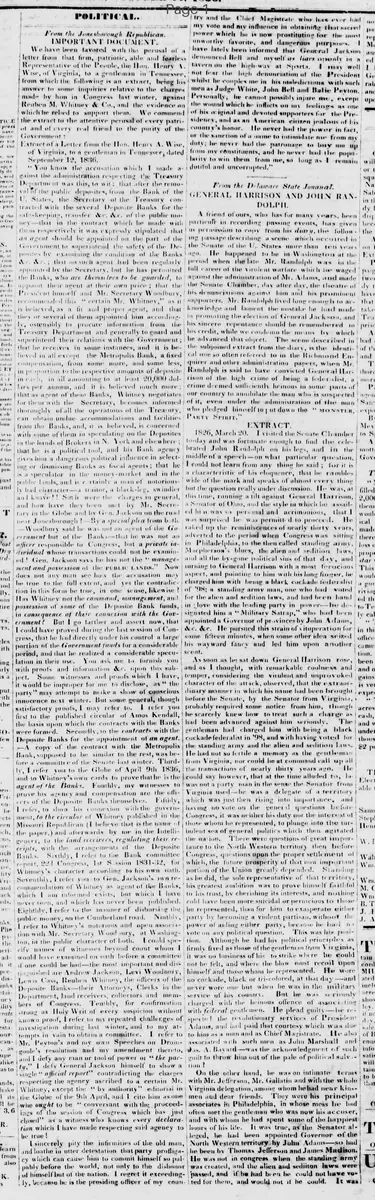
IMPORTANT DOCUMENT.
We have been favored with the perusal of a letter from that firm, patriotic, able and fearless Representative of the People, the Hon. Henry A. Wise, of Virginia, to a gentleman in Tennessee,
from which the following is an extract, being his answer to some inquiries relative to the charges made by him in Congress last winter against Reuben M. Whitney & Co., and the evidence on which he relied to support them. We commend the extract to the attentive perusal of every patriot and of every real friend to the purity of the Government:
Extract of a Letter from the Hon. Henry A. Wise, of Virginia, to a gentleman in Tennessee, dated September 12, 1836.
"You know the accusation which I made against the administration respecting the Treasury Department was this, to wit: that after the removal of the public deposites, from the Bank of the U. States, the Secretary of the Treasury contracted with the several Deposite Banks for the safe-keeping, transfer &c. &c. of the public money-that in the contract which he made with them respectively it was expressly stipulated that an agent should be appointed on the part of the Government to superintend the safety of the Deposites by examining the condition of the Banks &c. &c.; that no such agent had been regularly appointed by the Secretary, but he has permitted the Banks, who are themselves to be guarded, to appoint their agent at their own price; that the President himself and Mr. Secretary Woodbury,
recommended this "certain Mr. Whitney," as it is believed, as a fit and proper agent, and that they or several of them appointed him accordingly, ostensibly to procure information from the Treasury Department and generally to guard and superintend their relations with the Government; that he receives, in some instances, and it is believed in all except the Metropolis Bank, a fixed compensation, from some more, and some less,
in proportion to the respective amounts of deposite in each, in all amounting to at least 20,000 dollars per annum, and it is believed much more; that as agent of these Banks, Whitney negotiates for them with the Secretary, becomes informed thoroughly of all the operations of the Treasury,
can obtain undue accommodations and facilities from the Banks, and, it is believed, is concerned with some of them in speculating on the Deposites in the hands of Brokers in N. York and elsewhere; that he is a political tool, and his Bank agency gives him a dangerous political influence in selecting or dismissing Banks as fiscal agents; that he is a speculator in the money-market and in the public lands, and is certainly a man of notoriously bad character-a traitor, a black-leg, swindler and knave!! Such were the charges in general, and how have they been met by Mr. Secretary in the Globe and by Gen. Jackson on the road near Jonesborough? -By a special plea from both. —Woodbury said he was not an agent of the Government but of the Banks-that he was not an officer responsible to Congress, but a private individual whose transactions could not be examined! Gen. Jackson says he has not the "management and possession of the public Funds." Now does not any man see how the accusation may be true to the full extent, and yet the contradiction in this form be true, in one sense, likewise? Has Whitney not the command, management, and possession of some of the Deposite Bank funds,
in consequence of their connexion with the Government? But I go farther and assert now, that I could have proved during the last session of Congress, that he had directly under his control a large portion of the Government funds for a considerable period, and that he realized a considerable speculation in their use. You ask me to furnish you with proofs and information &c. upon this subject. Some witnesses and proofs which I have,
it would be improper for me to disclose, as "the party" may attempt to make a show of conscious innocence next winter. But some general, though satisfactory proofs, I may refer to. I refer you first to the published circular of Amos Kendall,
the basis upon which the contracts with the Banks were formed. Secondly, to the contracts with the Deposite Banks for the appointment of an agent. -A copy of the contract with the Metropolis Bank, supposed to be similar to the rest, was before a committee of the Senate last winter. Thirdly, I refer you to the Globe of April 9th 1836,
and to Whitney's own cards to prove that he is the agent of the Banks. Fourthly, my witnesses to prove his agency and compensation are the officers of the Deposite Banks themselves. Fifthly,
I refer, to show his connexion with the government, to the circular of Whitney published in the Missouri Republican (I believe that is the name of the paper,) and afterwards by me in the Intelligencer, to the land receivers, regulating their receipts, with the arrangements of the Deposite Banks. Sixthly, I refer to the Bank committee report, 22d Congress, 1st Session 1831-32, for Whitney's character according to his own oath. Seventhly, I refer you to Gen. Jackson's own recommendation of Whitney as agent of the Banks,
which I am informed exists, but which I have never seen, and which has never been published. Eighthly, I refer to the manner of disbursing the public money, on the Cumberland road. Ninthly,
I refer to Whitney's notorious and open association with Mr. Secretary Woodbury, at Washington, in the public character of both. I could specify names of witnesses beyond count whom I would have examined on oath before a committee if one could be had-the most important and distinguished are Andrew Jackson, Levi Woodbury,
Lewis Cass, Reuben Whitney, the officers of the Deposite Banks-their Attorneys, Clerks in the Department, land receivers, collectors and members of Congress. Tenthly, for confirmation strong as Holy Writ of every suspicion without known proof, I refer to my repeated challenges of investigation during last winter, and to my attempts in vain to obtain a committee. I refer to Mr. Peyton's and my own Speeches on Drummgoole's resolution and my amendment thereto,
and I defy any man or tool of power or "the party," I defy General Jackson himself to show a single "official report" contradicting the charges respecting the agency ascribed to a certain Mr. Whitney, except the "by authority" editorial in the Globe of the 9th April, and I cite him as one who ought to be "conversant with the proceedings of the session of Congress which has just closed" as a witness who knows every declaration which I have made respecting said agency to be true!
I sincerely pity the infirmities of the old man,
and loathe in utter detestation that party profligacy which can cause him to commit himself so palpably before the world, not only to the dishonor of himself but of the nation. I regret it exceedingly, because he is the presiding officer of my country and the Chief Magistrate who has ever had my vote and my influence in obtaining that sacred power which he is now prostituting for the most unworthy favorite, and dangerous purposes.
I have lately been informed that General Jackson denounced Bell and myself as liars openly in a tavern on the high-way at Sparta. I may well not fear the high denunciation of the President whilst he couples me in his maledictions with such men as Judge White, John Bell and Balie Peyton. Personally, he cannot possibly injure me, except the wound which he inflicts on my feelings as one of his original and devoted supporters for the Presidency, and as an American citizen jealous of his country's honor. He never had the power in fact, or the sanction of a name to intimidate me from my duty; he never had the patronage to buy me up from my constituents, and he never had the popularity to win them from me, so long as I remain dutiful and uncorrupted."
What sub-type of article is it?
What themes does it cover?
What keywords are associated?
What entities or persons were involved?
Where did it happen?
Story Details
Key Persons
Location
Washington
Event Date
September 12, 1836
Story Details
Henry A. Wise defends his congressional charges against Reuben M. Whitney, accusing him of acting as an unauthorized agent for deposite banks, receiving compensation, speculating on public funds, and exerting undue political influence, with references to proofs and witnesses.