Thank you for visiting SNEWPapers!
Sign up free
The Patowmac Guardian, And Berkeley Advertiser
Martinsburg, Shepherdstown, Berkeley County, Jefferson County, West Virginia
What is this article about?
Detailed account of the 1793 Philadelphia yellow fever epidemic: origins, spread from August to November, 20,000 fled city, heroic efforts by officials and volunteers like Girard and Helm, total deaths ~4031, praises benevolence amid distress.
Merged-components note: Merging the main Yellow Fever article with its associated tables providing burial statistics and committee list, as they are integral to the narrative and referenced in the text.
Clipping
OCR Quality
Full Text
YELLOW-FEVER.
A Concise account of its probable origin and of its effects.
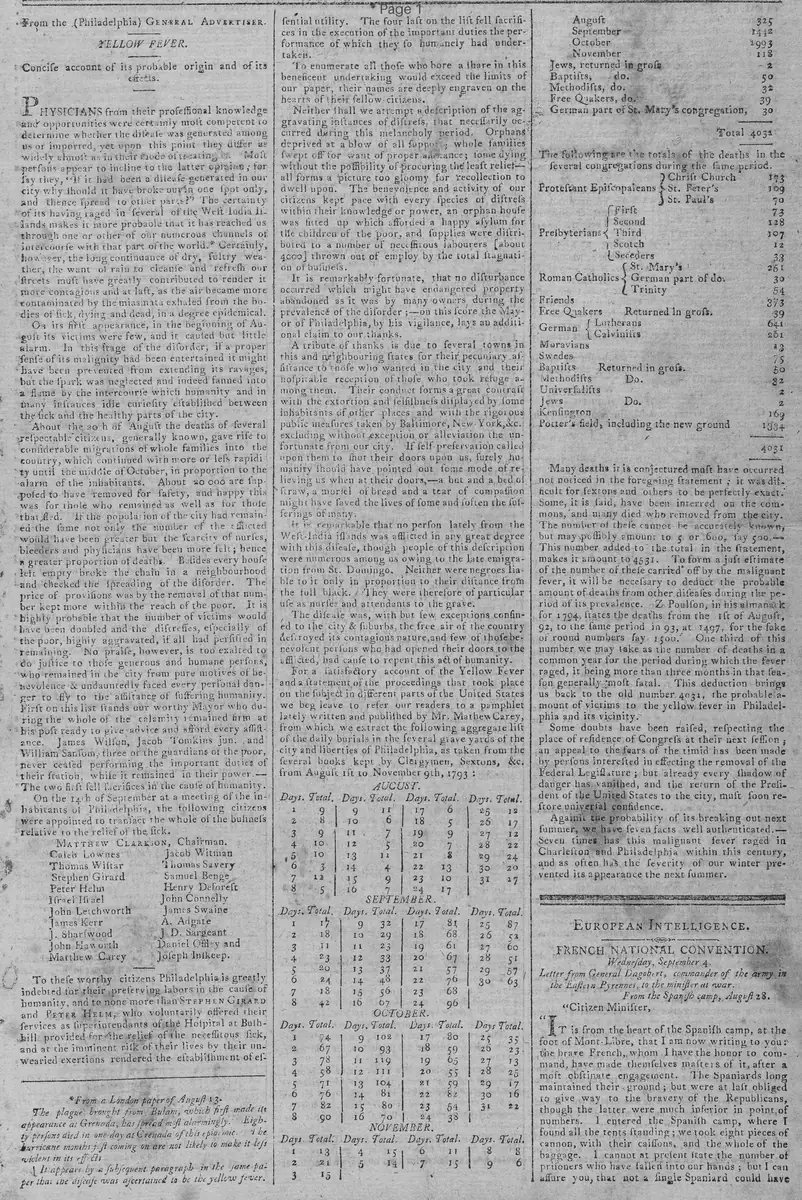
PHYSICIANS from their professional knowledge and opportunities were certainly most competent to determine whether the disease was generated among us or imported, yet upon this point they differ as widely almost as in their mode of treating it. Most persons appear to incline to the latter opinion; for say they, 'If it had been a disease generated in our city why should it have broke out in one part only, and thence spread to other parts?' The certainty of its having raged in several of the West-India Islands makes it more probable that it has reached us through one or other of our numerous channels of intercourse with that part of the world. Certainly, however, the long continuance of dry, sultry weather, the want of rain to cleanse and refresh our streets must have greatly contributed to render it more contagious and at last, as the air became more contaminated by the miasmata exhaled from the bodies of sick, dying and dead, in a degree epidemical.
On its first appearance, in the beginning of August its victims were few, and it caused but little alarm. In this stage of the disorder, if a proper Sense of its malignity had been entertained it might have been prevented from extending its ravages, but the spark was neglected and indeed fanned into a flame by the intercourse which humanity and in many instances idle curiosity established between the sick and the healthy parts of the city.
About the 20th of August the deaths of several respectable citizens, generally known, gave rise to considerable migrations of whole families into the country, which continued with more or less rapidity until the middle of October, in proportion to the alarm of the inhabitants. About 20,000 are supposed to have removed for safety, and happy this was for those who remained as well as for those that fled. If the population of the city had remained the same not only the number of the afflicted would have been greater but the scarcity of nurses, bleeders and physicians have been more felt; hence a greater proportion of deaths. Besides every house left empty broke the chain in a neighbourhood and checked the spreading of the disorder. The price of provisions was by the removal of that number kept more within the reach of the poor. It is highly probable that the number of victims would have been doubled and the distresses, especially of the poor, highly aggravated, if all had persisted in remaining. No praise, however, is too exalted to do justice to those generous and humane persons, who remained in the city from pure motives of benevolence & undauntedly faced every personal danger to fly to the assistance of suffering humanity.
First on this list stands our worthy Mayor who during the whole of the calamity remained firm at his post ready to give advice and afford every assistance. James Wilson, Jacob Tomkins jun., and William Sansom, three of the guardians of the poor, never ceased performing the important duties of their station, while it remained in their power.-- The two first fell sacrifices in the cause of humanity.
On the last of September at a meeting of the inhabitants of Philadelphia, the following citizens were appointed to transact the whole of the business relative to the relief of the sick.
To these worthy citizens Philadelphia is greatly indebted for their preserving labours in the cause of humanity, and to none more than STEPHEN GIRARD and Peter Helm, who voluntarily offered their services as superintendents of the Hospital at Bush-hill provided for the relief of the necessitous sick, and at the imminent risk of their lives by their unwearied exertions rendered the establishment effectual.
*From a London paper of August 13.
The plague brought from Bulam, which first made its appearance at Grenada has spread with alarmingly. Eighty persons died in one day at Grenada of this epidemic. In the hurricane months it is coming on are not likely to make it less virulent in its effects this winter.
It appears by a subsequent paragraph in the same paper that the disease was ascertained to be the yellow fever.
essential utility. The four last on the list fell sacrifices in the execution of the important duties the performance of which they so humanely had undertaken.
To enumerate all those who bore a share in this beneficent undertaking would exceed the limits of our paper, their names are deeply engraven on the hearts of their fellow-citizens.
Neither shall we attempt a description of the aggravating instances of distress, that necessarily occurred during this melancholy period. Orphans deprived at a blow of all support; whole families swept off for want of proper assistance; some dying without the possibility of procuring the least relief-- all forms a picture too gloomy for recollection to dwell upon. The benevolence and activity of our citizens kept pace with every species of distress within their knowledge or power, an orphan house was fitted up which afforded a happy asylum for the children of the poor, and supplies were distributed to a number of necessitous labourers [about 4000] thrown out of employ by the total stagnation of business.
It is remarkably fortunate, that no disturbance occurred which might have endangered property abandoned as it was by many owners during the prevalence of the disorder; on this score the Mayor of Philadelphia, by his vigilance, lays an additional claim to our thanks.
A tribute of thanks is due to several towns in this and neighbouring states for their pecuniary assistance to those who wanted in the city and their hospitable reception of those who took refuge among them. Their conduct forms a great contrast with the extortion and selfishness displayed by some inhabitants of other places and with the rigorous public measures taken by Baltimore, New-York, &c. excluding without exception or alleviation the unfortunate from our city. If self-preservation called upon them to shut their doors upon us, surely humanity should have pointed out some mode of relieving us when at their doors,-- a hut and a bed of straw, a morsel of bread and a tear of compassion might have saved the lives of some and soften the sufferings of many.
It is remarkable that no person lately from the West-India islands was afflicted in any great degree with this disease, though people of this description were numerous among us owing to the late emigration from St. Domingo. Neither were negroes liable to it only in proportion to their distance from the full black. They were therefore of particular use as nurses and attendants to the grave.
The disease was, with but few exceptions confined to the city & suburbs, the free air of the country destroyed its contagious nature, and few of those benevolent persons who had opened their doors to the afflicted, had cause to repent this act of humanity.
For a satisfactory account of the Yellow Fever and a statement of the proceedings that took place on the subject in different parts of the United States we beg leave to refer our readers, to a pamphlet lately written and published by Mr. Mathew Carey, from which we extract the following aggregate list of the daily burials in the several grave yards of the city and liberties of Philadelphia, as taken from the several books kept by Clergymen, Sextons, &c. from August 1st to November 9th, 1793 :
AUGUST
. . SEPTEMBER. ..
OCTOBER ::
:NOVEMBER.::
Many deaths it is conjectured must have occurred not noticed in the foregoing statement ; it was difficult for sextons and others to be perfectly exact. Some, it is said, have been interred on the commons, and many died who removed from the city. The number of these cannot be accurately known, but may possibly amount to 500 or 600, say 600 is the probable amount.
This number added to the total in the statement, makes it amount to 4531. To form a just estimate of the number of those carried off by the malignant fever, it will be necessary to deduct the probable amount of deaths from other diseases during the period of its prevalence. Z. Poulson, in his almanack for 1794, states the deaths from the 1st of August, 92, to the same period in 93, at 1497, for the sake of round numbers say, 1900. One third of this number we may take as the number of deaths in a common year for the period during which the fever raged, it being more than three months in that season generally most fatal. This deduction brings us back to the old number 4031, the probable amount of victims to the yellow fever in Philadelphia and its vicinity.
Some doubts have been raised, respecting the place of residence of Congress at their next session an appeal to the fears of the timid has been made by persons interested in effecting the removal of the Federal Legislature ; but already every shadow of danger has vanished, and the return of the President of the United States to the city, must soon restore universal confidence.
Against the probability of its breaking out next summer, we have seven facts well authenticated.-- Seven times has this malignant fever raged in Charleston and Philadelphia within this century, and as often has the severity of our winter prevented its appearance the next summer.
| August | 325 |
| September | 1442 |
| October | 1993 |
| November | 118 |
| Jews, returned in grofs | 2 |
| Baptiffs, do. | 50 |
| Methodifts, do. | 32 |
| Free Quakers, do. | 39 |
| German part of St. Mary's congregation, | 30 |
| Total 4034 | |
| The following are the totals of the deaths in the several congregations during the same period. | |
| Chrift Church | 173 |
| Protefant Epifcopaleans | 109 |
| St. Paul's | 70 |
| First | 73 |
| Second | 128 |
| Preibyterians Third | 107 |
| Scotch | 12 |
| Leceders | 33 |
| St. Mary's | 251 |
| Roman Catholics German part of do. | 30 |
| Trinity | 54 |
| Friends | 373 |
| Free Quakers Returned in grofs. | 39 |
| German Lutherans | 641 |
| Calvinifis | 261 |
| Moravians | 13 |
| Swedes | 75 |
| Baptiffs Returned in grofs. | 50 |
| Methodifts Do. | 32 |
| Universfalifts | 2 |
| Jews Do. | 2 |
| Kenfington | 169 |
| Potter's field, including the new ground | 1334 |
| Matthew Clarkson, Chairman. | |
| Caleb Lownes | Jacob Witman |
| Thomas Wiftar | Thomas Savery |
| Stephen Girard | Samuel Benge |
| Peter Helm | Henry Deforeft |
| Israel Israel | John Connelly |
| John Letchworth | James Swaine |
| James Kerr | A. Adgate |
| J. Sharwood | J. D. Sargeant |
| John Haworth | Daniel Oftley and |
| Matthew Carey | Joseph Inikeep. |
| Days. | Total. | Days. | Total. | Days. | Total. | Days. | Total. |
| 1 | 9 | 9 | 11 | 17 | 6 | 25 | 12 |
| 2 | 8 | 10 | 6 | 18 | 5 | 26 | 17 |
| 3 | 9 | 11 | 7 | 19 | 9 | 27 | 12 |
| 4 | 10 | 12 | 5 | 20 | 7 | 28 | 22 |
| 5 | 10 | 13 | 11 | 21 | 8 | 29 | 24 |
| 6 | 3 | 14 | 4 | 22 | 13 | 30 | 20 |
| 7 | 12 | 15 | 9 | 23 | 10 | 31 | 17 |
| 8 | 5 | 16 | 7 | 24 | 17 |
| Days. Total. | Days. Total. | Days. Total. | Days. Total. | Days. Total. |
| 1 | 17 | 9 | 32 | 17 |
| 2 | 18 | 10 | 29 | 18 |
| 3 | 11 | 11 | 23 | 19 |
| 4 | 23 | 12 | 33 | 20 |
| 5 | 20 | 13 | 37 | 21 |
| 6 | 24 | 14 | 48 | 22 |
| 7 | 18 | 15 | 56 | 23 |
| 8 | 42 | 16 | 67 | 24 |
| Days. | Total. | Days. | Total. | Days. | Total. | Days. | Total. |
| 1 | 74 | 9 | 102 | 17 | 80 | 25 | 35 |
| 2 | 67 | 10 | 93 | 18 | 59 | 26 | 23 |
| 3 | 78 | 11 | 119 | 19 | 65 | 27 | 13 |
| 4 | 58 | 12 | 111 | 20 | 55 | 28 | 25 |
| 5 | 71 | 13 | 104 | 21 | 59 | 29 | 17 |
| 6 | 76 | 14 | 81 | 22 | 82 | 30 | 16 |
| 7 | 82 | 15 | 80 | 23 | 54 | 31 | 22 |
| 8 | 90 | 16 | 70 | 24 | 38 |
| Days. | Total. | Days. | Total. | Days. | Total. | Days. | Total. |
| 1 | 13 | 4 | 15 | 6 | 11 | 8 | 8 |
| 2 | 21 | 5 | 14 | 7 | 15 | 9 | 6 |
| 3 | 15 |
What sub-type of article is it?
What themes does it cover?
What keywords are associated?
What entities or persons were involved?
Where did it happen?
Story Details
Key Persons
Location
Philadelphia
Event Date
1793 08 01 To 1793 11 09
Story Details
Account of the 1793 yellow fever epidemic in Philadelphia, likely imported from West Indies, exacerbated by weather; initial neglect led to spread; mass migrations reduced deaths; praises mayor, guardians, and relief committee for aid; statistics show 4031 deaths after adjustments; contrasts with other cities' responses; notes immunity in some groups.