Thank you for visiting SNEWPapers!
Sign up free
Daily National Intelligencer
Washington, District Of Columbia
What is this article about?
U.S. House of Representatives debates a bill to raise an additional 20,000-man army for one year during the War of 1812. Key issues include presidential appointment of officers, executive power limits, war strategy doubts, past military failures, and calls for more deliberation. Motions to strike sections and rise for further consideration fail.
Clipping
OCR Quality
Full Text
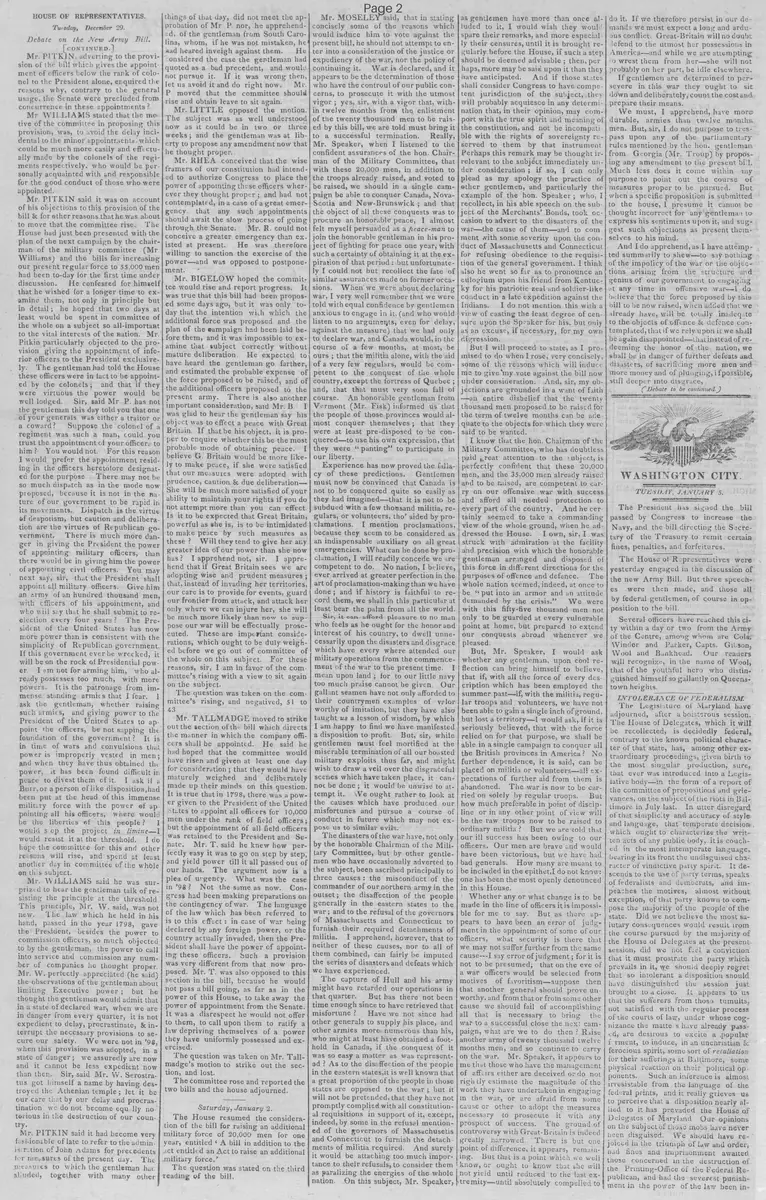
Tuesday, December 29.
Debate on the New Army Bill.
CONTINUED.
Mr. PITKIN, adverting to the provision of the bill which gives the appointment of officers below the rank of colonel to the President alone, enquired the reasons why, contrary to the general usage, the Senate were precluded from concurrence in these appointments?
Mr. WILLIAMS stated that the motive of the committee in proposing this provision, was, to avoid the delay incidental to the minor appointments, which could be much more easily and effectually made by the colonels of the regiments respectively, who would be personally acquainted with and responsible for the good conduct of those who were appointed.
Mr. PITKIN said it was on account of his objections to this provision of the bill & for other reasons that he was about to move that the committee rise. The House had just been presented with the plan of the next campaign by the chairman of the military committee (Mr. Williams) and the bills for increasing our present regular force to 55,000 men had been to-day for the first time under discussion. He confessed for himself that he wished for a longer time to examine them, not only in principle but in detail; he hoped that two days at least would be spent in committee of the whole on a subject so all-important to the vital interests of the nation. Mr. Pitkin particularly objected to the provision giving the appointment of inferior officers to the President exclusively. The gentleman had told the House these officers were in fact to be appointed by the colonels; and that if they were virtuous the power would be well lodged. Sir, said Mr. P. has not the gentleman this day told you that one of your generals was either a traitor or a coward? Suppose the colonel of a regiment was such a man, could you trust the appointment of your officers to him? You would not. For this reason I would prefer the appointment residing in the officers heretofore designated for the purpose There may not be so much dispatch as in the mode now proposed, because it is not in the nature of our government to be rapid in its movements. Dispatch is the virtue of despotism, but caution and deliberation are the virtues of Republican government. There is much more danger in giving the President the power of appointing military officers, than there would be in giving him the power of appointing civil officers. You may next say, sir, that the President shall appoint all military officers. Give him an army of an hundred thousand men, with officers of his appointment, and who will say that he shall submit to re-election every four years? The President of the United States has now more power than is consistent with the simplicity of Republican government. If this government ever be wrecked, it will be on the rock of Presidential power. I am not for arming him, who already possesses too much, with more powers. It is the patronage from immense standing armies that I fear. I ask the gentleman, whether raising such armies, and giving power to the President of the United States to appoint the officers, be not sapping the foundation of the government? It is in time of wars and convulsions that power is improperly vested in men; and when they have thus obtained the power, it has been found difficult in peace to divest them of it. I ask if a Burr, or a person of like disposition, had been put at the head of this immense military force with the power of appointing all his officers, where would be the liberties of this people? I would stop the project in limine—I would resist it at the threshold. I do hope the committee for this and other reasons will rise, and spend at least another day in committee of the whole on this subject.
Mr. WILLIAMS said he was surprised to hear the gentleman talk of resisting the principle at the threshold This principle, Mr. W. said, was not new. The law which he held in his hand, passed in the year 1798, gave the President, besides the power to commission officers, so much objected to by the gentleman, the power to call into service and commission any number of companies he thought proper. Mr. W. perfectly appreciated (he said) the observations of the gentleman about limiting Executive power; but he thought the gentleman would admit that in a state of declared war, when we are in danger from every quarter, it is not expedient to delay, procrastinate, & interrupt the necessary provisions to secure our safety. We were not in '98, when this provision was adopted, in a state of danger; we assuredly are now and it cannot be less expedient now than then. Sir, said Mr. W. Serostratus got himself a name by having destroyed the Athenian temple; let it be our care that by our delay and procrastination we do not become equally notorious in the destruction of our country.
Mr. PITKIN said it had become very fashionable of late to refer to the administration of John Adams for precedents for measures of the present day. The measures to which the gentleman had alluded, together with many other things of that day, did not meet the approbation of Mr P nor, he apprehended, of the gentleman from South Carolina, whom, if he was not mistaken, he had heard inveigh against them. He considered the case the gentleman had quoted as a bad precedent, and would not pursue it. If it was wrong then, let us avoid it and do right now.
Mr. P moved that the committee should rise and obtain leave to sit again.
Mr. LITTLE opposed the motion. The subject was as well understood now as it could be in two or three weeks; and the gentleman was at liberty to propose any amendment now that he thought proper.
Mr. RHEA conceived that the wise framers of our constitution had intended to authorize Congress to place the power of appointing these officers wherever they thought proper ; and had not contemplated, in a case of a great emergency that any such appointments should await the slow process of going through the Senate. Mr. R. could not conceive a greater emergency than existed at present. He was therefore willing to sanction the exercise of the power—and was opposed to postponement.
Mr. BIGELOW hoped the committee would rise and report progress. It was true that this bill had been proposed some days ago, but it was only to-day that the intention with which the additional force was proposed and the plan of the campaign had been laid before them, and it was impossible to examine that subject correctly without mature deliberation. He expected to have heard the gentleman go farther, and estimated the probable expense of the force proposed to be raised, and of the additional officers proposed to the present army. There is also another important consideration, said Mr. B. I was glad to hear the gentleman say his object was to effect a peace with Great Britain. If that be his object, it is proper to enquire whether this be the most probable mode of obtaining peace. I believe G. Britain would be more likely to make peace, if she were satisfied that our measures were adopted with prudence, caution & due deliberation—She will be much more satisfied of your ability to maintain your rights if you do not attempt more than you can effect. Is it to be expected that Great Britain, powerful as she is, is to be intimidated to make peace by such measures as these ? Will they tend to give her any greater idea of our power than she now has? I apprehend not, sir. I apprehend that if Great Britain sees we are adopting wise and prudent measures; that, instead of invading her territories, our care is to provide for events, guard our frontier from attack, and attack her only where we can injure her, she will be much more likely than now to suppose our war will be effectually prosecuted. These are important considerations, which ought to be duly weighed before we go out of committee of the whole on this subject. For these reasons, sir, I am in favor of the committee's rising with a view to sit again on the subject.
The question was taken on the committee's rising, and negatived, 51 to 43
Mr. TALLMADGE moved to strike out the section of the bill which directs the manner in which the company officers shall be appointed. He said he had hoped that the committee would have risen and given at least one day for consideration; that they would have maturely weighed and deliberately made up their minds on this question. It is true that in 1798, there was a power given to the President of the United States to appoint all officers for 10,000 men under the rank of field officers; but the appointment of all field officers was retained to the President and Senate. Mr. T. said he knew how perfectly easy it was to go on step by step, and yield power till it all passed out of our hands. The argument now is a plea of urgency. What was the case in '98? Not the same as now. Congress had been making preparations on the contingency of war. The language of the law which has been referred to is to this effect: in case of war being declared by any foreign power, or the country actually invaded, then the President shall have the power of appointing these officers. Such a provision was very different from that now proposed. Mr. T. was also opposed to this section in the bill, because he would not pass a bill going, as far as in the power of this House, to take away the power of appointment from the Senate. It was a disrespect he would not offer to them, to call upon them to ratify a law depriving themselves of a power they have uniformly possessed and exercised.
The question was taken on Mr. Tallmadge's motion to strike out the section, and lost.
The committee rose and reported the two bills and the house adjourned.
Saturday, January 2.
The House resumed the consideration of the bill for raising an additional military force of 20,000 men for one year, entitled "A bill in addition to the act entitled an Act to raise an additional military force."
The question was stated on the third reading of the bill.
Mr. MOSELEY said, that in stating concisely some of the reasons which would induce him to vote against the present bill, he should not attempt to enter into a consideration of the justice or expediency of the war, nor the policy of continuing it, War is declared, and it appears to be the determination of those who have the controul of our public concerns, to prosecute it with the utmost vigor ; yes, sir, with a vigor that, within twelve months from the enlistment of the twenty thousand men to be raised by this bill, we are told must bring it to a successful termination. Really, Mr. Speaker, when I listened to the confident assurances of the hon. Chairman of the Military Committee, that with these 20,000 men, in addition to the troops already raised, and voted to be raised, we should in a single campaign be able to conquer Canada, Nova Scotia and New-Brunswick ; and that the object of all these conquests was to procure an honorable peace, I almost felt myself persuaded as a peace-man to join the honorable gentleman in his project of fighting for peace one year, with such a certainty of obtaining it at the expiration of that period : but unfortunately I could not but recollect the fate of similar assurances made on former occasions. When we were about declaring war, I very well remember that we were told with equal confidence by gentlemen anxious to engage in it, (and who would listen to no arguments, even for delay. against the measure) that we had only to declare war, and Canada would, in the course of a few months, at most, be ours ; that the militia alone, with the aid of a very few regulars, would be competent to the conquest of the whole country, except the fortress of Quebec ; and, that that must very soon fall of course. An honorable gentleman from Vermont (Mr. Fisk) informed us that the people of those provinces would almost conquer themselves; that they were at least pre-disposed to be conquered—to use his own expression, that they were "panting" to participate in our liberty.
Experience has now proved the fallacy of these predictions. Gentlemen must now be convinced that Canada is not to be conquered quite so easily as they had imagined--that it is not to be subdued with a few thousand militia, regulars, or volunteers, tho' aided by proclamations. I mention proclamations, because they seem to be considered as an indispensable auxiliary on all great emergencies. What can be done by proclamation, I will readily concede we are competent to do. No nation, I believe, ever arrived at greater perfection in the art of proclamation-making than we have done; and if history is faithful to record them, we shall in this particular at least bear the palm from all the world. Sir, it can afford pleasure to no man who feels as he ought for the honor and interest of his country, to dwell unnecessarily upon the disasters and disgrace which have every where attended our military operations from the commencement of the war to the present time. I mean upon land; for to our little navy too much praise cannot be given. Our gallant seamen have not only afforded to their countrymen examples of valor worthy of imitation, but they have also taught us a lesson of wisdom, by which I am happy to find we have manifested a disposition to profit. But, sir, while gentlemen must feel mortified at the miserable termination of all our boasted military exploits thus far, and might wish to draw a veil over the disgraceful scenes which have taken place, it cannot be done; it would be unwise to attempt it. We ought rather to look at the causes which have produced our misfortunes and pursue a course of conduct in future which may not expose us to similar evils.
The disasters of the war have, not only by the honorable Chairman of the Military Committee, but by other gentlemen who have occasionally adverted to the subject, been ascribed principally to three causes: the misconduct of the commander of our northern army in the outset; the disaffection of the people generally in the eastern states to the war; and to the refusal of the governors of Massachusetts and Connecticut to furnish their required detachments of militia. I apprehend, however, that to neither of these causes, nor to all of them combined, can fairly be imputed the series of disasters and defeats which we have experienced.
The capture of Hull and his army might have retarded our operations in that quarter. But has there not been time enough since to have retrieved that misfortune? Have we not since had other generals to supply his place, and other armies more numerous than his, who might at least have obtained a foot-hold in Canada, if the conquest of it was so easy a matter as was represented ? As to the disaffection of the people in the eastern states, it is well known that a great proportion of the people in those states are opposed to the war; but it will not be pretended, that they have not promptly complied with all constitutional requisitions in support of it, except, indeed, by some in the refusal mentioned of the governors of Massachusetts and Connecticut to furnish the detachments of militia required. And surely it would be attaching too much importance to their refusals, to consider them as paralizing the energies of the whole nation. On this subject, Mr. Speaker, as gentlemen have more than once alluded to it, I would wish they would spare their remarks, and more especially their censures, until it is brought regularly before the House, if such a step should be deemed advisable; then, perhaps, more may be said upon it than they have anticipated. And if those states shall consider Congress to have competent jurisdiction of the subject, they will probably acquiesce in any determination that, in their opinion, may comport with the true spirit and meaning of the constitution, and not be incompatible with the rights of sovereignty reserved to them by that instrument Perhaps this remark may be thought irrelevant to the subject immediately under consideration; if so, I can only plead as my apology the practice of other gentlemen, and particularly the example of the hon. Speaker; who, I recollect, in his able speech on the subject of the Merchants' Bonds, took occasion to advert to the disasters of the war--the cause of them--and to comment with some severity upon the conduct of Massachusetts and Connecticut for refusing obedience to the requisition of the general government. I think also he went so far as to pronounce an eulogium upon his friend from Kentucky for his patriotic zeal and soldier-like conduct in a late expedition against the Indians. I do not mention this with a view of casting the least degree of censure upon the Speaker for his, but only as an excuse, if necessary, for my own digression.
But I will proceed to state, as I promised to do when I rose, very concisely, some of the reasons which will induce me to give my vote against the bill now under consideration. And, sir, my objections are grounded in a want of faith --an entire disbelief that the twenty thousand men proposed to be raised for the term of twelve months can be adequate to the objects for which they were said to be wanted.
I know that the hon. Chairman of the Military Committee, who has doubtless paid great attention to the subject, is perfectly confident that these 20,000 men, and the 35,000 men already raised and to be raised, are competent to carry on our offensive war with success and afford all needed protection to every part of the country. And he certainly seemed to take a commanding view of the whole ground, when he addressed the House. I own, sir, I was struck with admiration at the facility and precision with which the honorable gentleman arranged and disposed of this force in different directions for the purposes of offence and defence. The whole nation seemed, indeed, at once to be " put into an armor and an attitude demanded by the crisis." We were with this fifty-five thousand men not only to be guarded at every vulnerable point at home, but prepared to extend our conquests abroad whenever we pleased.
But, Mr. Speaker, I would ask whether any gentleman, upon cool reflection can bring himself to believe, that if, with all the force of every description which has been employed the summer past--if, with the militia, regular troops and volunteers, we have not been able to gain a single inch of ground, but lost a territory--I would ask, if it is seriously believed, that with the force relied on for that purpose, we shall be able in a single campaign to conquer all the British provinces in America? No further dependence, it is said, can be placed on militia or volunteers--all expectations of further aid from them is abandoned. The war is now to be carried on solely by regular troops. But how much preferable in point of discipline or in any other point of view will be the raw troops now to be raised to ordinary militia ? But we are told that our ill success has been owing to our officers. Our men are brave and would have been victorious, but we have had bad generals. How many are meant to be included in the epithet, I do not know: one has been the most openly denounced in this House.
Whether any or what change is to be made in the line of officers it is impossible for me to say. But as there appears to have been an error of judgment in the appointment of some of our officers, what security is there that we may not suffer further from the same cause---I say error of judgment: for it is not to be presumed, that on the eve of a war officers would be selected from motives of favoritism--suppose then that another general should prove unworthy, and from that or from some other cause we should fail of accomplishing all that is necessary to bring the war to a successful close the next campaign, what are we to do then ? Raise another army of twenty thousand twelve months men, and so continue to carry on the war. Mr. Speaker, it appears to me that those who have the management of affairs either are deceived or do not rightly estimate the magnitude of the work they have undertaken in engaging in the war, or are afraid from some cause or other to adopt the measures necessary to prosecute it with any prospect of success. The ground of controversy with Great-Britain is indeed greatly narrowed There is but one point of difference, it appears, remaining. But that is a point which we well know, or ought to know that she will not yield until reduced to the last extremity--until absolutely compelled to do it. If we therefore persist in our demands we must expect a long and arduous conflict. Great-Britain will no doubt defend to the utmost her possessions in America--and while we are attempting to wrest them from her--she will not probably on her part, be idle elsewhere. If gentlemen are determined to persevere in this war they ought to sit down and deliberately, count the cost and prepare their means.
We must, I apprehend, have more durable, armies than twelve months men. But, sir, I do not purpose to trespass upon any of the parliamentary rules mentioned by the hon. gentleman from Georgia (Mr. Troup) by proposing any amendment to the present bill. Much less does it come within my purpose to point out the course of measures proper to be pursued. But when a specific proposition is submitted to the house, I presume it cannot be thought incorrect for any gentleman to express his sentiments upon it, and suggest such objections as present themselves to his mind.
And I do apprehend, as I have attempted summarily to shew--to say nothing of the impolicy of the war or the objections arising from the structure and genius of our government to engaging at any time in offensive war--I do believe that the force proposed by this bill to be now raised, when added that we already have, will be totally inadequate to the objects of offence & defence contemplated, that if we rely upon it we shall be again disappointed--that instead of redeeming the honor of the nation, we shall be in danger of further defeats and disasters, of sacrificing more men and more money and of plunging, if possible. still deeper into disgrace,
(Debate to be continued.)
What sub-type of article is it?
What themes does it cover?
What keywords are associated?
What entities or persons were involved?
Where did it happen?
Story Details
Key Persons
Location
House Of Representatives
Event Date
Tuesday, December 29; Saturday, January 2
Story Details
Debate on bill to raise 20,000 additional soldiers for one year, objections to presidential appointment of officers bypassing Senate, concerns over executive power expansion, past war failures, and inadequacy of proposed force for conquering British provinces and achieving peace.