Thank you for visiting SNEWPapers!
Sign up free
United Automobile Worker
Detroit, Wayne County, Michigan
What is this article about?
In June 1949, labor and liberal economists warn that Congress's economy bloc cuts to federal spending could trigger a major depression amid signs of recession, including declining consumer demand and industrial output. They advocate increased government spending, opposing figures like Sen. Paul Douglas, while citing the 1946 full employment law.
Clipping
OCR Quality
Full Text
June, 1949
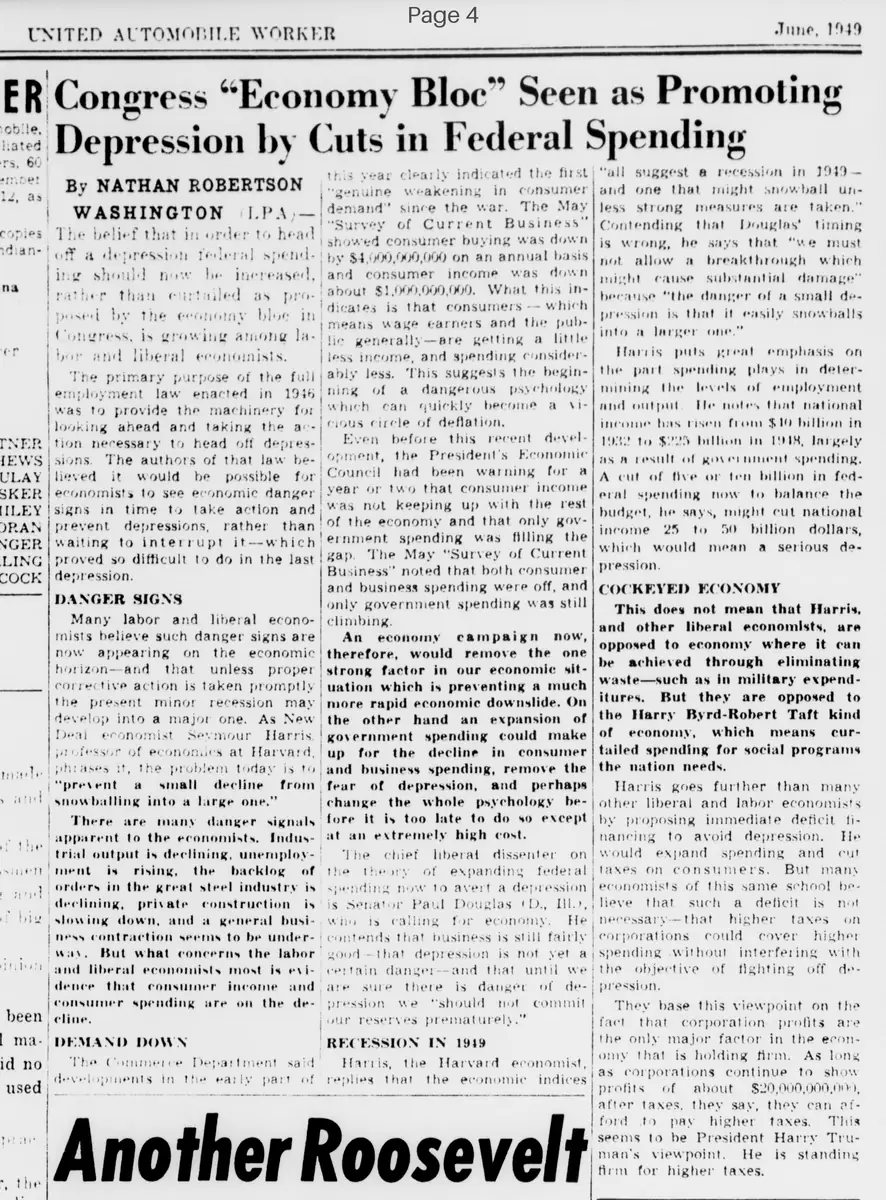
Congress "Economy Bloc" Seen
as
Promoting
Depression by Cuts in Federal
Spending
By NATHAN ROBERTSON
WASHINGTON--
The belief that in order to head
off a depression federal spend-
ing should now be increased.
rather than curtailed as pro-
posed by the economy bloc in
Congress, is growing among la-
bor and liberal economists.
The primary purpose of the full
employment law enacted in 1946
was to provide the machinery for
looking ahead and taking the ac-
tion necessary to head off depres-
sions. The authors of that law be-
lieved it would be possible for
economists to see economic danger
signs in time to take action and
prevent depressions, rather than
waiting to interrupt it--which
proved so difficult to do in the last
depression.
DANGER SIGNS
Many labor and liberal econo-
mists believe such danger signs are
now appearing
on the economic
horizon--and that unless proper
corrective action is taken promptly
the present minor recession may
develop into a major one. As New
Deal economist Seymour Harris,
professor of economics at Harvard,
phrases it, the problem today is to
"prevent
a small decline from
snowballing into a large one."
There are many danger signals
apparent to the economists. Indus-
trial output is declining, unemploy-
ment is rising.
the backlog
of
orders in the great steel industry is
disappearing. Private construction is
slowing down, and a general busi-
ness contraction seems to be under
way. But what concerns the labor
and liberal economists most is evi-
dence that consumer income and
consumer spending are on the de-
cline.
DEMAND DOWN
The Commerce Department said
developments in the early part
of
this year clearly indicated the first
genuine weakening in consumer
demand since the war. The May
"Survey of Current Business"
showed consumer buying was down
by $4,000,000,000 on an annual basis
and consumer income was down
about $1,000,000,000. What this in-
dicates is that consumers--which
means wage earners and the pub-
lic generally--are getting a little
less income, and spending consider-
ably less. This suggests the begin-
ning of a dangerous psychology
which can quickly become a vi-
cious circle of deflation.
Even before this recent devel-
opment, the President's Economic
Council had been warning for
a
year or two that consumer income
was not keeping up with the rest
of the economy and that only gov-
ernment spending was filling the
gap. The May "Survey of Current
Business" noted that both consumer
and business spending were off, and
only government spending was still
climbing.
An
economy
campaign
now,
therefore, would remove the one
strong factor in our economic sit-
uations which is preventing a much
more rapid economic downslide. On
the
other hand
an expansion of
government spending could make
up for the decline
in consumer
and business spending, remove the
fear of depression, and
perhaps
change the whole psychology
be-
fore it is too late to do so except
at an extremely high cost.
The chief liberal dissenter on
the theory of expanding federal
spending now to avert a depression
is Senator Paul Douglas (D., Ill.),
who is calling for economy. He
contends that business is still fairly
good--that depression is not yet a
certain danger--and that until we
are sure there is danger of de-
pression we "should not commit
our reserves prematurely."
RECESSION IN 1949
Harris, the Harvard economist,
replies that the economic indices
all suggest a recession in 1949-
and one that might snowball un-
less strong measures are taken.
Contending that Douglas' timing
is wrong, he says that "we must
not allow a breakthrough which
might cause substantial damage"
because "the danger of a small de-
pression is that it easily snowballs
into a larger one."
Harris puts great emphasis on
the part spending plays in deter-
mining the levels of employment
and output. He notes that national
income has risen from $50 billion in
1932 to $225 billion in 1948, largely
as a result of government spending.
A cut of five or ten billion in fed-
eral spending now to balance the
budget, he says, might cut national
income 25 to 50 billion dollars
which would mean a serious de-
pression.
COCKEYED ECONOMY
This does not mean that Harris,
and other liberal economists,
are
opposed to economy where it can
be achieved through eliminating
waste--such as in military expend-
itures. But they are opposed to
the Harry Byrd-Robert Taft kind
of economy, which means cur-
tailed spending for social programs
the nation needs.
Harris goes further than many
other liberal and labor economists
by proposing immediate deficit fi-
nancing to avoid depression. He
would expand spending and cut
taxes on consumers. But many
economists of this same school be-
lieve that such a deficit is not
necessary--that higher taxes on
corporations could cover higher
spending without interfering with
the objective of fighting off de-
pression.
They base this viewpoint on the
fact that corporation profits are
the only major factor in the econ-
omy that is holding firm. As long
as corporations continue to show
profits of about $20,000,000,000
after taxes, they say, they can af-
ford to pay higher taxes. This
seems to be President Harry Tru-
man's viewpoint. He is standing
firm for higher taxes.
What sub-type of article is it?
What keywords are associated?
What entities or persons were involved?
Where did it happen?
Domestic News Details
Primary Location
Washington
Event Date
June 1949
Key Persons
Outcome
potential recession developing into major depression if federal spending is cut; warnings of declining consumer income and spending, with government spending as the stabilizing factor.
Event Details
Labor and liberal economists argue that increasing federal spending is necessary to prevent a minor recession from becoming a major depression, opposing the Congress economy bloc's proposed cuts. Danger signs include declining industrial output, rising unemployment, disappearing steel orders, slowing construction, and weakening consumer demand. The full employment law of 1946 is cited as a tool for preventive action. Senator Paul Douglas dissents, advocating economy until depression is certain. Economists like Harris emphasize the role of government spending in maintaining national income and propose deficit financing or higher corporate taxes to avert crisis.