Thank you for visiting SNEWPapers!
Sign up free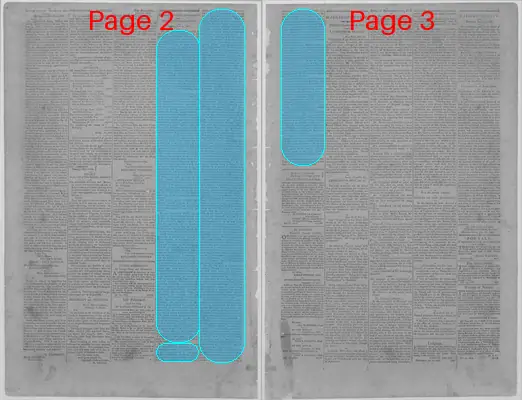
The National Intelligencer And Washington Advertiser
Washington, District Of Columbia
What is this article about?
Massachusetts House debates Mr. Morton's motion for an address praising President Jefferson's principles and services, despite opposition citing election loss and policy disputes. Motion postponed 142-92.
Merged-components note: This is a continuation of the report on the Massachusetts legislature debate regarding an address to President Jefferson, which flows directly from one component to the next based on sequential reading order and matching topic; relabeled from 'story' to 'domestic_news' as it reports on legislative proceedings rather than a narrative article.
Clippings
1 of 2
OCR Quality
Full Text
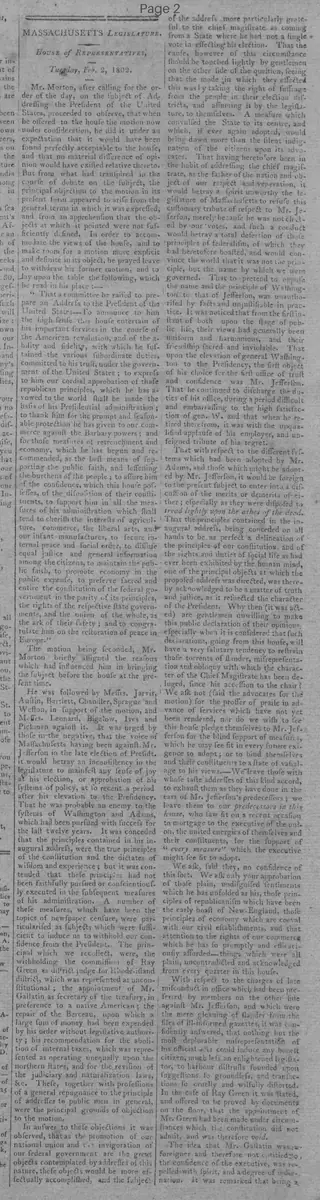
"That a committee be raised to prepare an Address to the President of the United States—To announce to him the high esteem this house entertain of his important services in the course of the American revolution, and of the ability and fidelity, with which he has sustained the various subordinate duties, committed to his trust, under the government of the United States; to express to him our cordial approbation of those republican principles, which he has avowed to the world shall be made the basis of his Presidential administration; to thank him for the prompt and seasonable protection he has given to our commerce against the Barbary powers; and for those measures of retrenchment and economy, which he has begun and recommended, as the best means of supporting the public faith, and lessening the burthens of the people: to assure him of the confidence, which this house possesses, of the disposition of their constituents, to support him in all the measures of his administration which shall tend to cherish the interests of agriculture, commerce, the liberal arts, and our infant manufactures, to secure internal peace and social order, to diffuse equal justice and general information among the citizens, to maintain the public faith, to promote economy in the public expense, to preserve sacred and entire the constitution of the federal government in the purity of its principles, the rights of the respective state governments, and the union of the whole, as the ark of their safety; and to congratulate him on the restoration of peace in Europe."
The motion being seconded, Mr. Morton briefly assigned the reasons which had influenced him in bringing the subject before the house at the present time.
He was followed by Messrs. Jarvis, Austin, Bartlett, Chandler, Sprague and Weston, in support of the motion, and Messrs. Leonard, Bigelow, Ives and Pickman against it. It was urged by those in the negative, that the voice of Massachusetts having been against Mr. Jefferson in the late election of President, it would betray an inconsistency in the legislature to manifest any sense of joy at his election, or approbation of his systems of policy, at so recent a period after his elevation to the Presidency. That he was probably an enemy to the systems of Washington and Adams, which had been pursued with success for the last twelve years. It was conceded that the principles contained in his inaugural address, were the true principles of the constitution and the dictates of wisdom and experience; but it was contended that these principles had not been faithfully pursued or conscientiously executed in the subsequent measures of his administration. A number of these measures, which have been the topics of newspaper censure, were particularized as subjects which were sufficient to induce us to withhold our confidence from the President. The principal which we recollect, were, the withholding the commission of Ray Green as district judge for Rhode-Island district, which was represented as unconstitutional; the appointment of Mr. Gallatin as secretary of the treasury, in preference to a native American; the repair of the Berceau, upon which a large sum of money had been expended by his order without legislative authority; his recommendation for the abolition of internal taxes, which was represented as operating unequally upon the northern states, and for the revision of the judiciary and naturalization laws, &c. These, together with professions of a general repugnance to the principle of addresses to public men in general, were the principal grounds of objection to the motion.
In answer to these objections it was observed, that as the promotion of our national union and the invigoration of our federal government are the great objects contemplated by addresses of this nature, these objects would be more effectually accomplished, and the subject of the address more particularly grateful to the chief magistrate as coming from a State where he had not a single vote in effecting his election. That the cause, however of this circumstance should be touched lightly by gentlemen on the other side of the question, seeing that the mode in which they effected this was by taking the right of suffrage from the people in their election districts, and assuming it by the legislature, to themselves. A measure which convulsed the State to its centre, and which, if ever again adopted, would bring down more than the silent indignation of the citizens upon its advocates. That having heretofore been in the habit of addressing the chief magistrate, as the father of the nation and object of our respect and veneration, it would betray a spirit unworthy the legislature of Massachusetts to refuse this customary tribute of respect to Mr. Jefferson, merely because he was not elected by our votes, and such a conduct would betray a total desertion of those principles of federalism, of which they had heretofore boasted, and would convince the world that it was not the principle, but the man by which we were governed. That to pretend to oppose the name and the principle of Washington to that of Jefferson, was unauthorized by facts and unjustifiable in practice. It was noticed that from the first instant of both upon the stage of public life, their views had generally been uniform and harmonious, and their friendship sacred and inviolable. That upon the elevation of general Washington to the Presidency, the first object of his choice for the first office of trust and confidence was Mr. Jefferson. That he continued to discharge the duties of his office, during a period difficult and embarrassing to the high satisfaction of gen. W. and that when he retired therefrom, it was with the unqualified applause of his employer, and unfeigned tribute of his regret.
That with respect to the different systems which had been adopted by Mr. Adams, and those which might be adopted by Mr. Jefferson, it would be foreign to the present subject to enter into a discussion of the merits or demerits of either; especially as they were disposed to tread lightly upon the ashes of the dead. That the principles contained in the inaugural address, being conceded on all hands to be as perfect a delineation of the principles of our constitution, and of the rights and duties of social life as had ever been exhibited by the human mind, one of the principal objects at which the proposed address was directed, was thereby acknowledged to be a matter of truth and justice, as it respected the character of the President. Why then (it was asked) are gentlemen unwilling to make this public declaration of their opinions, especially when it is considered that such declarations, going from this house, will have a very salutary tendency to restrain those torrents of slander, misrepresentation and obloquy with which the character of the Chief Magistrate has been deluged, since his accession to the chair?
We ask not (said the advocates of the motion) for the power of praise in advance of services which have not yet been rendered, nor do we wish to see this house pledge themselves to Mr. Jefferson for the blind support of measures, which he may see fit in every future exigence to adopt; or to bind themselves and their constituents to a state of vassalage to his views. We leave those with whose state addresses of this kind accord, to exhaust them as they have done in the years of Mr. Jefferson's predecessors; we leave them to our predecessors in this house, who saw fit on a recent occasion to mortgage to the executive of the union, the united energies of themselves and their constituents, for the support of "every measure" which the executive might see fit to adopt.
We ask, said they, no confidence of this sort. We ask only your approbation of those plain, undisguised sentiments which he has unfolded as his, those principles of republicanism which have been the early boast of New-England, those principles of economy which are coeval with our civil establishments, and that attention to the rights of our commerce which he has so promptly and efficaciously afforded—things which were all plain, uncontradicted and acknowledged from every quarter in this house.
With respect to the charges of late misconduct in office which had been preferred by members on the other side against Mr. Jefferson, and which were the mere gleaning of slander from the files of ill-informed gazettes, it was confidently answered, that nothing but the most deplorable misrepresentation of his official acts could induce any honest citizen, much less an enlightened legislator, to harbour distrusts founded upon suggestions so groundless, and transactions so cruelly and wilfully distorted.
In the case of Ray Green it was stated, and offered to be proved by documents on the floor, that the appointment of Mr. Green had been made under circumstances which the constitution did not admit, and was therefore void.
The idea that Mr. Gallatin was a foreigner and therefore not entitled to the confidence of the executive, was repelled with spirit, and a degree of indignation. It was remarked that being a
citizen of the United States at the time of the adoption of the constitution, he thereby became, in common with us, a member of the social compact; and as such entitled by solemn contract, to all the rights and immunities flowing therefrom. His general character was abundantly defended from the suggestions which were thrown out to his prejudice, and the peculiar propriety of his conducting an office to which he had devoted the studies and labor of his life were strongly enforced.
The repairs of the Berceau were explained upon principles which have been often stated, and which have appeared satisfactory, and highly honorable to the character of administration. The abolition of the internal taxes, upon the conditions recommended by the President, was justified as a measure of policy and justice; and as an actual saving of some thousands of dollars to the United States, which accrued upon the collection, and the perquisites of the numerous officers by whom it is collected.
The repeal of the late judiciary system, as recommended by the President, and passed in the Senate of the United States, it was observed could by no means be charged upon Mr. Jefferson, as an innovation upon the established systems of our government; it was in fact the doing away an innovation which had been lately engrafted upon our former system, and which appeared as yet to have answered no valuable purpose, but that of providing convenient seats of retirement to its authors and their friends.
Upon these grounds, the opposers of the motion were called upon to answer why they refused to lend their public approbation to the principles of the address, which they all affected to approve; or to assure the Chief Magistrate, that while his conduct comported with the sentiments which he avowed, he should receive our cordial support.
In the course of debate, several observations were made by those in opposition to the motion, which indicated a desire to avoid a direct vote on the question—and which was finally effected by a motion of Mr. Fisher, that the question under consideration should be postponed to the next session of the legislature.
The question was then taken upon Mr. Fisher's motion by yeas and nays, as follows:—Yeas, 142—Nays, 92.
What sub-type of article is it?
What keywords are associated?
What entities or persons were involved?
Where did it happen?
Domestic News Details
Primary Location
Massachusetts
Key Persons
Outcome
the motion to prepare an address to president jefferson was postponed to the next session by a vote of 142 yeas to 92 nays.
Event Details
In the Massachusetts House, Mr. Morton withdrew his initial motion and proposed a new one to raise a committee for an address to President Jefferson, praising his revolutionary services, republican principles, protection of commerce, measures of economy, and congratulating on European peace. Debate ensued with supporters highlighting unity and approval of principles, while opponents objected due to Massachusetts' vote against Jefferson, alleged inconsistencies with prior administrations, and specific policy criticisms like withholding Ray Green's commission, appointing Gallatin, repairing the Berceau, and tax abolition. The address was defended as promoting national union, and charges against Jefferson were refuted. Mr. Fisher's motion to postpone prevailed.