Thank you for visiting SNEWPapers!
Sign up free
Atlanta Daily World
Atlanta, Fulton County, Georgia
What is this article about?
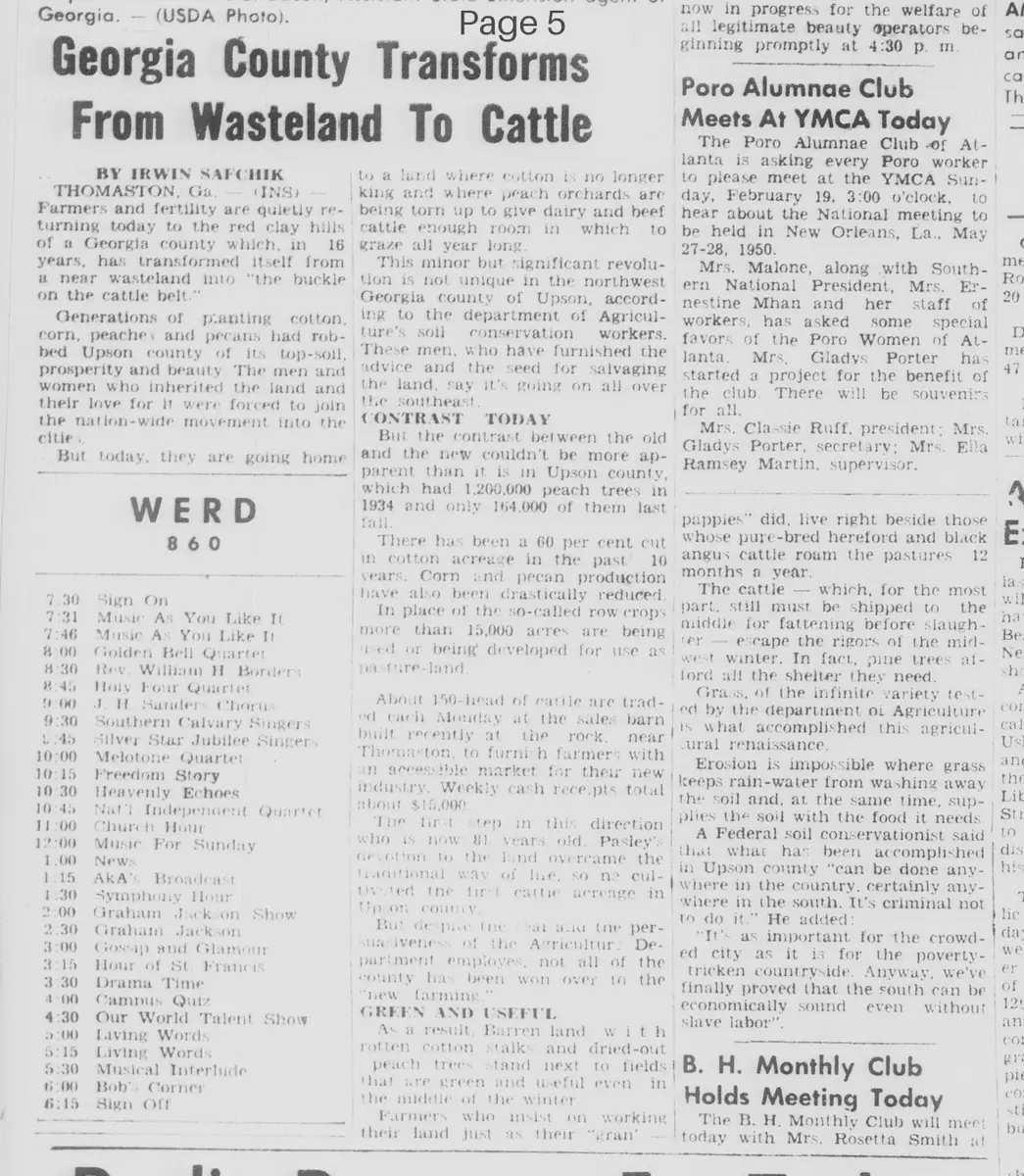
Upson County, Georgia, has shifted from eroded cotton and peach farming to cattle ranching over 16 years, with soil conservation efforts converting over 15,000 acres to pastureland and boosting local cattle markets.
Clipping
OCR Quality
Full Text
From Wasteland To Cattle
BY Ihwn sahk
THOMASTON, Ga. (INS)
Farmers and fertility are quietly returning today to the red clay hills of a Georgia county which, in 16 years, has transformed itself from a near wasteland into "the buckle on the cattle belt".
Generations of planting cotton, corn, peaches, and pecans had robbed Upson county of its top-soil, prosperity and beauty. The men and women who inherited the land and their love for it were forced to join the nation-wide movement to the cities.
But today, they are going home.
to a land where cotton is no longer king and where peach orchards are being torn up to give dairy and beef cattle enough room in which to graze all year long.
This minor but significant revolution is not unique in the northwest Georgia county of Upson, according to the department of Agriculture's soil conservation workers.
These men, who have furnished the advice and the seed for salvaging the land as it's going on all over the southeast.
CONTRAST TODAY
But the contrast between the old and the new couldn't be more apparent than it is in Upson county, which had 1,200,000 peach trees in 1934 and only 164,000 of them last fall.
There has been a 60 per cent cut in cotton acreage in the past 10 years. Corn and pecan production have also been drastically reduced.
In place of the so-called row crops more than 15,000 acres are being or being developed for use as pasture land.
About 150-head of cattle are traded each Monday at the sales barn built recently at the rock near Thomaston to furnish farmers with an accessible market for their new industry. Weekly cash receipts total about $16,000.
In the right direction who is now 81 years old Pasley Ge otol to, the innd overeame the tiuajomal way o le. o ne cul- tw ed tne tiri catte acreage in Up on count.
Bu de Ds tt ca diu tne per- Ja ivene o! the A Tricultur De- puriment empioye. not all of the ointy ha beeh won over to the new fatminy.
GREES AND USEFUL
A a result Bairen land w i t h rotten cotton talk and dred-out peach trees tand next to felds 'hd' are ercen and uefnl eten in he middie ot the winter.
Iainer who m ist on workine thei hand just i their eran.
pappies did live right beside those whose pure-bred hereford and black angus cattle roam the pastures 12 months a year.
The cattle - which, for the most part, still must be shipped to the middle for fattening before laugh- er - e cape the rigors of the mid- we t winter. In fact, pine tree af- ford all the shelter they need.
Gra s. of the infinite variety te t- ed by the departinent ot Agriculture 1 what accomplished th agrieui- ral renaissance.
Erosion is impossible where grass keeps rain-water from wa·hing away the coil and, at the same time, sup- plies the sol with the food it needs.
A Federal soil con ervationist said that what ha been aecomphshed in Upson county "can be done any- where m the country, certainly anvy- where in the south. It's criminal not to do It" He added.
It' a important for the crowd- ed city as it is for the poverty- tricken country ide. Anyway, we've finally proved that the south can be economically sound even without slave labor.
What sub-type of article is it?
What keywords are associated?
Where did it happen?
Domestic News Details
Primary Location
Upson County, Georgia
Outcome
peach trees reduced from 1,200,000 in 1934 to 164,000; 60 percent cut in cotton acreage over past 10 years; over 15,000 acres converted to pastureland; weekly cattle sales of about 150 head generating $16,000 in receipts.
Event Details
Upson County has transformed over 16 years from eroded wasteland due to row crops like cotton, corn, peaches, and pecans to a cattle production area with year-round grazing on developed pastures, aided by U.S. Department of Agriculture soil conservation advice and seeds; some farmers resist change, leaving barren land amid green pastures.