Thank you for visiting SNEWPapers!
Sign up free
Norfolk Gazette And Publick Ledger
Norfolk, Virginia
What is this article about?
A propagandistic defense of the Allied powers' conduct in occupied France during the 1815 war, criticizing French revolutionaries, ministers like Fouché, and Bonaparte's accomplices for past atrocities and current instability under Louis XVIII. It argues for French submission to ensure peace and security for Europe.
Merged-components note: Continuation of the long article on the pretended answer of the allies, spanning page break.
Clippings
1 of 2
OCR Quality
Full Text
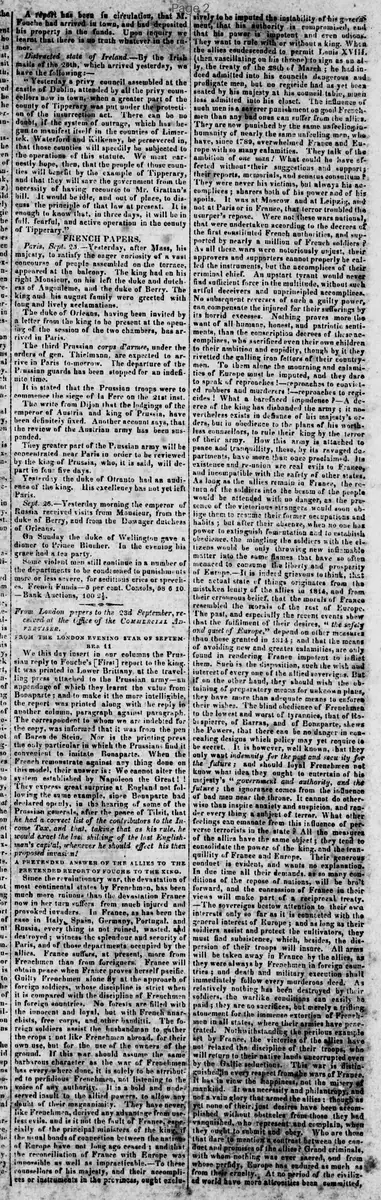
Since the revolutionary war, the devastation of most continental states by Frenchmen, has been much more ruinous than the devastation France now in her turn suffers from much injured and provoked invaders. In France, as has been the case in Italy, Spain, Germany, Portugal, and Russia, every thing is not ruined, wasted, and destroyed; witness the splendour and security of Paris, and of those departments occupied by the allies. France suffers, at present, more from Frenchmen than from foreigners. France will obtain peace when France proves herself pacific. Guilty Frenchmen alone fly at the approach of foreign soldiers, whose discipline is strict when it is compared with the discipline of Frenchmen in foreign countries. No forests are filled with the innocent and loyal, but with French anarchists, free corps, and other banditti. The foreign soldiers assist the husbandman to gather the crops; not like Frenchmen abroad, for their own use, but for the use of the owners of the ground. If this war should assume the same barbarous character as the war of Frenchmen has every where done, it is solely to be attributed to perfidious Frenchmen, not listening to the voice of any authority. It is a bold and undeserved insult to the allied powers, to allow any doubt of their magnanimity. They have never like Frenchmen, derived any advantage from useless evils, and is it not the fault of France especially of the principal ministers of the king if the usual bonds of connection between the nations of Europe have not long ago ceased; and that the reconciliation of France with Europe was impossible as well as impracticable.—To these counsellors of his majesty, and their accomplices or instruments in the provinces, ought exclusively to be imputed the instability of his government that his authority, is, compromised, and that his power is impotent and even odious. They want to rule with or without a king. When the allies condescended to permit Louis XVIII. (then vacillating on his throne) to sign as an ally, the treaty of the 23d of March; he had indeed admitted into his councils dangerous and profligate men, but no regicide had as yet been seated by his majesty at his council table, much less admitted into his closet. The influence of such men is a severer punishment on good Frenchmen than any bad ones can suffer from the allies. They are now punished by the same unfeeling inhumanity of nearly the same unfeeling men, who have, since 1789, overwhelmed France and Europe with so many calamities. They talk of the ambition of one man! What could he have effected without—their suggestions and support; their reports, memorandums, and senatus consuitum? They were never his victims, but always his accomplices; sharers both of his power and of his spoils. It was at Moscow and at Leipzig, and not at Paris or in France, that terror troubled the usurper's repose. Were not these wars national, that were undertaken according to the decrees of the first constituted French authorities, and supported by nearly a million of French soldiers? As all these wars were notoriously unjust, their approvers and supporters cannot properly be called the instruments, but the accomplices of their criminal chief. An upstart tyrant would never find sufficient force in the multitude, without such artful deceivers and unprincipled accomplices. No subsequent reverses of such a guilty power, can compensate the injured for their sufferings by its horrid excesses. Nothing proves more the want of all humane, honest, and patriotic sentiments, than the conscription decrees of these accomplices, who sacrificed even their own children to their ambition and cupidity, though by it they rivetted the galling iron fetters of their countrymen. To them alone the mourning and calamities of Europe must be imputed, and they dare to speak of reproaches!—reproaches to convicted robbers and murderers!—reproaches to regicides! What a barefaced impudence?—A decree of the king has disbanded the army; it nevertheless exists in defiance of his majesty's orders, but in obedience to the plans of his worthless counsellors, to rule their king by the terror of their army. How this army is attached to peace and tranquillity, these, by its ravaged departments, have more than once proclaimed. Its existence and re-union are real evils to France, and incompatible with the safety of other states. As long as the allies remain in France, the return of the soldiers into the bosom of the people would be attended with no danger, as the presence of the victorious strangers would soon obligate them to resume their former occupations and habits; but after their absence, when no one has power to extinguish fermentation and to establish obedience, the mingling the soldiers with the citizens would be only throwing new intolerable matter into the same flames that have so often menaced to consume the liberty and prosperity of Europe.—It is indeed grievous to think, that the actual state of things originates from the mistaken lenity of the allies in 1814, and from their erroneous belief, that the morals of France resembled the morals of the rest of Europe. The past, and especially the recent events shew that the fulfilment of their desires, "the safety and quiet of Europe," depend on other measures than these granted in 1814; and that the means of avoiding new and greater calamities, are only found in rendering France impotent to inflict them. Such is the disposition, such the wish and interest of every one of the allied sovereigns. But if on the other hand, they should wish the obtaining of preparatory means for unknown plans, they have more than adequate means to enforce their wishes. The blind obedience of Frenchmen to the lowest and worst of tyrannies, that of Robespierre, of Barras, and of Bonaparte, shews the Powers, that there can be no danger in concealing designs which policy may yet require to be secret. It is however, well known, but they only want indemnity for the past and security for the future; and should loyal Frenchmen not know what idea they ought to entertain of his majesty's "government and authority, and the future; the ignorance comes from the influence of bad men near the throne. It cannot do otherwise than inspire anxiety and suspicion, and render every thing a subject of terror. What other feelings can emanate from this influence of perverse terrorists in the state? All the measures of the allies have the same object; they tend to consolidate the power of the king, and the tranquillity of France and Europe. Their generous conduct is evident, and wants no explanation. In due time all their demands, as so many conditions of the repose of nations, will be bro't forward, and the concession of France in their views will make part of a reciprocal treaty.—The sovereigns bestow attention to their own interests only so far as it is connected with the general interest of Europe; and as long as their soldiers assist and protect the cultivators, they must find subsistence, which, besides, the dispersion of their troops will insure. All arms will be taken away in France by the allies, as they were always by Frenchmen in foreign countries; and death and military execution shall immediately follow every murderous deed. As relatively nothing has been destroyed by their soldiers, the warlike conditions can easily be paid; they are no sacrifices, but merely a trifling atonement for the immense extortion of Frenchmen in all states, where their armies have penetrated. Notwithstanding the perilous example set by France, the victories of the allies have not relaxed the discipline of their troops, who will return to their native lands uncorrupted even by the Gallic seductions. This war is distinguished in every respect from the wars of France It has in view the happiness, not the misery of mankind. It was necessity and philanthropy, and not vain glory that armed the allies: though as yet none of their just desires have been accomplished without obstacles from those they had vanquished, who represent and complain, when they ought to submit and obey. Who are those that dare to mention a contrast between the conduct and promises of the allies? Grand criminals, with whom nothing was ever sacred, and from whose perfidy, Europe has endured as much as from their cruelty. At no period of the civilized world have more atrocities been committed, Never has the human race, or mankind been more oppressed, than since Gallic sophists and hypocrites proclaimed their pretended liberal ideas, their age of reason and their rights of man. The public opinion that could approve of such fallacies, and of their consequences, such enormities, ought not to be tolerated, much less respected by princes, armed in the defence of the cause of legitimacy and of morality. They cannot be satisfied with the punishment of a single individual, as long as his accomplices in the sporting with the calamities of nations are at large, and in influence to commit new violences and their habitual inhumanity.
Had the king's authority been duly respected, and had Frenchmen been dutiful and quiet, the entry of the allied sovereigns into Paris might have put an end to the war. But the degradation of the monarch by the criminals who forced themselves into his councils, and disseminated confusion and anarchy to keep their usurped places, rendered some severity necessary as long as peace was unsafe. Besides, the evils inflicted by France and others were much greater, and of such a dark character, that they could be inflicted by Frenchmen alone. They took place in the midst of peace, often in the countries of the friends of France, or of neutrals, without combats and without resistance; and when the use of arms had no other object than the gratification of French vanity and cupidity. The allies are, therefore, far from imitating what they properly impute to Frenchmen as a crime. It is indeed too well known, and it will indeed be long remembered, that the want not only of moderation, but of every sentiment of honor and humanity of Gallic invaders, habituated and crushed both the north and the south, both the east and the west, and that such barbarous provocations called forth the dormant not extinct spirit of patriotism, of the oppressed. Their few and momentary acts of retaliation cannot be called a vengeance or years of unheard-of calamities--calamities that had for object to make them dread being erased from the list of nations, and to render of Europe France, and thus to prove that nations may die in modern as well as ancient times. They, were, however, quiet, until, thanks to French armies and policy, they had no longer any thing to preserve -not even the hopes of maintaining their names as nations; but no sooner had they lost almost every thing, and their ruin was nearly confirmed -than a new order of things, a new series of events arose. An ardent patriotism took the place of resignation; and France, respecting no government, and renouncing all obedience, felt in her turn some of the evils of war and of conquest, though the steps of her invaders were marked with other blood than that of a resisting undisciplined soldiery, and of other armed rebels.
If France wished to destroy herself; if the victims of La Vendee unite themselves with their assassins of the rebel army : if the king removes, and his functionaries quit their places, the allies will then be obliged, by a military rule to prevent a catastrophe more fatal to France than to themselves. But woe then to the evil advisers of his majesty. Woe then to those men of blood, with whom originate such uncommon wretchedness. They then shall feel the whole weight of the wrath of the victors, and numerous gibbets all over France, shall prove, that the vanquished and the vanquishers do not lie together in the same grave.
What sub-type of article is it?
What keywords are associated?
What entities or persons were involved?
Where did it happen?
Foreign News Details
Primary Location
France
Event Date
1815
Key Persons
Outcome
allies demand indemnity and security; potential disbanding of french army; threats of severe punishment for french criminals and regicides; aim for peace and consolidation of king's power.
Event Details
The text presents a pretended response from the Allies countering Fouché's report to the King, defending their disciplined occupation of France against French devastation abroad, blaming French ministers and revolutionaries for instability and past wars, referencing the 1815 Treaty of March 23, and warning of consequences if French resistance continues.