Thank you for visiting SNEWPapers!
Sign up free
Rhode Island American And Gazette
Providence, Providence County, Rhode Island
What is this article about?
Richard Rush, in response to an Anti-Masonic committee in York, Pennsylvania, denounces Freemasonry for its secrecy and potential dangers, citing the unpunished 1826 murder of William Morgan as evidence of its obstruction of justice. He criticizes the press's silence and urges continued Anti-Masonic efforts to protect public liberty and law.
Merged-components note: Continuation of Richard Rush's anti-masonic letter across multiple columns on page 2.
Clipping
OCR Quality
Full Text
York, (Penn.) May 4, 1831.
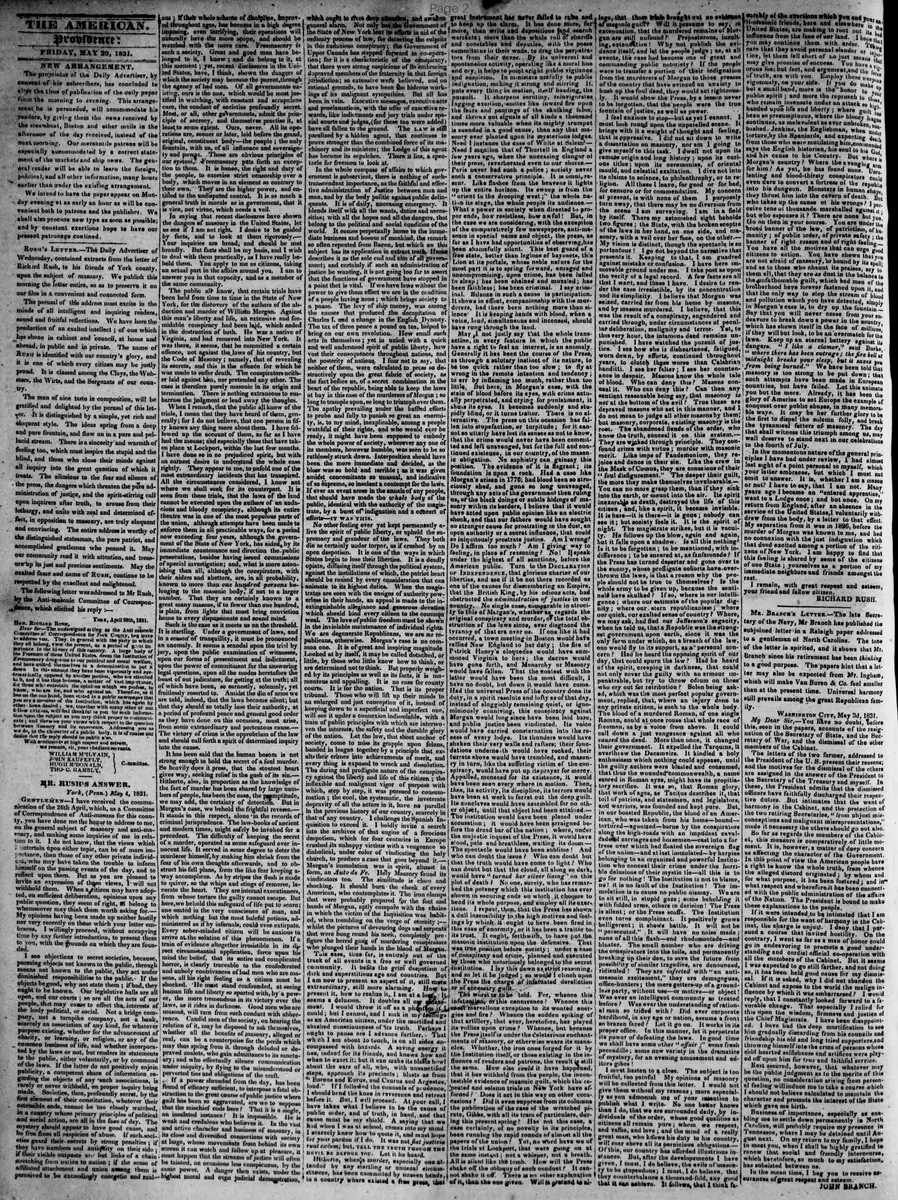
Gentlemen—I have received the communication of the 26th April, which, as a Committee of Correspondence of Anti-masons for this county, you have done me the honor to address to me, on the general subject of masonry and anti-masonry, and making some inquiries of me in relation to it. I do not know, that the views which I entertain upon either topic, can be of more importance, than those of any other private individual, who may have taken the trouble to inform himself on the passing events of the day, and to reflect upon them. But as you are pleased to invite an expression of those views, I will not withhold them. When a citizen may have adopted, on sufficient deliberation, opinions upon any public question, they seem of right, to belong to whomsoever may think them worth asking for.—
My opinions having been made up neither hastily nor very recently on those which your letter embraces, I willingly proceed, without occupying time by any further introduction, to present them to you, with the grounds on which they are founded.
I see objections to secret societies, because, pursuing objects not known to the public, through means not known to the public, they act under diminished responsibilities to the public. If the objects be good, why not state them; if bad, they ought to be known. Our legislative halls are all open, and our courts; so are all the acts of our people, that may come to effect the interests of the body political, or social. Not a bridge company, not a turnpike company, not a bank, scarcely an association of any kind, for whatever purpose existing, whether for the advancement of charity, or learning, or religion, or any of the common business of life, and whether incorporated by the laws or not, but renders its statements to the public, either voluntarily, or by command of the laws. If the latter do not positively enjoin publicity, a competent share of information regarding the objects of any such associations, is rarely or never withheld, on proper inquiry being made. Societies, then, profoundly secret, by the first element of their constitution, whatever their ostensible ends, cannot be too closely watched. in a country whose primary principles of political and social action, are all in the face of day. The mystery should appear to have good cause, and be free from all suspicion of abuse. If such societies guard their secrets by strong penalties; if they have numbers and antiquity on their side; if their visible outposts are but links of a chain stretching from nation to nation; if the sense of affiliated attachment and union among them is perceived to be exceedingly energetic and zealous: if their whole scheme of discipline, improved throughout ages, has become in a high degree imposing, even terrifying, their operations will naturally have the more scope, and should be watched with the more care. Freemasonry is such a society. Great and good men have belonged to it, I know; and do belong to it, at this moment; yet, recent disclosures in the United States, have, I think, shown the dangers of which the society may become the parent, through the agency of bad men. Of all governments existing, ours is the one, which would be most justified in watching, with constant and scrupulous care, the conduct of societies profoundly secret. Most, or all, other governments, admit the principle of secrecy, and themselves practise it, at least to some extent. Ours, never. All its operations are, sooner or later, laid before the grand, original, constituent body—the people; the only fountain, with us, of all influence and sovereignty and power. These are obvious principles of our system, Freemasonry puts forth an exception to them. It is hence, the right and duty of the people, to exercise strict censorship over a body, which moves in an element so contrary to their own. They are the higher power, and entitled to the undisputed control. It is as much a general truth in morals as in government, that it is vice, not virtue, which needs a veil.
In saying that recent disclosures have shown the dangers of masonry in the United States, let us see if I am not right. I desire to be guided by facts, and to look at them rigorously. Your inquiries are broad; and should be met broadly. But facts shall be my basis, and I wish to deal with them practically, as I have really beheld them. You apply to me as citizens, taking an actual part in the affairs around you. I am to answer you in that capacity, and as a member of the same community.
The public all know, that certain trials have been held from time to time in the State of New York, for the discovery of the authors of the abduction and murder of William Morgan. Against this man's liberty and life, an extensive and formidable conspiracy had been laid, which ended in the destruction of both. He was a native of Virginia, and had removed into New York. It was there, it seems, that he committed a certain offence, not against the laws of his country, but the Code of Masonry; namely, that of revealing its secrets, and this is the offence for which he was made to suffer death. The conspirators neither laid against him, nor pretended any other. The case is therefore purely masonic in its origin and termination. There is nothing extraneous to embarrass the judgment or lead away the thoughts.
When I remark, that the public all know of the trials, I mean that they have heard of them, generally; for I do not believe, that one person in fifty knows any thing more about them. I have followed up the account of them, as far as I have had the means; and especially those that have taken place at Lockport, within the last few months. I have done so in no prejudiced spirit, but with an earnest desire to understand the whole case rightly. They appear to me, to unfold one of the most extraordinary incidents that has transpired. All the circumstances considered, I know not where we shall seek for its counterpart. It is seen from these trials. that the laws of the land cannot be executed upon the authors of an audacious and bloody conspiracy, although its entire theatre was in one of the most populous parts of the union, although attempts have been made to enforce them in all practicable ways, for a period now exceeding two years, although the government of the State of New York, has aided by its immediate countenance and direction the public prosecutions, besides having issued commissions of special investigation; and, what is more astonishing than all, although the conspirators, with their aiders and abettors, are, in all probability, known to more than one hundred persons belonging to the masonic body, if not to a larger number. That they are certainly known to a great many masons, if to fewer than one hundred, is plain, from lights that must bring conviction home to every dispassionate and sound mind.
Such is the case as it meets us on the threshold. It is startling. Under a government of laws, and in a season of tranquillity, it must be pronounced an anomaly. It seems a scandal upon the trial by jury, upon the public examination of witnesses, upon our forms of presentment and indictment, upon the power of commitment for the answering legal questions, upon all the modes heretofore the boast of our judicature, or getting at the truth; all of which have been, so earnestly, solemnly, yet fruitlessly resorted to. Amidst the din of arms we are told, indeed, that the laws become silent; but that they should so totally lose their authority, at a period of profound peace and general good order as they have done on this occasion, must arise, from some extraordinary and portentous cause.— The victory of crime is the opprobrium of the law and should call forth a spirit of determined inquiry into the cause.
It has been said that the human bosom is not strong enough to hold the secret of a foul murder. So heavily does it press, that the stoutest heart gives way, seeking relief in the gush of its sin. Hitherto, also, in proportion as the knowledge of the fact of murder has been shared by large numbers of people, has been the ease, the promptitude, we may add, the certainty of detection. But in Morgan's case, we behold the frightful reverse.— It stands in this respect, alone in the records of criminal jurisprudence. The law-books of ancient and modern times, might safely be invoked for a precedent. The difficulty of keeping the secret of a murder, operated as some safeguard over innocent life. It served in some degree to deter the murderer himself, by making him shrink from the fear of his own thoughts afterwards, and to obstruct his fell plans, from the like fear keeping away accomplices. As by stripes the flesh is made to quiver, so the whips and stings of remorse, lacerate the heart. They are internal executioners, from whose torture the guilty cannot escape. But here, we behold this safeguard of life put to scorn; one seated in the very conscience of man, and which nothing but the most baleful potions, administered as if by infernals, could ever extirpate.
Every sober-minded citizen will be anxious to arrive at the solution of this phenomenon. If a train of evidence altogether irresistible in its direct circumstantial application, force upon his mind the belief, that its entire and complicated horror, is clearly traceable to the confederated and unholy contrivances of bad men who are masons, all his right feeling as a citizen must be shocked. He must stand confounded, at seeing human life and liberty so sported with, by a power, the more tremendous in its victory over the laws, as it rides in darkness. Good men who are masons, will turn from such conduct with abhorrence. Candid men of the society, on hearing the relation of it, may be disposed to ask themselves, whether all the benefits of masonry, alleged or real, can be a counterpoise for the perils which may thus spring from it, through deluded or depraved zealots, who gain admittance to its sanctuary; and who effectually silence communication under iniquity, by flying to the misunderstood or perverted ties and obligations of the craft.
If a power shrouded from the day, has been found of efficacy sufficient, to interpose a fatal obstruction to the great course of public justice where guilt has been so aggravated, are we to suppose that the mischief ends here? That it is a single, an insulated instance? It is impossible. He is weak and credulous who believes it. In the vast and active character and business of masonry, in its close and diversified connections with society at large, whose movements from behind its own screen it can watch and follow up at pleasure, it must happen that the streams of justice will often be tainted, on occasions less conspicuous, by the same power. A danger then exists, under the highest moral and even judicial demonstration, which ought to rivet deep attention, and awaken general alarm.
Not only had the Government of the State of New York lent its efforts in aid of the ordinary process of law, for detecting the culprits in this audacious conspiracy; the Government of Upper Canada has stepped forward in co-operation; or it is a characteristic of the conspiracy, that there were strong suspicions of its embracing depraved members of the fraternity in that foreign jurisdiction; so extensive were believed, and on rational grounds, to have been the hideous workings of its malignant sympathies. But all has been in vain. Executive messages, executive acts and proclamations, with the offer of executive rewards, like indictments and jury trials under special courts and judges, (for these too were added) have all fallen to the ground. The Law is still paralyzed by a hidden agent, that continues to prove stronger than the combined force of its machinery and its ministers; the Lodge of this agent has become its sepulchre. There it lies, a spectacle for freemen to look at.
In the whole compass of affairs to which government is subservient, there is nothing of such transcendant importance, as the faithful and effective administration of Justice between man and man, and by the body politic against public delinquents. It is of daily, unceasing emergency. It blends itself with all the wants, duties and necessities; with all the hopes and all the dangers, that belong to the political and social condition of the world. It comes perpetually home to the immediate business and bosom of mankind, the remark so often repeated from Bacon, but which on this subject has its application in extract truth. Hume describes it as the sole end and aim of all government; and certainly if such an administration of justice be wanting, it is not going too far to assert that the functions of government have stopped in a point that is vital. If we have laws without the power to give them effect we are in the condition of a people having none; which brings society to a pause. The levy of ship money, was among the causes that produced the decapitation of Charles I. and a change in the English Dynasty. The tax of three pence a pound on tea, helped to bring on our own revolution. How small such acts in themselves; yet in union with a quick and well understood spirit of public liberty, how vast their consequences throughout nations, and the posterity of nations. I fear not to say, that neither of them, were calculated to press so destructively upon the great fabric of society, as the fact before us, of a secret combination in the heart of the republic, being able to keep the laws at bay in this case of the murderers of Morgan; so long to trample upon, so long to triumph over them.
The apathy prevailing under the baffled efforts to probe and fully to punish so great an enormity, is, to my mind, inexplicable, among a people watchful of their rights, and who would ever be ready, it might have been supposed to embody the whole power of society, wherever any one of its members, however humble, was seen to be so ruthlessly struck down. Interposition should have been the more immediate and decided, as the blow was so bold and terrible; as it was given amidst concomitants so unusual, and indicative of so supreme, so insolent a contempt for the laws. If ever an event arose in the annals of any people, that should have made the whole body of the public, identical with the authority of the magistrate, by a burst of indignation and a concert of efforts—IT WAS THIS.
No other feeling ever yet kept permanently alive the spirit of public liberty, or upheld the supremacy and grandeur of the laws. They both die as certainly under torpor, as if crushed by an open despotism. It is one of the ways in which States begin to lose their liberties. It is a deadly opiate, diffusing itself through the political system, against the instillations of which, the patriot heart should be roused by every consideration that can animate to its highest duties. When the magistrates are seen with the ensigns of authority powerless in their hands, an appeal is made to the inextinguishable allegiance and generous devotion which should bind every citizen to the common weal. The love of public freedom must be shown in the inviolable maintenance of individual rights. We are degenerate Republicans, we are no republicans, otherwise. Morgan's case is no common one. It is of great and inspiring magnitude. Looked at by itself, it may be called detached, or little, by those who little know how to think, or are determined not to think. But properly weighed by its principles as well as its facts, it is momentous and appalling. It is no case for county courts. It is for the nation. That is its proper tribunal. Those who will lift up their minds to an enlarged and just conception of it, instead of keeping down to a superficial and imperfect one; will see it under a connexion indissoluble, with a train of public principles with which are interwoven the interests, the safety and the durable glory of the nation. Let the law, that sheet anchor of society, come to miss its grapple upon felons, banded in league together by a principle that exalts their crimes into achievements of merit, and every thing is exposed to wreck and dissolution.
The daring and profligate nature of the conspiracy against the liberty and life of this citizen; the inflexible and malignant vigor of purpose with which, step by step, it was pursued to consummation; the cool, the systematic, the inveterate depravity of all the actors in it, have no parallel in the previous history of our country, scarcely in that of any country. I challenge the Spanish Inquisition to exceed it. I boldly invite a search into the archives of that engine of a ferocious despotism, which for four centuries in Europe crushed its unhappy victims with a vengeance so diabolical, under color of vindicating the holy church, to produce a case that goes beyond it.— Morgan's immolation was in spirit, almost in form, an Auto de Fe. Holy Masonry found its vindicators too. The similitude is close and shocking. It should burn the cheek of every American, who contemplates it. The iron clamps that were probably prepared for the feet and hands of Morgan, aptly compare with the chains in which the victim of the Inquisition was habited, when trembling on the verge of eternity ;— whilst the pictures of devouring dogs and serpents that were hung round his neck, completely prefigure the horrid gang of murdering conspirators who plunged their hands in the blood of Morgan.
This case, thus far, is entirely out of the track of all events in a free or well governed community. It befits the grim despotism of dark and superstitious age and countries. But I am now to present an aspect of it, still more extraordinary, still more alarming. How to present it, how to realize it, I am at a loss: It seems a delusion. It doubles all my ghastement. I would throw it off as a phantom if I could; but I cannot, and I sink in my feelings as an American citizen, under the mortified and abashed consciousness of its truth. Perhaps I ought to pause ere I advance further. That which I am about to touch, is on all sides encompassed with hazards. A saving energy it has, indeed of its friends, and knows how and when to exert it; but it can make its blasts howl about the ears of all, who, with unsanctified steps, approach its precincts; blasts as from Borens and Eurus, and Caurus and Argestes, loud. If I followed the counsels of prudence, I should bend the knee in reverence and retreat before it. But, I will proceed. At your call, I have taken what I believe to be the cause of public order, and of truth, in hand, and that cause must be my shield. A saying that we had when I was at school, comes into my mind. I scarcely know how to quote it, and must hope for your pardon if I do. It was not fiat justicia ruat coelum; but, TELL THE TRUTH THOUGH THE DEVIL BE BEFORE YOU. Let it be heard.
Hitherto, when a murder, especially one attended by any startling or unusual circumstances, has been committed by unseen hands, in a country where existed a free press, that great instrument has never failed to raise and to keep up the alarm, It has done more, far more, than write and depositions and search warrants; more than the whole roll of sheriffs and constables and deputies, with the posse comitatus in their wake, to drag the perpetrators from their cover. By its universal and spontaneous activity, operating like a moral hue and cry, it helps to point aright public vigilance and suspicion. It ministers usually to public indignation, making it strong and stirring It. Puts every thing in motion, itself heading the pursuit. it sharpens scrutiny, reinvigorates lagging exertion, smites like inward fire upon the fears and pantings of the skulking felon, and throws out signals of all kinds a thousand times more valuable when its mighty trumpet is sounded in a good cause, than any that masonry ever planted upon its mysterious lodges.
Need I instance the case of White at Salem?— Need I mention that of Thurtell in England a few years ago, when the unceasing clangor of their press, reverberated even to our shores.— Paris never had such a police; society never such a conservative principle. It is omnipresent. Like flashes from the heavens it lights up the entire horizon. Its sweep is from the orient to the drooping west; the whole nation its stage, the whole people its audience.— What a power in society when directed to proper ends, how resistless, how awful! But, in the case we are considering, with the exception of the comparatively few newspapers, anti-masonic in special name and object, the press, as far as I have had opportunities of observing, has been shamefully silent. This best guard of a free state, better than legions of bayonets, this Lion at its portals, whose noble nature or the most part it is to spring forward, enraged and uncompromising, upon crime, has been lulled to sleep; has been chained and muzzled; has been faithless; has been criminal. I say criminal. Silence in such a cause is participation. It shows in effect, companionship with the murderers, had there been nothing more than silence. It is keeping hands with blood, when a voice, loud, simultaneous and incensed, should have rung through the land.
May I not justly say that the whole transaction, in every feature in which the public have a right to feel an interest, is an anomaly. Generally it has been the course of the Press as through a salutary instinct of its nature, to be too quick rather than too slow; to fly at wrong in the remote intention and tendency; to err by inflaming too much, rather than too little. But here, in Morgan's case, with the stain of blood before its eyes, with crime actually perpetrated, and crying for punishment, it shuts its eyes. It becomes suddenly and stupidly blind, or it turns traitor. There is no alternative. The press on this occasion has fallen into stupefaction, or turpitude; for it cannot so utterly have lost its senses as not to know, that the crime would never have been committed and left unavenged, but for the full and continued existence, in our country, of the masonic obligation. No sophistry can gainsay this position. The evidence of it is flagrant; its foundation is upon a rock. Had a case like Morgan's arisen in 1776; had blood been so atrociously shed, and gone so long unavenged through any acts of the government then ruling us, or the black doings or subtle hidings of masonry within its borders, I believe that it would have acted upon public opinion like an electric shock, and that our fathers would have sought no stronger cause for prostrating in the dust, an open authority or a secret influence, that could so iniquitously prostrate justice. Am I wrong? Do I affirm too much? Am I giving way to feeling, in place of reasoning? No! I speak under the highest of all sanctions, before the American public. Turn to the Declaration of Independence, that glorious charter of our liberties, and see if it be not there recorded as one of the causes for dismembering an Empire, that the British King, by his odious acts, had obstructed the administration of justice in our country. No single case, comparable in atrocity to this of Morgan's, whether as regards the original conspiracy and murder, or the total obstruction of the laws since, ever disgraced the tyranny of that era over us. If one like it had occurred, a town meeting in Boston would have rallied New England to her duty; the fire of Patrick Henry's eloquence would have summoned Virginia to hers: the decree would have gone forth, and Monarchy or Masonry would have fallen. That the contest with the latter would have been the most difficult, I have no doubt, but down it would have come.
Had the universal Press of the country done its duty, in a spirit resolute and lofty as of that day, instead of sluggishly remaining quiet, or ignominiously conniving, this conspiracy against Morgan would long since have been laid bare, and public justice been vindicated. Its voice would have carried consternation into the recesses of every lodge. Its thunders would have shaken their very walls and rafters; their foundations underneath would have rocked, their turrets above would have trembled, and masonry in turn, like the suffering victim of the conspiracy, would have put up its prayer for mercy. Appalled, menaced for its existence, it would have been seen every where in motion. Then, then, its activity, its discipline, its terrors would have been at work to ferret out the deep guilt. Its conclaves would have assembled for no other object, until that object had been attained.— The institution would have been placed under accusation; it would have been arraigned before the dread bar of the nation; where, under the majestic inquest of the Press, it would have stood, pale and breathless, waiting its doom— The spectacle would have been sublime! And who can doubt the issue? Who can doubt but that the truth would have come to light? Who can doubt but that the cloud, all along so dark, would have "turned her silver lining" on this plot of death? No one, surely, who has remarked the potency which this institution has ever shown in securing ends on which it chooses to bend its whole purpose, and employ all its exertions. I repeat, then, that the Press has shown a dull insensibility to the high motives and feelings by which, it ought to have been fired in this case of enormity, or it has been a traitor to its trust. It ought, forthwith, to have put the masonic institution upon the defensive. That was true position before society; under a case of conspiracy and crime, planned and executed by those who notoriously belonged to the secret institution. I lay this down as strict reasoning, and so let it be judged; so would I clinch upon the Press the charge of infatuated dereliction or of accessary guilt.
The worst is to be told. For, whence this infatuation, or this connivance? Whence this most marvellous exception to its wonted energies and fire? Whence the sudden spiking of that artillery, that ever, heretofore, has played its vollies upon crime? Whence, but because the Press itself is under the deleterious enchantments of masonry, or otherwise wears its manacles. Whether, the iron ones forged for it by the Institution itself, or those existing in the influence of renders and patrons, the result is still the same. How else could it have happened, that it has withheld from the people, the incontestible evidence of masonic guilt, which the repeated and solemn trials in New York have afforded? Does it act in this way on other occasions? Did it even suppress from its columns the publication of the case of the wretched pirate, Gibbs, with all its train of particulars, during this present spring? Has not this case, a case certainly, of no novelty in its principles, been running the rapid rounds of almost all the papers of the union? Yet. no word have we of the trials at Lockport, that were going on at the same instant : not a whisper, not a breath. All is silent like the tomb. How will the Press shake off the obloquy of such conduct? It cannot shake it off. There is no other explanation of it, than the one given. Will it pretend allegiance, that those trials brought out no evidence of masonic guilt? Will it presume to say, in extenuation, that the murdered remains of Morgan are still unfound? Preposterous, insulting, extenuation! Why not publish the evidence itself, and let the people judge; as, at all events, the case had become one of great and commanding public notoriety? If the people were to transfer a portion of their indignation from the murderers of Morgan to those presses of the country that have evinced an anxiety to hush up the foul deed, they would act righteously. It would show the Press, by a lesson never to be forgotten, that the people were the true fountain of justice, as well as power.
I feel anxious to stop—but as yet I cannot. I must look round upon the unparalleled scene. It brings with it a weight of thought and feeling, that is oppressive. I did not sit down to write a dissertation on masonry, nor am I going to give myself to this task. I dwell not upon its remote origin and long history; upon its curious titles; upon its ceremonies, of oriental mould, and celestial exaltation. I dive not into its claims to science, to philanthropy, or to religion. All these I leave, for good or for bad, or censure or for commendation. My concern at present, is with none of them I purposely turn away, that there may be no diversion from the scene I am surveying. I am in a field by itself. There my astonished sight beholds two figures; the State, with the broken sceptre of the laws in her hand, on one side, and masonry, with a veil over her face, on the other.— My vision is distinct, though the spectacle is so portentous! I go not beyond the narrative that presents it. Keeping to that, I am guarded against mistake or confusion. I have here immovable ground under me. I take post as upon the verity of a legal record. A few facts are all that I want, and these I have. I desire to render the case irresistible, by its concentration and its simplicity. I believe that Morgan was seized, carried far from his home by masons, and by masons murdered. I believe, that this was the result of a conspiracy, engendered and carried through, under circumstances of peculiar deliberation, malignity and terror. Yet, to this very hour, the infamous deed remains unpunished. I have watched the pursuit of justice. I see how she is disheartened, fatigued, worn down, by efforts, continued throughout years, to clutch these worse than Calabrian banditti. I see her falter; I see her countenance in despair. Masons know the whole tale of blood. Who can deny this? Masons conceal it. Who can deny this? Can then any sentient reasonable being say, that masonry is not at the bottom of the evil? True these are depraved masons who act in this manner, and I do not mean to judge all other masons by them; but masonry, corporate, existing masonry is the root. The abandoned fiends of the order, who know the truth, conceal it on this system.— They are wicked through principle. They confound crime with virtue; murder with masonic merit. Like imps of Pandemonium, they rejoice and dance in their sin. Like the crew in the Masque of Comus, they are conscious of their foul disfigurement. The deeper their guilt, the more they make themselves invulnerable.— You can no more grasp them, than if they sink into the earth, or mount into the air. Its spirit inexorable as death, destroyed the life of this citizen, and, like a spirit, it became invisible. It is here—it is there—it is gone; nobody can see it; but society feels it. It is the spirit of night. The magistrate strikes, but it is in vacancy. He follows up the blow, again and again, but it falls upon a shadow. Is all this nothing Is it to be forgotten; to be mentioned, with indifference; to be sneered at, as fanfaronade? If the Press has turned deserter and gone over to the enemy, whose profligate cohorts have overthrown the laws, is that a reason why the people should not be true to themselves? Is the whole army to be given up, because the sentinel have skulked? If so, where is our intelligence; where our estimate of the popular dignity; where our stern republicanism; where our quick, our exalted sense of country? Where, we may ask, had fled our Jefferson's sagacity, when he told us, that a Republic was the strongest government upon earth, since it was the only form under which, on a breach of the law, one would fly to its support, as a personal concern? Had he heard the opposing spirit of our day, that could spurn the law? Had he heard of the spirit, creeping in darkness, that could not only cover the guilty with an armour impenetrable, but try to throw odium on those who cry out for retribution? Solon being asked, which was the most perfect popular government, replied, that, where an injury done to any private citizen, is such to the whole body. The blood of a murdered Roman, of one single Roman, could at once rouse that whole race of freemen, as by a voice from above. It could call down a just vengeance against all who caused the deed. More than once, it changed their government. It expelled the Tarquins, it overthrew the Decemvirs. It kindled a holy enthusiasm which nothing could appease, until the guilty authors were blasted and consumed, that thus the wounded commonwealth, a name sacred in Roman eyes, might have its propitiatory sacrifice. it was so, that Roman glory, that work of ages, as Tacitus describes it, that toil of patriots, and statesmen, and legislators, and warriors, was founded and kept pure. But, in our boasted Republic, the blood of an American. who was taken from his home—bound— tortured—agonized—borne by the conspirators along the high-roads with an impudent cavalcade of carriages and horsemen—cast into a fortress over which had floated the sovereign flag of the union—and at last immolated—by harpies belonging to an organized and powerful Institution who conceal their crime under the horrible delusions of their mystic tie—all this is to go for nothing! The Institution is not to blame, no! it is no fault of the Institution! The immolation is to cause no public dismay. We are to sit still, in stupid gaze; some beholding it with folded arms, others in derision! The Press is silent; or the Press scoffs. The Institution even turns complainant. It positively grows belligerent; it shows battle. It will not be "persecuted." It will have no noise made; none of all this flash—and rhodomontade—and bluster. The small number who are driving the conspirators into the toils, and permanently breaking up their den, to save the future from possibility of similar tragedies, are denounced, ridiculed! They are infected with "an anti-masonic excitement," they are demagogues, office-hunters; the mere getters-up of a groundless party, without use—or motive—or object!
Was ever an intelligent community so treated before? Was ever the understanding of rational men so trifled with? Did ever corporate hardihood, in any age or nation, assume a front so brazen faced? Let it go on. It works in its proper office. In this manner, let it perpetrate its power of defeating the laws. In good time we shall have some other "affair ;" some fresh peccadillo; some new variety in the dramatics of mystery, for an evening amusement and editors gibes!
I must hasten to a close, The subject is too fruitful, too painful. My opinions of masonry will be collated from this letter, I would not give them without my reasons; more especially as you admonish me of your intention to publish what I write. No one knows better than I do, that we are surrounded daily, by individuals of the order, whose good qualities as citizens all remain pure; whom we respect, and value, and love ; and the mind of a really great man, who knows his duty to his country, will soar above all its pernicious obligations.— Of this, our country has afforded illustrious instances, But, after the developments I have given, I must, I do believe, the evils of masonry to be stupendous; I must, I do believe, that they counterbalance a thousand-fold, any good that is easily caught at: It follows, that I think you and your anti-masonic friends are here making, and to root out its bad influence from the face of our land. I hope that you may continue them with ardor. Let them fall short of personal of no slander just means or injustice that may give promise of success orous foe but act and argument and the force of truth are with you vigorously on your side If you do make up but public a small spirit band and more more is the the reproach honor to to those your who remain insensate under an attack so high handed upon life and liberty where guilt has been so presumptuous where the bloody league bashed continues Jenkins as malevolent the Englishman as ever unbroken when under una- torture by the Spaniards and expecting dea from those who were mutilating him commended says the English historian his soul to his God and his cause to his Country.
But where is Morgan's country? Where the avenging arm for him? As yet, he has found none. Unrelenting and blood-thirsty conspirators could even dare to convert a fortress of the republic into his dungeon. Monsters in human shape, they thrust him into the cavern of death. But who takes up the cause of his wrongs? I perceive tens of thousands. marshalled against it; but who espouses it? There are none but you. Go on then in your course. You are under the broad banner of the law, of patriotism, of humanity; of public order, of private safety; the banner of right reason and of right feeling.— You have all the motives that can urge good citizens to action. You have shown that you are not afraid of masonry, or bound by its spell; and as to those who chant its praises, say to them all, that they are as dust in the balance to the unfathomable guilt, which bad men of the brotherhood have forever fastened upon it, and that the only way to stop the stream of blood and pollution which you have detected, simply in Morgan's case is, to dry up the fountain.— Say that you will never cease from your endeavors to break down a power in the country, which has shown itself in the face of millions, if they will but look, to be an overmatch for the laws. Keep up an eternal battery against its dangers. " I like a clamor," said Burke, " where there has been outrage; the fire bell at midnight breaks your sleep, but it saves you from being burned." We have been told that masonry is too strong to be put down; that such attempts have been made in European countries, but have failed. Let this animate you but the more. Already, it has been the glory of America to set Europe the example of conquest over public abuses, in many memorable ways. it may be her further glory to be the first to dispel the solemn folly, and break the tyrannical fetters of- masonry. The day that shall witness this triumph among us, may well deserve to stand next in our celebrations to the fourth of July.
In the momentous nature of the general principles I have had under review, I had almost lost sight of a point personal to myself, which your letter embraces, but which I must not omit to answer. It is, whether I am a mason or not? I have to say, that I am not. Many years ago I became an "entered apprentice, went to a Lodge once; and but once. On my return from England, after an absence in the service of the United States, I voluntarily withdrew from the body, by a letter to that effect. My separation from it was in 1826, before the murder of Morgan was known to me, and had no connexion with the just indignation which that deed excited among a portion of the citizens of New York. I am happy to find that this feeling is shared by some of the citizens of one State; yourselves as a portion of my immediate neighbors and friends amongst the rest.
I remain, with great respect and esteem,
your friend and fellow citizen.
RICHARD RUSH.
What sub-type of article is it?
What themes does it cover?
What keywords are associated?
What entities or persons were involved?
Letter to Editor Details
Author
Richard Rush
Recipient
Gentlemen (Committee Of Correspondence Of Anti Masons For This County)
Main Argument
secret societies like freemasonry pose dangers due to their secrecy and diminished accountability, exemplified by the unpunished murder of william morgan by masons, which obstructs justice and requires vigilant public oversight and anti-masonic action to protect republican principles.
Notable Details