Thank you for visiting SNEWPapers!
Sign up free
Editorial
October 2, 1856
Southern Christian Advocate
Charleston, Charleston County, South Carolina
What is this article about?
A religious editorial advocating for the revival of responsive worship in church services, arguing it enlivens devotion and is scripturally supported in Jewish, early Christian, and heavenly traditions, signed by E. M. P. from Sparta, Ga.
Clipping
OCR Quality
98%
Excellent
Full Text
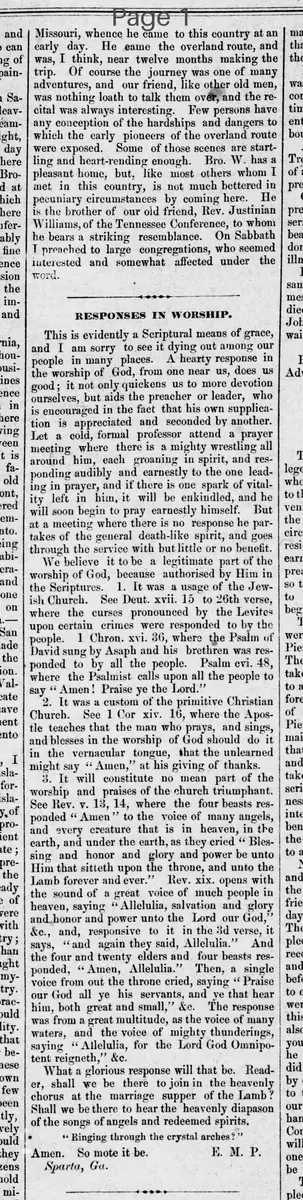
RESPONSES IN WORSHIP.
This is evidently a Scriptural means of grace, and I am sorry to see it dying out among our people in many places. A hearty response in the worship of God, from one near us, does us good; it not only quickens us to more devotion ourselves, but aids the preacher or leader, who is encouraged in the fact that his own supplication is appreciated and seconded by another. Let a cold, formal professor attend a prayer meeting where there is a mighty wrestling all around him, each groaning in spirit, and responding audibly and earnestly to the one leading in prayer, and if there is one spark of vitality left in him, it will be enkindled, and he will soon begin to pray earnestly himself. But at a meeting where there is no response he partakes of the general death-like spirit, and goes through the service with but little or no benefit.
We believe it to be a legitimate part of the worship of God, because authorised by Him in the Scriptures. 1. It was a usage of the Jewish Church. See Deut. xvii. 15 to 26th verse. where the curses pronounced by the Levites upon certain crimes were responded to by the people. 1 Chron. xvi. 36, where the Psalm of David sung by Asaph and his brethren was responded to by all the people. Psalm cvi. 48, where the Psalmist calls upon all the people to say "Amen! Praise ye the Lord."
2. It was a custom of the primitive Christian Church. See 1 Cor xiv. 16, where the Apostle teaches that the man who prays, and sings, and blesses in the worship of God should do it in the vernacular tongue, that the unlearned might say "Amen," at his giving of thanks.
3. It will constitute no mean part of the worship and praises of the church triumphant. See Rev. v. 13, 14, where the four beasts responded "Amen" to the voice of many angels, and every creature that is in heaven, in the earth, and under the earth, as they cried "Blessing and honor and glory and power be unto Him that sitteth upon the throne, and unto the Lamb forever and ever." Rev. xix. opens with the sound of a great voice of much people in heaven, saying Allelulia, salvation and glory and honor and power unto the Lord our God,' &c., and, responsive to it in the 3d verse, it says, "and again they said, Allelulia." And the four and twenty elders and four beasts responded, "Amen, Allelulia." Then, a single voice from out the throne cried, saying "Praise our God all ye his servants, and ye that fear him, both great and small," &c. The response was from a great multitude, as the voice of many waters, and the voice of mighty thunderings, saying "Allelulia, for the Lord God Omnipotent reigneth," &c.
What a glorious response will that be. Reader, shall we be there to join in the heavenly chorus at the marriage supper of the Lamb? Shall we be there to hear the heavenly diapason of the songs of angels and redeemed spirits.
"Ringing through the crystal arches?"
Amen. So mote it be
E. M. P.
Sparta, Ga.
This is evidently a Scriptural means of grace, and I am sorry to see it dying out among our people in many places. A hearty response in the worship of God, from one near us, does us good; it not only quickens us to more devotion ourselves, but aids the preacher or leader, who is encouraged in the fact that his own supplication is appreciated and seconded by another. Let a cold, formal professor attend a prayer meeting where there is a mighty wrestling all around him, each groaning in spirit, and responding audibly and earnestly to the one leading in prayer, and if there is one spark of vitality left in him, it will be enkindled, and he will soon begin to pray earnestly himself. But at a meeting where there is no response he partakes of the general death-like spirit, and goes through the service with but little or no benefit.
We believe it to be a legitimate part of the worship of God, because authorised by Him in the Scriptures. 1. It was a usage of the Jewish Church. See Deut. xvii. 15 to 26th verse. where the curses pronounced by the Levites upon certain crimes were responded to by the people. 1 Chron. xvi. 36, where the Psalm of David sung by Asaph and his brethren was responded to by all the people. Psalm cvi. 48, where the Psalmist calls upon all the people to say "Amen! Praise ye the Lord."
2. It was a custom of the primitive Christian Church. See 1 Cor xiv. 16, where the Apostle teaches that the man who prays, and sings, and blesses in the worship of God should do it in the vernacular tongue, that the unlearned might say "Amen," at his giving of thanks.
3. It will constitute no mean part of the worship and praises of the church triumphant. See Rev. v. 13, 14, where the four beasts responded "Amen" to the voice of many angels, and every creature that is in heaven, in the earth, and under the earth, as they cried "Blessing and honor and glory and power be unto Him that sitteth upon the throne, and unto the Lamb forever and ever." Rev. xix. opens with the sound of a great voice of much people in heaven, saying Allelulia, salvation and glory and honor and power unto the Lord our God,' &c., and, responsive to it in the 3d verse, it says, "and again they said, Allelulia." And the four and twenty elders and four beasts responded, "Amen, Allelulia." Then, a single voice from out the throne cried, saying "Praise our God all ye his servants, and ye that fear him, both great and small," &c. The response was from a great multitude, as the voice of many waters, and the voice of mighty thunderings, saying "Allelulia, for the Lord God Omnipotent reigneth," &c.
What a glorious response will that be. Reader, shall we be there to join in the heavenly chorus at the marriage supper of the Lamb? Shall we be there to hear the heavenly diapason of the songs of angels and redeemed spirits.
"Ringing through the crystal arches?"
Amen. So mote it be
E. M. P.
Sparta, Ga.
What sub-type of article is it?
Moral Or Religious
What keywords are associated?
Responsive Worship
Scriptural Responses
Church Prayer
Amen
Heavenly Praises
Jewish Church
Christian Church
What entities or persons were involved?
Jewish Church
Primitive Christian Church
Church Triumphant
E. M. P.
Editorial Details
Primary Topic
Advocacy For Responsive Worship In Church
Stance / Tone
Encouraging Revival Of Scriptural Responsive Practices
Key Figures
Jewish Church
Primitive Christian Church
Church Triumphant
E. M. P.
Key Arguments
Hearty Responses Quicken Personal Devotion And Encourage Leaders
Responses Are Scripturally Authorized In Jewish Worship (Deut. Xvii, 1 Chron. Xvi, Psalm Cvi)
Responses Were Customary In Primitive Christian Church (1 Cor. Xiv.16)
Responses Will Feature In Heavenly Worship (Rev. V, Xix)
Urges Readers To Prepare For Participation In Heavenly Chorus