Thank you for visiting SNEWPapers!
Sign up free
The Fairfield News And Herald
Winnsboro, Fairfield County, South Carolina
What is this article about?
In the U.S. House, debate begins on the Lodge election bill. Lodge supports it; Hemphill (SC) opposes, calling it unconstitutional and sectional, citing past interferences. Rowell (IL) defends it with Southern fraud examples; Lehlbach (NJ) and Tucker (VA) oppose, favoring state control.
Clipping
OCR Quality
Full Text
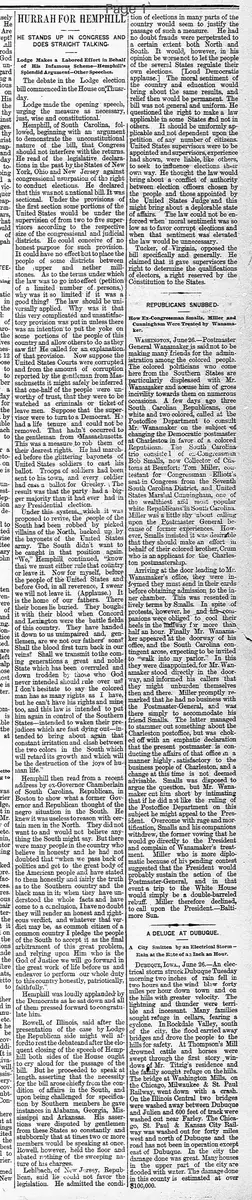
HE STANDS UP IN CONGRESS AND DOES STRAIGHT TALKING.
Lodge Makes a Labored Effort in Behalf of His Infamous Scheme—Hemphill's Splendid Argument—Other Speeches.
The debate in the Lodge election bill commenced in the House on Thursday.
Lodge made the opening speech, urging the measure as necessary, just, wise and constitutional.
Hemphill, of South Carolina, followed, beginning with an argument to demonstrate the unconstitutional nature of the bill, that Congress should not interfere with the returns. He read of the legislative declarations in the past by the States of New York, Ohio and New Jersey against congressional usurpation of the right to conduct elections. He declared that this was not a national bill. It was sectional. Under the provisions of the first section some portions of the United States would be under the supervision of from two to five supervisors according to the respective size of the congressional and judicial districts. He could conceive of no honest purpose for such provision. It could have no effect but to place the people of some districts between the upper and nether millstones. As to the terms under which the law was to go into effect (petition of a limited number of persons,) why was it so limited if it was a good thing? The law should be universally applied. Why was it that this very complicated and unsatisfactory provision was put in unless there was an intention to put the yoke on some portions of the people of this country and allow others to do as they saw fit? He called for an explanation of that provision. Now suppose the United States Courts were corrupted and from the amount of corruption reported by the gentleman from Massachusetts it might safely be inferred that one-half of the people were unworthy of trust, that they were to be watched as criminals or ticket of leave men. Suppose that the supervisor were to turn to a Democrat. He had a life tenure and could not be removed. That hadn't occurred to the gentleman from Massachusetts. This was a measure to rob them of their dearest rights. He had marched before the glittering bayonets of United States soldiers to cast his ballot. Troops of soldiers had been sent to his town, and every soldier had cast a ballot for Greeley. The result was that the party had a bigger majority than it had ever had in any Presidential election. Under this system, which it was proposed to revive, the people of the South had been robbed by picked villains of the North, backed up by the bayonets of the United States army. The South didn't want to be caught in that position again.
"We," Hemphill continued, "know that we must either rule that country or leave it. Now for myself, before the people of the United States and before God, in all reverence, I swear we will not leave it. (Applause.) It is the home of our fathers. There their bones lie buried. They bought it with their blood when Concord and Lexington were the battle fields of this country. They have handed it down to us unimpaired and, gentlemen, are we not our fathers' sons? Shall the blood first turn back in our veins? Shall we transmit to the coming generations a great and noble State which has been overruled and down trodden by those who God never intended should rule over us? I don't hesitate to say the colored man has as many rights as I have, but he can't have his rights and mine too, and this law is intended to put him again in control of the Southern States intended to waken their prejudices which are fast dying out--intended to bring about again that constant irritation and clash between the two colors in the South which will retard its growth and which will be the destruction of the joys of human life."
Hemphill then read from a recent address by ex-Governor Chamberlain of South Carolina, Republican, in Boston to show what a former Governor and Republican thought of the negro situation in the South. He knew it was useless to reason with certain men in the North. They did not want to and would not believe anything the South might say. But there were many people in the country who believe in honesty and he had not doubted that "when we pass back of politics and get to the great body of the American people and have stated to them honestly and fairly the truth as to the Southern country and the black man in it; when they have understood the whole facts and have come to a conclusion, I have no doubt they will render an honest and righteous verdict, and whatever that verdict may be, as a common citizen of a common country I pledge the people of the South to accept it as the final arbitrament of this great problem and relying upon Him who is the God of Justice we will go forward in the great work of life before us and endeavor to perform our whole duty to this country honestly, patriotically, faithfully."
Hemphill was loudly applauded by the Democrats as he sat down and all of them pressed forward to congratulate him.
Rowell, of Illinois, said after the presentation of the case by Lodge the Republican side might well afford to rest the debate and after the eloquent closing of the speech of Hemphill both sides of the House ought to cry aloud for the passage of the bill. But he proceeded to speak at length, asserting that the necessity for the bill arose chiefly from the condition of affairs in the South, and upon being challenged for specification by Southern members he gave instances in Alabama, Georgia, Mississippi and Arkansas. His assertions were disputed by gentlemen from these States so constantly and stubbornly that at times two or more members would be speaking at once. Rowell, however, held the floor and abated nothing of the sweeping nature of his charges.
Lehlbach, of New Jersey, Republican, said he could not favor the legislation. He admitted the condition of elections in many parts of the country would seem to justify the passage of such a measure. He had no doubt frauds were perpetrated to a certain extent both North and South. It would, however, in his opinion be worse not to let the people of the several States regulate their own elections. [Loud Democratic applause.] The moral sentiment of the country and education would bring about the same results, and relief then would be permanent. The bill was not general and uniform. He questioned the right to make a law applicable in some States and not in others. It should be uniformly applicable and not dependent upon the petition of any number of citizens. United States supervisors were to be appointed and supervisors, experience had shown, were liable, like others, to seek to influence elections their own way. He thought the law would bring about a conflict of authority between election officers chosen by the people and those appointed by the United States Judge and this might bring about a deplorable state of affairs. The law could not be enforced when moral sentiment was so low as to favor corrupt elections and when that sentiment was elevated the law would be unnecessary.
Tucker, of Virginia, opposed the bill specifically and generally. He claimed that it gave supervisors the right to determine the qualifications of electors, a right reserved by the Constitution to the States.
What sub-type of article is it?
What themes does it cover?
What keywords are associated?
What entities or persons were involved?
Where did it happen?
Story Details
Key Persons
Location
House Of Representatives
Event Date
Thursday
Story Details
Debate on the Lodge election bill in Congress: Lodge opens in support; Hemphill argues against its constitutionality, sectional bias, and potential for abuse, invoking Southern history and rights; Rowell defends with examples of Southern fraud; Lehlbach and Tucker oppose, emphasizing state sovereignty and risks of federal interference.