Thank you for visiting SNEWPapers!
Sign up free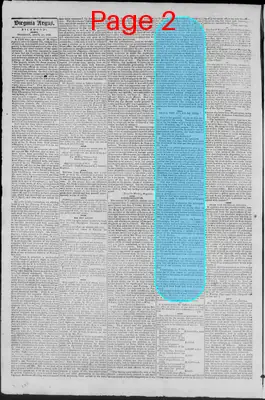
Editorial
April 12, 1808
Virginia Argus
Richmond, Virginia
What is this article about?
This editorial questions the freedom of the oceans amid global tensions, criticizing British aggression against neutral shipping and praising a French diplomatic note by Champagny for urging U.S. to assert independence. It defends U.S. neutrality principles from the Revolution and 1780 Armed Neutrality, condemns demands by British envoy Rose, and calls for Americans to heed Madison's response to Rose.
Clipping

OCR Quality
95%
Excellent
Full Text
SHALL THE OCEAN BE FREE?
This is the question which at this moment agitates the world. Destined by situation, by the habits which form the second nature of society, the U. S. will be a maritime and commercial people. To us then the issue of this question is, next to our independence and liberty, the most momentous that can be agitated.
Has it been free hitherto?
Every man can answer the question.
Every man can say, who has destroyed the freedom of the seas and the peace of all the world.
There is an article published said to be from the French minister for foreign affairs—we believe it to be authentic, and enquire not how it came to be published it merits attention, for it speaks a language, dignified, and fraught with the most solemn truths—after the declaration of Copenhagen, that there should be no neutrals—the mission and the arrogance of Rose, were necessary effects of an original cause—and after the declaration at Copenhagen, by Cathcart and Gambier, that there should be no neutrals, what had America to expect—the most envied, the most prosperous, and therefore the most hated and feared of all neutrals.
The vast crisis which approaches, has been long foretold—and if the infatuation of partial and momentary avarice, will disregard all considerations of national and permanent independence and prosperity, in order to gratify that avarice, it will bring the dispute to that issue, among ourselves.
Are we ready to abandon the principles of the revolution.
Are we ready to abandon the principles of the armed neutrality of 1780.
We cannot but take one or the other of these questions—their nature and character is common—and involve considerations which we shall lay before our readers in a more deliberate form.
For the present, and on this letter of Champagny we now say, that it contains most solemn and serious truths—that in relation to the U. S. it speaks the language of liberality and friendship—that in regard to the tyrant of the seas, it speaks very far short of the enormities committed against us by G. Britain.
With regard to the policy of the U. S. it has been and is pacific, but never can this nation abandon to any power, the rights of an independent nation. This the missionary of England on the 17th of last month required of our government to do.
Yet we have not seen a single word uttered against the audacious and insolent demand.
Rose demanded of us to recall our proclamation, and stain our shores by admitting into our ports the blood steeped murderers of our citizens, the insulters of our flag.
Champagny, the French minister, calls upon the U. S. to assert its independence, to maintain its rights, to vindicate its independence.
What do we see—not a sentiment of dissatisfaction with the former—while the latter is represented as guilty of as much violence as if New York had been Copenhagened.
The people of America should peruse and re-peruse that dignified and inimitable letter of Mr. Madison to Mr. Rose—it should be in the hand of every youth and in the heart of every upright man—Aurora.
This is the question which at this moment agitates the world. Destined by situation, by the habits which form the second nature of society, the U. S. will be a maritime and commercial people. To us then the issue of this question is, next to our independence and liberty, the most momentous that can be agitated.
Has it been free hitherto?
Every man can answer the question.
Every man can say, who has destroyed the freedom of the seas and the peace of all the world.
There is an article published said to be from the French minister for foreign affairs—we believe it to be authentic, and enquire not how it came to be published it merits attention, for it speaks a language, dignified, and fraught with the most solemn truths—after the declaration of Copenhagen, that there should be no neutrals—the mission and the arrogance of Rose, were necessary effects of an original cause—and after the declaration at Copenhagen, by Cathcart and Gambier, that there should be no neutrals, what had America to expect—the most envied, the most prosperous, and therefore the most hated and feared of all neutrals.
The vast crisis which approaches, has been long foretold—and if the infatuation of partial and momentary avarice, will disregard all considerations of national and permanent independence and prosperity, in order to gratify that avarice, it will bring the dispute to that issue, among ourselves.
Are we ready to abandon the principles of the revolution.
Are we ready to abandon the principles of the armed neutrality of 1780.
We cannot but take one or the other of these questions—their nature and character is common—and involve considerations which we shall lay before our readers in a more deliberate form.
For the present, and on this letter of Champagny we now say, that it contains most solemn and serious truths—that in relation to the U. S. it speaks the language of liberality and friendship—that in regard to the tyrant of the seas, it speaks very far short of the enormities committed against us by G. Britain.
With regard to the policy of the U. S. it has been and is pacific, but never can this nation abandon to any power, the rights of an independent nation. This the missionary of England on the 17th of last month required of our government to do.
Yet we have not seen a single word uttered against the audacious and insolent demand.
Rose demanded of us to recall our proclamation, and stain our shores by admitting into our ports the blood steeped murderers of our citizens, the insulters of our flag.
Champagny, the French minister, calls upon the U. S. to assert its independence, to maintain its rights, to vindicate its independence.
What do we see—not a sentiment of dissatisfaction with the former—while the latter is represented as guilty of as much violence as if New York had been Copenhagened.
The people of America should peruse and re-peruse that dignified and inimitable letter of Mr. Madison to Mr. Rose—it should be in the hand of every youth and in the heart of every upright man—Aurora.
What sub-type of article is it?
Foreign Affairs
War Or Peace
What keywords are associated?
Freedom Of Seas
Neutral Rights
British Aggression
French Diplomacy
Armed Neutrality
Copenhagen Declaration
Rose Mission
What entities or persons were involved?
U.S.
France
Champagny
Great Britain
Rose
Madison
Copenhagen
Editorial Details
Primary Topic
Freedom Of The Seas And U.S. Neutral Rights
Stance / Tone
Strongly Pro Neutrality And Anti British Aggression
Key Figures
U.S.
France
Champagny
Great Britain
Rose
Madison
Copenhagen
Key Arguments
The Ocean's Freedom Is Crucial For U.S. Maritime Interests.
Britain Has Destroyed Freedom Of The Seas.
French Note By Champagny Contains Solemn Truths And Urges U.S. Independence.
U.S. Should Not Abandon Revolutionary Principles Or 1780 Armed Neutrality.
Criticize Rose's Demands To Admit British Ships And Recall U.S. Proclamation.
Praise Madison's Letter To Rose As Exemplary.
U.S. Policy Is Pacific But Must Defend Independent Rights.