Thank you for visiting SNEWPapers!
Sign up free
The Rhode Island American, And General Advertiser
Providence, Providence County, Rhode Island
What is this article about?
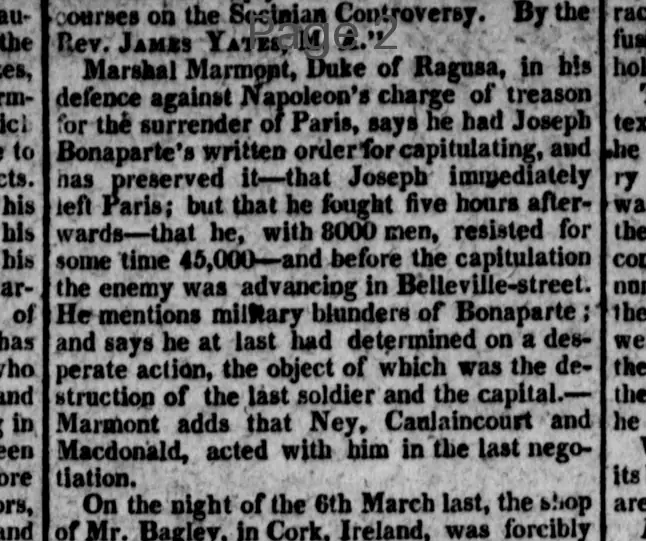
Marshal Marmont defends Napoleon's treason charge over Paris surrender, citing Joseph Bonaparte's order, his five-hour fight with 8,000 against 45,000, Bonaparte's blunders, and collaboration with Ney, Caulaincourt, and Macdonald in negotiations.
Clipping
OCR Quality
Full Text
What sub-type of article is it?
What keywords are associated?
What entities or persons were involved?
Where did it happen?
Foreign News Details
Primary Location
Paris
Key Persons
Outcome
with 8000 men resisted 45,000 for some time; surrender of paris
Event Details
Marshal Marmont, Duke of Ragusa, in his defence against Napoleon's charge of treason for the surrender of Paris, says he had Joseph Bonaparte's written order for capitulating, and has preserved it--that Joseph immediately left Paris; but that he fought five hours afterwards--that he, with 8000 men, resisted for some time 45,000 --and before the capitulation the enemy was advancing in Belleville-street. He mentions military blunders of Bonaparte; and says he at last had determined on a desperate action, the object of which was the destruction of the last soldier and the capital. Marmont adds that Ney, Caulaincourt and Macdonald, acted with him in the last negotiation.