Thank you for visiting SNEWPapers!
Sign up free
Alexandria Gazette & Advertiser
Alexandria, Virginia
What is this article about?
Reports from Smyrna papers detail dire situation in Greek War of Independence: Turks under Captain Pacha raise siege of Caristo, advance on Athens; Ibrahim Pacha's army enters Morea; Egyptian fleet heads to Candia. Greeks disorganized, fleeing to Salamis and Acropolis.
Clipping
OCR Quality
Full Text
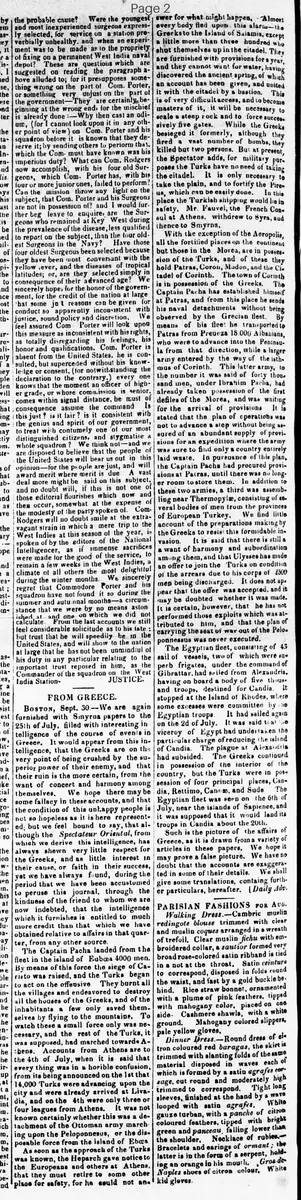
Boston, Sept. 30—We are again furnished with Smyrna papers to the 25th of July, filled with interesting intelligence of the course of events in Greece. It would appear from this intelligence, that the Greeks are on the very point of being crushed by the superior power of their enemy, and that their ruin is the more certain, from the want of concert and harmony among themselves. We hope there may be some fallacy in these accounts, and that the condition of this unhappy people is not so hopeless as it is here represented: but we feel bound to say, that although the Spectateur Oriental, from which we derive this intelligence, has always shewn very little respect for the Greeks, and as little interest in their cause, or faith in their success, yet we have always found, during the period that we have been accustomed to peruse this journal, through the kindness of the friend to whom we are now indebted, that the intelligence which it furnishes is entitled to much more credit than that which we have obtained relative to affairs in that quarter, from any other source.
The Captain Pacha landed from the fleet in the island of Eubœa 4000 men. By means of this force the siege of Caristo was raised, and the Turks began to act on the offensive They burnt all the villages and endeavored to destroy all the houses of the Greeks, and of the inhabitants a few only saved themselves by flying to the mountains. To watch these a small force only was necessary, and the rest of the Turks, it was supposed, had marched towards Athens. Accounts from Athens are to the 4th of July, when it is said that every thing was in a horrible confusion, from its being announced on the 1st that 14,000 Turks were advancing upon the city and were already arrived at Livadia. and on the 4th were only three or four leagues from Athens. It was not known certainly whether this was a detachment of the Ottoman army marching upon the Peloponnesus, or the disposable force from the island of Eubœa As soon as the approach of the Turks was known, the Heparch gave notice to the Europeans and others at Athens. that they must retire to some other place for safety, for he could not answer for what might happen. Almost every body fled upon this alarm—the Greeks to the Island of Salamis, except a little more than three hundred who shut themselves up in the citadel. They are furnished with provisions for a year, and they cannot want for water, having discovered the ancient spring, of which an account has been given, and united it with the citadel by a bastion. This is of very difficult access, and to become masters of it, it will be necessary to scale a steep rock and to force successively five gates. While the Greeks besieged it formerly, although they fired a vast number of bombs, they killed but two persons. But at present, the Spectator adds, for military purposes the Turks have no need of taking the citadel. It is only necessary to take the plain, and to fortify the Piraeus, which can be easily done. In this place the Turkish shipping would lie in safety. Mr. Fauvel, the French Consul at Athens, withdrew to Syra, and thence to Smyrna.
With the exception of the Acropolis, all the fortified places on the continent but those in the Morea, are in possession of the Turks, and of these they hold Patras, Coron, Modon, and the Citadel of Corinth. The town of Corinth is in possession of the Greeks. The Captain Pacha has established himself at Patras, and from this place he sends his naval detachments without being observed by the Grecian fleet. By means of his fleet he transported to Patras from Prevesa 18,000 Albanians, who were to advance into the Peninsula from that direction, while a larger army entered by the way of the isthmus of Corinth. This latter army, to the number it was said of forty thousand men, under Ibrahim Pacha, had already taken possession of the first defiles of the Morea, and was waiting for the arrival of provisions It is stated that the plan of operations was not to advance a step without being assured of an abundant supply of provisions for an expedition where the army was sure to find only a country entirely laid waste. In pursuance of this plan, the Captain Pacha had procured provisions at Patras, until there was no longer room to store them. In addition to these two armies, a third was assembling near Thermopylæ, consisting of several bodies of men from the provinces of European Turkey. We find little account of the preparations making by the Greeks to resist this formidable invasion.
It is said that there is still a want of harmony and subordination among them, and that Ulysses has made an offer to join the Turks on condition of the arrears due to his corps of 2500 men being discharged. It does not appear that the offer was accepted, and it may be doubted whether it was made. It is certain, however, that he has not performed those exploits which was attributed to him, and that the plan of carrying the seat of war out of the Peloponnesus was never executed.
The Egyptian fleet, consisting of 43 sail of vessels, two of which were superb frigates, under the command of Gibrattar, had sailed from Alexandria, having on board a body of five thousand troops, destined for Candia. It stopped at the Island of Rhodes, where some excesses were committed by the Egyptian troops It had sailed again on the 2d of July. It was said that the viceroy of Egypt had undertaken the particular charge of reducing the island of Candia. The plague at Alexandria had subsided. The Greeks continued in possession of the interior of the country, but the Turks were in possession of four principal places, Candia, Rettimo, Canea, and Suda The Egyptian fleet was seen on the 6th of July, near the islands of Sapienza, and it was supposed that it would land its troops in Candia about the 20th.
Such is the picture of the affairs of Greece, as it is drawn from a variety of articles in these papers. We hope it may prove a false picture. We have no doubt that the accounts are exaggerated in some of their details. We shall give some translations, containing further particulars, hereafter. [Daily Adv.
What sub-type of article is it?
What keywords are associated?
What entities or persons were involved?
Where did it happen?
Foreign News Details
Primary Location
Greece
Event Date
Smyrna Papers To The 25th Of July
Key Persons
Outcome
turks raise siege of caristo, burn villages, advance on athens and morea with 40,000 under ibrahim pacha and 18,000 albanians; greeks flee to salamis and acropolis; egyptian fleet of 43 vessels with 5,000 troops heads to candia; internal greek disharmony reported.
Event Details
Smyrna papers report Turks landing 4,000 men in Euboea, raising Caristo siege, burning villages, advancing on Athens with 14,000 troops; Heparch warns Europeans to flee; 300 Greeks hold Acropolis; Captain Pacha at Patras transports 18,000 Albanians; Ibrahim Pacha's 40,000 enter Morea; third army near Thermopylae; Greek disunity, Ulysses rumored to defect; Egyptian fleet sails for Candia with troops, after stop at Rhodes.