Thank you for visiting SNEWPapers!
Sign up free
Literary
January 24, 1829
Republican Herald
Providence, Providence County, Rhode Island
What is this article about?
In a village on Lake Erie's Canada side, idle but proud Baptiste courts emigrant farmer's daughter Louisa. To prove he can support her, he works diligently on the farm for a year, earns her hand, and they marry amid a chaotic charivari, reforming his ways.
Clipping
OCR Quality
95%
Excellent
Full Text
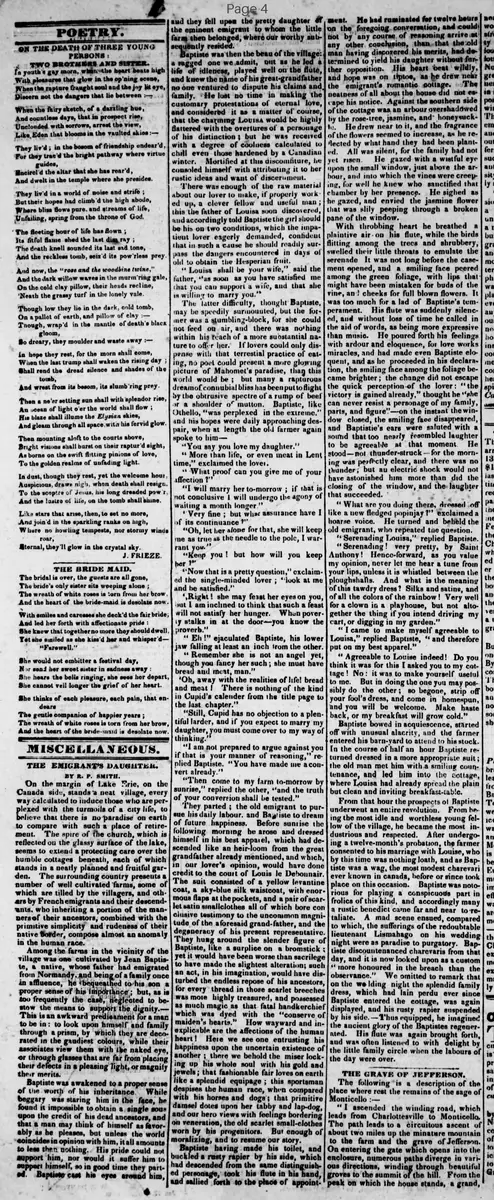
MISCELLANEOUS.
THE EMIGRANT'S DAUGHTER.
BY R. P. SMITH.
On the margin of Lake Erie, on the Canada side, stands a neat village, every way calculated to induce those who are perplexed with the turmoils of a city life, to believe that there is no paradise on earth to compare with such a place of retirement. The spire of the church, which is reflected on the glassy surface of the lake, seems to extend a protecting care over the humble cottages beneath, each of which stands in a neatly planned and fruitful garden. The surrounding country presents a number of well cultivated farms, some of which are tilled by the villagers, and others by French emigrants and their descendants, who inheriting a portion of the manners of their ancestors, combined with the primitive simplicity and rudeness of their native border, compose almost an anomaly in the human race.
Among the farms in the vicinity of the village was one cultivated by Jean Baptiste, a native, whose father had emigrated from Normandy, and being of a family once in affluence, he bequeathed to his son a proper sense of his importance; but, as is too frequently the case, neglected to bestow the means to support the dignity.—This is an awkward predicament for a man to be in: to look upon himself and family through a prism, by which they are decorated in the gaudiest colours, while their associates view them with the naked eye, or through glasses that are far from placing their defects in a pleasing light, or magnifying their merits.
Baptiste was awakened to a proper sense of the worth of his inheritance. While beggary was staring him in the face, he found it impossible to obtain a single sous upon the credit of his dead ancestors, and that a man may think of himself as favorably as he pleases, but unless the world coincides in opinion with him, it all amounts to less than nothing. His pride could not support him, nor would it suffer him to support himself, so in good time they parted. Baptiste cast his eyes around him, and they fell upon the pretty daughter of the eminent emigrant to whom the little farm then belonged; where our worthy subsequently resided.
Baptiste was then the beau of the village: a ragged one we admit, but as he led a life of idleness, played well on the flute and knew the name of his great-grandfather no one ventured to dispute his claims and family. He lost no time in making the customary protestations of eternal love, and considered it as a matter of course, that the charming Louisa would be highly flattered with the overtures of a personage of his distinction: but he was received with a degree of coolness calculated to chill even those hardened by a Canadian winter. Mortified at this discomfiture, he consoled himself with attributing it to her rustic ideas and want of discernment.
There was enough of the raw material about our lover to make, if properly worked up, a clever fellow and useful man; this the father of Louisa soon discovered and accordingly told Baptiste the girl should be his on two conditions, which the impatient lover eagerly demanded, confident that in such a cause he should readily surpass the dangers encountered in days of old to obtain the Hesperian fruit.
"Louisa shall be your wife," said the father, "as soon as you have satisfied me that you can support a wife, and that she is willing to marry you."
The latter difficulty, thought Baptiste may be speedily surmounted, but the former was a stumbling-block, for she could not feed on air, and there was nothing within his reach of a more substantial nature to offer her. If lovers could only dispense with that terrestrial practice of eating, no poet could present a more glowing picture of Mahomet's paradise, than this world would be; but many a rapturous dream of connubial bliss has been put to flight by the obtrusive spectre of a rump of beef or a shoulder of mutton. Baptiste, like Othello, "was perplexed in the extreme." and his hopes were daily approaching despair, when at length the old farmer again spoke to him—
"You say you love my daughter."
"More than life, or even meat in Lent time," exclaimed the lover.
"What proof can you give me of your affection?"
"I will marry her to-morrow: if that is not conclusive I will undergo the agony of waiting a month longer."
"Very fine; but what assurance have I of its continuance?"
"Oh, let her alone for that, she will keep me as true as the needle to the pole, I warrant you."
"Keep you! but how will you keep her?"
"Now that is a pretty question," exclaimed the single-minded lover; look at me and be satisfied."
"Right! she may feast her eyes on you, but I am inclined to think that such a feast will not satisfy her hunger. When poverty stalks in at the door—you know the proverb."
"Eh!" ejaculated Baptiste, his lower jaw falling at least an inch from the other.
"Remember she is not an angel yet, though you fancy her such; she must have bread and meat, man."
"Oh, away with the realities of life! bread and meat! There is nothing of the kind in Cupid's calendar from the title page to the last chapter."
"Still, Cupid has no objection to a plentiful larder, and if you expect to marry my daughter, you must come over to my way of thinking."
"I am not prepared to argue against you if that is your manner of reasoning," replied Baptiste. "You have made me a convert already."
"Then come to my farm to-morrow by sunrise," replied the other, "and the truth of your conversion shall be tested."
They parted; the old emigrant to pursue his daily labour, and Baptiste to dream of future happiness. Before sunrise the following morning he arose and dressed himself in his best apparel, which had descended like an heir-loom from the great grandfather already mentioned, and which, in our lover's opinion, would have done credit to the court of Louis le Debonair.
The suit consisted of a yellow levantine coat, a sky-blue silk waistcoat, with enormous flaps at the pockets, and a pair of scarlet satin smallclothes all of which bore conclusive testimony to the uncommon magnitude of the aforesaid grand-father, and the degeneracy of his present representative.
They hung around the slender figure of Baptiste, like a surplice on a broomstick: yet it would have been worse than sacrilege to have made the slightest alteration; such an act, in his imagination, would have disturbed the endless repose of his ancestors, for every thread in those scarlet breeches was more highly treasured, and possessed as much magic as that fatal handkerchief which was dyed with the "conserve of maiden's hearts."
How wayward and inexplicable are the affections of the human heart! Here we see one entrusting his happiness upon the uncertain existence of another; there we behold the miser locking up his whole soul with his gold and jewels; that fashionable fair loves nothing on earth like a splendid equipage; this sportsman despises the human race, when compared with his horses and dogs; that primitive damsel dotes upon her tabby and lap-dog, and our hero views with feelings bordering on veneration, the old scarlet small-clothes worn by his progenitors. But enough of moralizing, and to resume our story.
Baptiste having made his toilet, and buckled a rusty rapier by his side, which had descended from the same distinguished personage, took his flute in his hand. and sallied forth to the place of appointment. He had ruminated for twelve hours on the foregoing conversation, and could not by any course of reasoning arrive at any other conclusion, than that the old man having discovered his merits, had determined to yield his daughter without further opposition. His heart beat wildly, and hope was on tiptoe, as he drew near the emigrant's romantic cottage. "The neatness of all about the house did not escape his notice. Against the southern side of the cottage was an arbour overshadowed by the rose-tree, jasmine, and honeysuckle. He drew near to it, and the fragrance of the flowers seemed to increase, as he reflected by what hand they had been planted. All was silent, for the family had not yet risen.
He gazed with a wistful eye upon the small window, just above the arbour, and into which the vines were creeping, for well he knew who sanctified that chamber by her presence. He sighed as he gazed, and envied the jasmine flower that was slily peeping through a broken pane of the window.
With throbbing heart he breathed a plaintive air on his flute, while the birds flitting among the trees and shrubbery, swelled their little throats to emulate the serenade It was not long before the casement opened, and a smiling face peered among the green foliage, with lips that might have been mistaken for buds of the vine, and cheeks for full blown flowers. It was too much for a lad of Baptiste's temperament. His flute was suddenly silenced, and without loss of time he called in the aid of words, as being more expressive than music. He poured forth his feelings with ardour and eloquence, for love works miracles, and had made even Baptiste eloquent, and as he proceeded in his declaration, the smiling face among the foliage became brighter; the change did not escape the quick perception of the lover: "the victory is gained already," thought he "she can never resist a personage of my family, parts, and figure"—on the instant the window closed, the smiling face disappeared, and Baptiste's ears were saluted with a sound that too nearly resembled laughter to be agreeable at that moment. He stood—not thunder-struck—for the morning was perfectly clear, and there was no thunder; but an electric shock would not have astonished him more than did the closing of the window, and the laughter that succeeded.
"What are you doing there, dressed off like a new fledged popinjay?" exclaimed a hoarse voice. He turned and beheld the old emigrant, who repeated the question.
"Serenading Louisa," replied Baptiste.
"Serenading! very pretty, by Saint Anthony! Hence-forward, as you value my opinion, never let me hear a tune from your lips, unless it is whistled between the ploughshares. And what is the meaning of this tawdry dress? Silks and satins, and of all the colors of the rainbow! Very well for a clown in a playhouse, but not altogether the thing if you intend driving my cart, or digging in my garden."
"I came to make myself agreeable to Louisa," replied Baptiste, "and therefore put on my best apparel."
"Agreeable to Louisa indeed! Do you think it was for this I asked you to my cottage! No: it was to make yourself useful to me. But in doing the one you may possibly do the other; so begone, strip off your fool's dress, and come in homespun, and you will be welcome. Make haste back, or my breakfast will grow cold."
Baptiste bowed in acquiescence, started off with unusual alacrity, and the farmer entered his barn-yard to attend to his stock.
In the course of half an hour Baptiste returned dressed in a more appropriate suit; the old man met him with a smiling countenance, and led him into the cottage, where Louisa had already spread the plain but clean and inviting breakfast-table.
From that hour the prospects of Baptiste underwent an entire revolution. From being the most idle and worthless young fellow of the village, he became the most industrious and respected. After undergoing a twelve-month's probation, the farmer consented to his marriage with Louisa, who by this time was nothing loath, and as Baptiste was a wag, the most modest charivari ever known in Canada, before or since took place on this occasion.
Baptiste was notorious for playing a conspicuous part in frolics of this kind, and accordingly many a rustic benedict came from far and near to retaliate. A mad scene ensued, compared to which, the sufferings of the redoubtable lieutenant Lismahago on his wedding night were as paradise to purgatory. Baptiste discountenanced charivaris from that day, and it is now looked upon as a custom more honoured in the breach than the observance." We omitted to remark that on the wedding night the splendid family dress, which had lain perdu ever since Baptiste entered the cottage, was again displayed, and his rusty rapier suspended by his side.—Thus equipped, he imagined the ancient glory of the Baptistes regenerated. His flute was again brought forth, and was often listened to with delight by the little family circle when the labours of the day were over.
THE EMIGRANT'S DAUGHTER.
BY R. P. SMITH.
On the margin of Lake Erie, on the Canada side, stands a neat village, every way calculated to induce those who are perplexed with the turmoils of a city life, to believe that there is no paradise on earth to compare with such a place of retirement. The spire of the church, which is reflected on the glassy surface of the lake, seems to extend a protecting care over the humble cottages beneath, each of which stands in a neatly planned and fruitful garden. The surrounding country presents a number of well cultivated farms, some of which are tilled by the villagers, and others by French emigrants and their descendants, who inheriting a portion of the manners of their ancestors, combined with the primitive simplicity and rudeness of their native border, compose almost an anomaly in the human race.
Among the farms in the vicinity of the village was one cultivated by Jean Baptiste, a native, whose father had emigrated from Normandy, and being of a family once in affluence, he bequeathed to his son a proper sense of his importance; but, as is too frequently the case, neglected to bestow the means to support the dignity.—This is an awkward predicament for a man to be in: to look upon himself and family through a prism, by which they are decorated in the gaudiest colours, while their associates view them with the naked eye, or through glasses that are far from placing their defects in a pleasing light, or magnifying their merits.
Baptiste was awakened to a proper sense of the worth of his inheritance. While beggary was staring him in the face, he found it impossible to obtain a single sous upon the credit of his dead ancestors, and that a man may think of himself as favorably as he pleases, but unless the world coincides in opinion with him, it all amounts to less than nothing. His pride could not support him, nor would it suffer him to support himself, so in good time they parted. Baptiste cast his eyes around him, and they fell upon the pretty daughter of the eminent emigrant to whom the little farm then belonged; where our worthy subsequently resided.
Baptiste was then the beau of the village: a ragged one we admit, but as he led a life of idleness, played well on the flute and knew the name of his great-grandfather no one ventured to dispute his claims and family. He lost no time in making the customary protestations of eternal love, and considered it as a matter of course, that the charming Louisa would be highly flattered with the overtures of a personage of his distinction: but he was received with a degree of coolness calculated to chill even those hardened by a Canadian winter. Mortified at this discomfiture, he consoled himself with attributing it to her rustic ideas and want of discernment.
There was enough of the raw material about our lover to make, if properly worked up, a clever fellow and useful man; this the father of Louisa soon discovered and accordingly told Baptiste the girl should be his on two conditions, which the impatient lover eagerly demanded, confident that in such a cause he should readily surpass the dangers encountered in days of old to obtain the Hesperian fruit.
"Louisa shall be your wife," said the father, "as soon as you have satisfied me that you can support a wife, and that she is willing to marry you."
The latter difficulty, thought Baptiste may be speedily surmounted, but the former was a stumbling-block, for she could not feed on air, and there was nothing within his reach of a more substantial nature to offer her. If lovers could only dispense with that terrestrial practice of eating, no poet could present a more glowing picture of Mahomet's paradise, than this world would be; but many a rapturous dream of connubial bliss has been put to flight by the obtrusive spectre of a rump of beef or a shoulder of mutton. Baptiste, like Othello, "was perplexed in the extreme." and his hopes were daily approaching despair, when at length the old farmer again spoke to him—
"You say you love my daughter."
"More than life, or even meat in Lent time," exclaimed the lover.
"What proof can you give me of your affection?"
"I will marry her to-morrow: if that is not conclusive I will undergo the agony of waiting a month longer."
"Very fine; but what assurance have I of its continuance?"
"Oh, let her alone for that, she will keep me as true as the needle to the pole, I warrant you."
"Keep you! but how will you keep her?"
"Now that is a pretty question," exclaimed the single-minded lover; look at me and be satisfied."
"Right! she may feast her eyes on you, but I am inclined to think that such a feast will not satisfy her hunger. When poverty stalks in at the door—you know the proverb."
"Eh!" ejaculated Baptiste, his lower jaw falling at least an inch from the other.
"Remember she is not an angel yet, though you fancy her such; she must have bread and meat, man."
"Oh, away with the realities of life! bread and meat! There is nothing of the kind in Cupid's calendar from the title page to the last chapter."
"Still, Cupid has no objection to a plentiful larder, and if you expect to marry my daughter, you must come over to my way of thinking."
"I am not prepared to argue against you if that is your manner of reasoning," replied Baptiste. "You have made me a convert already."
"Then come to my farm to-morrow by sunrise," replied the other, "and the truth of your conversion shall be tested."
They parted; the old emigrant to pursue his daily labour, and Baptiste to dream of future happiness. Before sunrise the following morning he arose and dressed himself in his best apparel, which had descended like an heir-loom from the great grandfather already mentioned, and which, in our lover's opinion, would have done credit to the court of Louis le Debonair.
The suit consisted of a yellow levantine coat, a sky-blue silk waistcoat, with enormous flaps at the pockets, and a pair of scarlet satin smallclothes all of which bore conclusive testimony to the uncommon magnitude of the aforesaid grand-father, and the degeneracy of his present representative.
They hung around the slender figure of Baptiste, like a surplice on a broomstick: yet it would have been worse than sacrilege to have made the slightest alteration; such an act, in his imagination, would have disturbed the endless repose of his ancestors, for every thread in those scarlet breeches was more highly treasured, and possessed as much magic as that fatal handkerchief which was dyed with the "conserve of maiden's hearts."
How wayward and inexplicable are the affections of the human heart! Here we see one entrusting his happiness upon the uncertain existence of another; there we behold the miser locking up his whole soul with his gold and jewels; that fashionable fair loves nothing on earth like a splendid equipage; this sportsman despises the human race, when compared with his horses and dogs; that primitive damsel dotes upon her tabby and lap-dog, and our hero views with feelings bordering on veneration, the old scarlet small-clothes worn by his progenitors. But enough of moralizing, and to resume our story.
Baptiste having made his toilet, and buckled a rusty rapier by his side, which had descended from the same distinguished personage, took his flute in his hand. and sallied forth to the place of appointment. He had ruminated for twelve hours on the foregoing conversation, and could not by any course of reasoning arrive at any other conclusion, than that the old man having discovered his merits, had determined to yield his daughter without further opposition. His heart beat wildly, and hope was on tiptoe, as he drew near the emigrant's romantic cottage. "The neatness of all about the house did not escape his notice. Against the southern side of the cottage was an arbour overshadowed by the rose-tree, jasmine, and honeysuckle. He drew near to it, and the fragrance of the flowers seemed to increase, as he reflected by what hand they had been planted. All was silent, for the family had not yet risen.
He gazed with a wistful eye upon the small window, just above the arbour, and into which the vines were creeping, for well he knew who sanctified that chamber by her presence. He sighed as he gazed, and envied the jasmine flower that was slily peeping through a broken pane of the window.
With throbbing heart he breathed a plaintive air on his flute, while the birds flitting among the trees and shrubbery, swelled their little throats to emulate the serenade It was not long before the casement opened, and a smiling face peered among the green foliage, with lips that might have been mistaken for buds of the vine, and cheeks for full blown flowers. It was too much for a lad of Baptiste's temperament. His flute was suddenly silenced, and without loss of time he called in the aid of words, as being more expressive than music. He poured forth his feelings with ardour and eloquence, for love works miracles, and had made even Baptiste eloquent, and as he proceeded in his declaration, the smiling face among the foliage became brighter; the change did not escape the quick perception of the lover: "the victory is gained already," thought he "she can never resist a personage of my family, parts, and figure"—on the instant the window closed, the smiling face disappeared, and Baptiste's ears were saluted with a sound that too nearly resembled laughter to be agreeable at that moment. He stood—not thunder-struck—for the morning was perfectly clear, and there was no thunder; but an electric shock would not have astonished him more than did the closing of the window, and the laughter that succeeded.
"What are you doing there, dressed off like a new fledged popinjay?" exclaimed a hoarse voice. He turned and beheld the old emigrant, who repeated the question.
"Serenading Louisa," replied Baptiste.
"Serenading! very pretty, by Saint Anthony! Hence-forward, as you value my opinion, never let me hear a tune from your lips, unless it is whistled between the ploughshares. And what is the meaning of this tawdry dress? Silks and satins, and of all the colors of the rainbow! Very well for a clown in a playhouse, but not altogether the thing if you intend driving my cart, or digging in my garden."
"I came to make myself agreeable to Louisa," replied Baptiste, "and therefore put on my best apparel."
"Agreeable to Louisa indeed! Do you think it was for this I asked you to my cottage! No: it was to make yourself useful to me. But in doing the one you may possibly do the other; so begone, strip off your fool's dress, and come in homespun, and you will be welcome. Make haste back, or my breakfast will grow cold."
Baptiste bowed in acquiescence, started off with unusual alacrity, and the farmer entered his barn-yard to attend to his stock.
In the course of half an hour Baptiste returned dressed in a more appropriate suit; the old man met him with a smiling countenance, and led him into the cottage, where Louisa had already spread the plain but clean and inviting breakfast-table.
From that hour the prospects of Baptiste underwent an entire revolution. From being the most idle and worthless young fellow of the village, he became the most industrious and respected. After undergoing a twelve-month's probation, the farmer consented to his marriage with Louisa, who by this time was nothing loath, and as Baptiste was a wag, the most modest charivari ever known in Canada, before or since took place on this occasion.
Baptiste was notorious for playing a conspicuous part in frolics of this kind, and accordingly many a rustic benedict came from far and near to retaliate. A mad scene ensued, compared to which, the sufferings of the redoubtable lieutenant Lismahago on his wedding night were as paradise to purgatory. Baptiste discountenanced charivaris from that day, and it is now looked upon as a custom more honoured in the breach than the observance." We omitted to remark that on the wedding night the splendid family dress, which had lain perdu ever since Baptiste entered the cottage, was again displayed, and his rusty rapier suspended by his side.—Thus equipped, he imagined the ancient glory of the Baptistes regenerated. His flute was again brought forth, and was often listened to with delight by the little family circle when the labours of the day were over.
What sub-type of article is it?
Prose Fiction
What themes does it cover?
Love Romance
Moral Virtue
Social Manners
What keywords are associated?
Emigrant Daughter
Jean Baptiste
Louisa Romance
Canadian Village
Pride And Work
Charivari Wedding
What entities or persons were involved?
By R. P. Smith
Literary Details
Title
The Emigrant's Daughter
Author
By R. P. Smith
Form / Style
Humorous Short Story
Key Lines
"Louisa Shall Be Your Wife," Said The Father, "As Soon As You Have Satisfied Me That You Can Support A Wife, And That She Is Willing To Marry You."
"More Than Life, Or Even Meat In Lent Time," Exclaimed The Lover.
"Oh, Away With The Realities Of Life! Bread And Meat! There Is Nothing Of The Kind In Cupid's Calendar From The Title Page To The Last Chapter."
They Hung Around The Slender Figure Of Baptiste, Like A Surplice On A Broomstick: Yet It Would Have Been Worse Than Sacrilege To Have Made The Slightest Alteration;
From That Hour The Prospects Of Baptiste Underwent An Entire Revolution. From Being The Most Idle And Worthless Young Fellow Of The Village, He Became The Most Industrious And Respected.