Thank you for visiting SNEWPapers!
Sign up free
Literary
October 12, 1838
Burlington Free Press
Burlington, Chittenden County, Vermont
What is this article about?
Narrator on a Sunday excursion in Normandy observes French customs, enjoys nature near Harfleur and Gourlay, meets joyful harvesters including betrothed Jacques and Marie. La Mere Francon recounts tragic tale of lovers Pierre and Josephine: Pierre's madness leads to his cliff suicide; Josephine becomes maniacal and dies.
Clipping
OCR Quality
95%
Excellent
Full Text
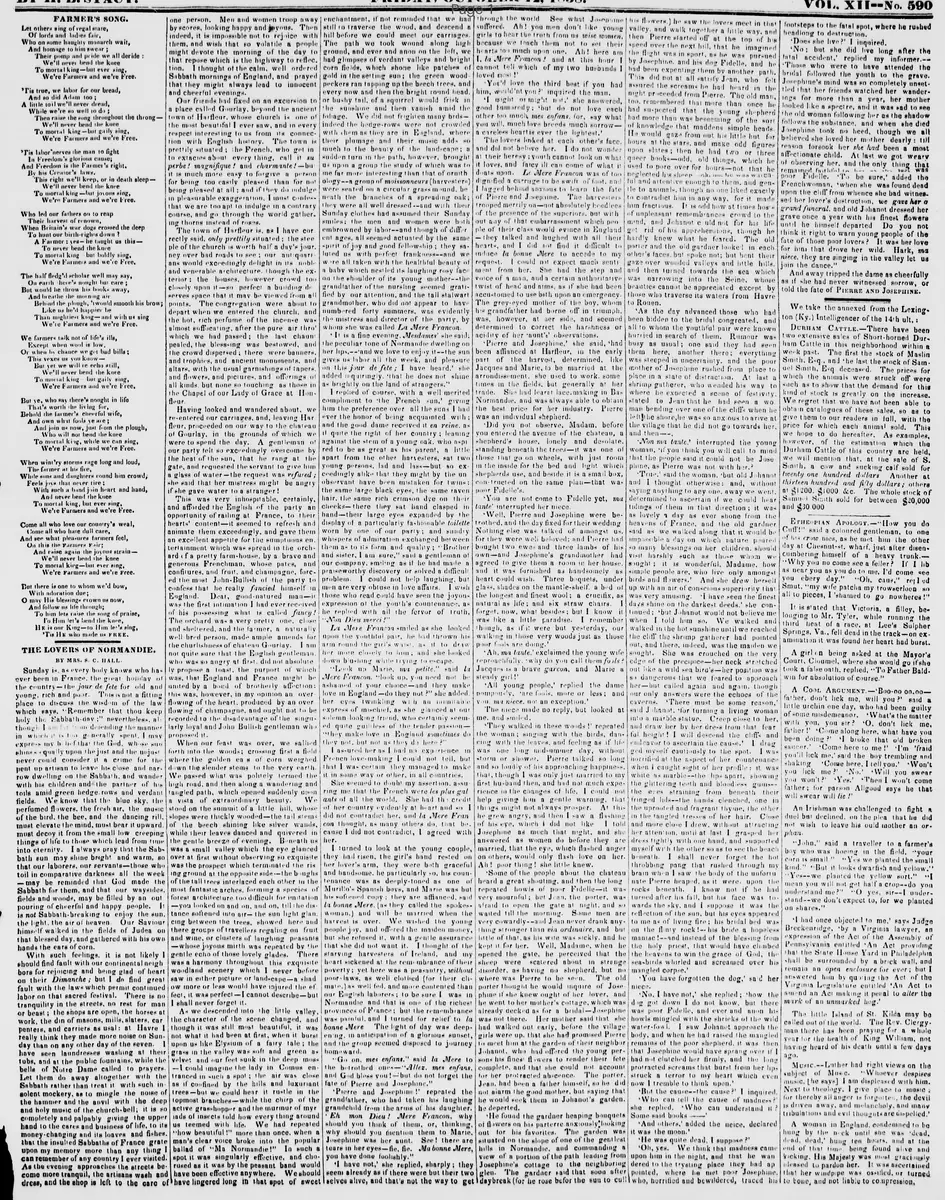
THE LOVERS OF NORMANDIE.
BY MRS. S. C. HALL.
Sunday is, as every body knows who has ever been in France, the great holiday of the country—the jour de fete for old and young, rich and poor. This is not a fitting place to discuss the wisdom of the law which says, "Remember that thou keep holy the Sabbath-day:" nevertheless, although I am far from defending the manner in which it is generally spent, I may express my belief that the God, whose sun shines equally upon the just and the unjust, never could consider it a crime for the pent up artisan to leave the close and narrow dwelling on the Sabbath, and wander with his children and the partner of his toils amid green hedgerows and verdant fields. We know that the blue sky, the perfumed flowers, the fresh air, the music of the bird, the bee, and the dancing rill, must elevate the mind, must bear it upward, must decoy it from the small low creeping things of life to those which lead from time into eternity. I always pray that the Sabbath sun may shine bright and warm, so that our laborers, our servants—those who toil in comparative darkness all the week—may be reminded that God made the Sabbath for them, and that our waysides, fields and woods, may be filled by an outpouring of cheerful and happy people. It is not Sabbath-breaking to enjoy the sun, the light, the air of heaven. Our Saviour himself walked in the fields of Judea on that blessed day, and gathered with his own hands the ears of corn.
With such feelings, it is not likely I should find fault with our continental neighbors for rejoicing and being glad of heart on their Dimanche; but I do find great fault with the laws which permit continued labor on that sacred festival. There is no tranquillity in the streets, no rest for man or beast; the shops are open, the horses at work, the din of masons, mills, slaters, carpenters, and carriers as usual: at Havre I really think they made more noise on Sunday than on any other day of the seven. I have seen laundresses washing at their tubs, and at the public fountains, while the bells of Notre Dame called to prayers. Let them do away altogether with the Sabbath rather than treat it with such insolent mockery, as to mingle the noise of the hammer and the anvil with the deep and holy music of the church-bell; it is so completely and palpably giving the upper hand to the cares and business of life, to its money-changing and its loaves and fishes, that the insulted Sabbaths of France grate upon my memory more than any thing I can remember of any country I ever visited.
As the evening approaches the streets become more tranquil, the artisans wash and dress, and the shop is left to the care of one person. Men and women troop away by scores, looking happy and joyous. Then indeed, it is impossible not to rejoice with them, and wish that so volatile a people might devote the morning of the day to that repose which is the highway to reflection. I thought of the calm, well ordered Sabbath mornings of England, and prayed that they might always lead to innocent and cheerful evenings.
Our friends had fixed on an excursion to a place called Gourlay, beyond the ancient town of Harfleur, whose church is one of the most beautiful I ever saw, and in every respect interesting to us from its connection with English history. The town is prettily situated; the French, who get into extacies about every thing, call it superbe! magnifique! and charmante!—but it is much more easy to forgive a person for being too easily pleased than for not being pleased at all: and if they do indulge in pleasurable exaggeration, I must confess that we are too apt to indulge in a contrary course, and go through the world gathering thorns instead of roses.
The town of Harfleur is, as I have correctly said, only prettily situated: the steeple of the church is worth half a day's journey over bad roads to see; our antiquarians would exceedingly delight in its noble and venerable architecture, though the exterior: the houses, however crowd too closely upon it—so perfect a building deserves space that it may be viewed from all points. The congregation were about to depart when we entered the church, and the hot, rich perfume of the incense was almost suffocating, after the pure air through which we had passed; the last chant pealed, the blessing was bestowed, and the crowd dispersed; there were banners, and trophies, and ancient monuments, and altars, with the usual garnishing of tapers, and flowers, and pictures, and offerings of all kinds, but none so touching as those in the Chapel of our Lady of Grace at Honfleur.
Having looked and wandered about, we re-entered our carriages, and, leaving Harfleur, proceeded on our way to the chateau of Gourlay, in the grounds of which we were to spend the day. A gentleman of our party felt so exceedingly overcome by the heat of the sun, that he rang at the gate, and requested the servant to give him a glass of water—the request was refused; she said that her mistress might be angry if she gave water to a stranger!
This was very inhospitable, certainly, and afforded the English of the party an opportunity of railing at France, to their hearts' content—it seemed to refresh and animate them exceedingly, and gave them an excellent appetite for the sumptuous entertainment which was spread in the orchard of a pretty farm-house, by a brave and generous Frenchman, whose pates, and confitures, and fruit, and champagne, forced the most John-Bullish of the party to confess that he really fancied himself in England. Dear, good-natured man—it was the first intimation I had ever received of his possessing what is called fancy!
The orchard was a very pretty one, close and sheltered, and the farmer, a naturally well bred person, made ample amends for the churlishness of chateau Gourlay. I am not quite sure that the English gentleman, who was so angry at first, did not absolutely propose a toast, the purport of which was, that England and France might be united by a bond of brotherly affection: this was, however, in my opinion an overflowing of the heart, produced by an overflowing of champagne, and ought not to be recorded to the disadvantage of the singularly loyal and John Bullish gentleman who proposed it.
When our feast was over, we sallied forth into the woods; crossing first a field where the golden ears of corn weighed down the slender stems to the very earth. We passed what was politely termed the high road, and then along a wandering and tangled path, which opened suddenly upon a vista of extraordinary beauty. We stood on the summit of a little hill, whose slopes were thickly wooded—the tall stems of the beech shining like silver wands, while their leaves danced and quivered in the gentle breeze of evening. Beneath us was a small valley which the eye glanced over at first without observing so exquisite was the prospect which terminated the rising ground at the opposite side—the boughs of the tall trees interlaced each other in the most fantastic arches, forming a species of forest architecture too difficult for imitation—you looked on and on, and on, till the distance softened into air—the sun light glancing between the trees, showed here and there groups of travellers regaling on fruit and wine, or clusters of laughing peasants—whose joyous mirth was repeated by the gentle echo of those lovely glades. There was a harmony throughout this exquisite woodland scenery which I never before saw in either picture or landscape—a shadow more or less would have injured the effect. It was perfect—I cannot describe—but I shall never forget it.
As we descended into the little valley, the character of the scene changed, and though it was still most beautiful, it was not what it had been at first, when it burst upon us like Elysium of a fairy tale: the grass in the valley was soft and green as velvet: and our feet sunk in the deep moss—I could imagine the lady in Comus entranced in such a spot; the air was close as if confined by the hills and luxuriant trees—but we could hear it rustle in the topmost branches—while the chirp of the active grasshopper and the murmur of myriads of insects told how every thing around us teemed with life. We had repeated "how beautiful!" more than once, when a man's clear voice broke into the popular ballad of "Ma Normandie!" In such a spot it was singularly effective, and chorused as it was by the peasant band would have been effective anywhere. We should have lingered long in that spot of sweet enchantment, if not reminded that we had still to traverse the wood, and descend a hill before we could meet our carriages.
The path we took wound along high ground, and ever and anon on the left, we had glimpses of verdant valleys and bright corn fields, which shone like patches of gold in the setting sun; the green woodpeckers ran tapping up the beech trees, and every now and then the bright round head, or busby tail, of a squirrel would frisk in the sunshine and then vanish amid the foliage. We did not frighten many birds—indeed the hedge-rows were not crowded with them as they are in England, where their plumage and their music adds so much to the beauty of the landscape; a sudden turn in the path, however, brought us upon a group the study of which was to me far more interesting than that of ornithology—a group of moissonneurs (harvesters) were seated on a circular grass mound, beneath the branches of a spreading oak; they were all well dressed—and with their Sunday clothes had assumed their Sunday smiles: the men and women were both embrowned by labor—and though of different ages, all seemed actuated by the same spirit of joy and good fellowship; they saluted us with perfect frankness—and we were all taken with the healthful beauty of a baby which nestled its laughing rosy face on the shoulder of its young mother—the grandfather of the nursling seemed gratified by our attention, and the tall stalwart grandmother, who did not appear to have numbered forty summers, was evidently the mistress and director of the party, by whom she was called La Mere Francon.
"It is a fine evening, Mesdames," she said: the peculiar tone of Normandie dwelling on her lips,—"and we love to enjoy it—the sun gives us labor all the week, and pleasure on this jour de fete; I have heard," she added inquiringly, "that he does not shine as brightly on the land of strangers."
I replied of course, with a well merited compliment to the French sun, giving him the preference over all the suns I had ever the honor of being acquainted with; and the good dame received it en reine, as if quite the right of her country; leaning against the stem of a young oak, who aspired to be as great as his parent, a little apart from the other harvesters, sat two young persons, lad and lass—but so exceedingly alike that they might by the unobservant have been mistaken for twins: the same large black eyes, the same raven hair, the same rich crimson dye on their cheeks—there they sat hand clasped in hand—their large eyes expanded by the display of a particularly fashionable toilette worn by one of our party; and sundry whispers of admiration exchanged between them as to its form and quality; "Brother and sister, I am sure," said a gentleman of our company, smiling as if he had made a praiseworthy discovery or solved a difficult problem. I could not help laughing, but men are very obtuse in love affairs. I wish those who read could have seen the joyous expression of the youth's countenance, as he replied with all the fervor of truth, "Non Dieu merci!"
La Mere Francon smiled as she looked upon the youthful pair. He had thrown his arm round the girl's waist, as if to draw her more closely to him: and she looked down blushing while trying to escape. "Look up Marie, ma petite," said La Mere Francon, "look up, you need not be ashamed of your choice—and they make love in England—do they not?" she added, her eyes twinkling with an inimitable expression of mischief, as she glanced at our solemn looking friend, who certainly seemed quite guiltless of the tender passion—"They make love in England sometimes do they not, but not as they do here?"
I assured her as I had no experience in French love-making I could not tell, but that I was certain they managed to make it in some way or other, in all countries. She seemed to doubt my assertion, assuring me that the French were les plus galants of all the world. She had the credu of her country evidently at heart and so I did not contradict her, and La Mere Francon thought, as many others do, that because I did not contradict, I agreed with her.
I turned to look at the young couple, they had risen, the girl's hand rested on her lover's arm, they were both graceful and handsome, he particularly so, his countenance was as deeply-toned as one of Murillo's Spanish boys, and Marie was but his softened copy; they are affianced, said la bonne Mere, (as they called the spokeswoman.) and will be married when the harvest is over. We wished the young people joy, and offered the maiden money, but she refused it, with a gentle assurance that she did not want it. I thought of the starving harvesters of Ireland, and my heart sickened at the remembrance of their poverty: yet here was a peasantry, without poor-laws, as well clothed (for their climate.) as well fed, and more contented than our English laborers: to be sure I was in Normandie and that is one of the richest provinces of France: but the remembrance was painful, and I turned for relief to la bonne Mere. The light of day was deepening, in anticipation of a glorious sunset, and the group seemed disposed to journey homeward.
"Go on, mes enfans," said La Mere to the betrothed ones—"Allez, mes enfans, and God bless you!—but do not forget the fate of Pierre and Josephine."
"Pierre and Josephine!" repeated the grandfather, who had taken his laughing grandchild from the arms of his daughter. "Eh mon Dieu! Mere Francon, why should you think of them, or, thinking, why should you mention them to Marie. Josephine was her aunt. See! there are tears in her eyes—fie, fie, ma bonne Mere, you have done foolishly."
"I have not," she replied, sharply; "they seem already as if there were but their two selves alive, and that's not the way to get through the world. See what Josephine suffered. Ah! you men don't like young girls to hear the truth from us wise women, because we teach them not to set their hearts too much upon one, Ah! here am I, la Mere Francon! and at this hour I cannot tell which of my two husbands I loved most!"
"You'd love the third best if you had him, wouldn't you?" inquired the man.
"I might or might not," she answered, good humoredly; "but do not love each other too much, mes enfans, for, say what you will, much love breeds much sorrow—a careless heart is ever the lightest."
The lovers linked at each other's face, and did not believe her. I do not wonder at their heresy; youth cannot look on what it loves, and fancy ill can come of what it doats upon. La Mere Francon was of too dignified a carriage to be swift of foot, and I lagged behind anxious to learn the fate of Pierre and Josephine. The harvesters trooped merrily on—not absolutely heedless of the presence of the superiors, but without any of that embarrassment which people of their class would evince in England—they talked and laughed with all their hearts, and I did not find it difficult to induce la bonne Mere to accede to my request. I could not expect much sentiment from her. She had the step and voice of a man, and a certain authoritative twist of head and arms, as if she had been accustomed to use both upon an emergency. The grey-eyed mother of the boy, whom his grandfather had borne off in triumph was, however, at her side, and seemed determined to correct the harshness or acidity of her 'aunt's' observations.
"Pierre and Josephine," she said, "had been affianced at Harfleur, in the early part of the harvest, determined, like Jacques and Marie, to be married at the arrondissement, she used to work, sometimes in the fields, but generally at her trade. She had learnt lace-making in Bas Normandie, and was always able to obtain the best price for her industry. Pierre was an individual shepherd.
"Did you not observe, Madam, before you entered the avenue of the chateau, a shepherd's house, lonely and desolate, standing beneath the trees—it was one of those that go on wheels, with just room in the inside for the bed and light which shepherds use, and beside it is a small box, constructed on the same plan—that was poor Fidelle's.
"You are not come to Fidelle yet, ma tante," interrupted her niece.
Well. Pierre and Josephine were betrothed, and the day fixed for their wedding. Nothing else was talked of amongst us, for they were well beloved: and Pierre had bought two ewes and three lambs of his own—and Josephine's grandmother had agreed to give them a room in her house, and it was furnished as handsomely as heart could wish. Three bouquets, under glass, shades on the mantel-shelf, a bed of the longest and finest wool; a crucifix, as natural as life; and six straw chairs. I forget, now, what besides: but I know it was like a little paradise. I remember though, as if it were but yesterday, our walking in those very woods just as those poor fools are doing.
"Ah, ma tante," exclaimed the young wife reproachfully, "why do you call them fools? Jacques is a brave garcon, and Marie a steady girl!"
"All young people," replied the dame pompously, "are fools, more or less; and you, ma niece, not an exception."
The niece made no reply, but looked at me, and smiled.
"They walked in these woods!" repeated the woman: singing with the birds, dancing with the leaves, and feeling as if life was one long midsummer day, without storm or shower. Pierre talked so long and so loudly of his approaching happiness, that, though I was only just married to my first husband then, and had not much experience in the changes of life, I could not help giving him a gentle warning, that things might not always prosper. At this he grew angry, and then I saw a flashing of his eye, which I did not like. I told Josephine as much that night, and she answered as women do before they are married, that the eye, which flashed anger on others, would only flash love on her. Ah! poor thing! she little knew.
Some of the people about the chateau heard a great shouting, and then the long repeated howls of poor Fidelle—it was very mournful; but Jean, the porter, was afraid to open the gate at night, and so waited till the morning. Some men are very cowardly—and Jean never drank anything stronger than vin ordinaire, and but little of that, as his wife was sickly, and he kept it for her. Well, Madame, when he opened the gate, he perceived that the sheep were scattered about in strange disorder, as having no shepherd, but nowhere was Pierre to be seen. The old porter thought he would inquire of Josephine if she knew aught of her lover, and he went to her mother's cottage, which was already decked as for a bridal—Josephine was not there. Her mother said that she had walked out early, before the village girls were up, that she had promised Pierre to meet him at the garden of their neighbor Johanot, who had offered the young persons his finest flowers to render their fete complete, and that she could not account for her protracted absence. The porter, Jean, had been a father himself, so he did not alarm the good mother, but saying that he would seek them in Johanot's garden, he departed.
He found the gardener heaping bouquets of flowers on his parterre, anxiously looking out for his favorites. The garden was situated on the slope of one of the gentlest hills in Normandie, and commanding a view of a portion of the path leading from Josephine's cottage to the neighboring glen. The gardener said that soon after daybreak (for he rose before the sun to cull his flowers,) he saw the lovers meet in that valley, and walk together a little way, and then Pierre started off at the top of his speed over the next hill, that he imagined the flight was in sport, as he was pursued by Josephine, and his dog Fidelle, and he had been expecting them by another path.
This did not at all satisfy Jean, who felt assured the screams he had heard in the night proceeded from Pierre. The old man, too, remembered that more than once he had suspected that the young shepherd had more than was beseeming of the sort of knowledge that maddens simple heads. He would gaze from out his little hut for hours at the stars, and make odd figures upon slates; then he had two or three queer books—odd, old things, which he used to pore over for hours—not that he neglected his sheep oh, no. he was wakeful, and attentive enough to them, and gentle to animals, though no one liked exactly to contradict him in any way, for it made him fractious. It is odd how at times hosts of unpleasant remembrances crowd to the mind, and Johanot could not for his life get rid of his apprehensions, though he hardly knew what he feared. The old porter and the old gardener looked in each other's faces, but spoke not; but bent their gaze over wooded valleys and little hills, and then turned towards the sea which was narrowing into the Seine, whose beauties cannot be appreciated except by those who traverse its waters from Havre to Rouen.
As the day advanced those who had been bidden to the bridal congregated, and all to whom the youthful pair were known hurried in search of them. Rumour was busy as usual; one said they had seen them here, another there; everything was steeped in uncertainty, and the poor mother of Josephine rushed from place to place in a state of distraction. At last a shrimp gatherer, who wended his way to where he expected a scene of festivity, stated to Jean that he had seen a woman bending over one of the cliffs when he left the shore, he was so anxious to arrive at the village that he did not go towards her, and then—
"Non ma tante," interrupted the young woman, "if you think you will call to mind that the people said it could not be Josephine, as Pierre was not with her."
True, said the woman, "but old Johanot and I thought otherwise: and, without saying anything to any one, away we went, determined to ascertain if we could hear tidings of them in that direction; it was as lovely a day as ever shone from the heavens of France, and the old gardener said as we walked along that it would be impossible a day on which nature poured so many blessings on her children, should visit harshly such as those whom we sought: it is wonderful, Madame, how simple people are, who live only amongst birds and flowers." And she drew herself up with an air of conscious superiority that was very amusing. "I have seen the finest days shine on the darkest deeds," she continued: but Johanot would not believe me when I told him so. We walked and walked in the hot sunshine until we reached the cliff the shrimp gatherer had pointed out, and there, indeed, was the maiden we sought. She was crouched on the very edge of the precipice—her neck stretched out like a wild sea bird's—her position was so dangerous that we feared to approach her—but called again and again, though our only answers were the echoes of the caverns. "There must be some reason," said Johanot, "for turning a living woman into a marble statue. Creep close to her, and draw her by her dress from that fearful height! I will descend the cliffs and endeavor to ascertain the cause." I dragged myself cautiously to the spot. I was horrified at the aspect of her countenance when I caught sight of her profile: it was white as marble—the lips apart, showing the glittering teeth and bloodless gums—the eyes straining from beneath their fringed lids—the hands clenched, one in the uprooted and fragrant thyme, the other in the tangled tresses of her hair. Close and more close I drew, without attracting her attention, until at last I grasped her dress tightly with one hand, and supported myself with the other so as to see the beach beneath. I shall never forget the hot throbbing pang that rushed through my brain when I saw the body of the unfortunate Pierre heaped, as it were, upon the rocks beneath. I know not if he had turned after his fall, but his face was towards the sky, and I suppose it was the reflection of the sun, but his eyes appeared to me as of living fire: his bridal bed was on the flinty rock!—his bride a hopeless maniac!—and instead of the blessing from the holy priest, that would have climbed the heavens to win the grace of God, the sea-birds whirled and screamed over his mangled corpse.
"You have forgotten the dog," said her niece.
"No, I have not," she replied: "how the dog got down I do not know, but there was poor Fidelle, and ever and anon his howls mingled with the shrieks of the wild water-fowl. I saw Johanot approach the body, and when he had raised the mangled remains of the poor shepherd, it was then that Josephine would have sprang over if I had not clutched her firmly, and the long protracted screams that burst from her lips struck a terror to my heart which even now I tremble to think upon.
"But the cause—the cause?" I inquired.
"Who can tell the cause of madness?" she replied. Who can understand it? Some said books
And others," added the niece, "declared it was the moon."
"He was quite dead, I suppose?"
"Oh, yes. We think that madness came upon him in the night, and that he wandered to the trysting place they had appointed, where he met poor Josephine, who, horrified and bewildered, traced his footsteps to the fatal spot, where he rushed headlong to destruction.
"Does she live?" I inquired.
"No: but she did live long after the fatal accident," replied my informer.—"Those who were to have attended the bridal followed the youth to the grave. Josephine's mind was so completely unsettled that her friends watched her wanderings for more than a year, her mother looked like a spectre, and it was sad to see the old woman following her as the shadow follows the substance, and when she died Josephine took no heed, though we all believed she loved her mother dearly: till reason forsook her she had been a most affectionate child. At last we got weary of observing her, and the only thing that remained faithful in her—that was poor Fidelle. To be sure," added the Frenchwoman, "when she was found dead upon the cliff from whence she had witnessed her lover's destruction, we gave her a grand funeral, and old Johanot dressed her grave once a year with his finest flowers until he himself departed. Do you not think it right to warn young people of the fate of those poor lovers? It was her love for him that drove her wild. Hark, ma niece, they are singing in the valley let us join the dance."
And away tripped the dame as cheerfully as if she had never witnessed sorrow, or told the fate of PIERRE And JOSEPHINE.
BY MRS. S. C. HALL.
Sunday is, as every body knows who has ever been in France, the great holiday of the country—the jour de fete for old and young, rich and poor. This is not a fitting place to discuss the wisdom of the law which says, "Remember that thou keep holy the Sabbath-day:" nevertheless, although I am far from defending the manner in which it is generally spent, I may express my belief that the God, whose sun shines equally upon the just and the unjust, never could consider it a crime for the pent up artisan to leave the close and narrow dwelling on the Sabbath, and wander with his children and the partner of his toils amid green hedgerows and verdant fields. We know that the blue sky, the perfumed flowers, the fresh air, the music of the bird, the bee, and the dancing rill, must elevate the mind, must bear it upward, must decoy it from the small low creeping things of life to those which lead from time into eternity. I always pray that the Sabbath sun may shine bright and warm, so that our laborers, our servants—those who toil in comparative darkness all the week—may be reminded that God made the Sabbath for them, and that our waysides, fields and woods, may be filled by an outpouring of cheerful and happy people. It is not Sabbath-breaking to enjoy the sun, the light, the air of heaven. Our Saviour himself walked in the fields of Judea on that blessed day, and gathered with his own hands the ears of corn.
With such feelings, it is not likely I should find fault with our continental neighbors for rejoicing and being glad of heart on their Dimanche; but I do find great fault with the laws which permit continued labor on that sacred festival. There is no tranquillity in the streets, no rest for man or beast; the shops are open, the horses at work, the din of masons, mills, slaters, carpenters, and carriers as usual: at Havre I really think they made more noise on Sunday than on any other day of the seven. I have seen laundresses washing at their tubs, and at the public fountains, while the bells of Notre Dame called to prayers. Let them do away altogether with the Sabbath rather than treat it with such insolent mockery, as to mingle the noise of the hammer and the anvil with the deep and holy music of the church-bell; it is so completely and palpably giving the upper hand to the cares and business of life, to its money-changing and its loaves and fishes, that the insulted Sabbaths of France grate upon my memory more than any thing I can remember of any country I ever visited.
As the evening approaches the streets become more tranquil, the artisans wash and dress, and the shop is left to the care of one person. Men and women troop away by scores, looking happy and joyous. Then indeed, it is impossible not to rejoice with them, and wish that so volatile a people might devote the morning of the day to that repose which is the highway to reflection. I thought of the calm, well ordered Sabbath mornings of England, and prayed that they might always lead to innocent and cheerful evenings.
Our friends had fixed on an excursion to a place called Gourlay, beyond the ancient town of Harfleur, whose church is one of the most beautiful I ever saw, and in every respect interesting to us from its connection with English history. The town is prettily situated; the French, who get into extacies about every thing, call it superbe! magnifique! and charmante!—but it is much more easy to forgive a person for being too easily pleased than for not being pleased at all: and if they do indulge in pleasurable exaggeration, I must confess that we are too apt to indulge in a contrary course, and go through the world gathering thorns instead of roses.
The town of Harfleur is, as I have correctly said, only prettily situated: the steeple of the church is worth half a day's journey over bad roads to see; our antiquarians would exceedingly delight in its noble and venerable architecture, though the exterior: the houses, however crowd too closely upon it—so perfect a building deserves space that it may be viewed from all points. The congregation were about to depart when we entered the church, and the hot, rich perfume of the incense was almost suffocating, after the pure air through which we had passed; the last chant pealed, the blessing was bestowed, and the crowd dispersed; there were banners, and trophies, and ancient monuments, and altars, with the usual garnishing of tapers, and flowers, and pictures, and offerings of all kinds, but none so touching as those in the Chapel of our Lady of Grace at Honfleur.
Having looked and wandered about, we re-entered our carriages, and, leaving Harfleur, proceeded on our way to the chateau of Gourlay, in the grounds of which we were to spend the day. A gentleman of our party felt so exceedingly overcome by the heat of the sun, that he rang at the gate, and requested the servant to give him a glass of water—the request was refused; she said that her mistress might be angry if she gave water to a stranger!
This was very inhospitable, certainly, and afforded the English of the party an opportunity of railing at France, to their hearts' content—it seemed to refresh and animate them exceedingly, and gave them an excellent appetite for the sumptuous entertainment which was spread in the orchard of a pretty farm-house, by a brave and generous Frenchman, whose pates, and confitures, and fruit, and champagne, forced the most John-Bullish of the party to confess that he really fancied himself in England. Dear, good-natured man—it was the first intimation I had ever received of his possessing what is called fancy!
The orchard was a very pretty one, close and sheltered, and the farmer, a naturally well bred person, made ample amends for the churlishness of chateau Gourlay. I am not quite sure that the English gentleman, who was so angry at first, did not absolutely propose a toast, the purport of which was, that England and France might be united by a bond of brotherly affection: this was, however, in my opinion an overflowing of the heart, produced by an overflowing of champagne, and ought not to be recorded to the disadvantage of the singularly loyal and John Bullish gentleman who proposed it.
When our feast was over, we sallied forth into the woods; crossing first a field where the golden ears of corn weighed down the slender stems to the very earth. We passed what was politely termed the high road, and then along a wandering and tangled path, which opened suddenly upon a vista of extraordinary beauty. We stood on the summit of a little hill, whose slopes were thickly wooded—the tall stems of the beech shining like silver wands, while their leaves danced and quivered in the gentle breeze of evening. Beneath us was a small valley which the eye glanced over at first without observing so exquisite was the prospect which terminated the rising ground at the opposite side—the boughs of the tall trees interlaced each other in the most fantastic arches, forming a species of forest architecture too difficult for imitation—you looked on and on, and on, till the distance softened into air—the sun light glancing between the trees, showed here and there groups of travellers regaling on fruit and wine, or clusters of laughing peasants—whose joyous mirth was repeated by the gentle echo of those lovely glades. There was a harmony throughout this exquisite woodland scenery which I never before saw in either picture or landscape—a shadow more or less would have injured the effect. It was perfect—I cannot describe—but I shall never forget it.
As we descended into the little valley, the character of the scene changed, and though it was still most beautiful, it was not what it had been at first, when it burst upon us like Elysium of a fairy tale: the grass in the valley was soft and green as velvet: and our feet sunk in the deep moss—I could imagine the lady in Comus entranced in such a spot; the air was close as if confined by the hills and luxuriant trees—but we could hear it rustle in the topmost branches—while the chirp of the active grasshopper and the murmur of myriads of insects told how every thing around us teemed with life. We had repeated "how beautiful!" more than once, when a man's clear voice broke into the popular ballad of "Ma Normandie!" In such a spot it was singularly effective, and chorused as it was by the peasant band would have been effective anywhere. We should have lingered long in that spot of sweet enchantment, if not reminded that we had still to traverse the wood, and descend a hill before we could meet our carriages.
The path we took wound along high ground, and ever and anon on the left, we had glimpses of verdant valleys and bright corn fields, which shone like patches of gold in the setting sun; the green woodpeckers ran tapping up the beech trees, and every now and then the bright round head, or busby tail, of a squirrel would frisk in the sunshine and then vanish amid the foliage. We did not frighten many birds—indeed the hedge-rows were not crowded with them as they are in England, where their plumage and their music adds so much to the beauty of the landscape; a sudden turn in the path, however, brought us upon a group the study of which was to me far more interesting than that of ornithology—a group of moissonneurs (harvesters) were seated on a circular grass mound, beneath the branches of a spreading oak; they were all well dressed—and with their Sunday clothes had assumed their Sunday smiles: the men and women were both embrowned by labor—and though of different ages, all seemed actuated by the same spirit of joy and good fellowship; they saluted us with perfect frankness—and we were all taken with the healthful beauty of a baby which nestled its laughing rosy face on the shoulder of its young mother—the grandfather of the nursling seemed gratified by our attention, and the tall stalwart grandmother, who did not appear to have numbered forty summers, was evidently the mistress and director of the party, by whom she was called La Mere Francon.
"It is a fine evening, Mesdames," she said: the peculiar tone of Normandie dwelling on her lips,—"and we love to enjoy it—the sun gives us labor all the week, and pleasure on this jour de fete; I have heard," she added inquiringly, "that he does not shine as brightly on the land of strangers."
I replied of course, with a well merited compliment to the French sun, giving him the preference over all the suns I had ever the honor of being acquainted with; and the good dame received it en reine, as if quite the right of her country; leaning against the stem of a young oak, who aspired to be as great as his parent, a little apart from the other harvesters, sat two young persons, lad and lass—but so exceedingly alike that they might by the unobservant have been mistaken for twins: the same large black eyes, the same raven hair, the same rich crimson dye on their cheeks—there they sat hand clasped in hand—their large eyes expanded by the display of a particularly fashionable toilette worn by one of our party; and sundry whispers of admiration exchanged between them as to its form and quality; "Brother and sister, I am sure," said a gentleman of our company, smiling as if he had made a praiseworthy discovery or solved a difficult problem. I could not help laughing, but men are very obtuse in love affairs. I wish those who read could have seen the joyous expression of the youth's countenance, as he replied with all the fervor of truth, "Non Dieu merci!"
La Mere Francon smiled as she looked upon the youthful pair. He had thrown his arm round the girl's waist, as if to draw her more closely to him: and she looked down blushing while trying to escape. "Look up Marie, ma petite," said La Mere Francon, "look up, you need not be ashamed of your choice—and they make love in England—do they not?" she added, her eyes twinkling with an inimitable expression of mischief, as she glanced at our solemn looking friend, who certainly seemed quite guiltless of the tender passion—"They make love in England sometimes do they not, but not as they do here?"
I assured her as I had no experience in French love-making I could not tell, but that I was certain they managed to make it in some way or other, in all countries. She seemed to doubt my assertion, assuring me that the French were les plus galants of all the world. She had the credu of her country evidently at heart and so I did not contradict her, and La Mere Francon thought, as many others do, that because I did not contradict, I agreed with her.
I turned to look at the young couple, they had risen, the girl's hand rested on her lover's arm, they were both graceful and handsome, he particularly so, his countenance was as deeply-toned as one of Murillo's Spanish boys, and Marie was but his softened copy; they are affianced, said la bonne Mere, (as they called the spokeswoman.) and will be married when the harvest is over. We wished the young people joy, and offered the maiden money, but she refused it, with a gentle assurance that she did not want it. I thought of the starving harvesters of Ireland, and my heart sickened at the remembrance of their poverty: yet here was a peasantry, without poor-laws, as well clothed (for their climate.) as well fed, and more contented than our English laborers: to be sure I was in Normandie and that is one of the richest provinces of France: but the remembrance was painful, and I turned for relief to la bonne Mere. The light of day was deepening, in anticipation of a glorious sunset, and the group seemed disposed to journey homeward.
"Go on, mes enfans," said La Mere to the betrothed ones—"Allez, mes enfans, and God bless you!—but do not forget the fate of Pierre and Josephine."
"Pierre and Josephine!" repeated the grandfather, who had taken his laughing grandchild from the arms of his daughter. "Eh mon Dieu! Mere Francon, why should you think of them, or, thinking, why should you mention them to Marie. Josephine was her aunt. See! there are tears in her eyes—fie, fie, ma bonne Mere, you have done foolishly."
"I have not," she replied, sharply; "they seem already as if there were but their two selves alive, and that's not the way to get through the world. See what Josephine suffered. Ah! you men don't like young girls to hear the truth from us wise women, because we teach them not to set their hearts too much upon one, Ah! here am I, la Mere Francon! and at this hour I cannot tell which of my two husbands I loved most!"
"You'd love the third best if you had him, wouldn't you?" inquired the man.
"I might or might not," she answered, good humoredly; "but do not love each other too much, mes enfans, for, say what you will, much love breeds much sorrow—a careless heart is ever the lightest."
The lovers linked at each other's face, and did not believe her. I do not wonder at their heresy; youth cannot look on what it loves, and fancy ill can come of what it doats upon. La Mere Francon was of too dignified a carriage to be swift of foot, and I lagged behind anxious to learn the fate of Pierre and Josephine. The harvesters trooped merrily on—not absolutely heedless of the presence of the superiors, but without any of that embarrassment which people of their class would evince in England—they talked and laughed with all their hearts, and I did not find it difficult to induce la bonne Mere to accede to my request. I could not expect much sentiment from her. She had the step and voice of a man, and a certain authoritative twist of head and arms, as if she had been accustomed to use both upon an emergency. The grey-eyed mother of the boy, whom his grandfather had borne off in triumph was, however, at her side, and seemed determined to correct the harshness or acidity of her 'aunt's' observations.
"Pierre and Josephine," she said, "had been affianced at Harfleur, in the early part of the harvest, determined, like Jacques and Marie, to be married at the arrondissement, she used to work, sometimes in the fields, but generally at her trade. She had learnt lace-making in Bas Normandie, and was always able to obtain the best price for her industry. Pierre was an individual shepherd.
"Did you not observe, Madam, before you entered the avenue of the chateau, a shepherd's house, lonely and desolate, standing beneath the trees—it was one of those that go on wheels, with just room in the inside for the bed and light which shepherds use, and beside it is a small box, constructed on the same plan—that was poor Fidelle's.
"You are not come to Fidelle yet, ma tante," interrupted her niece.
Well. Pierre and Josephine were betrothed, and the day fixed for their wedding. Nothing else was talked of amongst us, for they were well beloved: and Pierre had bought two ewes and three lambs of his own—and Josephine's grandmother had agreed to give them a room in her house, and it was furnished as handsomely as heart could wish. Three bouquets, under glass, shades on the mantel-shelf, a bed of the longest and finest wool; a crucifix, as natural as life; and six straw chairs. I forget, now, what besides: but I know it was like a little paradise. I remember though, as if it were but yesterday, our walking in those very woods just as those poor fools are doing.
"Ah, ma tante," exclaimed the young wife reproachfully, "why do you call them fools? Jacques is a brave garcon, and Marie a steady girl!"
"All young people," replied the dame pompously, "are fools, more or less; and you, ma niece, not an exception."
The niece made no reply, but looked at me, and smiled.
"They walked in these woods!" repeated the woman: singing with the birds, dancing with the leaves, and feeling as if life was one long midsummer day, without storm or shower. Pierre talked so long and so loudly of his approaching happiness, that, though I was only just married to my first husband then, and had not much experience in the changes of life, I could not help giving him a gentle warning, that things might not always prosper. At this he grew angry, and then I saw a flashing of his eye, which I did not like. I told Josephine as much that night, and she answered as women do before they are married, that the eye, which flashed anger on others, would only flash love on her. Ah! poor thing! she little knew.
Some of the people about the chateau heard a great shouting, and then the long repeated howls of poor Fidelle—it was very mournful; but Jean, the porter, was afraid to open the gate at night, and so waited till the morning. Some men are very cowardly—and Jean never drank anything stronger than vin ordinaire, and but little of that, as his wife was sickly, and he kept it for her. Well, Madame, when he opened the gate, he perceived that the sheep were scattered about in strange disorder, as having no shepherd, but nowhere was Pierre to be seen. The old porter thought he would inquire of Josephine if she knew aught of her lover, and he went to her mother's cottage, which was already decked as for a bridal—Josephine was not there. Her mother said that she had walked out early, before the village girls were up, that she had promised Pierre to meet him at the garden of their neighbor Johanot, who had offered the young persons his finest flowers to render their fete complete, and that she could not account for her protracted absence. The porter, Jean, had been a father himself, so he did not alarm the good mother, but saying that he would seek them in Johanot's garden, he departed.
He found the gardener heaping bouquets of flowers on his parterre, anxiously looking out for his favorites. The garden was situated on the slope of one of the gentlest hills in Normandie, and commanding a view of a portion of the path leading from Josephine's cottage to the neighboring glen. The gardener said that soon after daybreak (for he rose before the sun to cull his flowers,) he saw the lovers meet in that valley, and walk together a little way, and then Pierre started off at the top of his speed over the next hill, that he imagined the flight was in sport, as he was pursued by Josephine, and his dog Fidelle, and he had been expecting them by another path.
This did not at all satisfy Jean, who felt assured the screams he had heard in the night proceeded from Pierre. The old man, too, remembered that more than once he had suspected that the young shepherd had more than was beseeming of the sort of knowledge that maddens simple heads. He would gaze from out his little hut for hours at the stars, and make odd figures upon slates; then he had two or three queer books—odd, old things, which he used to pore over for hours—not that he neglected his sheep oh, no. he was wakeful, and attentive enough to them, and gentle to animals, though no one liked exactly to contradict him in any way, for it made him fractious. It is odd how at times hosts of unpleasant remembrances crowd to the mind, and Johanot could not for his life get rid of his apprehensions, though he hardly knew what he feared. The old porter and the old gardener looked in each other's faces, but spoke not; but bent their gaze over wooded valleys and little hills, and then turned towards the sea which was narrowing into the Seine, whose beauties cannot be appreciated except by those who traverse its waters from Havre to Rouen.
As the day advanced those who had been bidden to the bridal congregated, and all to whom the youthful pair were known hurried in search of them. Rumour was busy as usual; one said they had seen them here, another there; everything was steeped in uncertainty, and the poor mother of Josephine rushed from place to place in a state of distraction. At last a shrimp gatherer, who wended his way to where he expected a scene of festivity, stated to Jean that he had seen a woman bending over one of the cliffs when he left the shore, he was so anxious to arrive at the village that he did not go towards her, and then—
"Non ma tante," interrupted the young woman, "if you think you will call to mind that the people said it could not be Josephine, as Pierre was not with her."
True, said the woman, "but old Johanot and I thought otherwise: and, without saying anything to any one, away we went, determined to ascertain if we could hear tidings of them in that direction; it was as lovely a day as ever shone from the heavens of France, and the old gardener said as we walked along that it would be impossible a day on which nature poured so many blessings on her children, should visit harshly such as those whom we sought: it is wonderful, Madame, how simple people are, who live only amongst birds and flowers." And she drew herself up with an air of conscious superiority that was very amusing. "I have seen the finest days shine on the darkest deeds," she continued: but Johanot would not believe me when I told him so. We walked and walked in the hot sunshine until we reached the cliff the shrimp gatherer had pointed out, and there, indeed, was the maiden we sought. She was crouched on the very edge of the precipice—her neck stretched out like a wild sea bird's—her position was so dangerous that we feared to approach her—but called again and again, though our only answers were the echoes of the caverns. "There must be some reason," said Johanot, "for turning a living woman into a marble statue. Creep close to her, and draw her by her dress from that fearful height! I will descend the cliffs and endeavor to ascertain the cause." I dragged myself cautiously to the spot. I was horrified at the aspect of her countenance when I caught sight of her profile: it was white as marble—the lips apart, showing the glittering teeth and bloodless gums—the eyes straining from beneath their fringed lids—the hands clenched, one in the uprooted and fragrant thyme, the other in the tangled tresses of her hair. Close and more close I drew, without attracting her attention, until at last I grasped her dress tightly with one hand, and supported myself with the other so as to see the beach beneath. I shall never forget the hot throbbing pang that rushed through my brain when I saw the body of the unfortunate Pierre heaped, as it were, upon the rocks beneath. I know not if he had turned after his fall, but his face was towards the sky, and I suppose it was the reflection of the sun, but his eyes appeared to me as of living fire: his bridal bed was on the flinty rock!—his bride a hopeless maniac!—and instead of the blessing from the holy priest, that would have climbed the heavens to win the grace of God, the sea-birds whirled and screamed over his mangled corpse.
"You have forgotten the dog," said her niece.
"No, I have not," she replied: "how the dog got down I do not know, but there was poor Fidelle, and ever and anon his howls mingled with the shrieks of the wild water-fowl. I saw Johanot approach the body, and when he had raised the mangled remains of the poor shepherd, it was then that Josephine would have sprang over if I had not clutched her firmly, and the long protracted screams that burst from her lips struck a terror to my heart which even now I tremble to think upon.
"But the cause—the cause?" I inquired.
"Who can tell the cause of madness?" she replied. Who can understand it? Some said books
And others," added the niece, "declared it was the moon."
"He was quite dead, I suppose?"
"Oh, yes. We think that madness came upon him in the night, and that he wandered to the trysting place they had appointed, where he met poor Josephine, who, horrified and bewildered, traced his footsteps to the fatal spot, where he rushed headlong to destruction.
"Does she live?" I inquired.
"No: but she did live long after the fatal accident," replied my informer.—"Those who were to have attended the bridal followed the youth to the grave. Josephine's mind was so completely unsettled that her friends watched her wanderings for more than a year, her mother looked like a spectre, and it was sad to see the old woman following her as the shadow follows the substance, and when she died Josephine took no heed, though we all believed she loved her mother dearly: till reason forsook her she had been a most affectionate child. At last we got weary of observing her, and the only thing that remained faithful in her—that was poor Fidelle. To be sure," added the Frenchwoman, "when she was found dead upon the cliff from whence she had witnessed her lover's destruction, we gave her a grand funeral, and old Johanot dressed her grave once a year with his finest flowers until he himself departed. Do you not think it right to warn young people of the fate of those poor lovers? It was her love for him that drove her wild. Hark, ma niece, they are singing in the valley let us join the dance."
And away tripped the dame as cheerfully as if she had never witnessed sorrow, or told the fate of PIERRE And JOSEPHINE.
What sub-type of article is it?
Prose Fiction
What themes does it cover?
Love Romance
Death Mortality
Moral Virtue
What keywords are associated?
Normandy Lovers
Tragic Romance
French Sabbath
Harvest Peasants
Madness Suicide
What entities or persons were involved?
By Mrs. S. C. Hall.
Literary Details
Title
The Lovers Of Normandie.
Author
By Mrs. S. C. Hall.
Key Lines
"Much Love Breeds Much Sorrow—A Careless Heart Is Ever The Lightest."
His Bridal Bed Was On The Flinty Rock!—His Bride A Hopeless Maniac!—And Instead Of The Blessing From The Holy Priest, That Would Have Climbed The Heavens To Win The Grace Of God, The Sea Birds Whirled And Screamed Over His Mangled Corpse.
Do You Not Think It Right To Warn Young People Of The Fate Of Those Poor Lovers? It Was Her Love For Him That Drove Her Wild.