Thank you for visiting SNEWPapers!
Sign up free
Gazette Of The United States
New York, New York County, New York
What is this article about?
U.S. House of Representatives proceedings on June 21-22, 1790: Passed Post-Office bill; rejected spirits duties repeal; appointed debt payment committee; advanced and passed accounts settlement bill; introduced tonnage duty bill; handled war-related petitions; progressed Indian trade regulation bill with amendments.
Merged-components note: Sequential reports on congressional proceedings for June 21 and 22.
Clippings
1 of 2
OCR Quality
Full Text
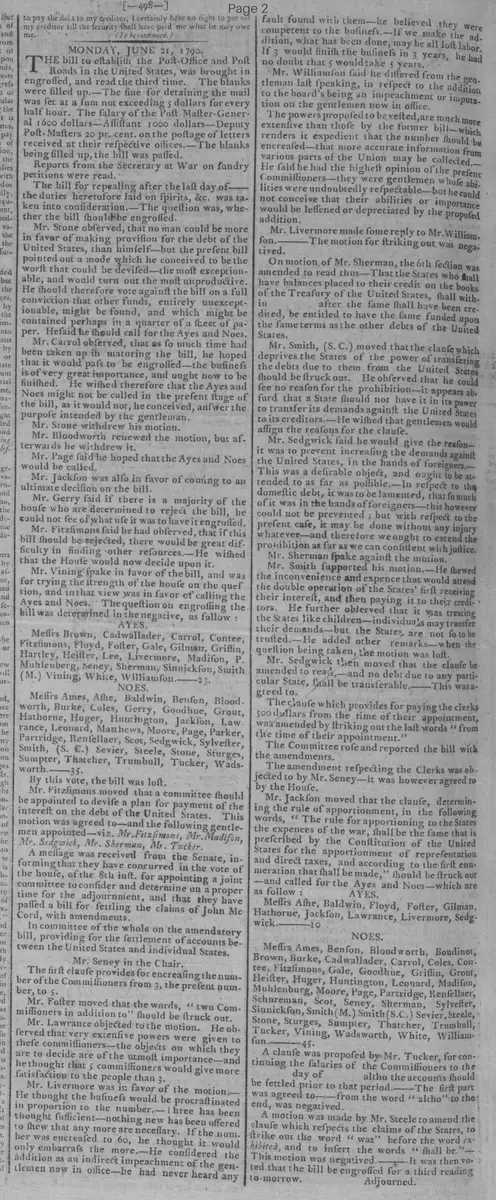
THE bill to establish the Post-Office and Post Roads in the United States, was brought in engrossed, and read the third time. The blanks were filled up.—The fine for detaining the mail was set at a sum not exceeding 5 dollars for every half hour. The salary of the Post-Master-General 1600 dollars—Assistant 1000 dollars—Deputy Post-Masters 20 pr. cent. on the postage of letters received at their respective offices.—The blanks being filled up, the bill was passed.
Reports from the Secretary at War on sundry petitions were read.
The bill for repealing after the last day of the duties heretofore laid on spirits, &c. was taken into consideration.—The question was, whether the bill should be engrossed.
Mr. Stone observed, that no man could be more in favor of making provision for the debt of the United States, than himself but the present bill pointed out a mode which he conceived to be the worst that could be devised the most exceptionable, and would turn out the most unproductive. He should therefore vote against the bill on a full conviction that other funds, entirely unexceptionable, might be found, and which might be contained perhaps in a quarter of a sheet of paper. He said he should call for the Ayes and Noes.
Mr. Carrol observed. that as so much time had been taken up in maturing the bill, he hoped that it would pass to be engrossed—the business is of very great importance, and ought now to be finished. He wished therefore that the Ayes and Noes might not be called in the present stage of the bill, as it would not, he conceived, answer the purpose intended by the gentleman.
Mr. Stone withdrew his motion.
Mr. Bloodworth renewed the motion, but afterwards he withdrew it.
Mr. Page said he hoped that the Ayes and Noes would be called.
Mr. Jackson was also in favor of coming to an ultimate decision on the bill.
Mr. Gerry said if there is a majority of the house who are determined to reject the bill, he could not see of what use it was to have it engrossed.
Mr. Fitzsimons said he had observed, that if this bill should be rejected, there would be great difficulty in finding other resources.—He wished that the House would now decide upon it.
Mr. Vining spoke in favor of the bill, and was for trying the strength of the house on the question, and in that view was in favor of calling the Ayes and Noes. The question on engrossing the bill was determined in the negative, as follow:
AYES. Messrs Brown, Cadwallader, Carrol, Contee, Fitzsimons, Floyd, Foster, Gale, Gilman, Griffin, Hartley, Heister, Lee, Livermore, Madison, P. Muhlenberg, Seney, Sherman, Sinnickson, Smith (M.) Vining, White, Williamson.—23.
NOES. Messrs Ames, Ashe, Baldwin, Benson, Bloodworth, Burke, Coles, Gerry, Goodhue, Grout, Hathorne, Huger, Huntington, Jackson, Lawrance, Leonard, Matthews, Moore, Page, Parker, Partridge, Rensselaer, Scott, Sedgwick, Sylvester, Smith, (S. C.) Sevier, Steele, Stone, Sturges, Sumter, Thatcher, Trumbull, Tucker, Wadsworth.—35.
By this vote, the bill was lost.
Mr. Fitzsimons moved that a committee should be appointed to devise a plan for payment of the interest on the debt of the United States. This motion was agreed to—and the following gentlemen appointed—viz. Mr. Fitzsimons, Mr. Madison, Mr. Sedgwick, Mr. Sherman, Mr. Tucker.
A message was received from the Senate, informing that they have concurred in the vote of the house, of the 8th inst. for appointing a joint committee to consider and determine on a proper time for the adjournment, and that they have passed a bill for settling the claims of John McCord, with amendments.
In committee of the whole on the amendatory bill, providing for the settlement of accounts between the United States and individual States.
Mr. Seney in the Chair.
The first clause provides for increasing the number of the Commissioners from 3, the present number, to 5.
Mr. Foster moved that the words, "two Commissioners in addition to" should be struck out.
Mr. Lawrance objected to the motion. He observed that very extensive powers were given to these commissioners—the objects on which they are to decide are of the utmost importance—and he thought that 5 commissioners would give more satisfaction to the people than 3.
Mr. Livermore was in favor of the motion.—He thought the business would be procrastinated in proportion to the number. Three has been thought sufficient—nothing new has been offered to shew that any more are necessary. If the number was increased to 60, he thought it would only embarrass the more.—He considered the addition as an indirect impeachment of the gentlemen now in office—he had never heard any fault found with them—he believed they were competent to the business.—If we make the addition, what has been done, may be all lost labor. If 3 would finish the business in 3 years, he had no doubt that 5 would take 5 years.
Mr. Williamson said he differed from the gentleman last speaking, in respect to the addition to the board's being an impeachment or imputation on the gentlemen now in office. The powers proposed to be vested, are much more extensive than those by the former bill—which renders it expedient that the number should be increased—that more accurate information from various parts of the Union may be collected.—He said he had the highest opinion of the present Commissioners—they were gentlemen whose abilities were undoubtedly respectable—but he could not conceive that their abilities or importance would be lessened or depreciated by the proposed addition.
Mr. Livermore made some reply to Mr. Williamson.
The motion for striking out was negatived.
On motion of Mr. Sherman, the 6th section was amended to read thus—That the States who shall have balances placed to their credit on the books of the Treasury of the United States, shall thereafter the same shall have been credited, be entitled to have the same funded upon the same terms as the other debts of the United States.
Mr. Smith, (S. C.) moved that the clause which deprives the States of the power of transferring the debts due to them from the United States should be struck out. He observed that he could see no reason for the prohibition—it appears absurd that a State should not have it in its power to transfer its demands against the United States to its creditors.—He wished that gentlemen would assign the reasons for the clause.
Mr. Sedgwick said he would give the reason—it was to prevent increasing the demands against the United States, in the hands of foreigners.—This was a desirable object, and ought to be attended to as far as possible.—In respect to that domestic debt, it was to be lamented, that so much of it was in the hands of foreigners—this however could not be prevented; but with respect to the present case, it may be done without any injury whatever—and therefore we ought to extend the prohibition as far as we can consistent with justice.
Mr. Sherman spoke against the motion.
Mr. Smith supported his motion.—He shewed the inconvenience and expence that would attend the double operation of the States' first receiving their interest, and then paying it to their creditors. He further observed that it was treating the States like children—individuals may transfer their demands—but the States are not so to be trusted.—He added other remarks—when the question being taken, the motion was lost.
Mr. Sedgwick then moved that the clause be amended to read,—and no debt due to any particular State, shall be transferable. This was agreed to.
The clause which provides for paying the clerks 50 dollars from the time of their appointment, was amended by striking out the last words "from the time of their appointment."
The Committee rose and reported the bill with the amendments.
The amendment respecting the Clerks was objected to by Mr. Seney—it was however agreed to by the House.
Mr. Jackson moved that the clause, determining the rule of apportionment, in the following words, "The rule for apportioning to the States the expences of the war, shall be the same that is prescribed by the Constitution of the United States for the apportionment of representation and direct taxes, and according to the first enumeration that shall be made," should be struck out—and called for the Ayes and Noes—which are as follow:
AYES. Messrs Ashe, Baldwin, Floyd, Foster, Gilman, Hathorne, Jackson, Lawrance, Livermore, Sedgwick.—10
NOES. Messrs Ames, Benson, Bloodworth, Boudinot, Brown, Burke, Cadwallader, Carrol, Coles, Contee, Fitzsimons, Gale, Goodhue, Griffin, Grout, Heister, Huger, Huntington, Leonard, Madison, Muhlenberg, Moore, Page, Partridge, Rensselaer, Schureman, Scott, Seney, Sherman, Sylvester, Sinnickson, Smith (M.) Smith (S.C.) Sevier, Steele, Stone, Sturges, Sumter, Thatcher, Trumbull, Tucker, Vining, Wadsworth, White, Williamson.—45.
A clause was proposed by Mr. Tucker, for continuing the salaries of the Commissioners to the day of although the accounts should be settled prior to that period.—The first part was agreed to—from the word "altho" to the end, was negatived.
A motion was made by Mr. Steele to amend the clause which respects the claims of the States, to strike out the word "was" before the word exhibited, and to insert the words "shall be."—This motion was negatived. It was then voted that the bill be engrossed for a third reading to-morrow.
Adjourned.
TUESDAY, JUNE 22.
The amendatory bill providing for the settlement of accounts between the United States and individual States, having been engrossed—the House filled up the blanks, and passed the bill.
Mr. Goodhue, of the committee appointed for the purpose, brought in a bill laying an additional duty on tonnage, pursuant to resolutions of the House; the bill was read and referred to a committee of the whole, to be taken up to-morrow.
Sundry reports of the Secretary at War were read—among others, on the petition of the heirs of William Gould, deceased, praying an allowance of his half pay for his children, for reasons set forth—the report was in favor of granting the petition, and that 1680 dollars, the half pay of a captain for 7 years, be granted—this report, on motion of Mr. Seney, was accepted, and a committee, consisting of Mr. Seney, Mr. Vining and Mr. Moore, was appointed to bring in a bill accordingly.
The amendment of the Senate to the bill for satisfying the claims of John McCord was agreed to.
Mr. Lawrence presented a petition from certain inhabitants of the county of Westchester in the State of New-York, praying payment for losses sustained during the war—which was read, and referred to the Secretary at War.
On motion of Mr. Boudinot, the report of the Secretary at War, on the petition of William Oliver, was read, and agreed to.
In committee of the whole, on the bill to regulate trade and intercourse with the Indian Tribes, Mr. Boudinot in the Chair.
The committee agreed to sundry amendments to this bill, which were reported to the House and adopted.
Mr. Sherman moved that the 4th section should be struck out of the bill—viz. That a sum not exceeding one thousand dollars, be appropriated out of the monies arising from duties on imports and tonnage, subject to the orders of the President of the United States, to be laid out in goods and articles of trade suitable for supplying the wants and necessities of the Indians, and to be vended and retailed to them, through the agency of the said Superintendents, and persons to be licensed by them for that purpose, in such manner, and conformably to such regulations, as the President of the United States shall establish.
On this motion, Mr. Jackson called for the ayes and noes—which are as follows.
AYES. Mesrs. Ashe, Bloodworth, Coles, Floyd, Foster, Gerry, Goodhue, Hathorne, Vining, Huger, Huntington, Jackson, Leonard, Livermore, Parker, Rensselaer, Schureman, Sedgwick, Seney, Sever, Sherman, Sylvester, Stone, Sturges, Sumter, Tucker—26.
NOES. Mesrs. Ames, Baldwin, Benson, Boudinot, Brown, Cadwallader, Contee, Fitzsimons, Gale, Gilman, Griffin, Hartley, Lawrence, Lee, Madison, Matthews, Moore, P. Muhlenberg, Page, Scott, Sinnickson, Smith (M.), Smith (S.C.), Steele, Trumbull, Wadsworth, White—27.
On motion of Mr. Steele, a clause was added limiting the duration of the bill to two years.
It was then ordered that the bill be engrossed. Adjourned.
What sub-type of article is it?
What keywords are associated?
What entities or persons were involved?
Domestic News Details
Event Date
June 21 22, 1790
Key Persons
Outcome
post-office bill passed; spirits duties repeal bill rejected (23-35); debt payment committee appointed; accounts settlement bill advanced and passed; tonnage duty bill introduced; gould heirs petition granted (1680 dollars); mccord claims bill amendment agreed; oliver petition agreed; indian trade bill amended, section struck (26-27), limited to two years, engrossed.
Event Details
House debates and votes on Post-Office establishment bill, which passed with specified fines and salaries; consideration and rejection of spirits duties repeal bill after debate on funding alternatives; appointment of committee (Fitzsimons, Madison, Sedgwick, Sherman, Tucker) for debt interest payment plan; Senate message on adjournment committee and McCord claims; committee of whole on accounts settlement bill, debates on commissioners number (retained 5), amendments to sections on state balances, debt transfer prohibition, clerks pay, apportionment rule (retained 45-10), salaries continuation; bill engrossed and passed next day; tonnage duty bill introduced; war secretary reports, including favorable on Gould heirs (committee appointed); Westchester petition referred; Oliver petition agreed; Indian trade bill amendments adopted, 4th section struck out, duration limited to two years.