Thank you for visiting SNEWPapers!
Sign up free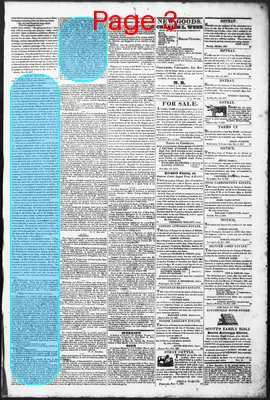
Literary
November 22, 1827
The Litchfield County Post
Litchfield, Litchfield County, Connecticut
What is this article about?
Article advocates for infant schools in England, originally for poor children, to foster moral character, cleanliness, and intellectual growth through play and discipline. Quotes Journal of Education and Mr. Wilderspin's rules for teachers, emphasizing example over precept, with an anecdote on honesty.
Merged-components note: Continuation of literary article on infant education and schools.
Clipping
OCR Quality
95%
Excellent
Full Text
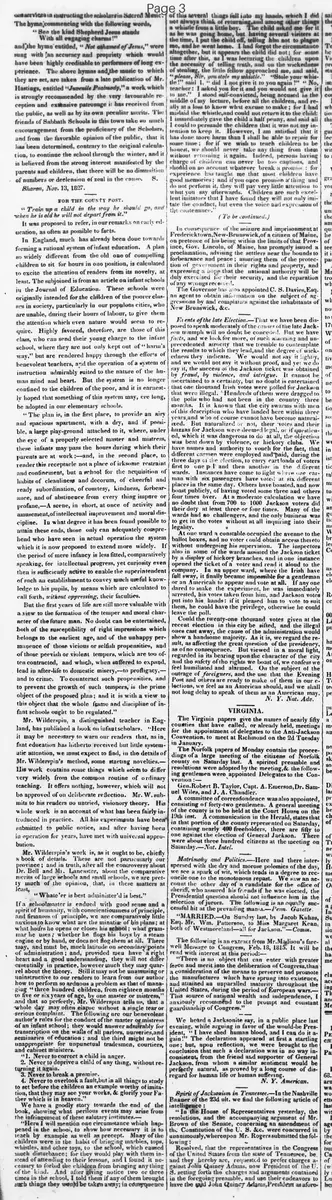
For the County Post,
"Train up a child in the way he should go, and
when he is old he will not depart from it."
It was proposed to refer, in our remarks on early education, as often as possible to facts.
In England, much has already been done towards forming a rational system of infant education. A plan so widely different from the old one of compelling children to sit for hours in one position, is calculated to excite the attention of readers from its novelty, at least. The subjoined is from an article on infant schools in the Journal of Education. These schools were originally intended for the children of the poorer classes in society, particularly in our populous cities, who are unable, during their hours of labour, to give them the attention which even nature would seem to require. Highly favored, therefore, are those of this class, who can send their young charge to the infant school, where they are not only kept out of "harm's way," but are rendered happy through the efforts of benevolent teachers, and the operation of a system of instruction admirably suited to the nature of the human mind and heart. But the system is no longer confined to the children of the poor, and it is earnestly hoped that something of this system may, ere long, be adopted in our elementary schools.
"The plan is, in the first place, to provide an airy and spacious apartment, with a dry, and if possible, a large play-ground attached to it, where, under the eye of a properly selected master and mistress, these infants may pass the hours during which their parents are at work;—and, in the second place, to render this receptacle not a place of irksome restraint and confinement, but a school for the acquisition of habits of cleanliness and decorum, of cheerful and ready subordination, of courtesy, kindness, forbearance, and of abstinence from every thing impure or profane,—A scene, in short, at once of activity and amusement, of intellectual improvement and moral discipline. In what degree it has been found possible to attain these ends, those only can adequately comprehend who have seen in actual operation the system which it is now proposed to extend more widely. If the period of mere infancy is less fitted, comparatively speaking, for intellectual progress, yet curiosity even then is sufficiently active to enable the superintendent of such an establishment to convey much useful knowledge to his pupils, by means which are calculated to call forth, without oppressing, their faculties.
But the first years of life are still more valuable with a view to the formation of the temper and moral character of the future man. No doubt can be entertained, both of the susceptibility of right impressions which belongs to the earliest age, and of the unhappy permanence of those vicious or selfish propensities, and of those peevish or violent tempers, which are too often contracted, and which, when suffered to expand, lead in after-life to domestic misery,—to profligacy, and to crime. To counteract such propensities, and to prevent the growth of such tempers, is the prime object of the proposed plan; and it is with a view to this object that the whole frame and discipline of infant schools ought to be regulated."
Mr. Wilderspin, a distinguished teacher in England, has published a book on infant schools. "Here it may be necessary to warn our readers that, as infant education has hitherto received but little systematic attention, we must expect to find, in the details of Mr. Wilderspin's method, some starting novelties. His work contains some things which seem to differ very widely from the common routine of ordinary teaching. It offers nothing, however, which will not be approved of on deliberate reflection. Mr. W. submits to his readers no untried, visionary theory. His whole work is an account of what has been fairly introduced in practice. All his experiments have been submitted to public notice, and after having been in operation for years, have met with universal approbation.
Mr. Wilderspin's work is, as it ought to be, chiefly a book of details. These are not particularly our province; and in truth, after all the controversy about Dr. Bell and Mr. Lancaster, about the comparative merits of large schools and small schools, we are pretty much of the opinion, that, in these matters at least,
"Whate'er is best administered is best."
If a schoolmaster is endued with good sense and a spirit of humanity, with conscientiousness of principle, and firmness of principle, we are comparatively little anxious to know what are the minutiae of his plans; at what hours he opens or closes his school; what grammar he uses; whether he flogs his boys by a steam engine or by hand, or does not flog them at all. There may, and must be, much latitude on secondary points of administration; and, provided men have a right heart and a good understanding, they will not differ essentially in practice, however much they may quarrel about the theory. Still it may not be unamusing or uninstructive to our readers to learn from our author how to perform so arduous a problem as that of managing "three hundred children, from eighteen months to five or six years of age, by one master or mistress," and that so perfectly, Mr. Wilderspin tells us, that a whole day may often elapse without a single tear or serious complaint. The following are our benevolent author's rules for the conduct of the master or mistress of an infant school; they would answer admirably for transcription on the walls of all parlors, nurseries, and seminaries of education; and the third might not be inappropriate for unpunctual tradesmen, courtiers, and cabinet ministers.
"1. Never to correct a child in anger.
2. Never to deprive a child of any thing, without returning it again.
3. Never to break a promise.
4. Never to overlook a fault, but in all things to study to set before the children an example worthy of imitation, that they may see your works, & glorify your Father which is in heaven."
We have a goodly story towards the end of the book, showing what perilous events may arise from the infringement of these salutary institutes.
"Here I will mention one circumstance which happened in the school, to show how necessary it is to teach by example as well as precept. Many of the children were in the habit of bringing marbles, tops, whistles, and other toys, to the school, which caused much disturbance; for they would play with them instead of attending to their lessons, and I found it necessary to forbid the children from bringing any thing of the kind. And after giving notice two or three times in the school, I told them if any of them brought such things they would be taken away; in consequence of this several things fell into my hands, which I did not always think of returning, and among other things a whistle from a little boy. The child asked me for it as he was going home, but having several visitors at the time, I put the child off, telling him not to plague me, and he went home. I had forgot the circumstance altogether, but it appears the child did not; for some time after this, as I was lecturing the children upon the necessity of telling truth, and on the wickedness of stealing, the little fellow approached me, and said, "please, Sir, you stole my whistle." "Stole your whistle!" said I, "did I not give it to you again?" "No, teacher: I asked you for it and you would not give it to me." I stood self-convicted, being accused in the middle of my lecture, before all the children, and really at a loss to know what excuse to make: for I had mislaid the whistle, and could not return it to the child: I immediately gave the child a half penny, and said all I could to persuade the children that it was not my intention to keep it. However, I am satisfied that it has done more harm than I shall be able to repair for some time; for if we wish to teach children to be honest, we should never take any thing from them without returning it again. Indeed, persons having charge of children can never be too cautious, and should on no account whatever break a promise: for experience has taught me that most children have good memories; and if you once promise a thing and do not perform it, they will pay very little attention to what you say afterwards. Children are such excellent imitators that I have found they will not only imitate the conduct, but even the voice and expression of the countenance."
(To be continued.)
"Train up a child in the way he should go, and
when he is old he will not depart from it."
It was proposed to refer, in our remarks on early education, as often as possible to facts.
In England, much has already been done towards forming a rational system of infant education. A plan so widely different from the old one of compelling children to sit for hours in one position, is calculated to excite the attention of readers from its novelty, at least. The subjoined is from an article on infant schools in the Journal of Education. These schools were originally intended for the children of the poorer classes in society, particularly in our populous cities, who are unable, during their hours of labour, to give them the attention which even nature would seem to require. Highly favored, therefore, are those of this class, who can send their young charge to the infant school, where they are not only kept out of "harm's way," but are rendered happy through the efforts of benevolent teachers, and the operation of a system of instruction admirably suited to the nature of the human mind and heart. But the system is no longer confined to the children of the poor, and it is earnestly hoped that something of this system may, ere long, be adopted in our elementary schools.
"The plan is, in the first place, to provide an airy and spacious apartment, with a dry, and if possible, a large play-ground attached to it, where, under the eye of a properly selected master and mistress, these infants may pass the hours during which their parents are at work;—and, in the second place, to render this receptacle not a place of irksome restraint and confinement, but a school for the acquisition of habits of cleanliness and decorum, of cheerful and ready subordination, of courtesy, kindness, forbearance, and of abstinence from every thing impure or profane,—A scene, in short, at once of activity and amusement, of intellectual improvement and moral discipline. In what degree it has been found possible to attain these ends, those only can adequately comprehend who have seen in actual operation the system which it is now proposed to extend more widely. If the period of mere infancy is less fitted, comparatively speaking, for intellectual progress, yet curiosity even then is sufficiently active to enable the superintendent of such an establishment to convey much useful knowledge to his pupils, by means which are calculated to call forth, without oppressing, their faculties.
But the first years of life are still more valuable with a view to the formation of the temper and moral character of the future man. No doubt can be entertained, both of the susceptibility of right impressions which belongs to the earliest age, and of the unhappy permanence of those vicious or selfish propensities, and of those peevish or violent tempers, which are too often contracted, and which, when suffered to expand, lead in after-life to domestic misery,—to profligacy, and to crime. To counteract such propensities, and to prevent the growth of such tempers, is the prime object of the proposed plan; and it is with a view to this object that the whole frame and discipline of infant schools ought to be regulated."
Mr. Wilderspin, a distinguished teacher in England, has published a book on infant schools. "Here it may be necessary to warn our readers that, as infant education has hitherto received but little systematic attention, we must expect to find, in the details of Mr. Wilderspin's method, some starting novelties. His work contains some things which seem to differ very widely from the common routine of ordinary teaching. It offers nothing, however, which will not be approved of on deliberate reflection. Mr. W. submits to his readers no untried, visionary theory. His whole work is an account of what has been fairly introduced in practice. All his experiments have been submitted to public notice, and after having been in operation for years, have met with universal approbation.
Mr. Wilderspin's work is, as it ought to be, chiefly a book of details. These are not particularly our province; and in truth, after all the controversy about Dr. Bell and Mr. Lancaster, about the comparative merits of large schools and small schools, we are pretty much of the opinion, that, in these matters at least,
"Whate'er is best administered is best."
If a schoolmaster is endued with good sense and a spirit of humanity, with conscientiousness of principle, and firmness of principle, we are comparatively little anxious to know what are the minutiae of his plans; at what hours he opens or closes his school; what grammar he uses; whether he flogs his boys by a steam engine or by hand, or does not flog them at all. There may, and must be, much latitude on secondary points of administration; and, provided men have a right heart and a good understanding, they will not differ essentially in practice, however much they may quarrel about the theory. Still it may not be unamusing or uninstructive to our readers to learn from our author how to perform so arduous a problem as that of managing "three hundred children, from eighteen months to five or six years of age, by one master or mistress," and that so perfectly, Mr. Wilderspin tells us, that a whole day may often elapse without a single tear or serious complaint. The following are our benevolent author's rules for the conduct of the master or mistress of an infant school; they would answer admirably for transcription on the walls of all parlors, nurseries, and seminaries of education; and the third might not be inappropriate for unpunctual tradesmen, courtiers, and cabinet ministers.
"1. Never to correct a child in anger.
2. Never to deprive a child of any thing, without returning it again.
3. Never to break a promise.
4. Never to overlook a fault, but in all things to study to set before the children an example worthy of imitation, that they may see your works, & glorify your Father which is in heaven."
We have a goodly story towards the end of the book, showing what perilous events may arise from the infringement of these salutary institutes.
"Here I will mention one circumstance which happened in the school, to show how necessary it is to teach by example as well as precept. Many of the children were in the habit of bringing marbles, tops, whistles, and other toys, to the school, which caused much disturbance; for they would play with them instead of attending to their lessons, and I found it necessary to forbid the children from bringing any thing of the kind. And after giving notice two or three times in the school, I told them if any of them brought such things they would be taken away; in consequence of this several things fell into my hands, which I did not always think of returning, and among other things a whistle from a little boy. The child asked me for it as he was going home, but having several visitors at the time, I put the child off, telling him not to plague me, and he went home. I had forgot the circumstance altogether, but it appears the child did not; for some time after this, as I was lecturing the children upon the necessity of telling truth, and on the wickedness of stealing, the little fellow approached me, and said, "please, Sir, you stole my whistle." "Stole your whistle!" said I, "did I not give it to you again?" "No, teacher: I asked you for it and you would not give it to me." I stood self-convicted, being accused in the middle of my lecture, before all the children, and really at a loss to know what excuse to make: for I had mislaid the whistle, and could not return it to the child: I immediately gave the child a half penny, and said all I could to persuade the children that it was not my intention to keep it. However, I am satisfied that it has done more harm than I shall be able to repair for some time; for if we wish to teach children to be honest, we should never take any thing from them without returning it again. Indeed, persons having charge of children can never be too cautious, and should on no account whatever break a promise: for experience has taught me that most children have good memories; and if you once promise a thing and do not perform it, they will pay very little attention to what you say afterwards. Children are such excellent imitators that I have found they will not only imitate the conduct, but even the voice and expression of the countenance."
(To be continued.)
What sub-type of article is it?
Essay
What themes does it cover?
Moral Virtue
Religious
What keywords are associated?
Infant Schools
Early Education
Moral Character
Wilderspin
Teaching By Example
Literary Details
Subject
Early Education And Infant Schools
Key Lines
"Train Up A Child In The Way He Should Go, And When He Is Old He Will Not Depart From It."
"1. Never To Correct A Child In Anger. 2. Never To Deprive A Child Of Any Thing, Without Returning It Again. 3. Never To Break A Promise. 4. Never To Overlook A Fault, But In All Things To Study To Set Before The Children An Example Worthy Of Imitation, That They May See Your Works, & Glorify Your Father Which Is In Heaven."
"Please, Sir, You Stole My Whistle."