Thank you for visiting SNEWPapers!
Sign up free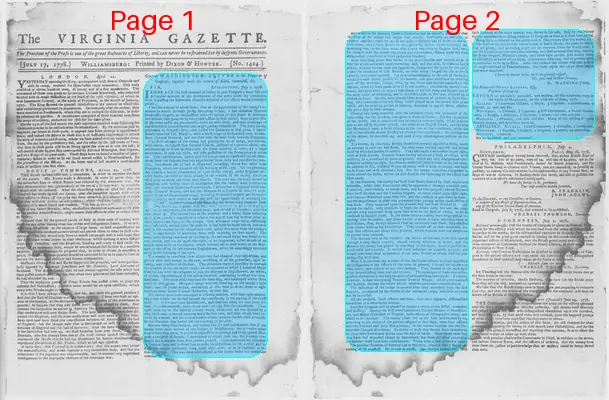
The Virginia Gazette
Richmond, Williamsburg, Richmond County, Virginia
What is this article about?
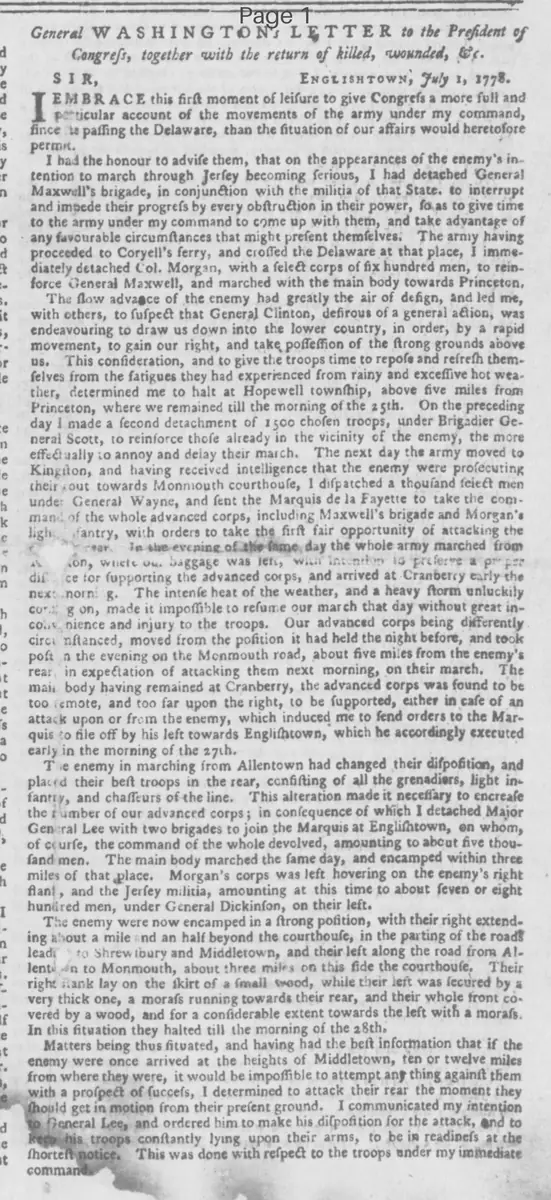
General Washington's letter to Congress details the American army's movements and the Battle of Monmouth on June 28, 1778, including strategy, retreat of advanced corps under General Lee, successful counterattacks, enemy retreat, and casualty returns. Lee is under arrest.
Merged-components note: Continuation of General Washington's letter to Congress detailing the Battle of Monmouth, spanning page 1 and page 2; relabeled from 'story' for the second part to match the domestic war news context.
Clippings
1 of 2
OCR Quality
Full Text
SIR,
ENGLISHTOWN, July 1, 1778.
I EMBRACE this first moment of leisure to give Congress a more full and particular account of the movements of the army under my command, since the passing the Delaware, than the situation of our affairs would heretofore permit.
I had the honour to advise them, that on the appearances of the enemy's intention to march through Jersey becoming serious, I had detached General Maxwell's brigade, in conjunction with the militia of that State, to interrupt and impede their progress by every obstruction in their power, so as to give time to the army under my command to come up with them, and take advantage of any favourable circumstances that might present themselves. The army having proceeded to Coryell's ferry, and crossed the Delaware at that place, I immediately detached Col. Morgan, with a select corps of six hundred men, to reinforce General Maxwell, and marched with the main body towards Princeton. The slow advance of the enemy had greatly the air of design, and led me, with others, to suspect that General Clinton, desirous of a general action, was endeavouring to draw us down into the lower country, in order, by a rapid movement, to gain our right, and take possession of the strong grounds above us. This consideration, and to give the troops time to repose and refresh themselves from the fatigues they had experienced from rainy and excessive hot weather, determined me to halt at Hopewell township, above five miles from Princeton, where we remained till the morning of the 26th. On the preceding day I made a second detachment of 1000 chosen troops, under Brigadier General Scott, to reinforce those already in the vicinity of the enemy, the more effectually to annoy and delay their march. The next day the army moved to Kingston, and having received intelligence that the enemy were prosecuting their route towards Monmouth courthouse, I dispatched a thousand select men under General Wayne, and sent the Marquis de la Fayette to take the command of the whole advanced corps, including Maxwell's brigade and Morgan's light infantry, with orders to take the first fair opportunity of attacking the rear. In the evening of the same day the whole army marched from Kingston, where our baggage was left, with intention to preserve a proper distance for supporting the advanced corps, and arrived at Cranberry early the next morning. The intense heat of the weather, and a heavy storm unluckily coming on, made it impossible to resume our march that day without great inconvenience and injury to the troops. Our advanced corps being differently circumstanced, moved from the position it had held the night before, and took post in the evening on the Monmouth road, about five miles from the enemy's rear in expectation of attacking them next morning, on their march. The main body having remained at Cranberry, the advanced corps was found to be too remote, and too far upon the right, to be supported, either in case of an attack upon or from the enemy, which induced me to send orders to the Marquis to file off by his left towards Englishtown, which he accordingly executed early in the morning of the 27th. The enemy in marching from Allentown had changed their disposition, and placed their best troops in the rear, consisting of all the grenadiers, light infantry, and chasseurs of the line. This alteration made it necessary to increase the number of our advanced corps; in consequence of which I detached Major General Lee with two brigades to join the Marquis at Englishtown, on whom, of course, the command of the whole devolved, amounting to about five thousand men. The main body marched the same day, and encamped within three miles of that place. Morgan's corps was left hovering on the enemy's right flank, and the Jersey militia, amounting at this time to about seven or eight hundred men, under General Dickinson, on their left. The enemy were now encamped in a strong position, with their right extending about a mile and an half beyond the courthouse, in the parting of the roads leading to Shrewsbury and Middletown, and their left along the road from Allentown to Monmouth, about three miles on this side the courthouse. Their right flank lay on the skirt of a small wood, while their left was secured by a very thick one, a morass running towards their rear, and their whole front covered by a wood, and for a considerable extent towards the left with a morass. In this situation they halted till the morning of the 28th. Matters being thus situated, and having had the best information that if the enemy were once arrived at the heights of Middletown, ten or twelve miles from where they were, it would be impossible to attempt anything against them with a prospect of success, I determined to attack their rear the moment they should get in motion from their present ground. I communicated my intention to General Lee, and ordered him to make his disposition for the attack, and to keep his troops constantly lying upon their arms, to be in readiness at the shortest notice. This was done with respect to the troops under my immediate command.
About five in the morning General Dickinson sent an express, informing that the front of the enemy had began their march. I instantly put the army in motion, and sent orders by one of my Aids to General Lee to move on and attack them, unless there should be very powerful reasons to the contrary, acquainting him, at the same time, that I was marching to support him, and, for doing it with the greater expedition and convenience, should make the men disencumber themselves of their packs and blankets.
After marching about five miles, to my great surprize and mortification, I met the whole advanced corps retreating, and, as I was told, by General Lee's orders, without having made any opposition, except one fire given by the party under the command of Col. Butler, on their being charged by the enemy's cavalry, who were repulsed. I proceeded immediately to the rear of the corps, which I found closely pressed by the enemy, and gave directions for forming part of the retreating troops, who, by the brave and spirited conduct of the officers, aided by some pieces of well served artillery, checked the enemy's advance, and gave time to make a disposition of the left wing and second line of the army upon an eminence, and in a wood a little in the rear, covered by a morass in front. On this were placed some batteries of cannon by Lord Stirling, who commanded the left wing, which played upon the enemy with great effect, and seconded by parties of infantry, detached to oppose them, effectually put a stop to their advance.
General Lee being detached with the advanced corps, the command of the right wing, for the occasion, was given to General Green. For the expedition of the march, and to counteract any attempt to turn our right, I had ordered him to file off by the new church, two miles from English Town, and fall into the Monmouth road, a small distance in the rear of the court-house, while the rest of the column moved directly on towards the court-house. On intelligence of the retreat, he marched up, and took a very advantageous position on the right.
The enemy, by this time, finding themselves warmly opposed in front, made an attempt to turn our left flank, but they were bravely repulsed and driven back by detached parties of infantry. They also made a movement to our right, with as little success, General Green having advanced a body of troops, with artillery, to a commanding piece of ground, which not only disappointed their design of turning our right, but severely enfiladed those in front of the left wing. In addition to this, General Wayne advanced with a body of troops, and kept up so severe and well-directed a fire, that the enemy were soon compelled to retire behind the defile, where the first stand in the beginning of the action had been made.
In this situation, the enemy had both their flanks secured by thick woods and morasses, while their front could only be approached through a narrow pass. I resolved, nevertheless, to attack them, and for that purpose ordered General Poor with his own and the Carolina brigade, to move round upon their right, and General Woodford upon their left, and the artillery to gall them in front, but the impediment in their way prevented their getting within reach before it was dark. They remained upon the ground they had been directed to occupy during the night, with intention to begin the attack early the next morning, and the army continued lying upon their arms in the field of action, to be in readiness to support them. In the mean time the enemy were employed in removing their wounded, and about twelve o'clock at night marched away in such silence, that, though General Poor lay extremely near them, they effected their retreat without his knowledge. They carried off all their wounded, except four officers and about forty privates, whose wounds were too dangerous to permit their removal.
The extreme heat of the weather, the fatigue of the men from their march through a deep sandy country, almost entirely destitute of water, and the distance the enemy had gained by marching in the night, made a pursuit impracticable and fruitless. It would have answered no valuable purpose, and would have been fatal to numbers of our men, several of whom died the preceding day with heat.
Were I to conclude my account of this day's transactions without expressing my obligations to the officers of the army in general, I should do injustice to their merit, and violence to my own feelings. They seemed to vie with each other in manifesting their zeal and bravery. The catalogue of those who distinguished themselves is too long to admit of particularizing individuals. I cannot, however, forbear mentioning Brigadier General Wayne, whose good conduct and bravery, through the whole action, deserves particular commendation. The behaviour of the troops in general after they recovered from the first surprize, occasioned by the retreat of the advanced corps, was such as could not be surpassed. All the artillery, both officers and men, that were engaged, distinguished themselves in a remarkable manner.
Enclosed Congress will be pleased to receive a return of our killed, wounded, and missing: Among the first were Lieutenant Colonel Bonner of Pennsylvania, and Major Dickinson of Virginia, both officers of distinguished merit, and much to be regretted. The enemy's slain left on the field and buried by us, according to the return of the persons assigned to that duty, were four officers and two hundred and forty five privates; in the former number was the Honourable Colonel Monckton. Exclusive of these they buried some themselves, as there were several new graves near the field of battle. How many men they may have had wounded cannot be determined, but from the usual proportion the number must have been considerable. There were a few prisoners taken.
The peculiar situation of General Lee at this time, requires that I should say nothing of his conduct. He is now in arrest. The charges against him, with such sentence as the court martial may decree in his case, shall be transmitted for the approbation or disapprobation of Congress as soon as it shall have passed.
Being fully convinced by the gentlemen of this country that the enemy cannot be hurt or injured in their embarkation at Sandy Hook, the place to which they are going, and unwilling to get too far removed from the North river, I put the troops in motion early this morning, and shall proceed that way, leaving the Jersey brigade, Morgan's corps, and other light parties (the militia being all dismissed) to hover about them, countenance desertion, and to prevent their depredations as far as possible. After they embark the former will take post in the neighbourhood of Elizabethtown, the latter rejoin the corps from which they were detached.
I have the honour to be, with the greatest respect, Sir, your most obedient servant,
G. WASHINGTON.
The Honourable Henry Laurens, Esq. President of Congress.
RETURN of the killed, wounded, and missing, of the American army in the battle of Monmouth, on the 28th day of June, 1778.
KILLED. 1 Lieutenant Colonel, 1 Major, 3 Captains, 2 Lieutenants, 1 Serjeant, 52 rank and file.
WOUNDED. 2 Colonels, 8 Captains, 4 first Lieutenants, 2 second Lieutenants, 1 Ensign, 1 Adjutant, 8 serjeants, 1 drum, 120 rank and file.
MISSING. 5 serjeants, 126 rank and file. Many of the missing dropped through fatigue, and have since come in.
ARTILLERY. KILLED. 1 first Lieutenant, 7 matrosses, 1 bombardier.
WOUNDED. 1 Captain, 1 serjeant, 1 corporal, 1 gunner, 10 matrosses.
MISSING. 1 matross
Six horses killed, and two wounded.
What sub-type of article is it?
What keywords are associated?
What entities or persons were involved?
Where did it happen?
Domestic News Details
Primary Location
Monmouth, New Jersey
Event Date
28th Day Of June, 1778
Key Persons
Outcome
american: killed - 1 lt col, 1 major, 3 captains, 2 lt, 1 sgt, 52 rank/file; artillery killed - 1 1st lt, 7 matrosses, 1 bombardier. wounded - 2 col, 8 capt, 4 1st lt, 2 2nd lt, 1 ensign, 1 adj, 8 sgt, 1 drum, 120 rank/file; artillery wounded - 1 capt, 1 sgt, 1 cpl, 1 gunner, 10 matrosses. missing - 5 sgt, 126 rank/file; artillery missing - 1 matross. many missing returned. enemy: 4 officers (incl. col. monckton) and 245 privates killed (buried by americans), some buried by enemy; considerable wounded (carried off except 4 officers, 40 privates); few prisoners taken. enemy retreated at night; pursuit impracticable due to heat and fatigue. general lee under arrest.
Event Details
Washington's army pursued British forces under Clinton through New Jersey, detaching forces to harass the enemy. On June 28, advanced corps under Lee retreated without significant opposition, but main army under Washington halted the British advance, repulsed flank attacks, and forced enemy retirement during intense heat. Planned renewed attack prevented by night retreat.