Thank you for visiting SNEWPapers!
Sign up free
Virginia Statesman
Wheeling, Ohio County, West Virginia
What is this article about?
In 1827 South Carolina equity case, Judge Desaussure ruled a witness competent despite believing divine rewards/punishments occur only in this life, not afterlife, allowing testimony in land partition dispute between siblings, emphasizing religious liberty and justice.
Clipping
OCR Quality
Full Text
[FROM THE LIBERALIST.]
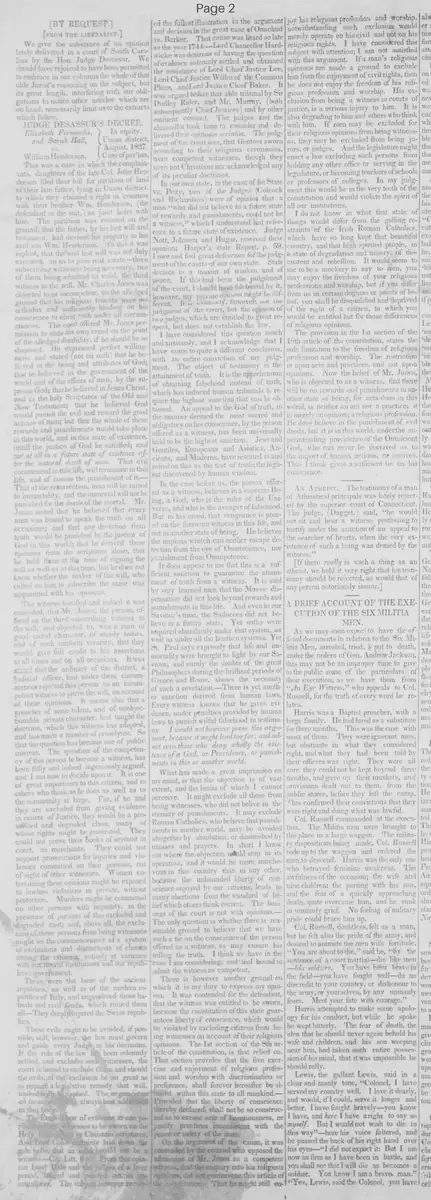
We give the substance of an opinion lately delivered in a court of South Carolina by the Hon. Judge Desaussure. We should have rejoiced to have been permitted to embrace in our columns the whole of that able Jurist's reasoning on the subject, but its great length, interfering with our obligations to notice other articles which are on hand, necessarily limit us to the extracts which follow.
JUDGE DESAUSSURE'S DECREE.
Elizabeth Fernandis, ) In equity.
and Sarah Hall, Union district,
vs. August, 1827
William Henderson, (Case of partition.
This was a case in which the complainants, daughters of the late Col. John Henderson filed their bill for partition of land of their late father, lying in Union district, to which they claimed a right in common with their brother Wm. Henderson, (the defendant in the suit.) as joint heirs with him. The partition was resisted on the ground, that the father, by his last will and testament, had devised his property to his said son Wm. Henderson. To this it was replied, that the said last will was not duly executed, so as to pass real estate—three subscribing witnesses being necessary, two of them being admitted as valid, the third witness to the will, Mr. Charles Jones was objected to as incompetent, on the alleged ground that his religious tenets were not conscientious to elicit oath under all circumstances orthodox and sufficiently binding on his conscience. The court offered Mr. Jones permission to state his own creed on the point of the alleged disability, if he should be so disposed. He expressed perfect willingness, and stated (not on oath) that he believed in the government of the world and of the affairs of man, by the supreme God; that he believed in the being and attributes of God; that he believed in Jesus Christ, and in the holy Scriptures of the Old and New Testament; that he believed God would punish the evil and reward the good actions of men; but that the whole of these rewards and punishments would take place in this world, and in this state of existence, until the justice of God be satisfied; and not at all in a future state of existence after the natural death of man. That evil commenced in this life, will terminate in this life, and of course the punishment of it.— That at the resurrection, man will be raised to immortality, and the immortal will not be punished for the deeds of the mortal. Mr. Jones stated that he believed that every man was bound to speak the truth on all occasions; and that any deviation from truth would be punished by the justice of God in this world; that he derived these opinions from the scriptures alone, that he held them at the time of signing the will as well as at this time, but he does not know whether the maker of the will, who called on him to subscribe the same was acquainted with his opinions.
The witness testified and indeed it was conceded, that Mr. Jones, the person, offered as the third subscribing witness to the will, and objected to, was a man of good moral character, of steady habits, and of such uniform veracity, that they would give full credit to his assertions at all times and on all occasions. It was stated that the ordinary of the district, a judicial officer, had under these circumstances rejected this person as an incompetent witness, on account of these opinions. It seems also that a certain witness to prove the will, on account of preacher of some talent, and of unobjectionable private character, had taught the doctrine, which this witness has adopted, and has made a number of proselytes. So that the question has become one of public interest. The question of the competency of this person to become a witness, has been fully and indeed ingeniously argued, and I am now to decide upon it. It is one of great importance to this citizen, and to others who think as he does as well as to the community at large. For, if he and they are excluded from giving evidence in courts of Justice, they would be a proscribed and degraded class; many of whose rights might be prostrated. They could not prove their books of account in court, as merchants. They could not support prosecutions for injuries and violences committed on their persons, out of sight of other witnesses. Women entertaining these opinions might be exposed to lawless violations in private, without protection. Murders might be committed on other persons with impunity, in the presence of persons of this excluded and degraded cast; and, above all, the exclusion of these persons from being witnesses might be the commencement of a system of exclusions and distinctions of classes among the citizens, entirely at variance with our liberal institutions and our republican government.
Those were the bane of the ancient republics, as well as of the modern republics of Italy, and engendered those hatreds and civil feuds, which ruined them all—They deeply injured the Swiss republics.
These evils ought to be avoided, if possible; still, however, the law must govern and guide every Judge in his decisions. If the rule of the law had been solemnly settled, and excludes such witnesses, the court is bound to exclude them; and should the evils, of the exclusion be so great as to require a legislative remedy that will, undoubtedly be supplied. The argumentum ab inconsonantiae is always best addressed to that body. The English law of evidence at one period, required all witnesses to be sworn on the Holy Christian scriptures, And Lord Coke mainly laid down the rule to be, that an infidel should not be a witness—Co. Litt. 6 b. From this opinion Lord Hale and the judges of later period, offered and pointed out its unsoundness. The subject however received the fullest illustration in the argument and decision in the great case of Omichund vs. Barker. That cause was heard so late as the year 1741: Lord Chancellor Hardwicke was desirous of having the question of evidence solemnly settled and obtained the assistance of Lord Chief Justice Lee, Lord Chief Justice Willes of the Common Pleas, and Lord Chief Justice Barker. It was argued before that able tribunal by Sir Dudley Rider, and Mr. Murray, (both subsequently Chief Justices) and by other eminent counsel. The judges and the chancellor took time to consider and delivered their opinions seriatim. The judgment of the court was, that Gentoos sworn according to their religious ceremonies, were competent witnesses, though they were not Christians nor acknowledged any of its peculiar doctrines.
In our own state, in the case of the State vs. Petty, two of the Judges (Colcock and Richardson) were of opinion that a man "who did not believe in a future state of rewards and punishments, could not be a witness." which I understand had reference to a future state of existence. Judge Nott, Johnson and Huger, reserved their opinion; Harper's state Reports, p. 59.
I owe and feel great deference for the judgment of the courts of our own state. Stare decisis is a maxim of wisdom and of peace. If this had been the judgment of the court, I should have felt bound by it, however, my private opinion might be different. It is evidently, however, not the judgment of the court, but the opinion of two judges, which are entitled to great respect, but does not establish the law.
I have considered this question much and anxiously, and I acknowledge that I have come to quite a different conclusion, with an entire conviction of my judgment. The object of testimony is the attainment of truth. It is the apprehension of obtaining falsehood instead of truth, which has induced human tribunals to require the highest sanction that can be obtained. An appeal to the God of truth, in the manner deemed the most sacred and obligatory on his conscience, by the person offered as a witness, has been universally held to be the highest sanction. Jews and Gentiles, Europeans and Asiatics, Ancients, and Moderns, have resorted to and relied on this as the test of truth; the highest discovered by human wisdom.
In the case before us, the person offered as a witness, believes in a supreme Being, a God, who is the ruler of the Universe, and who is the avenger of falsehood. But in his creed, that vengeance is poured on the forsworn witness in this life, and not in another state of being. He believes the impious wretch can neither escape detection from the eye of Omniscience, nor punishment from Omnipotence.
It does appear to me that this is a sufficient sanction to guarantee the attainment of truth from a witness. It is said by very learned men that the Mosaic dispensation did not look beyond rewards and punishments in this life. And even in our Saviour's time, the Sadducees did not believe in a future state, Yet oaths were required abundantly under that system, as well as under all the heathen systems. Yet S. Paul says expressly that life and immortality were brought to light by our Saviour, and surely the doubts of the great Philosophers during the brilliant periods of Greece and Rome, shews the necessity of such a revelation.—There is yet another sanction derived from human laws, Every witness knows that he gives evidence, under penalties provided by human laws to punish wilful falsehood in testimony. I would not however press this argument, because it might lead too far, and admit even those who deny wholly the existence of a God, or Providence, or punishments in this or another world.
What has made a great impression on my mind, is that the objection is of vast extent, and the limits of which I cannot perceive. It might exclude all those from being witnesses, who did not believe in the eternity of punishments, It may exclude Roman Catholics, who believe that punishments in another world, may be avoided altogether by absolution, or diminished by masses and prayers. In short I know not where the objection would stop in its operation, and it would be more mischievous in this country than in any other, because the unbounded liberty of conscience enjoyed by our citizens, leads to many aberrations from the standard of belief which others think correct. The business of the court is not with opinions.— The only question is whether there is reasonable ground to believe that we have such a tie on the conscience of the person offered as a witness, as may ensure his telling the truth. I think we have in the case I am considering, and feel bound to admit the witness as competent.
There is however another ground on which it is my duty to express my opinion. It was contended for the defendant, that the witness was entitled to be sworn, because the constitution of this state guarantees liberty of conscience. which would be violated by excluding citizens from being witnesses on account of their religious opinions. The 1st section of the 8th article of the constitution, is that relied on. That section provides that the free exercise and enjoyment of religious profession and worship without discrimination or preference, shall forever hereafter be allowed within this state to all mankind.— Provided that the liberty of conscience thereby declared, shall not be so construed as to excuse acts of licentiousness, or justify practices inconsistent with the peace or safety of the state.
On the argument of the cause, it was contended by the counsel who opposed the admission of Mr. Jones as a competent witness, that the enquiry into his religious opinions, did not contravene this article of the constitution. That he might still enjoy his religious profession and worship, notwithstanding such exclusion would merely operate on his civil and not on his religious rights, I have considered this subject with attention; I am not satisfied with this argument. If a man's religious opinions are made a ground to exclude him from the enjoyment of civil rights, then he does not enjoy the freedom of his religious profession and worship. His exclusion from being a witness in courts of justice, is a serious injury to him. It is also degrading to him and others who think with him. If men may be excluded for their religious opinions from being witnesses, they may be excluded from being jurors, or judges. And the legislature might enact a law excluding such persons from holding any other office or serving in the legislature, or becoming teachers of schools or professors of colleges. In my judgment this would be in the very teeth of the constitution and would violate the spirit of all our institutions.
I do not know in what that state of things would differ from the galling restraints of the Irish Roman Catholics, which have so long kept that beautiful country, and that high spirited people, in a state of degradation and misery, of discontent and rebellion. It would seem to me to be a mockery to say to men, you may enjoy the freedom of your religious professions and worship, but if you differ from us in certain dogmas or points of belief, you shall be disqualified and deprived of the right of a citizen, to which you would be entitled but for those differences of religious opinions.
The provision in the 1st section of the 8th article of the constitution, states the sole limitation to the freedom of religious profession and worship. The restriction is upon acts and practices, and not upon opinions. Now the belief of Mr. Jones, who is objected to as a witness, that there will be no rewards and punishments in another state of being, for acts done in this world, is neither an act nor a practice; it is merely an opinion; a religious profession. He does believe in the punishment of evil deeds, but it is in this world, under the superintending providence of the Omnipotent God, who can never be deceived as to the import of human actions, or motives. This I think gives a sufficient tie on his conscience.
As A Deist. The testimony of a man of Atheistical principles was lately rejected by the superior court of Connecticut. The judge, (Daggett,) said, "he would not sit and hear a witness professing to testify under the sanction of an appeal to the searcher of hearts, when the very existence of such a being was denied by the witness."
[If there really is such a thing as an atheist, we hold it very right that his testimony should be rejected, as would that of any person notoriously insane.]
What sub-type of article is it?
What themes does it cover?
What keywords are associated?
What entities or persons were involved?
Where did it happen?
Story Details
Key Persons
Location
Union District, South Carolina
Event Date
August, 1827
Story Details
Daughters of Col. John Henderson seek partition of father's land against brother William, contesting will's validity due to third witness Charles Jones's religious beliefs lacking future state punishments. Judge Desaussure rules Jones competent, as his belief in divine justice in this life suffices, protecting religious freedom under state constitution.