Thank you for visiting SNEWPapers!
Sign up free
Domestic News
May 7, 1819
The Rhode Island American, And General Advertiser
Providence, Providence County, Rhode Island
What is this article about?
Essay in Connecticut Courant on agricultural propagation of fruits, shrubs, and hops; advocates hop-beer over rum for farm workers to promote sobriety and moral reform among families and laborers.
Clipping
OCR Quality
98%
Excellent
Full Text
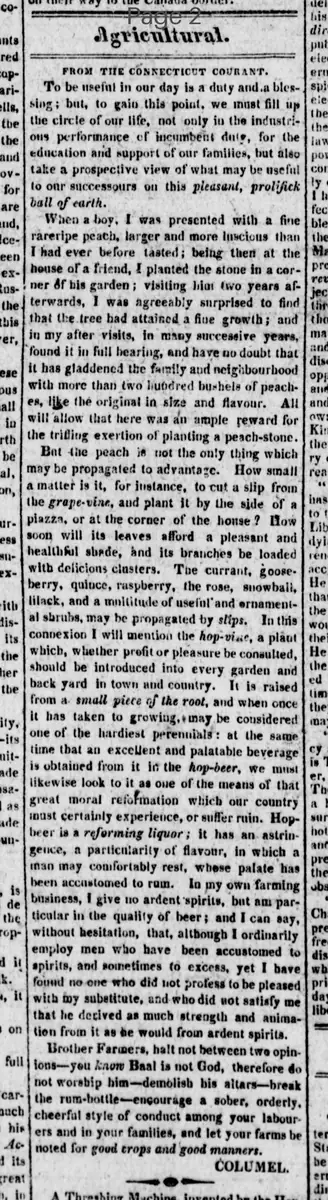
Agricultural.
FROM THE CONNECTICUT COURANT.
To be useful in our day is a duty and a blessing; but, to gain this point, we must fill up the circle of our life, not only in the industrious performance of incumbent duty, for the education and support of our families, but also take a prospective view of what may be useful to our successors on this pleasant, prolifick ball of earth.
When a boy, I was presented with a fine rareripe peach, larger and more luscious than I had ever before tasted; being then at the house of a friend, I planted the stone in a corner of his garden; visiting him two years afterwards, I was agreeably surprised to find that the tree had attained a fine growth; and in my after visits, in many successive years, found it in full bearing, and have no doubt that it has gladdened the family and neighbourhood with more than two hundred bushels of peaches, like the original in size and flavour. All will allow that here was an ample reward for the trifling exertion of planting a peach-stone.
But the peach is not the only thing which may be propagated to advantage. How small a matter is it, for instance, to cut a slip from the grape-vine, and plant it by the side of a piazza, or at the corner of the house? How soon will its leaves afford a pleasant and healthful shade, and its branches be loaded with delicious clusters. The currant, gooseberry, quince, raspberry, the rose, snowball, lilack, and a multitude of useful and ornamental shrubs, may be propagated by slips. In this connexion I will mention the hop-vine, a plant which, whether profit or pleasure be consulted, should be introduced into every garden and back yard in town and country. It is raised from a small piece of the root, and when once it has taken to growing, may be considered one of the hardiest perennials: at the same time that an excellent and palatable beverage is obtained from it in the hop-beer, we must likewise look to it as one of the means of that great moral reformation which our country must certainly experience, or suffer ruin. Hop-beer is a reforming liquor; it has an astringence, a peculiarity of flavour, in which a man may comfortably rest, whose palate has been accustomed to rum. In my own farming business, I give no ardent spirits, but am particular in the quality of beer; and I can say, without hesitation, that, although I ordinarily employ men who have been accustomed to spirits, and sometimes to excess, yet I have found no one who did not profess to be pleased with my substitute, and who did not satisfy me that he derived as much strength and animation from it as he would from ardent spirits.
Brother Farmers, halt not between two opinions-you know Baal is not God, therefore do not worship him-demolish his altars-break the rum-bottle-encourage a sober, orderly, cheerful style of conduct among your labourers and in your families, and let your farms be noted for good crops and good manners.
COLUMEL.
FROM THE CONNECTICUT COURANT.
To be useful in our day is a duty and a blessing; but, to gain this point, we must fill up the circle of our life, not only in the industrious performance of incumbent duty, for the education and support of our families, but also take a prospective view of what may be useful to our successors on this pleasant, prolifick ball of earth.
When a boy, I was presented with a fine rareripe peach, larger and more luscious than I had ever before tasted; being then at the house of a friend, I planted the stone in a corner of his garden; visiting him two years afterwards, I was agreeably surprised to find that the tree had attained a fine growth; and in my after visits, in many successive years, found it in full bearing, and have no doubt that it has gladdened the family and neighbourhood with more than two hundred bushels of peaches, like the original in size and flavour. All will allow that here was an ample reward for the trifling exertion of planting a peach-stone.
But the peach is not the only thing which may be propagated to advantage. How small a matter is it, for instance, to cut a slip from the grape-vine, and plant it by the side of a piazza, or at the corner of the house? How soon will its leaves afford a pleasant and healthful shade, and its branches be loaded with delicious clusters. The currant, gooseberry, quince, raspberry, the rose, snowball, lilack, and a multitude of useful and ornamental shrubs, may be propagated by slips. In this connexion I will mention the hop-vine, a plant which, whether profit or pleasure be consulted, should be introduced into every garden and back yard in town and country. It is raised from a small piece of the root, and when once it has taken to growing, may be considered one of the hardiest perennials: at the same time that an excellent and palatable beverage is obtained from it in the hop-beer, we must likewise look to it as one of the means of that great moral reformation which our country must certainly experience, or suffer ruin. Hop-beer is a reforming liquor; it has an astringence, a peculiarity of flavour, in which a man may comfortably rest, whose palate has been accustomed to rum. In my own farming business, I give no ardent spirits, but am particular in the quality of beer; and I can say, without hesitation, that, although I ordinarily employ men who have been accustomed to spirits, and sometimes to excess, yet I have found no one who did not profess to be pleased with my substitute, and who did not satisfy me that he derived as much strength and animation from it as he would from ardent spirits.
Brother Farmers, halt not between two opinions-you know Baal is not God, therefore do not worship him-demolish his altars-break the rum-bottle-encourage a sober, orderly, cheerful style of conduct among your labourers and in your families, and let your farms be noted for good crops and good manners.
COLUMEL.
What sub-type of article is it?
Agriculture
What keywords are associated?
Peach Planting
Grape Vines
Hop Beer
Temperance
Farming Advice
Sober Beverage
Moral Reformation
What entities or persons were involved?
Columel.
Where did it happen?
Connecticut
Domestic News Details
Primary Location
Connecticut
Key Persons
Columel.
Event Details
An essay advising on planting peach stones, grape vines, currants, gooseberries, quinces, raspberries, roses, snowballs, lilacs, and hop-vines for utility and ornament. Promotes hop-beer as a sober alternative to rum for workers, based on the author's farming experience, to foster moral reformation and good conduct among laborers and families.