Thank you for visiting SNEWPapers!
Sign up free
Editorial
January 24, 1824
Richmond Enquirer
Richmond, Richmond County, Virginia
What is this article about?
Editorial from Richmond endorses P. P. Barbour's argument against federal internal improvements like roads and canals, invoking Madison's veto and criticizing Monroe's reversal. It stresses strict constitutional limits to protect state rights, discusses Potomac canal bill debates, and urges safeguards against federal overreach.
Clipping
OCR Quality
98%
Excellent
Full Text
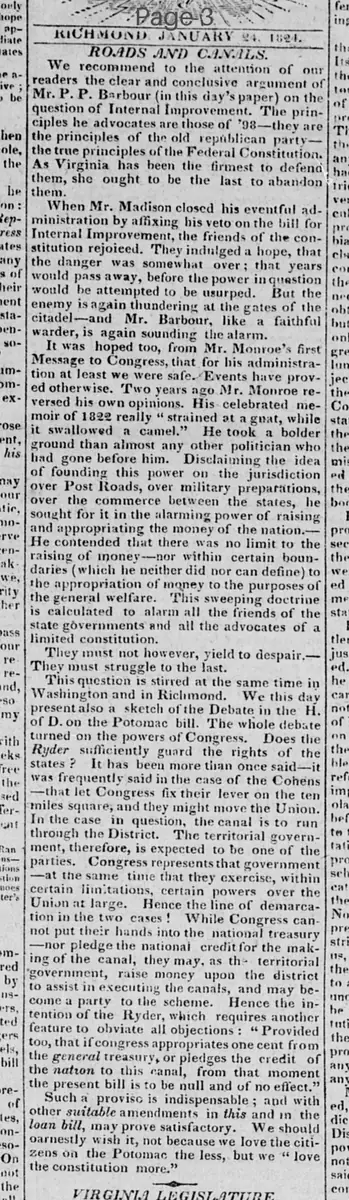
RICHMOND, JANUARY 24.
ROADS AND CANALS.
We recommend to the attention of our readers the clear and conclusive argument of Mr. P. P. Barbour (in this day's paper) on the question of Internal Improvement. The principles he advocates are those of '98—they are the principles of the old republican party—the true principles of the Federal Constitution. As Virginia has been the firmest to defend them, she ought to be the last to abandon them.
When Mr. Madison closed his eventful administration by affixing his veto on the bill for Internal Improvement, the friends of the constitution rejoiced. They indulged a hope, that the danger was somewhat over; that years would pass away, before the power in question would be attempted to be usurped. But the enemy is again thundering at the gates of the citadel—and Mr. Barbour, like a faithful warder, is again sounding the alarm.
It was hoped too, from Mr. Monroe's first Message to Congress, that for his administration at least we were safe. Events have proved otherwise. Two years ago Mr. Monroe reversed his own opinions. His celebrated memoir of 1822 really "strained at a gnat, while it swallowed a camel." He took a bolder ground than almost any other politician who had gone before him. Disclaiming the idea of founding this power on the jurisdiction over Post Roads, over military preparations, over the commerce between the states, he sought for it in the alarming power of raising and appropriating the money of the nation. He contended that there was no limit to the raising of money—nor within certain boundaries (which he neither did nor can define) to the appropriation of money to the purposes of the general welfare. This sweeping doctrine is calculated to alarm all the friends of the state governments and all the advocates of a limited constitution.
They must not however, yield to despair. They must struggle to the last.
This question is stirred at the same time in Washington and in Richmond. We this day present also a sketch of the Debate in the H. of D. on the Potomac bill. The whole debate turned on the powers of Congress. Does the Rider sufficiently guard the rights of the states? It has been more than once said—it was frequently said in the case of the Cohens—that let Congress fix their lever on the ten miles square, and they might move the Union.
In the case in question, the canal is to run through the District. The territorial government, therefore, is expected to be one of the parties. Congress represents that government—at the same time that they exercise, within certain limitations, certain powers over the Union at large. Hence the line of demarcation in the two cases! While Congress cannot put their hands into the national treasury—nor pledge the national credit for the making of the canal, they may, as the territorial government, raise money upon the district to assist in executing the canals, and become a party to the scheme. Hence the intention of the Rider, which requires another feature to obviate all objections: "Provided too, that if congress appropriates one cent from the general treasury, or pledges the credit of the nation to this canal, from that moment the present bill is to be null and of no effect."
Such a proviso is indispensable; and with other suitable amendments in this and in the loan bill, may prove satisfactory. We should earnestly wish it, not because we love the citizens on the Potomac the less, but we "love the constitution more."
ROADS AND CANALS.
We recommend to the attention of our readers the clear and conclusive argument of Mr. P. P. Barbour (in this day's paper) on the question of Internal Improvement. The principles he advocates are those of '98—they are the principles of the old republican party—the true principles of the Federal Constitution. As Virginia has been the firmest to defend them, she ought to be the last to abandon them.
When Mr. Madison closed his eventful administration by affixing his veto on the bill for Internal Improvement, the friends of the constitution rejoiced. They indulged a hope, that the danger was somewhat over; that years would pass away, before the power in question would be attempted to be usurped. But the enemy is again thundering at the gates of the citadel—and Mr. Barbour, like a faithful warder, is again sounding the alarm.
It was hoped too, from Mr. Monroe's first Message to Congress, that for his administration at least we were safe. Events have proved otherwise. Two years ago Mr. Monroe reversed his own opinions. His celebrated memoir of 1822 really "strained at a gnat, while it swallowed a camel." He took a bolder ground than almost any other politician who had gone before him. Disclaiming the idea of founding this power on the jurisdiction over Post Roads, over military preparations, over the commerce between the states, he sought for it in the alarming power of raising and appropriating the money of the nation. He contended that there was no limit to the raising of money—nor within certain boundaries (which he neither did nor can define) to the appropriation of money to the purposes of the general welfare. This sweeping doctrine is calculated to alarm all the friends of the state governments and all the advocates of a limited constitution.
They must not however, yield to despair. They must struggle to the last.
This question is stirred at the same time in Washington and in Richmond. We this day present also a sketch of the Debate in the H. of D. on the Potomac bill. The whole debate turned on the powers of Congress. Does the Rider sufficiently guard the rights of the states? It has been more than once said—it was frequently said in the case of the Cohens—that let Congress fix their lever on the ten miles square, and they might move the Union.
In the case in question, the canal is to run through the District. The territorial government, therefore, is expected to be one of the parties. Congress represents that government—at the same time that they exercise, within certain limitations, certain powers over the Union at large. Hence the line of demarcation in the two cases! While Congress cannot put their hands into the national treasury—nor pledge the national credit for the making of the canal, they may, as the territorial government, raise money upon the district to assist in executing the canals, and become a party to the scheme. Hence the intention of the Rider, which requires another feature to obviate all objections: "Provided too, that if congress appropriates one cent from the general treasury, or pledges the credit of the nation to this canal, from that moment the present bill is to be null and of no effect."
Such a proviso is indispensable; and with other suitable amendments in this and in the loan bill, may prove satisfactory. We should earnestly wish it, not because we love the citizens on the Potomac the less, but we "love the constitution more."
What sub-type of article is it?
Constitutional
Infrastructure
What keywords are associated?
Internal Improvements
Constitutional Limits
Federal Overreach
Potomac Canal
State Rights
Monroe Veto Reversal
What entities or persons were involved?
P. P. Barbour
James Madison
James Monroe
Congress
Virginia
Editorial Details
Primary Topic
Opposition To Federal Internal Improvements
Stance / Tone
Strongly Pro Strict Construction And State Rights
Key Figures
P. P. Barbour
James Madison
James Monroe
Congress
Virginia
Key Arguments
Principles Of 1798 And Old Republican Party Oppose Federal Internal Improvements
Madison's Veto Protected Constitutional Limits
Monroe Reversed His Stance In 1822, Justifying Appropriations For General Welfare Without Clear Bounds
Debate On Potomac Canal Bill Centers On Congressional Powers And State Rights
Rider Proviso Needed To Prevent Federal Treasury Use For Canals