Thank you for visiting SNEWPapers!
Sign up free
The New Hampshire Gazette
Portsmouth, Rockingham County, New Hampshire
What is this article about?
Napoleon Bonaparte intercepts letters from Cardinal Busca revealing the Court of Rome's secret negotiations with Austria against France, leading him to declare the armistice of June 1796 broken due to papal violations and alliances.
Merged-components note: Text flows continuously: the articles of the armistice declaration immediately follow the intercepted letters from Verona in this foreign news item on Italy and the Pope.
Clipping
OCR Quality
Full Text
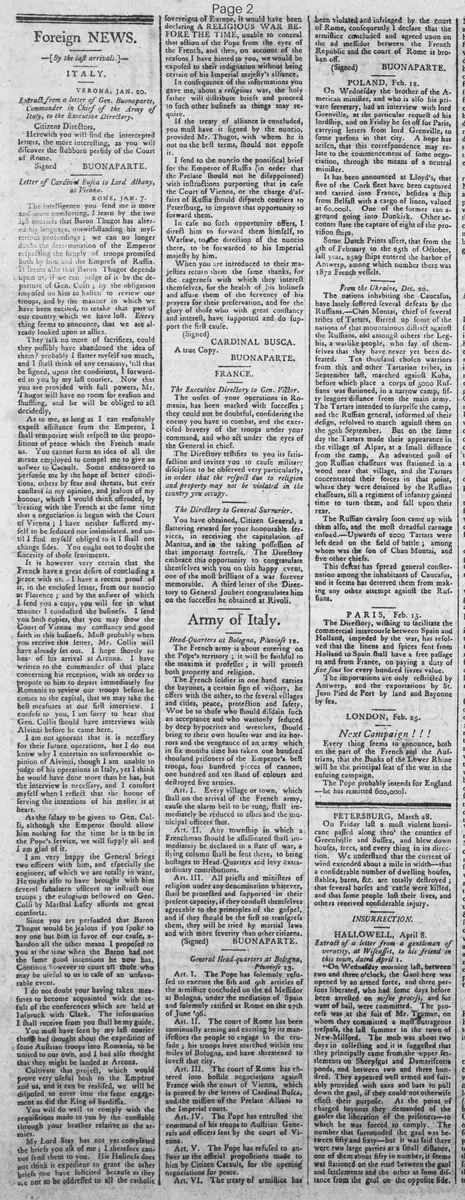
By the last arrivals.
ITALY.
VERONA, JAN. 20.
Extract from a letter of Gen. Buonaparte, Commander in Chief of the Army of Italy, to the Executive Directory
Citizens Directors,
Herewith you will find the intercepted letters, the more interesting, as you will discover the stubborn perfidy of the Court of Rome.
Signed,
BUONAPARTE.
Letter of Cardinal Busca to Lord Albany, at Vienna.
ROME, JAN. 7.
The intelligence you send me is more and more comforting, I learn by the two last couriers that Baron Thugut has altered his language, notwithstanding his mysterious proceedings; we can no longer doubt the determination of the Emperor respecting the supply of troops promised both by him and the Empress of Russia.
It seems also that Baron Thugut depends upon us, if we can judge of it by the departure of Gen. Colli; by the obligation imposed on him to hasten to review our troops, and by the manner in which we have been excited, to retake that part of our country which we have lost. Every thing seems to announce, that we are already looked upon as allies.
They talk no more of sacrifices. Could they possibly have abandoned the idea of them? Probably I flatter myself too much, and I shall think of any certainty, 'till that be signed, upon the conditions, I forwarded to you by my last courier. Now that you are provided with full powers, Mr. Thugut will have no room for evasion and shuffling, and he will be obliged to act decidedly,
As to me, as long as I can reasonably expect assistance from the Emperor, I shall temporize with respect to the propositions of peace which the French made us. You cannot form an idea of all the means employed to compel me to give an answer to Cacault. Some endeavored to persuade me by the hope of better conditions, others by fear and threats, but ever constant in my opinion, and jealous of my honour, which I would think offended, by treating with the French at the same time that a negociation is begun with the Court of Vienna: I have neither suffered myself to be seduced nor intimidated, and until I find myself obliged to it I shall not change sides. You ought not to doubt the sincerity of those sentiments.
It is however very certain that the French have a great desire of concluding a peace with us. I have a recent proof of it, in the enclosed letter, from our nuncio at Florence; and by the answer of which I send you a copy, you will see in what manner I conducted the business. I send you both copies. that you may show the Court of Vienna my constancy and good faith in this business. Most probably when you receive this letter, Mr. Colli will have already set out. I hope shortly to hear of his arrival at Ancona. I have written to the commander of that place concerning his reception, with an order to propose to him to depart immediately for Romania to review our troops before he comes to the capital, that we may take the best measures at our first interview. I confess to you, I am sorry to hear that Gen. Colli should have interviews with Alvinzi before he came here.
I am not ignorant that it is necessary for their future operations, but I do not know why I entertain an unfavourable opinion of Alvinzi, though I am unable to judge of his operations in Italy, yet I think he would have done more than he has, but the interview is necessary, and I comfort myself when I reflect that the honor of serving the intentions of his master is at heart.
As the salary to be given to Gen. Colli, although the Emperor should allow him nothing for the time he is to be in the Pope's service, we will supply all and I am glad of it.
I am very happy the General brings two officers with him, and especially the engineer, of which we are totally in want. He ought also to have brought with him several subaltern officers to instruct our troops; the eulogium bestowed on Gen. Colli by Marshal Lacy affords me great comforts.
Since you are persuaded that Baron Thugut would be jealous if you spoke to any one but him in favor of our cause, abandon all the other means I proposed to you at the time when the Baron had not the same good intentions he now has.
Continue however to court all those. who may be useful to us in case of an unfavourable event.
I do not doubt your having taken measures to become acquainted with the result of the conferences which are held at Inspruck with Clark. The information I shall receive from you shall be my guide.
You must have seen by my last courier that I had thought about the expedition of some Austrian troops into Romania, to be united to our own, and I had also thought that they might be landed at Ancona.
Cultivate that project, which would prove very useful both to the Emperor and us, and it can be realized, we will be disposed to enter into the same engagement as did the King of Sardinia.
You will do well to comply with the requisitions made to you by the constable through your brother relative to the armies.
My Lord Stay has not yet completed the briefs you ask of me ; I therefore can. not send them to you. His Holiness does not think it expedient to grant the other briefs you have solicited because as they are not to be addressed to all the catholic
Art. I. The Pope has solemnly refused to execute the 8th and 9th articles of the armistice concluded on the 3d Messidor at Bologna, under the mediation of Spain and solemnly ratified at Rome on the 27th of June '96.
Art. II. The court of Rome has been continually arming and exciting by its manifestoes the people to engage in the crusade ; his troops have marched within ten miles 'of Bologna, and have threatened to invest that city.
Art. III. The court of Rome has entered into hostile negociations against France with the court of Vienna, which is proved by the letters of Cardinal Busca, and the mission of the Prelate Albani to the Imperial court.
Art. IV. The Pope has entrusted the command of his troops to Austrian Generals and officers sent by the court of Vienna.
Art. V. The Pope has refused to answer to the official propositions made to him by Citizen Cacault, for the opening negociations for peace.
Art, VI. The treaty of armistice has been violated and infringed by. the court of Rome, consequently I declare that the armistice concluded and agreed upon on the 3d Messidor between the French Republic and the court of Rome is broken off.
(Signed)
BUONAPARTE.
What sub-type of article is it?
What keywords are associated?
What entities or persons were involved?
Where did it happen?
Foreign News Details
Primary Location
Italy
Event Date
Jan. 20
Key Persons
Outcome
armistice between french republic and court of rome declared broken off due to violations including refusal to execute articles, arming troops, hostile negotiations with vienna, and entrusting command to austrian officers.
Event Details
Gen. Buonaparte sends intercepted letters from Cardinal Busca to Lord Albany revealing the Court of Rome's secret alliance negotiations with Austria, including troop supplies, review by Gen. Colli, and temporizing with French peace propositions. Buonaparte lists papal violations of the armistice and declares it broken.