Thank you for visiting SNEWPapers!
Sign up free
Richmond Enquirer
Richmond, Richmond County, Virginia
What is this article about?
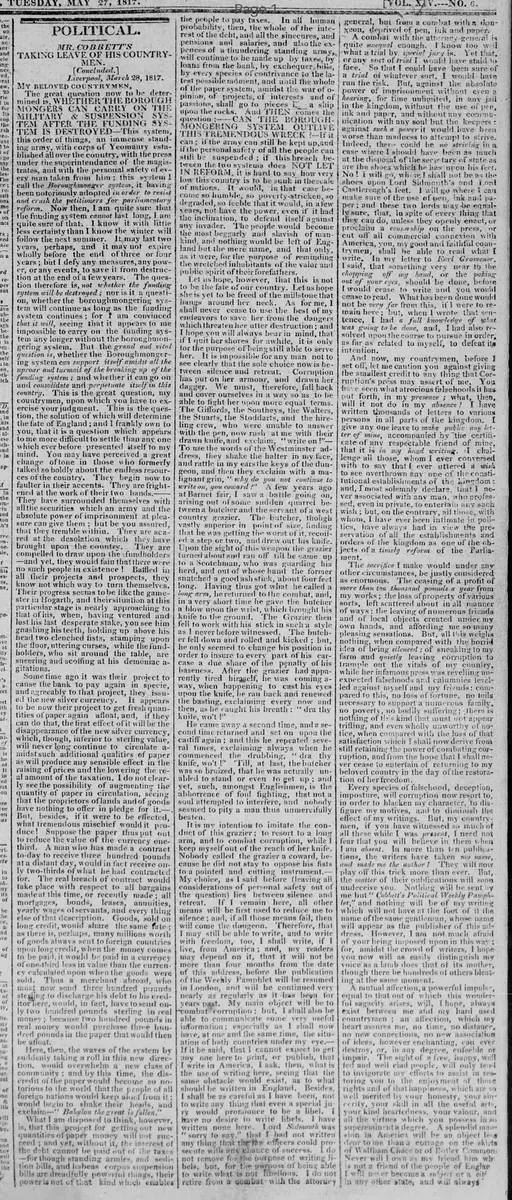
In his March 28, 1817, Liverpool address, William Cobbett warns countrymen of the imminent destruction of the funding system and doubts the boroughmonger system's survival amid ensuing tumult without parliamentary reform. He explains his retreat to America to evade imprisonment and continue anti-corruption writings.
Merged-components note: This is a continuation of William Cobbett's political address across pages; the second component's label changed from letter_to_editor to better fit the overall opinion piece.
Clippings
1 of 2
OCR Quality
Full Text
MR. COBBETT'S
TAKING LEAVE OF HIS COUNTRY-
MEN.
[Concluded.]
Liverpool, March 28, 1817.
MY BELOVED COUNTRYMEN,
The great question now to be determined is, WHETHER THE BOROUGH MONGERS CAN CARRY ON THE MILITARY & SUSPENSION SYSTEM AFTER THE FUNDING SYSTEM IS DESTROYED—This system, this order of things, an immense standing army, with corps of Yeomanry established all over the country, with the press under the superintendence of the magistrates, and with the personal safety of every man taken from him: this system I call the Boroughmonger system, it having been notoriously adopted in order to resist and crush the petitioners for parliamentary reform. Now then, I am quite sure that this funding system cannot last long, I am quite sure of that. I know it with little less certainty than I know the winter will follow the next summer. It may last two years, perhaps, and it may not expire wholly before the end of three or four years; but I defy any measures, any power, or any events, to save it from destruction at the end of a few years. The question therefore is, not whether the funding system will be destroyed; nor is it a question, whether the boroughmongering system will continue as long as the funding system continues: for I am convinced that it will, seeing that it appears to me impossible to carry on the funding system any longer without the boroughmongering system. But the grand and vital question is, whether the Boroughmongering system can support itself amidst all the uproar and tumult of the breaking up of the funding system; and whether it can go on and consolidate and perpetuate itself in this country. This is the great question, my countrymen, upon which you have to exercise your judgment. This is the question, the solution of which will determine the fate of England; and I frankly own to you, that it is a question which appears to me more difficult to settle than any one which ever before presented itself to my mind. You may have perceived a great change of tone in those who formerly talked so boldly about the endless resources of the country. They begin now to falter in their accents. They are frightened at the work of their own hands. They have surrounded themselves with all the securities which an army and the absolute power of imprisonment at pleasure can give them; but be you assured, that they tremble within. They are scared at the desolation which they have brought upon the country. They are compelled to draw upon the fundholders—and yet, they would fain that there were no such people in existence! Baffled in all their projects and prospects, they know not which way to turn themselves. Their progress seems to be like the gambler in Hogarth, and their situation at this particular stage is nearly approaching to that of his, when, having ventured and lost his last desperate stake, you see him gnashing his teeth, holding up above his head two clenched fists, stamping upon the floor, uttering curses, while the fundholders, who sit around the table, are sneering and scoffing at his demoniac agitations.
Sometime ago it was their project to cause the bank to pay again in specie, and agreeably to that project, they issued the new silver currency. It appears to be now their project to get fresh quantities of paper again afloat, and, if they can do that, the first effect of it will be the disappearance of the new silver currency, which, though inferior to sterling value, will never long continue to circulate amidst such additional quantities of paper as will produce any sensible effect in the raising of prices and the lowering the real amount of the taxation. I do not clearly see the possibility of augmenting the quantity of paper in circulation, seeing that the proprietors of lands and of goods have nothing to offer in pledge for it.— But, besides, if it were to be effected, what tremendous mischief would it produce! Suppose the paper thus put out to reduce the value of the currency one-third. A man who has made a contract to-day to receive three hundred pounds at a distant day, would in fact receive only two-thirds of what he had contracted for. The real breach of contract would take place with respect to all bargains made at this time, or recently made: all mortgages, bonds, leases, annuities, yearly wages of servants, and every thing else of that description. "Goods, sold on long credit, would share the same fate: as there is, perhaps, many millions worth of goods always sent to foreign countries upon long credit, when the money comes to be paid, it would be paid in a currency of one-third less in value than the currency calculated upon when the goods were sold. Thus a merchant abroad, who must now send three hundred pounds sterling to discharge his debt to his creditor here, would, in fact, have to send only two hundred pounds sterling in real money; because two hundred pounds in real money would purchase three hundred pounds in the paper that would then be afloat.
Here, then, the waves of the system by suddenly taking a roll in this new direction, would overwhelm a new class of community; and by this time, the discredit of the paper would become so notorious to the world that the people of all foreign nations would keep aloof from it: would begin to shake their heads, and exclaim—“Babylon the great is fallen."
What I am disposed to think, however, is, that this project for getting out new quantities of paper money will not succeed; and yet, without it, the interest of the debt cannot be paid out of the taxes —for though standing armies, and sedition bills, and habeas corpus suspension bills are dreadfully powerful things, their power is not of that kind which enables the people to pay taxes.. In all human probability, then, the whole of the interest of the debt, and all the sinecures, and pensions and salaries, and also the expenses of a thundering standing army, will continue to be made up by taxes, by loans from the bank, by exchequer bills, by every species of contrivance to the latest possible moment, and until the whole of this paper system, amidst the war of opinion, of projects, of interests and of passions, shall go to pieces like a ship upon the rocks. And THEN comes the question :—CAN THE BOROUGHMONGERING SYSTEM OUTLIVE THIS TREMENDOUS WRECK ?—If it can; if the army can still be kept up, and if the personal safety of all the people can still be suspended; if this breach between the two systems does NOT LET IN REFORM, it is hard to say how very low this country is to be sunk in the scale of nations. It would, in that case become so humble, so poverty-stricken, so degraded, so feeble that it would, in a few years, not have the power, even if it had the inclination, to defend itself against any invader. The people would become the most beggarly and slavish of mankind, and nothing would be left of England but the mere name, and that only, as it were, for the purpose of reminding the wretched inhabitants of the valor and public spirit of their forefathers.
Let us hope, however, that this is not to be the fate of our country. Let us hope she is yet to be freed of the millstone that hangs around her neck. As for me, I shall never cease to use the best of my endeavors to save her from the dangers which threaten her utter destruction; and I hope you will always bear in mind, that if I quit her shores for awhile, it is only for the purpose of being still able to serve her. It is impossible for any man not to see clearly that the sole choice now is between silence and retreat. Corruption has put on her armour, and drawn her dagger. We must, therefore, fall back and cover ourselves in a way so as to be able to fight her upon more equal terms. The Giffords, the Southeys, the Walters, the Stuarts, the Stoddarts, and the hireling crew, who were unable to answer with the pen, now rush at me with their drawn knife, and exclaim, "write on!"— To use the words of the Westminster address, they shake the halter in my face, and rattle in my ears the keys of the dungeon, and then they exclaim with a malignant grin, "why do you not continue to write on, you coward ?" A few years ago at Barnet fair, I saw a battle going on, arising out of some sudden quarrel between a butcher and the servant of a west country grazier. The butcher, though vastly superior in point of size, finding that he was getting the worst of it, recoiled a step or two, and drew out his knife. Upon the sight of this weapon the grazier turned about and ran off till he came up to a Scotchman, who was guarding his herd, and out of whose hand the former snatched a good ash stick, about four feet long. Having thus got what he called a long arm, he returned to the combat, and, in a very short time he gave the butcher a blow upon the wrist, which brought his knife to the ground. The Grazier then fell to work with his stick in such a style as I never before witnessed. The butcher fell down and rolled and kicked; but, he only seemed to change his position in order to insure to every part of his carcass a due share of the penalty of his baseness. After the grazier had apparently tired himself, he was coming away, when happening to cast his eyes upon the knife, he ran back and renewed the basting, exclaiming every now and then, as he caught his breath: "dra thy knite, wo't!" He came away a second time, and a second time returned and set on upon the caitiff again; and this he repeated several times, exclaiming always when he commenced the drubbing, "dra thy knife, wo't!" Till, at last, the butcher was so bruised, that he was actually unable to stand or even to get up; and yet, such, amongst Englishmen, is the abhorrence of foul fighting, that not a soul attempted to interfere, and nobody seemed to pity a man thus unmercifully beaten.
It is my intention to imitate the conduct of this grazier: to resort to a long arm, and to combat corruption, while I keep myself out of the reach of her knife. Nobody called the grazier a coward, because he did not stay to oppose his fists to a pointed and cutting instrument.— My choice, as I said before (leaving all considerations of personal safety out of the question) lies between silence and retreat. If I remain here, all other means will be first used to reduce me to silence: and, if all those means fail, then will come the dungeon. Therefore, that I may still be able to write, and to write with freedom, too, I shall write, if I live, from America; and, my readers may depend on it, that it will not be more than four months from the date of this address, before the publication of the Weekly Pamphlet will be resumed in London, and will be continued very nearly as regularly as it has been for years past. My main object will be to combat corruption; but, I shall also be able to communicate some very useful information: especially as I shall now have, at one and the same time, the situation of both countries under my eye.— If it be said, that I cannot expect to get any one here to print, or publish, that I write in America, I ask, then, what is the use of writing here, seeing that the same obstacle would exist, as to what should be written in England. Besides. I shall be as careful as I have been, not to write any thing that even a special jury would pronounce to be a libel. I have no desire to write libels. I have written none here. Lord Sidmouth was "sorry to say," that I had not written any thing that the law officers could prosecute with any chance of success. I do not remove for the purpose of writing libels, but, for the purpose of being able to write what is not libellous. I do not retire from a combat with the attorney general, but from a combat with a dungeon, deprived of pen, ink and paper. A combat with the attorney-general is quite unequal enough. I know too well what a trial by special jury is. Yet that, or any sort of trial I would have staid to face. So that I could have been sure of a trial of whatever sort. I would have run the risk. But, against the absolute power of imprisonment without even a hearing, for time unlimited, in any jail in the kingdom, without the use of pen, ink and paper, and without any communication with any soul but the keepers: against such a power it would have been worse than madness to attempt to strive. Indeed, there could be no striving in a case where I should have been as much at the disposal of the secretary of state as are the shoes which he has upon his feet. No! I will go. where I shall not be as the shoes upon Lord Sidmouth's and Lord Castlereagh's feet. I will go where I can make sure of the use of pen, ink and paper; and these two lords may be equally sure, that, in spite of every thing that they can do, unless they openly enact, or proclaim a censorship on the press, or cut off all commercial connexion with America, you, my good and faithful countrymen, shall be able to read what I write. In my letter to Earl Grosvenor, I said, that something very near to the chopping off my hand, or the poking out of your eyes, should be done, before I would cease to write and you would cease to read. What has been done would not be very far from this, if I were to remain here: but, when I wrote that sentence, I had a full knowledge of what was going to be done, and, I had also resolved upon the course to pursue in order, as far as related to myself, to defeat its intention.
And now, my countrymen, before I set off, let me caution you against giving the smallest credit to any thing that Corruption's press may assert of me. You have seen what atrocious falsehoods it has put forth, in my presence; what, then, will it not do in my absence? I have written thousands of letters to various persons in all parts of the kingdom. I give any one leave to make public any letter of mine, accompanied by the certificate of any respectable friend of mine, that it is in my hand writing. I challenge all those, whom I ever conversed with to say that I ever uttered a wish to see overthrown any one of the constitutional establishments of the Kingdom: and, I most solemnly declare, that I never associated with any man, who professed, even in private, to entertain any such wish; but, on the contrary, all those, with whom, I have ever been intimate in politics, have always had in view the preservation of all the establishments and orders of the kingdom as one of the objects of a timely reform of the Parliament.
The sacrifice I make would under any other circumstances, be justly considered as enormous. The ceasing of a profit of more than ten thousand pounds a year from my works; the loss of property of various sorts, left scattered about in all manner of ways: the leaving of numerous friends and of local objects created under my own hands, and affording me so many pleasing sensations. But, all this weighs nothing, when compared with the horrid idea of being silenced; of sneaking to my farm and quietly leaving corruption to trample out the vitals of my country, while her infamous press was revelling unchecked falsehoods and calumnies levelled against myself and my friends: compared to this, no loss of fortune, no toils necessary to support a numerous family, no poverty, no bodily suffering; there is nothing of this kind that must not appear trifling, and even wholly unworthy of notice, when compared with the loss of that satisfaction which I shall now derive from still retaining the power of combating corruption, and from the hope that I shall never cease to entertain of returning to my beloved country in the day of the restoration of her freedom.
Every species of falsehood, deception, imposture, will corruption now resort to, in order to blacken my character, to disfigure my motives, and to diminish the effect of my writings. But, my countrymen, if you have witnessed so much of all these while I was present, I need not fear that you will believe in them when I am absent. In more than ten publications, the writers have taken my name, and made me the author! They will now play off this trick more than ever. But, the matter of their publications will soon undeceive you. Nothing will be sent by me but "Cobbett's Political Weekly Pamphlet." and nothing will be of my writing which will not have at the foot of it the name of the same gentleman, whose name will appear as the publisher of this address. However, I am not much afraid of your being imposed upon in this way: for, amidst the crowd of writers, I hope you now will as easily distinguish my voice as a lamb does that of its mother, though there be hundreds of others bleating at the same moment.
A mutual affection, a powerful impulse, equal to that out of which this wonderful sagacity arises, will, I hope, always exist between me and my hard used countrymen; an affection, which my heart assures me, no time, no distance, no new connections, no new association of ideas, however enchanting, can ever destroy, or, in any degree, enfeeble or impair. The sight of a free, happy, well fed and well clad people, will only tend to invigorate my efforts to assist in restoring you to the enjoyment of those rights and of that happiness, which are so well merited by your honesty, your sincerity, your skill in all the useful arts, your kind heartedness, your valour, and all the virtues which you possess in so supereminent a degree. A splendid mansion in America will be an object less dear to me than a cottage on the skirts of Waltham Chase or of Epping Forest. Never will I own as my friend him who is not a friend of the people of England. I will never become a subject or a citizen in any other state, and will always
Sojourner in every country but England.
Any foible that may belong to your character, I shall always willingly allow to belong to my own. All the celebrity which my writings have obtained, and which they will preserve, long and long after Lords Liverpool and Sidmouth and Castlereagh are rotten and forgotten, I owe less to my own talents than to that discernment and that noble spirit in you, which have at once instructed my mind and warmed my heart: and my beloved countrymen, be you well assured, that the last beatings of that heart will be, love for the people, for the happiness and the renown of England; and hatred of their corrupt, hypocritical, dastardly and merciless foes.
WM. COBBETT
P. S. There will of necessity be about three months before the Weekly Political Pamphlet will be revived: but, in the meantime, my readers will find occupation in reading over and over again what I have addressed to them within the last five or six months. I beseech them to keep all the nice little books that they have got; not to be humbugged by any of the publications of corruption; they will find all my fore-tellings come true. I exhort them to exercise all the patience and fortitude they are masters of; not to be inveigled into any foolish and fruitless attacks upon the bakers and butchers and the like: never to give up one jot of their right to Parliaments chosen annually, and to a vote for every man twenty one years of age; and never to give up the hope that this right will be restored to them along with that happiness to which their industry and honesty and public spirit so justly entitle them. They may be assured, that if I have life for only a year or two at farthest, I shall be back with them again. The beautiful country through which I have so lately travelled bearing, upon every inch of it, such striking marks of the industry and skill of the people, never can be destined to be inhabited by slaves. To suppose such a thing possible would at once be to libel the nation and to blaspheme against Providence.
Let my readers not fear my finding out the means of communicating to them whatever I may write. They will see the Political pamphlet revive and be continued, until the day when they will find me again dating my address to them from London or from Botley.
WM. COBBETT.
What sub-type of article is it?
What keywords are associated?
What entities or persons were involved?
Editorial Details
Primary Topic
Farewell Address On Collapse Of Funding System And Survival Of Boroughmonger System
Stance / Tone
Strongly Critical Of Corruption And Boroughmongers, Advocating Parliamentary Reform
Key Figures
Key Arguments