Thank you for visiting SNEWPapers!
Sign up free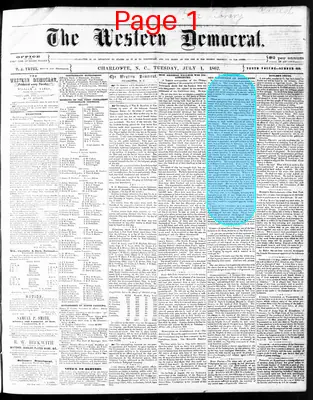
Editorial
July 1, 1862
The Western Democrat
Charlotte, Mecklenburg County, North Carolina
What is this article about?
A communication in the Richmond Enquirer critiques the exemption of foreign residents, especially Germans, from Confederate military duty. It questions their rights to conduct business and receive consular protection while avoiding service, detailing classes of German immigrants and citing figures like Carl Schurz.
Clipping
OCR Quality
95%
Excellent
Full Text
From the Richmond Enquirer.
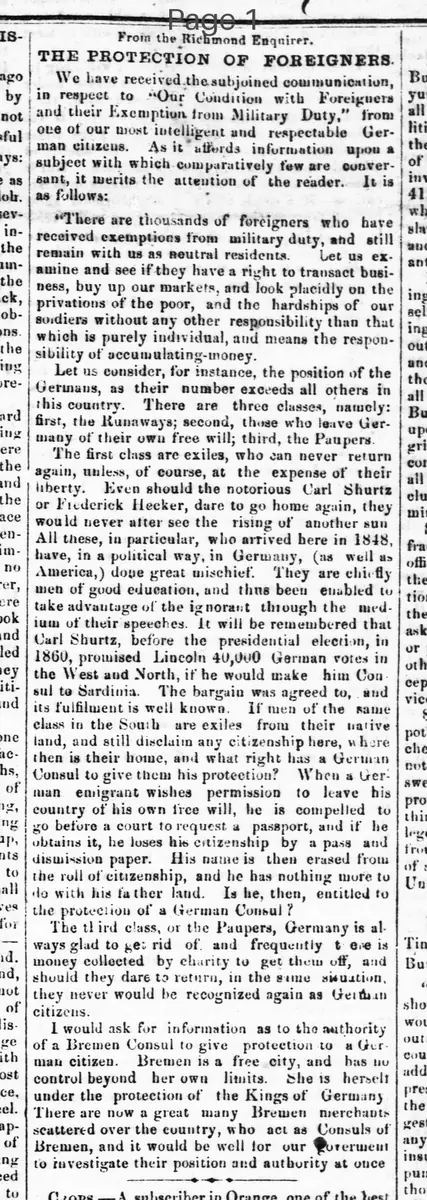
THE PROTECTION OF FOREIGNERS.
We have received the subjoined communication, in respect to "Our Condition with Foreigners and their Exemption from Military Duty," from one of our most intelligent and respectable German citizens. As it affords information upon a subject with which comparatively few are conversant, it merits the attention of the reader. It is as follows:
"There are thousands of foreigners who have received exemptions from military duty, and still remain with us as neutral residents. Let us examine and see if they have a right to transact business, buy up our markets, and look placidly on the privations of the poor, and the hardships of our soldiers without any other responsibility than that which is purely individual, and means the responsibility of accumulating money.
Let us consider, for instance, the position of the Germans, as their number exceeds all others in this country. There are three classes, namely: first, the Runaways; second, those who leave Germany of their own free will; third, the Paupers.
The first class are exiles, who can never return again, unless, of course, at the expense of their liberty. Even should the notorious Carl Schurz or Frederick Hecker, dare to go home again, they would never after see the rising of another sun. All these, in particular, who arrived here in 1848, have, in a political way, in Germany, (as well as America,) done great mischief. They are chiefly men of good education, and thus been enabled to take advantage of the ignorant through the medium of their speeches. It will be remembered that Carl Schurz, before the presidential election, in 1860, promised Lincoln 40,000 German votes in the West and North, if he would make him Consul to Sardinia. The bargain was agreed to, and its fulfilment is well known. If men of the same class in the South are exiles from their native land, and still disclaim any citizenship here, where then is their home, and what right has a German Consul to give them his protection?
When a German emigrant wishes permission to leave his country of his own free will, he is compelled to go before a court to request a passport, and if he obtains it, he loses his citizenship by a pass and dismission paper. His name is then erased from the roll of citizenship, and he has nothing more to do with his father land. Is he, then, entitled to the protection of a German Consul?
The third class, or the Paupers, Germany is always glad to get rid of, and frequently there is money collected by charity to get them off, and should they dare to return, in the same situation, they never would be recognized again as German citizens.
I would ask for information as to the authority of a Bremen Consul to give protection to a German citizen. Bremen is a free city, and has no control beyond her own limits. She is herself under the protection of the Kings of Germany. There are now a great many Bremen merchants scattered over the country, who act as Consuls of Bremen, and it would be well for our government to investigate their position and authority at once."
THE PROTECTION OF FOREIGNERS.
We have received the subjoined communication, in respect to "Our Condition with Foreigners and their Exemption from Military Duty," from one of our most intelligent and respectable German citizens. As it affords information upon a subject with which comparatively few are conversant, it merits the attention of the reader. It is as follows:
"There are thousands of foreigners who have received exemptions from military duty, and still remain with us as neutral residents. Let us examine and see if they have a right to transact business, buy up our markets, and look placidly on the privations of the poor, and the hardships of our soldiers without any other responsibility than that which is purely individual, and means the responsibility of accumulating money.
Let us consider, for instance, the position of the Germans, as their number exceeds all others in this country. There are three classes, namely: first, the Runaways; second, those who leave Germany of their own free will; third, the Paupers.
The first class are exiles, who can never return again, unless, of course, at the expense of their liberty. Even should the notorious Carl Schurz or Frederick Hecker, dare to go home again, they would never after see the rising of another sun. All these, in particular, who arrived here in 1848, have, in a political way, in Germany, (as well as America,) done great mischief. They are chiefly men of good education, and thus been enabled to take advantage of the ignorant through the medium of their speeches. It will be remembered that Carl Schurz, before the presidential election, in 1860, promised Lincoln 40,000 German votes in the West and North, if he would make him Consul to Sardinia. The bargain was agreed to, and its fulfilment is well known. If men of the same class in the South are exiles from their native land, and still disclaim any citizenship here, where then is their home, and what right has a German Consul to give them his protection?
When a German emigrant wishes permission to leave his country of his own free will, he is compelled to go before a court to request a passport, and if he obtains it, he loses his citizenship by a pass and dismission paper. His name is then erased from the roll of citizenship, and he has nothing more to do with his father land. Is he, then, entitled to the protection of a German Consul?
The third class, or the Paupers, Germany is always glad to get rid of, and frequently there is money collected by charity to get them off, and should they dare to return, in the same situation, they never would be recognized again as German citizens.
I would ask for information as to the authority of a Bremen Consul to give protection to a German citizen. Bremen is a free city, and has no control beyond her own limits. She is herself under the protection of the Kings of Germany. There are now a great many Bremen merchants scattered over the country, who act as Consuls of Bremen, and it would be well for our government to investigate their position and authority at once."
What sub-type of article is it?
Immigration
Military Affairs
Foreign Affairs
What keywords are associated?
Foreigners
Military Exemption
German Immigrants
Consular Protection
Neutral Residents
Civil War Duty
What entities or persons were involved?
Germans
Carl Schurz
Frederick Hecker
Abraham Lincoln
German Consul
Bremen Consul
Editorial Details
Primary Topic
Exemption Of Foreigners From Military Duty And Consular Protection
Stance / Tone
Critical Of Foreign Exemptions And Protections
Key Figures
Germans
Carl Schurz
Frederick Hecker
Abraham Lincoln
German Consul
Bremen Consul
Key Arguments
Foreigners Exempt From Military Duty Yet Conduct Business And Profit During War Hardships
German Immigrants Divided Into Runaways, Voluntary Emigrants, And Paupers, Each Losing Ties To Germany
Runaway Exiles Like Schurz And Hecker Cannot Return Home And Should Not Receive Consular Protection
Voluntary Emigrants Lose Citizenship Upon Leaving Germany, Questioning Their Consular Rights
Paupers Are Expelled By Germany And Not Recognized If Returning
Bremen Consuls Lack Authority To Protect German Citizens Beyond Their City Limits