Thank you for visiting SNEWPapers!
Sign up free
The National Intelligencer And Washington Advertiser
Washington, District Of Columbia
What is this article about?
Excerpt from Kentucky Gazette condemns war-mongering and separatist publication advocating Union dismemberment amid Spain's violation of Mississippi navigation treaty. Advocates negotiation over immediate war, expresses loyalty to federal administration and Union, signed by A Kentuckian.
Merged-components note: Continuation of the editorial discussing Kentucky's political sentiments and response to the New Orleans issue, with opinionated content justifying the editorial label.
Clippings
1 of 2
OCR Quality
Full Text
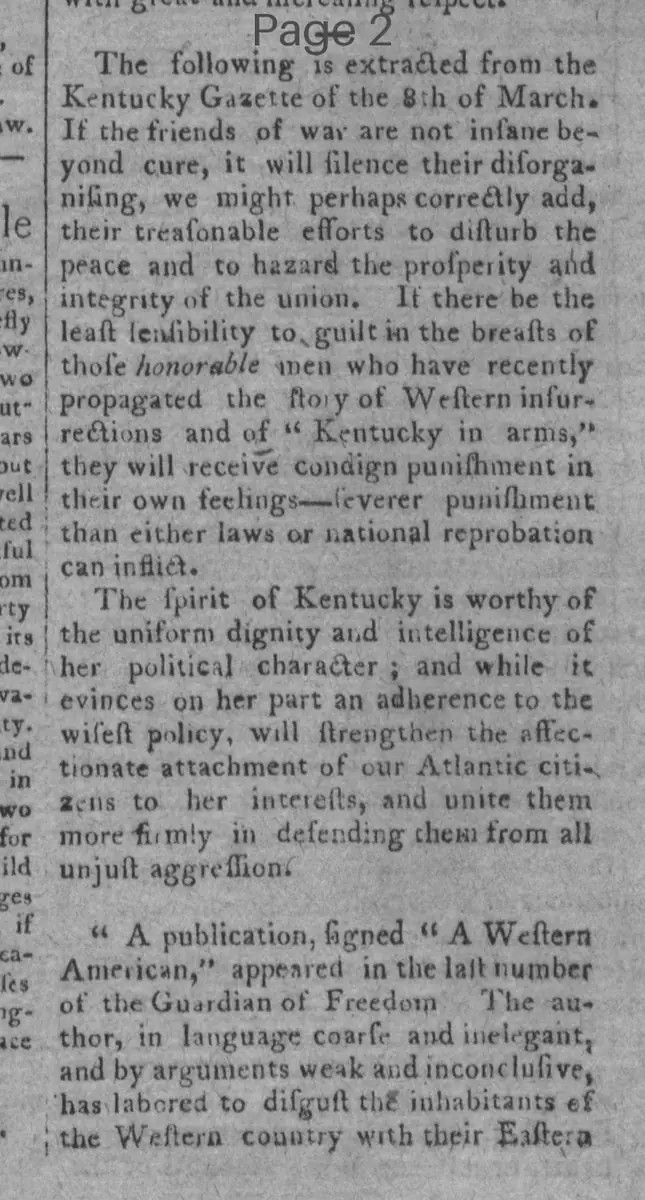
If the friends of war are not insane beyond cure, it will silence their disorganizing, we might perhaps correctly add, their treasonable efforts to disturb the peace and to hazard the prosperity and integrity of the union. If there be the least sensibility to guilt in the breasts of those honorable men who have recently propagated the story of Western insurrections and of "Kentucky in arms," they will receive condign punishment in their own feelings—severer punishment than either laws or national reprobation can inflict.
The spirit of Kentucky is worthy of the uniform dignity and intelligence of her political character; and while it evinces on her part an adherence to the wisest policy, will strengthen the affectionate attachment of our Atlantic citizens to her interests, and unite them more firmly in defending them from all unjust aggression.
"A publication, signed "A Western American," appeared in the last number of the Guardian of Freedom. The author, in language coarse and inelegant, and by arguments weak and inconclusive, has labored to disgust the inhabitants of the Western country with their Eastern brethren, and has unequivocally recommended a dismemberment of the Union.
At a period like the present, when the administration, by measures the most prompt and judicious, has evinced a tender respect for our violated rights: and when our fellow-citizens in every part of America have vied with each other in expressing their sense of the infraction of our treaty with Spain, the language expressed in that publication, deserves and receives the hearty execration of every good citizen. Impressed with a belief that the author was a proper subject for judicial animadversion, the attorney general has required his name, which has been furnished by the editor. It is the province of a court to decide on the criminality of the publication, and on that point, it would be improper, at present, to hazard a single remark. We earnestly request that our fellow-citizens of the Eastern States may remain perfectly assured, that we repose entire confidence in our administration, are grateful for the sensibility manifested in asserting our rights, and are nearly unanimous in sentiments of inflexible attachment to the Union."
We recommend to peruse the following piece, taken from the same paper. There is the best reason to believe that it correctly expresses the sentiments of the people of Kentucky.
TO the People of Kentucky.
AT a time when the violation of the treaty which recognizes our right to the navigation of the Mississippi justly engrosses the whole public attention—when the feelings of the nation are so alive to this subject that it is more than ever exposed to a wrong impulse, it is the duty of every citizen to think for himself, and without being lulled into supine neglect, or hurried away by passion or prejudice, determine upon the proper conduct which we ought to pursue.
That our rights, which are derived from nature, and are moreover solemnly acknowledged by compact, are not to be voluntarily relinquished, all will agree: That the infraction of the treaty is to be redressed, is equally incontestable: But whether this shall be effected by an immediate appeal to arms, or, before resorting to that extremity, we shall attempt negociation, is a question of the first magnitude. The writer of this address, without presuming to judge for or dictate to others, begs leave, in the exercise of a right inseparable from every freeman, to offer to the public his humble opinion, with some reasons in its support.
In determining upon this question a subordinate enquiry presents itself, entitled to notice. Is the denial of a deposit dictated by Spain itself, or is it the unauthorized measure of the intendant at New-Orleans? No doubt whether the one or the other, our right to demand satisfaction, and if withheld, to take it, is equally unimpaired. The responsibility of every government for the conduct of its agents towards other nations is undeniable. But then we should not impute an unjust action by a petty officer, to his nation, which has always appeared anxious to cultivate our friendship, without the most convincing proof. It is certain that if the measure has been determined upon by Spain, no hint of it has been communicated to our minister there, or by hers here. The proclamation of the intendant bears no evidence of its having proceeded from his king.—It on the contrary appears to have been dictated by himself. Its publication in this country is accompanied by information that it was so opposite to the opinion and wishes of the governor, that he doubted whether he would not resist it: and the question, would a petty intendant dare take upon himself the responsibility of hazarding the peace of his nation? is not more unanswerable than another Would a petty governor dare oppose the known wishes of his king? The Spanish ambassador, who according to the general practice of nations, is the proper organ through whom our government communicates, when applied to upon this subject, disavows the measure as an act of his government—declares his opinion to be, that it was totally unauthorized—and immediately employs all the means in his power to have it corrected. But bad Spain taken such a step, I ask those who existingly ascribe it to her, what motive had she for concealing her design? We have seen that she is liable to repair us any damage we may sustain, even if it were unauthorized. That she would have been obliged to have done, had the act been openly and avowedly her own. If this latter had been the case, persistence in it would produce war. But war is equally inevitable, if sanctioning the conduct of her intendant, she denies us instant redress: so that whether the measure be hers or her intendant's, the consequences are precisely the same—Satisfaction for the injury or war.
These reasons, with others, which must readily occur, will satisfy the candid that we cannot pronounce with absolute certainty that Spain has herself, although she is answerable for it, wantonly violated her engagements with us. I am willing to admit they are not conclusive. But, conceding for the sake of argument, that it is the result of a deliberate system of policy, let us then enquire whether it is not our duty to attempt a friendly adjustment, before we resort to the greatest of all human evils.
I will say nothing with respect to that construction of the treaty which many of our own enlightened citizens; interested in a contrary interpretation, are of opinion the instrument will bear; because, after having given it, the most attentive perusal, I am unable to persuade myself that it is possible to fairly expound it against our right of deposit. It is, however evident. that 'if Spain construes it differently from' 'us.' the instruments of fair discussion, not. those of war, afford the only rational means for adjusting the difference.
But the reasons before urged at least prove it doubtful whether we are to attribute the unfriendly measures at Orleans to Spain or her Intendant. Shall we then at the expense of a million of money, perhaps a million of men, in a doubtful case, declare war, or in other words seize on Louisiana, when it is probable we may secure every object which our honor or interest demands, without it? Shall America, whose finances are not yet recovered from the embarrassment of her revolutionary struggles, again plunge herself into a rash war, rather than wait six months for an object which she has every reason to believe may be obtained without it? Shall republican America, which besides the incitements common to all nations, is lead by the nature and genius of her government, to cultivate peace, follow the dreadful example of Europe so justly reprobated, of preferring war to amicable negociation? Let it not be understood, again I repeat it, that we should yield one single right, natural or acquired. Equally foreign from my intention is it that we should brook an insult, or be played or put off by the arts of negociation or the intrigues of courts. But while our determination is unalterable to maintain our national dignity and preserve our rights, let us not be hurried precipitately into excesses which we might afterwards have occasion to regret. Let us leave to the wild ambition of princes, the glory of uselessly lavishing the blood and treasure of their country. It should be with a great nation, as it is with a great man—unwilling to believe, but ever ready to avenge any wrongs that are offered, Humble, degraded indeed would be the free people of America if they were capable of receiving an insult from an insignificant Intendant. Let us first ascertain that he has the countenance of his master. It will be then time enough to teach the haughty Spaniard that by wresting from him his American possessions, the United States are able to strike the very foundations of his throne. If the result of Mr. Monroe's mission should prove inauspicious, but one opinion will pervade all America. We shall then possess but one mind and one arm. The patriotism of the country will banish all party distinctions, and the breast of every citizen will burn with indignant pride. If the single object of unanimity were alone to be gained by negociation, its importance would give this policy a decided preference. Instead of a divided people, the consequence of a premature war—instead of bayonets pointed in every direction, against ourselves as well as them, we shall present to the enemy, if an enemy we must have, one united, compact and invincible phalanx. Our eastern brethren will not then complain, as otherwise they might, that their commerce and their cities have been wantonly exposed; but feeling the sympathy which they have already so generously and promptly expressed, they would without a murmur unite in the support of our rights. It must be acknowledged by the most furious advocate for war, that with respect to Kentucky, the failure to designate a place of deposit, could have happened at no period more fortunate. The small portion of taxation which the present wise administration has left on us, enables us to do with much less money than at any former period. The destruction of our grain by the weevil and the small quantity of tobacco raised last year, being very much the principal objects of exportation; and the vessels, which by the unexampled enterprise of our citizens, now float on our rivers, and which, without stopping in their voyage, are able to traverse the widest ocean, will be sufficient to carry all our products to market; with very little aid at least by those which may ascend to Natchez. Before another crop comes round we shall have ascertained our fate.
Thus every motive concurs in recommending the adoption of pacific measures. If this view of the subject be correct, we have no cause to complain of the general government. Attentive to every part of the union, we have seen the concern which they have manifested in our behalf. The President has addressed two letters to our governor, expressive of his feelings upon this subject. He has appointed an envoy extraordinary to Spain and France, eminent for his abilities, his services, and his attachment to the object of his mission. The House of Representatives have passed resolutions which evince their fixed determination to maintain our rights, and upon the application of one of our members, without hesitation directed a suspension of the collection of the very light duties which we owe the treasury. In addition to all these measures, displaying on the part of the federal government, a solicitude for our welfare, which merits the highest gratitude and confidence, most of the states, whose legislatures have met since news of the denial of the place of deposit reached the eastern part of America, have offered their support in the assertion of our rights. Reposing in the wisdom of our administration, and obeying the dictates of prudence, let us hope that Mr. Monroe, will accomplish the objects of his mission. Let us not permit designing men, anxious to seize upon any pretext to induce us to withdraw our affections from the present administration, to lead us astray, or to suggest expedients dishonorable to ourselves and dangerous to our country. Let us await with patience his return—with that silent expectation. which, prepared to meet with joy the news of a happy issue, is nevertheless, if disappointed, ready to inflict a blow which will let all Europe know, that though difficult to be aroused, America acts with vigor and effect.
A KENTUCKIAN.
What sub-type of article is it?
What keywords are associated?
What entities or persons were involved?
Editorial Details
Primary Topic
Response To Spanish Violation Of Mississippi Navigation Treaty
Stance / Tone
Advocacy For Negotiation And Union Loyalty Against War And Separatism
Key Figures
Key Arguments