Thank you for visiting SNEWPapers!
Sign up free
Daily Kennebec Journal
Augusta, Kennebec County, Maine
What is this article about?
The New York Tribune critiques Jefferson Davis's political speech in Mississippi, where he defends secession as justified, claims the U.S. government has overthrown the Constitution, and implies the South's Union promise is no longer binding, echoing Northern Democratic views.
Clipping
OCR Quality
Full Text
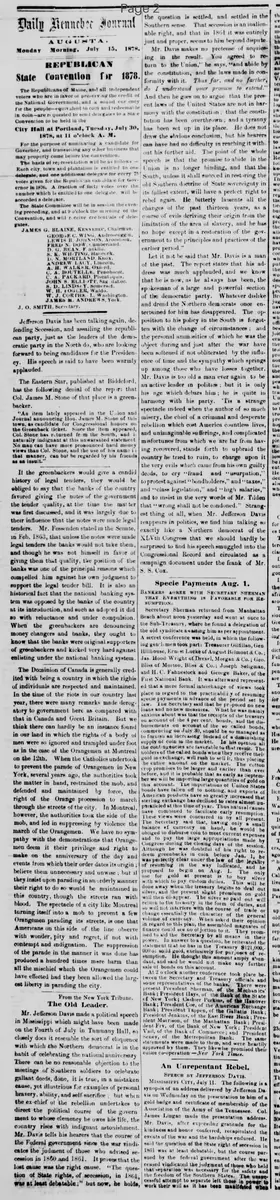
The Old Leader.
Mr. Jefferson Davis made a political speech in Mississippi which might have been made on the Fourth of July in Tammany Hall, so closely does it resemble the sort of eloquence with which the Northern democrat is in the habit of celebrating the national anniversary. There can be no reasonable objection to the meetings of Southern soldiers to celebrate gallant deeds, done, it is true, in a mistaken cause, yet illustrious for examples of personal bravery, ability, and self-sacrifice; but when the ex-chief of the rebellion undertakes to direct the political course of the government to whose clemency he owes his life, the country rises with indignant astonishment.
Mr. Davis tells his hearers that the course of the Federal government since the war vindicates the judgment of those who advised secession in 1860 and 1861. It proves that the lost cause was the right cause. "The question of State rights, of secession, in 1861, was at least debatable;" but now, he holds, the question is settled, and settled in the Southern sense. That secession is an inalienable right, and that in 1861 it was entirely just and proper, seems to him beyond dispute.
Mr. Davis makes no pretense of acquiescing in the result. "You agreed to return to the Union," he says, "and abide by the constitution, and the laws made in conformity with it. Thus far, and no farther do I understand your promise to extend."
And then he goes on to argue that the present laws of the United States are not in harmony with the constitution; that the constitution has been overthrown; and a tyranny has been set up in its place. He does not draw the obvious conclusion, but his hearers can have had no difficulty in reaching it without his further aid. The point of the whole speech is that the promise to abide in the Union is no longer binding, and that the South, unless it shall succeed in restoring the old Southern doctrine of State sovereignty in its fullest extent, will have a perfect right to rebel again. He bitterly laments all the changes of the past thirteen years, as a course of evils deriving their origin from the limitation of the area of slavery, and he has no hope except in a restoration of the government to the principles and practices of the earlier period.
Let it not be said that Mr. Davis is a man of the past. The report states that his address was much applauded, and we know that he is now, as he always has been, the spokesman of a large and powerful section of the democratic party. Whatever dislike and dread the Northern democrats once entertained for him has disappeared. The opposition to his policy in the South is forgotten with the change of circumstances; and the personal animosities of which he was the object during and just after the war have been softened if not obliterated by the influence of time and the sympathy which springs up among those who have losses together.
Mr. Davis is too old a man ever again to be an active leader in politics; but it is only his age which debars him; he is quite in harmony with his party. 'Tis a strange spectacle indeed when the author of so much misery, the chief of a criminal and desperate rebellion which cost America countless lives and unimaginable sufferings, and complicated misfortunes from which we are far from having recovered, stands forth to upbraid the country he tried to ruin, to charge upon it the very evils which came from his own guilty deeds, to cry "fraud" and "usurpation," to protest against "bondholders," and "taxes," and "class legislation," and "high salaries," and to insist in the very words of Mr. Tilden that "wrong shall not be condoned." Strangest thing of all, when Mr. Jefferson Davis reappears in politics, we find him talking so exactly like a Northern democrat of the XLVth Congress that we should hardly be surprised to find his speech smuggled into the Congressional Record and circulated as a campaign document under the frank of Mr. S. S. Cox.
What sub-type of article is it?
What themes does it cover?
What keywords are associated?
What entities or persons were involved?
Where did it happen?
Story Details
Key Persons
Location
Mississippi
Event Date
Past Thirteen Years After The Civil War
Story Details
Jefferson Davis delivers a speech in Mississippi defending secession and the Confederate cause, arguing that the U.S. government has violated the Constitution, implying the South's promise to stay in the Union is void, and advocating restoration of pre-war principles; the article criticizes him as the rebellion's leader aligning with Northern Democrats.